November 2026 Issue: AI, Warehouse Automation and the Future of Logistics

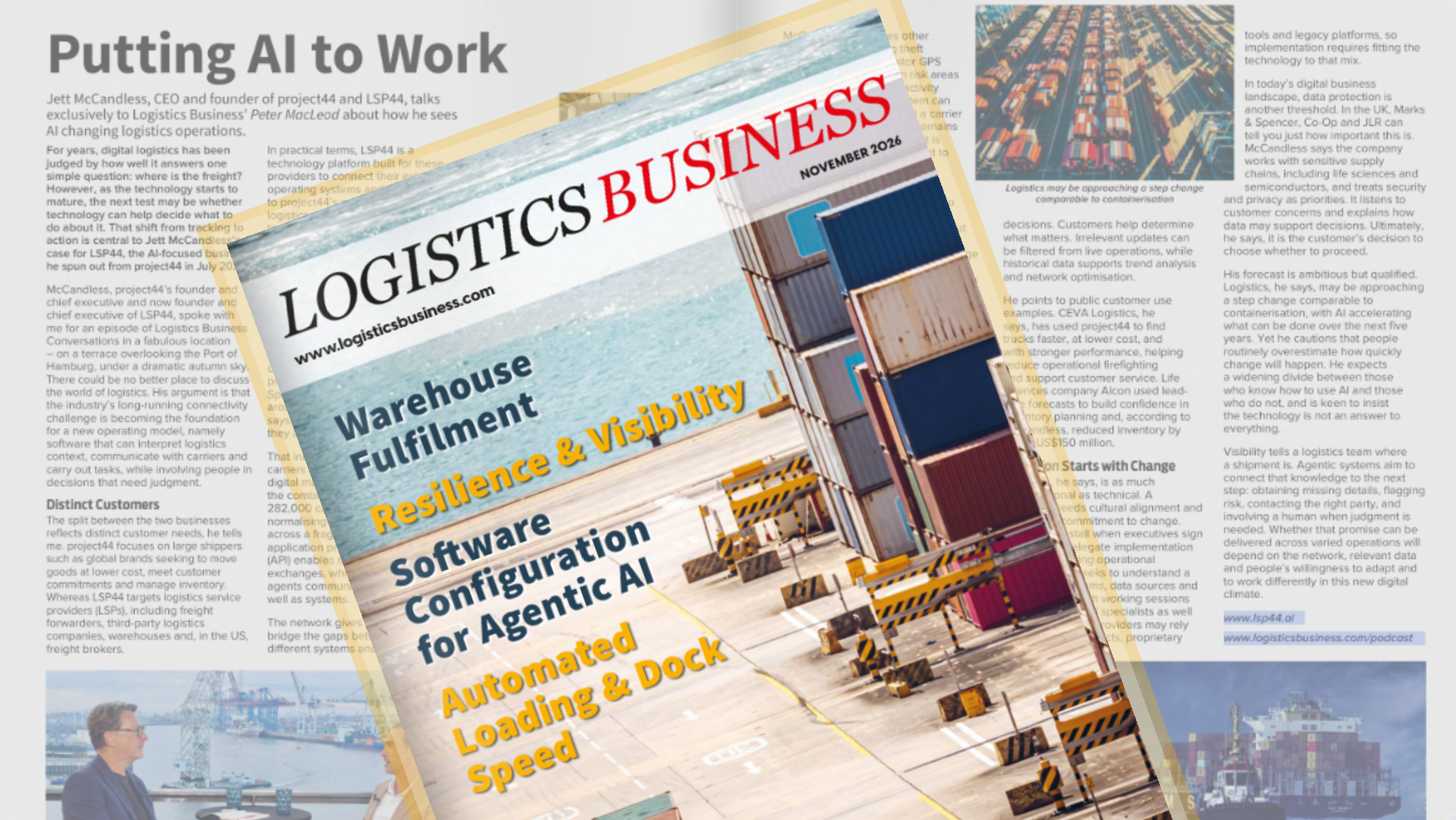
The November 2026 edition of Logistics Business Magazine is now available, featuring exclusive interviews, industry insights and the latest developments in warehouse automation, artificial intelligence, supply chain resilience and transport.

As logistics businesses face growing pressure to improve efficiency, manage disruption and embrace new technologies, this issue examines the innovations and strategies shaping the industry’s future.

Among the highlights:

Is AI About to Transform Logistics?

Jett McCandless, founder of project44 and LSP44, speaks exclusively to Editor Peter MacLeod about the shift from shipment visibility to AI-powered decision-making, and why the industry could be approaching a transformation comparable to containerisation. (Page 6)

Inside M&S’s £340 Million Warehouse Automation Project

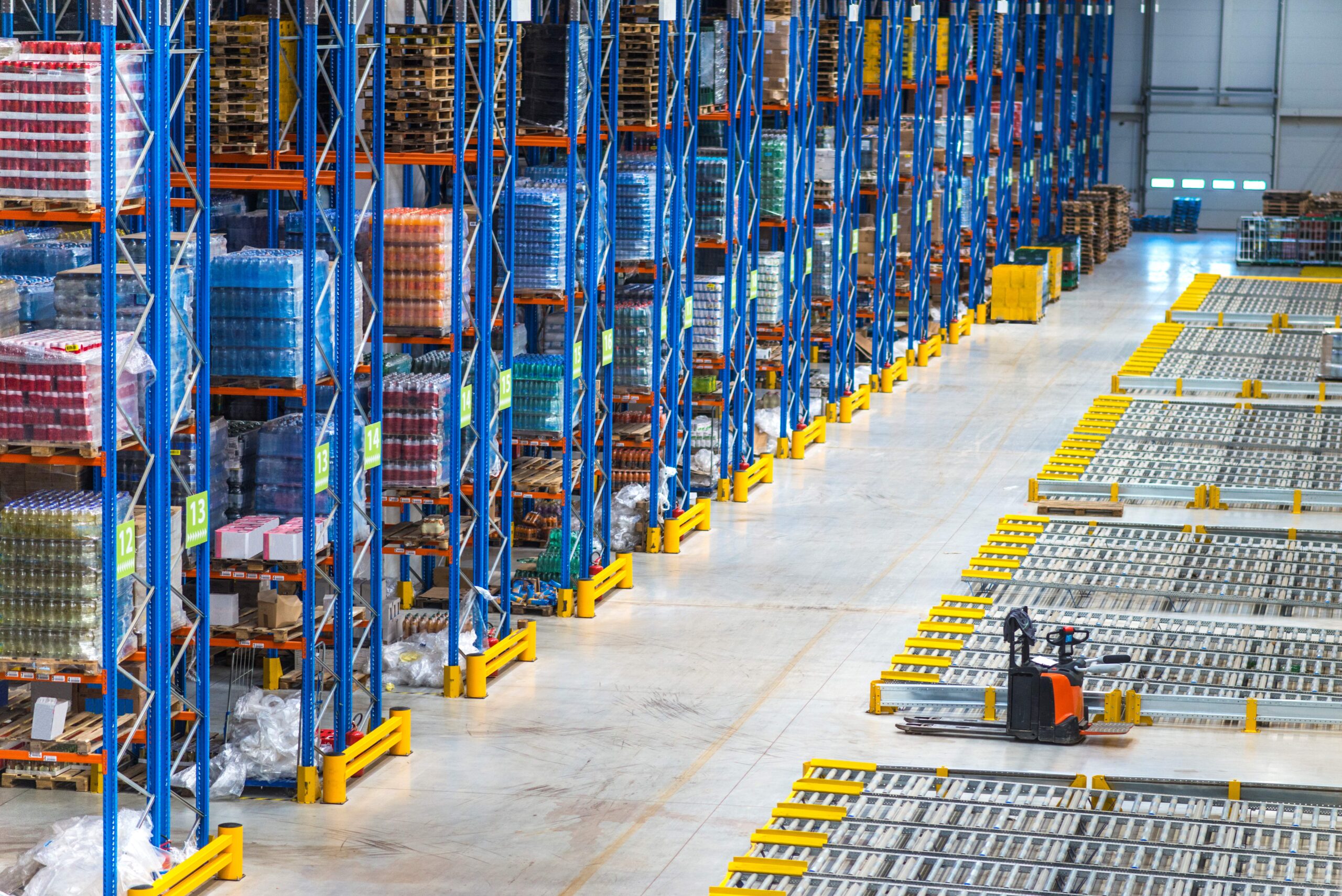
TGW Logistics reveals details of its major automation project for Marks & Spencer’s new Daventry grocery fulfilment centre, including the challenges of designing a facility for an unpredictable future. (Page 42)

How Footasylum Is Transforming Warehouse Fulfilment

A major automation project involving THG Fulfil and Footasylum has introduced 85 robots and 96,000 storage locations. We examine the technology, investment and reported productivity improvements behind the transformation. (Page 40)

Could Automated Loading Solve a Major Warehouse Bottleneck?

Joloda Hydraroll discusses the future of automated trailer loading, including technology designed to load non-modified trailers in under 10 minutes. (Page 36)

Building Supply Chains That Can Adapt

Daniel Carrera, President of UPS Europe, Middle East and Africa, explains why resilience is becoming as important as efficiency, while Blue Yonder explores how better freight emissions data could influence everyday transport decisions. (Pages 8 and 22)

The issue also covers autonomous mobile robots, warehouse safety, software integration, sustainable packaging and the latest innovations in materials handling.

Centre of Excellence Being Built in Monaghan

Moffett Automation has begun groundwork on a new Centre of Excellence at its headquarters in Clontibret, Co. Monaghan. Representing a €4 million investment, the facility will support research and development and provide a dedicated space to showcase the company’s warehouse automation systems.

The new Centre of Excellence will provide a practical setting for developing and demonstrating how software intelligence and engineered automation work together around the needs of warehouse operations.

Moffett Automation’s integrated offer combines software intelligence, engineered automation and lifecycle support. The company works through a global network of integrator partners, as well as direct project delivery.

Founder and Managing Director Sam Moffett said:

“Starting work on our new Centre of Excellence is an important step for Moffett Automation and our team in Monaghan. Warehouse automation depends on software and engineering working together in practice. Our ambition for this facility is to support research and development and demonstrate that integration, informed by the challenges our clients and partners face every day.”

The start of groundwork marks the first stage of construction at the headquarters site.

AI-Native Order Management Solution Launched

Blue Yonder has today launched its AI-native Order Management Solution as part of its Cognitive Solutions portfolio. It unifies every stage of an order, from the first delivery promise through fulfilment, customer service and returns. This helps retailers and distributors capture more revenue, lower fulfilment costs and keep their commitments to customers, even when priorities change.

Order management becomes the connecting point

Commerce, planning and execution systems often don’t work together around the order in real time. As a result, customer promises break. Shoppers see products that aren’t readily available, orders get cancelled and sales are lost.

“Every order touches almost every part of the supply chain. Planning, inventory, fulfilment, transportation, service and returns all decide whether a promise gets kept,” said Gurdip Singh, chief product officer, Blue Yonder.

“The next era of order management will come from the entire supply chain working together around every order. With Blue Yonder Cognitive Solutions, we’ve combined our proven unified decisioning with AI agents and intelligence from across our solutions portfolio. By bringing the right context and action to each operator, we reduce the lag between insight and execution and give them the context to act with speed and precision.”

Blue Yonder Order Management Solution serves as the intelligent coordination layer that connects on-hand and in-transit or on-order inventory with the life cycle of an item and a customer order across allocation, sourcing, promising, customer service and returns. It does so by interoperating with inventory planning and warehouse & logistics fulfillment systems. Businesses can now orchestrate and view an order’s movement across the lifecycle of an item and a customer order, and teams can adjust and optimise orders at scale to continuously improve service, cost, and margin. 

AI that lowers the complexity of the work 

Blue Yonder’s Fulfilment and Customer Service Agents identify the orders and risks that require attention and present the relevant data in one view. They explain why an order is at risk and the trade-offs behind each option. Operators can then act within the permissions and guardrails set by the business. There’s no more searching across applications or trying to decipher what’s happening.

The agents work inside configurable workspaces that give each team an experience tailored to its responsibilities. That means less switching between screens and faster decisions, making advanced order intelligence accessible beyond specialists.

Purpose-built B2B execution

Blue Yonder’s order-management foundation supports advanced capabilities for wholesale, distribution and hybrid B2B/B2C businesses. B2B orders inherently work differently from consumer orders. They often involve commitments against future supply, contract-specific service terms and allocation priorities for key accounts.

With this new order management solution businesses can now manage shared inventory while setting different rules for each account, channel, and contract, and intelligently rebalance supply across customer and channel priorities when conditions change. Building on these existing capabilities, Blue Yonder plans to continue investing in advanced B2B order management capabilities to help businesses confidently manage and fulfil complex orders.

How customers benefit 

The goal is to convert more demand with confident promises. Real-time inventory intelligence helps businesses see product availability across stores, distribution centres, suppliers, shipments in transit and eligible returns. It enables realistic delivery promises and reduces overselling, preventable cancellations and lost sales. Keep more orders and customer relationships on track. When supply, demand or capacity changes, Blue Yonder flags affected orders and recommends a response. Intelligent Rebalancer then reallocates and re-promises large volumes of orders to protect customer commitments through disruption.

Resolve issues faster with connected, transparent decisions. Shared context across the order lifecycle helps teams align on the best response and act before an issue affects more orders or customers. Fewer handoffs and less manual investigation enable faster resolution, more consistent decisions and better protection of customer promises, fulfilment costs and margin. Put returned inventory back to work. Smart Disposition applies business rules and profitability considerations to decide whether each returned item should be resold, repaired, returned to a vendor or routed elsewhere. Eligible items go back on sale sooner. 

Is Your Warehouse Labelling System Holding You Back?

Industrial label printing is undergoing a transformation. A new Logistics Business eBook, produced in partnership with Toshiba Tec, explores how smarter printing technology could help warehouses simplify operations, reduce costs and adapt to changing demands.

For years, industrial printers have been judged on their speed, reliability and durability. But as warehouse operations become increasingly complex, businesses are discovering that producing a label is only part of the challenge.

From integrating multiple warehouse management systems to managing changing regulatory requirements, the technology behind industrial labelling can have a significant impact on operational efficiency.

Titled Rethinking Industrial Labelling, the eBook sees Logistics Business Editor Peter MacLeod speak with Toshiba Tec experts about developments in industrial printing, including native PDF printing, automated printer-language detection and simplified system integration.

The publication also examines real-world applications, including an example where label modifications that previously took up to three hours were completed in just five minutes, and technology capable of reducing ribbon consumption by up to 75% in suitable applications.

As logistics operations face growing demands for efficiency, flexibility and traceability, the eBook considers how industrial labelling technology is evolving to meet these challenges.

Next Generation Dock Leveller

Hörmann has launched the new HTL3 dock leveller, a next-generation modular solution designed to deliver greater flexibility for both new-build and refurbishment projects while making installation and maintenance simpler. Building on decades of engineering expertise, the HTL3 combines high-strength steel construction with a redesigned telescopic lip and improved resistance to lane grooves, providing durability and reliable performance in demanding loading environments.

Independently tested to EN 1398, the HTL3 modular platform provides a robust solution for new-build loading facilities as well as the replacement and refurbishment of existing dock infrastructure and is available in three versions. The modular solution offers a core product with various options available to suit both new build and refurbishment projects.

The standard version has a compact design making it ideal for new builds and straightforward like-for-like replacements. While the R version features a variable adaptor solution that allows the width and length of the leveller to be adapted to fit an existing pit, making it particularly suitable as a replacement leveller in existing facilities.

Peak Loads

Durability has been a key consideration in the development of the HTL3. Its high-strength steel construction provides increased durability, while the redesigned, thicker telescopic lip offers approximately 50% greater resistance to fatigue under peak loads. The leveller also has improved resistance to lane grooves, supporting smoother and more reliable operation in busy loading areas.

The HTL3 has also been designed to make installation and servicing more straightforward. Improved access and an optimised hydraulic layout simplify installation and servicing, helping to reduce maintenance time and minimise operational downtime.
The new generation HTL3 is particularly compact for transportation, helping to reduce transport requirements and associated costs while supporting sustainability objectives – an increasingly important consideration for logistics and industrial developments.

With its modular construction, three application-specific versions and focus on durability, straightforward servicing and refurbishment flexibility, the HTL3 represents the next generation of Hörmann dock leveller technology.

No Power, No Warehouse Project

The electricity grid is becoming a critical constraint for warehouse development, writes George Day (pictured below), senior project manager at Pulse Consult.

Complex regulations, lengthy approval timelines and environmental impacts have long made planning a major hurdle for warehousing developers. Yet a new, critical constraint is taking centre stage: power.

Set against a background of increasing competition for grid capacity, Ofgem has launched a consultation as part of a wider programme of reforms to ensure network capacity is used for the projects that need it most, sending a clear message that grid capacity and connection delays are emerging as a critical and increasingly decisive risk to viable delivery.

In 2026, over 80% of UK logistics occupiers expect that their power requirements will increase over the next 12 months as more is needed to support large-scale, power-hungry sites. As a result, power availability is moving from a tick-box exercise to an integral requirement for modern warehouse development.

To stay ahead of the power challenge, developers must move from reacting to grid constraints to anticipating them, making power availability a fundamental consideration from the outset. This means undertaking early due diligence, engaging with key stakeholders and working collaboratively to identify constraints.

Preparing for a tech-intensive future

It isn’t surprising that the issue of power is being pushed to the top of the agenda. The warehouse of tomorrow is becoming increasingly more tech-intensive, from automated systems and substantial refrigeration demands to the electrification of fleets. As these requirements and advancements evolve, the technology required to support them can increase over the lifetime of a facility, causing unanticipated costs.

Developers need to look beyond the power required to get a project operational on day one and, rather, consider its ultimate power capacity from the outset. Failing to consider this growth can leave projects constrained by original grid connections, requiring costly upgrades later down the line. To future-proof power capacity, grid considerations need to be treated as two-fold. Not only do project teams need to ensure there is sufficient capacity to meet immediate operational requirements, but they must also anticipate the future needs of the building and its occupiers.

Power is no longer a simple utility. It is becoming a core determinant of the viability of a project. Answering early on the important questions of where, how and at what cost will bolster project resilience and give greater certainty and control over both project costs and the delivery path.

Act now for long-term project resilience

The complex planning process and the challenge of grid capacity are intrinsically linked, with site selection now requiring developers to consider not only whether land is suitable for development, but whether it can also secure the power needed to support it.

Those that fail to recognise this are forced to engage unexpectedly with Distribution Network Operators (DNOs) to install the relevant grid connections. This engagement can introduce significant delays and unexpected costs, with connection assessments, timelines and deliverability all placing constraints on initial project plans.

Data from Ofgem gathered as part of a feedback initiative reflects a clear message: grid connection delays are occurring too often, and delivery milestones are therefore being missed. For developers, the consequence of this is a domino effect, creating knock-on delays and increasing costs that place project viability at risk.

To mitigate this issue of squeezed DNOs and power-heavy projects, early due diligence is critical and should be integrated into the planning process, long before spades hit the ground. By introducing stringent due diligence teams to identify appropriate land that can support the power requirements needed, teams can uncover grid constraints early, reducing costly delays and increasing confidence in project deliverability.

Powering progress across every workstream

Early due diligence must be matched by early engagement and collaboration between key project partners, ensuring power constraints are understood and addressed before they become a barrier to delivery.

Project management teams should bring together key stakeholders from the outset to identify the key considerations that must be addressed early on, ensuring project viability later down the line. With this comes an integral reordering of priorities: power cannot sit at the end of the tick list. Instead, it must be mapped into the critical path from the outset, ensuring that key project stakeholders have the right discussions at the right time to determine where grid constraints sit within the wider delivery programme.

However, although project management teams can be the driver of these discussions, power supply considerations need to be embedded across entire development teams, rather than considered in a single workstream. From planning and commercial services to design and project controls teams, all functions need visibility of power requirements and potential constraints, ensuring that decisions are aligned.

The objective of early engagement is not simply to start conversations sooner, but to bring forward decisions that could otherwise become barriers to delivery.

Staying ahead of the power curve

The warehousing and logistics sector is becoming more technologically advanced, with greater reliance on sophisticated power-intensive systems. With this comes the certainty that power requirements and the reliance on sufficient grid connections are likely to continue evolving.

But with power becoming an increasingly constrained resource, project teams need to stay ahead of the curve and anticipate where grid capacity issues may arise, understanding how this may affect grid availability and project viability later down the line. Those that anticipate rising power demand and plan for it early will be better positioned to control costs, protect delivery timelines and ultimately turn power availability into a project advantage.

Removing Barriers to UK–EU Trade

The ongoing UK–EU reset in trade relations must prioritise economic growth, writes Richard Smith, MD of the Road Haulage Association (RHA).

Europe faces an estimated half-a-million unfilled truck driver positions, according to the International Road Transport Union (IRU). The UK continues to face its own challenges in recruiting and retaining professional drivers. Yet, at a time when skilled drivers are already a scarce resource, restrictions on their international mobility are making it harder for businesses to deploy the workforce they have.

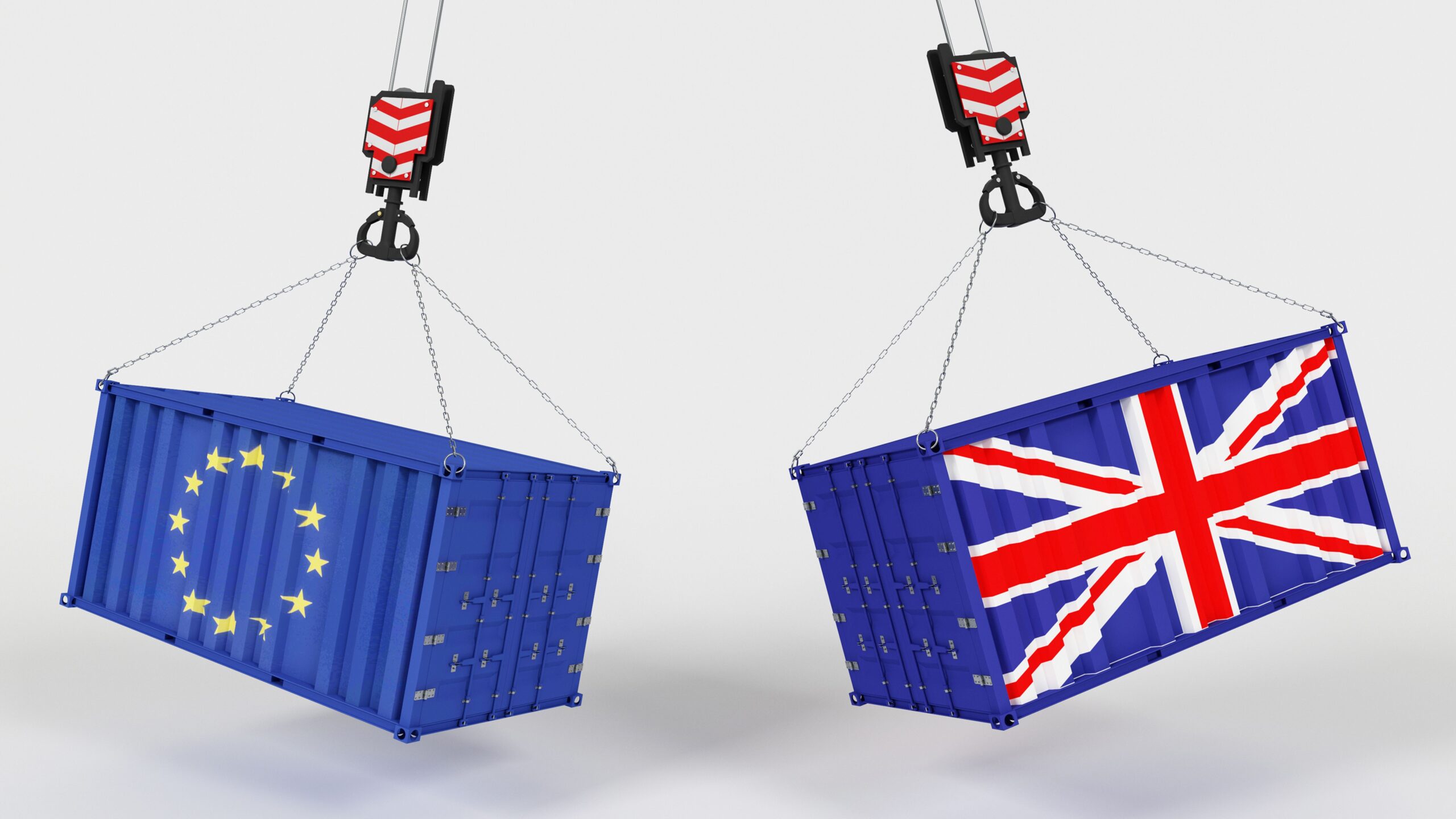
As the UK and European Union prepare for their forthcoming summit on 20th November, surely this is one of the practical barriers we should be seeking to remove? We believe it should be a priority, but the issue also highlights a much wider challenge.

If we’re serious about improving economic growth, increasing productivity and encouraging investment, we must address the barriers that make it harder for businesses to operate.

Professional driver mobility – an economic issue

The Schengen 90 days in any 180-day period rule presents a particular challenge for businesses operating internationally. Drivers of trucks, coaches and vans are not travelling for tourism, they are undertaking legitimate commercial activities that support trade and economic activity on both sides of the Channel.

The IRU’s research also indicates that around two-thirds of European road transport operators have turned down new contracts because they could not recruit enough drivers. Against that background, restricting the ability of existing, qualified drivers to undertake international work makes little economic sense.

The European Commission in its Visa Strategy earlier this year said that it would “work closely with Member States to identify pragmatic solutions to accommodate extended short stays for selected categories of third-country nationals”. This suggests there’s an appetite to relieve some of the issues supply chains are facing.

We are calling on the UK Government and the European Commission to make professional driver mobility an explicit negotiating priority at forthcoming summits. We want a practical, reciprocal arrangement that recognises the circumstances of professional drivers, including an appropriate exemption from the 90/180-day restriction.

This would not solve the wider driver shortage, but it would allow operators to make better use of their existing workforce, improve operational flexibility and support more reliable international supply chains. If the UK–EU reset is to be successful, it must deliver practical improvements that give businesses the confidence to invest, grow and create jobs.

We stand ready to work constructively with government and our European partners to make that happen.

The wider opportunity for British business

The Government has made clear its ambition to strengthen the UK’s relationship with the EU and stimulate economic growth and we share those ambitions. But the success of any reset should be measured by the practical improvements it delivers, not simply by agreements between governments.

For businesses, particularly SMEs, the costs and complexity associated with international trade remain significant challenges. To ease burdens, we strongly welcome the work undertaken by the UK Government and European Commission to introduce a new Sanitary and Phytosanitary (SPS) Agreement from 2027.

However, additional measures are needed to reduce unnecessary administration and unpredictable border delays. This all affects competitiveness and investment decisions, and these pressures don’t stop with transport operators. Every unnecessary delay, additional cost or lost commercial opportunity has a wider economic consequence. Making trade easier is about creating the conditions for businesses across the economy to succeed.

Borders, customs and international connectivity

The introduction of the EU Entry/Exit System is another area where practical cooperation is essential. Secure borders matter, but the systems used to manage them must also be efficient, proportionate and workable.

Commercial transport depends upon reliability and predictability, so delays at borders affect delivery schedules, vehicle utilisation, operating costs and customers. We also need continued progress on simplifying customs procedures, improving digital systems and reducing unnecessary bureaucracy.

For smaller businesses in particular, these changes could make international trade more accessible and commercially viable. The international coach sector must also be part of the discussion.

Coaches support tourism, education, cultural exchange and economic connectivity, yet operators continue to face challenges associated with border arrangements and driver mobility. A successful reset must recognise the different needs of trucks, coaches and vans and the contribution each makes to the wider economy.

Business confidence and investment

In recent conversations with operators across the country, one message has been particularly consistent. Businesses need confidence and certainty. They need to understand the environment in which they will be operating over the next six, twelve and eighteen months, and beyond.

The issue is not simply the cost of doing business today. It is the uncertainty about tomorrow. That uncertainty influences decisions about fleet replacement, recruitment, technology, decarbonisation and expansion. Businesses can often plan for known costs. What they find much harder to manage is uncertainty about future operating conditions. This is particularly relevant following the Autumn Budget, where the Government has rightly emphasised the importance of growth, investment and productivity.

But these ambitions will only be achieved if businesses have the confidence and capacity to invest. A successful UK–EU reset could make a meaningful contribution by reducing uncertainty, improving trading conditions and removing unnecessary barriers.

From political ambition to practical outcomes

We welcome the Government’s commitment to improving relations with the European Union and we want that relationship to succeed. But success must be measured through practical outcomes. Alongside the professional drivers’ exemption, we want improvements to border processes, simpler trading arrangements, greater regulatory cooperation and better recognition of international coach operations.

These are practical opportunities to support trade, improve productivity and strengthen economic growth across all four nations of the United Kingdom. We believe trade associations have an important role to play in helping policymakers understand how decisions affect businesses in the real world.

A successful UK–EU reset should not simply improve relationships between governments. It should make a measurable difference to the businesses and people who depend on those relationships every day. If we are serious about growing the British economy, we must make it easier for businesses to trade, easier for essential workers to operate internationally and easier for companies to invest with confidence.

Growth cannot simply be announced or expected. It must be enabled. The forthcoming summit is an opportunity to demonstrate exactly what that means.

New Firm Aims to end Route Optimisation Lock-ins

Three logistics software veterans have launched Propr Group Limited, a UK company taking aim at the high implementation fees and 36-month contracts common in route optimisation software.

ProprGroup’s core product, ProprTMS, combines four modules: ProprPlan (route planning and optimisation), ProprDispatch (dispatch and live route management), ProprExecute (driver app with proof of delivery) and ProprInsights (AI-powered operational reporting). It is aimed at UK operators running 10 or more vehicles, particularly in medical and pharmaceutical distribution, food and beverage, B2B distribution and big & bulky home delivery (think furniture and appliances).

The founders, James Holt, Gary Rosier-Taylor and John Hayes, estimate that around 70% of UK logistics operations either have no optimisation tool or do not use the optimisation engine in their existing system. They argue that long contract options and costly implementations make switching feel riskier than standing still if they haven’t proved their first system can really pay itself back to the business.

ProprGroup’s model reverses that. Customers prove the value of ProprTMS in their own operation first, and move to a longer-term agreement only once they are confident in the results, unless they choose to commit from the outset.

The company is now recruiting 10 to 15 UK operators to join a beta programme as founding customers, working directly with the founders to shape the product, on commercial terms designed to reflect that partnership.

James Holt, Co-founder, said:

Route optimisation has been around for decades, yet most UK fleets still aren’t getting the benefit. That isn’t a technology problem, it’s a trust problem. We’re developing ProprTMS so customers can see the value in their own operation before they’re asked to commit.

Gary Rosier-Taylor, Co-founder, said:

Every mile you don’t need to drive is fuel saved, emissions avoided and a driver home sooner, likely avoiding an infringement. We want to make that achievable for the thousands of UK fleets who, as of today, view 36 months plus a huge implementation fee as a massive leap of faith that isn’t validated inside their operation.

John Hayes, Co-founder, said:

I spend my days inside UK operations, and the pattern is the same: good teams, working hard, with tools that don’t properly support the way they need to operate. We believe the Propr way is to deploy software that supports the way business works, not one that asks you to change it to fit the software.

AGV now Handles up to 2 Tons

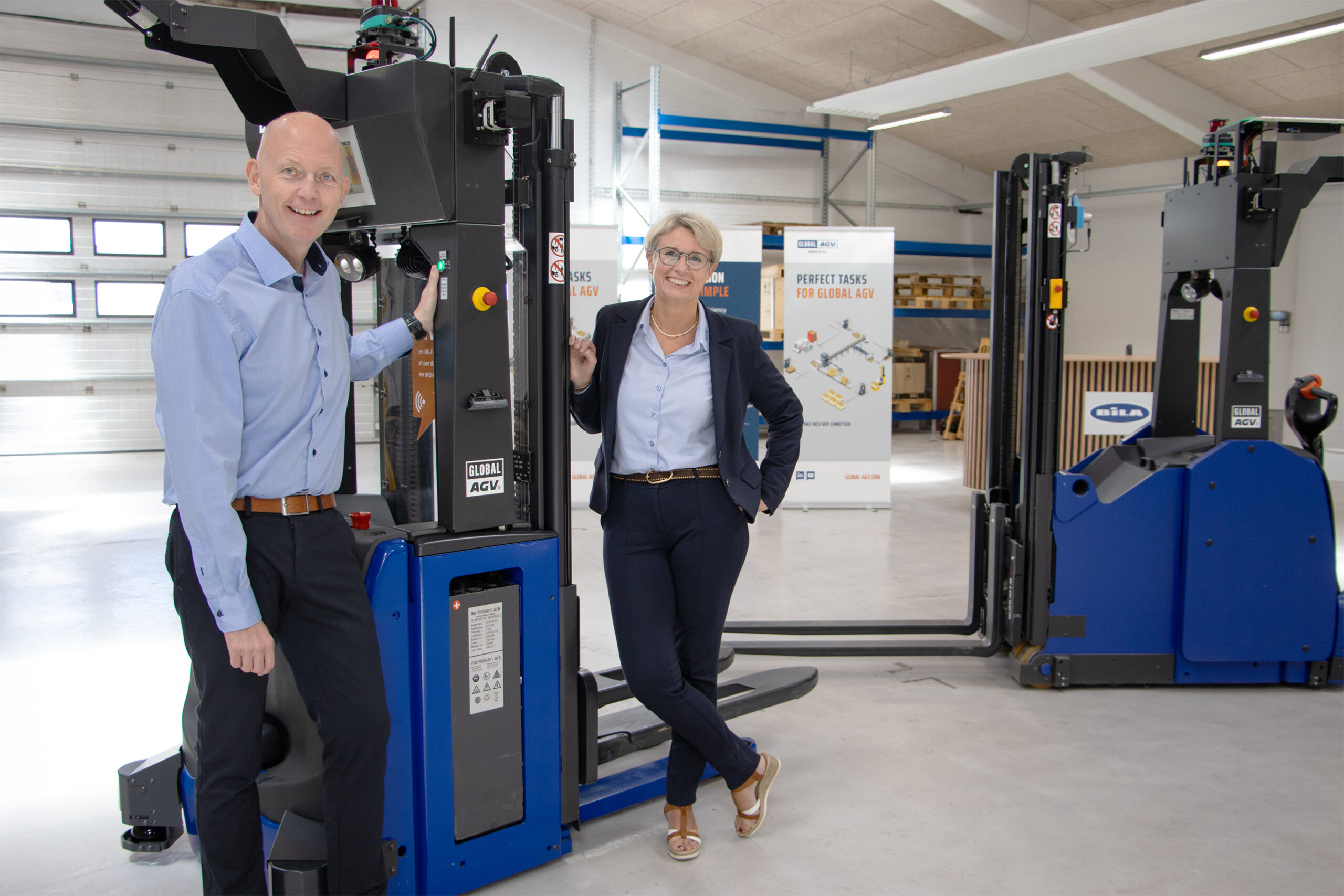
At the request of its customers, Danish company Global AGV has developed a new version of its autonomous forklift truck: the L20, which effortlessly handles loads of up to two tons. Despite its increased lifting capacity, the new model has grown by only 12 cm. This allows it to operate safely in both production environments and densely packed warehouse facilities.

We have successfully increased the payload capacity of our existing model by 40 percent without significantly changing its footprint. This is great news for companies across all industries that need to transport pallets carrying heavier loads. Our new model, the L20, effortlessly handles loads of up to two tons, turns in very confined spaces, and operates safely without taking up much more room than our other models,

says Majbritt Svane, Sales Director at Global AGV.

Successfully Handles Heavier Transport Tasks

The L20 is a further development of Global AGV’s popular L14 model. Despite an increase in lifting capacity of 600 kg, the L20 maintains exactly the same width and height as the company’s other models.

The new model was developed in close collaboration with customers who needed a higher lifting capacity than the 1,400 kg offered by the L14. This is particularly relevant in industries such as food processing, where ingredients like flour or butter are often transported in heavy bulk bags. The first three L20 units are already in operation at international production facilities, two of them in Iceland where they transport heavy pallets of fish,

explains Svane.

Easy to earn money

Global AGV is part of the BILA Group. Ten years ago, the Group’s CEO, Jan B. Sørensen, came up with the idea of freeing forklift operators from repeatedly driving the same routes and instead assigning them to more value-creating tasks. As a result, the truck now operates autonomously, transporting loaded pallets from one location to another and ultimately delivering them to the loading dock for shipment.

This smart little machine creates so much value for our customers that it’s hard not to make money from it. In many cases, the AGV pays for itself in less than a year. If, for example, it frees up two employees who can be reassigned to other tasks, it immediately increases productivity,

concludes Svane.

Warehouses Aren’t the ‘Bad Guy’

The UK warehousing sector employs around 760,000 people. Despite being a critical employer and key to economic growth, these operations feel unfairly targeted by some policy decisions, writes Les Knight (pictured, below), Sales Director, Still Materials Handling UK.

I’m proud to work in the warehouse sector. It powers growth, jobs and communities. Almost 75% of UK economic activity depends on warehousing, according to Dr Walter Boettcher, who heads up Research and Economics at Colliers UK. But we have only just been awarded our very own logistics minister. And yet, the UK Warehousing Association (UKWA) has to fight for fairer business rates in a way that critical infrastructure shouldn’t need to. And yet, National Insurance tax, and yet a two-tier planning system, and yet and yet and yet… Some policy decisions just don’t seem fair.

Despite these headwinds, warehouse operations are resilient. It’s a place I encourage people to work, one which provides a fulfilling career. I tell them we’re the good guy, actually. And at a time when there are lots of young people struggling to secure a job, I suggest we champion reliable employers, not shackle them.

Warehouse employment

Analysis produced for the UKWA by Kirsten Tisdale, from logistics consultancy Aricia, shows that the UK warehousing sector employs around 760,000 people, which is more than 70% higher than the figure the Office for National Statistics reports (440,000).

According to Aricia’s analysis, the ONS figures miss a lot of warehousing jobs in sectors such as retail and manufacturing.
Even if you are to use the ONS’s lower figure, warehousing jobs have grown by 40% since 2011, according to the analysis. In comparison, total UK employment grew by only 14% over the same period. For me this puts warehousing well within the good-guy column.

Growth in online shopping has helped create more warehouse jobs. However, research by Savills and the UKWA in 2024 found that third-party logistics companies used more warehouse space than online retailers. High street retailers also occupied more warehouse space than online retailers.

So the narrative we sometimes hear from government about targeting the big bad online retailers by taxing warehouses more, isn’t a fair fit. Warehouses are the backbone of high street retail and of the pubs being restocked by a brewery’s 3PL partner. Viewing every warehouse as an Amazon just isn’t helpful.

Warehousing and logistics is the good guy

I don’t doubt that the fearless voices of the UKWA and Logistics UK – among other trade bodies – will educate the new Minister within an inch of his life on the key role of warehousing and logistics as employers and as key players for economic growth.

“Our sector already contributes £175 billion in GVA every year… in fact, our industry enables more than £1 trillion of international trade every year… the sector has the potential to boost UK economic growth by a further £8 billion a year,” said Ben Fletcher, Logistics UK’s Chief Executive, earlier this year.

The good, the bad, and the FLTs

I visit warehouses regularly, and I talk to the people who run them. They are problem solvers, employers and partners to the businesses we all rely on – from shops and pubs to manufacturers and online retailers. My role as Sales Director for Still Materials Handling UK is to bring practical solutions to those operations and to help them keep moving safely, efficiently and confidently. If policymakers want growth, resilience and better work across the UK, they should start by seeing warehouses for what they are: not the bad guy, but one of the quiet forces keeping the economy moving.

Subscribe

Get notified about New Episodes of our Podcast, New Magazine Issues and stay updated with our Weekly Newsletter.