
TGW Logistics is at work on a major UK project with M&S. Paul Hamblin talks to the company about its approach to automation.
Craig Mitchell (pictured, below) brings a special combination to TGW Ltd’s logistics automation in the UK. As the sales project manager he is also a highly qualified mechanical engineer with a near-decade of experience as an application engineer and solutions designer with the company. It gives him a trusted standpoint to address customer challenges directly.
“I’m in that unique position where if a customer asks me an engineering question, I can generally answer it without having to speak to a team of people,” he says. “So I can give quick, accurate answers to customers at a high level of detail. I understand the challenge our customers as embarking on and what are the key watch-outs that could be missed at early stages.”
Does he believe the extraordinary pace of change in the industry has altered the nature of the engineering challenge? “I think in automation logistics the questions and challenges have not changed,” he reflects. “Engineering answers are very similar project to project. We always have the same conversation with building people about the floor loads and quality, for instance.”
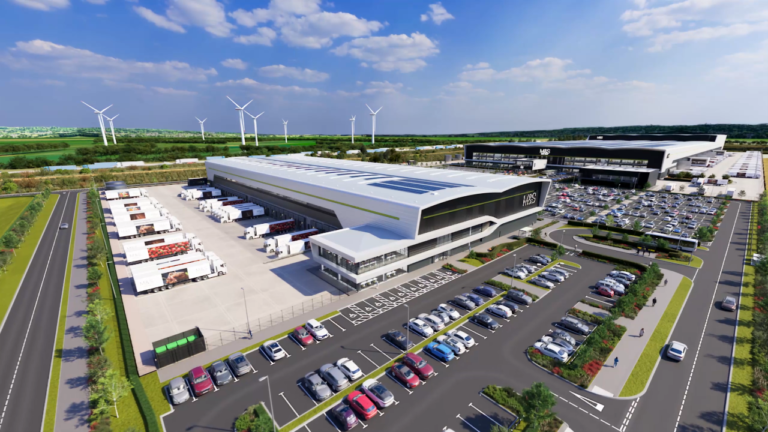
Austria-based TGW Logistics is gaining ground in the UK. Of particular note is a game-changing project announced in autumn last year. TGW is to partner with Marks & Spencer, one of the largest and most respected names in UK retail, in a 30m-high, future-proof grocery fulfilment centre, to be built alongside the M1 motorway at Daventry in the Midlands.

The project is an eye-catching coup for TGW. What does he think is the company’s appeal to huge names such as M&S?
“We tailor-make our solutions for our customers. We are not one to shoehorn them into something that isn’t right. And we we try to connect businesses together for a permanent partnership. Our view is that once you buy an automation site, you’re going to be with TGW now for 20 to 30 years. In those circumstances, a partnership needs to be right and the fit needs to be right.”
The process is holistic, he adds. “We’re really happy to consult early on, to be involved in the preliminary conversations, to help steer the business case, and to have the discussions at that granular level. And we like to give people a frank view of the market: this is not just what TGW can offer, but this is what everyone can market. Our role may then continue as an integrator as well, in terms of not just what we manufacture ourselves, but what we can source as well.”
True local contact adds another dimension. “In the UK, the relationships, the high-quality salespeople, the operations and service management are all based here. If you need to pick up the phone at any time during that project, whether it’s myself in sales or my colleagues in realisation, it’s a UK number you’re going to ring.”
It is a model neatly illustrated by the M&S project. “We’ve been working with them on it for three years,” he reveals. “No-one will claim that is an easy process for anyone because it takes time, procurement has to be arranged, board approvals take time. But we were there for the whole journey, from the very beginning.”
Cage Building
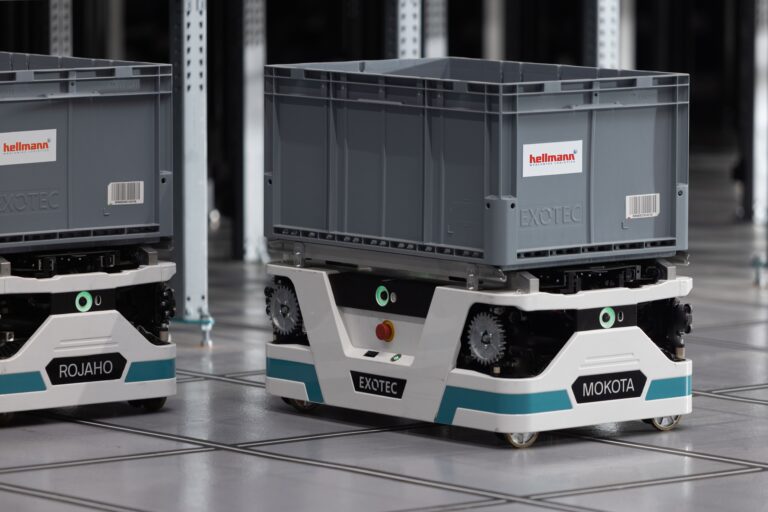
Due to complete in spring 2029, Daventry is an exciting project, not least because it is the first foray by M&S into grocery automation in this scale. It’s important to emphasise that the fulfilment centre is not for online retail to customers, but for direct replenishment to store. Robots will handle key tasks from transport to storage and retrieval to roll cage building, enabling maximum efficiency. The site will be divided into an ambient temperature area and a chilled area. The ambient area will include a high-bay pallet warehouse and a tray-based shuttle system, supported by a fleet of autonomous robots handling the transport of pallets from goods receiving into storage. Meanwhile, further robots will manage the automatic compilation of roll cages for store replenishment. The chilled area will feature a high-performance shuttle system buffering and sequencing trays to automated dolly building machines. Both zones will be interconnected by an energy-efficient conveyor network.

It’s most certainly a big deal, then – M&S have quoted investment at £340M. “They believe in us and trust us to deliver it. To all intents and purposes, we’re automating everything inside the four walls and if it makes economical sense to automate it, that’s what we’re doing.”
Logistics professionals already know the challenges that automation aims to address: labour shortage, increased productivity, cost-effectiveness. What about the increasing importance of flexibility in the context of inventory and capacity, the need to change tack at pace to meet fast-moving customer habits and needs?
“I think we see more and more people asking for flexibility to help them navigate the unknown,” he replies. “They don’t know what the future is going to bring. Growth used to be predictable, but it has become so volatile. Look at the fashion sector: the power of social media to influence a single SKU is now astonishing. Look at the impact that can have on the warehouse logistics behind the scenes. Suddenly one link with one t-shirt that catches the eye of 25,000 people and suddenly they’re all buying it. Your SKU that’s a C mover in the back of your warehouse is now the hottest topic in the building. And the warehouse manager can’t react because it was unanticipated and therefore there are no staff booked. We have a system, Flashpick, which is designed to handle this SKU unpredictability while maintaining the highest performance possible.
How will TGW continue to evolve to anticipate and meet the challenges faced by customers before those issues arrive?
“We provide sustained automation that will last for 20 to 30 years. We will maintain it, it will never be obsolete, but technology will move on. The TGW Logistics group and Foundation spend a significant amount every year on R&D, because learning and growing are a very important part of what makes us successful.”
He singles out a significant perspective. “Most of our customers very much want to be at the forefront of automation, but they don’t necessarily want to be ‘The First’. Our job is to help them achieve that ambition.”