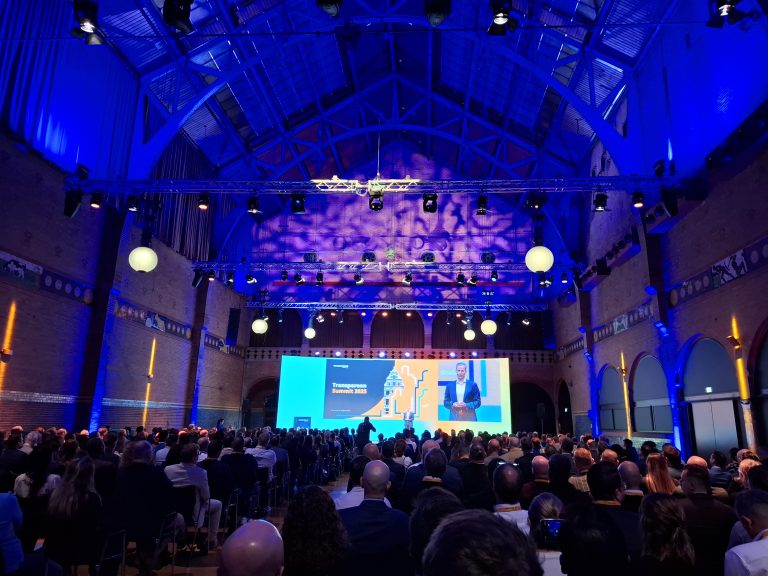
Samsara’s Go Beyond 2025 event at London’s Tobacco Dock felt less like a traditional B2B tech conference and more like an Apple product launch. From the slick stage design to the polished live demos, the connected operations platform provider clearly wanted to make a statement: AI isn’t coming to logistics, it’s already here.
Throughout the morning, Samsara executives unveiled what they called the next evolution of connected operations: a deeply integrated AI ecosystem that helps logistics operators plan smarter routes, navigate safely, automate customer communication, and simplify compliance. All of these new capabilities are built directly into the Samsara platform, with no extra modules or bolt-on software.
“We’re not just imagining what’s next… we’re building it… And we’re bringing this technology into the real world so that you can operate smarter.”
said Ryan Yu, VP of Product at Samsara, to an audience of logistics and fleet leaders.
Smarter route planning
The biggest applause of the day came when Yu demonstrated Samsara’s upcoming AI route planning feature. Using live operational data from within the platform — including delivery times, vehicle capacity, and traffic patterns, the system automatically generated optimal routes in seconds.
In the demo, 75 orders were condensed into five efficient routes, reducing both vehicle usage and overtime.
“Imagine efficient routes that delight your customers, more on-time arrivals, fewer vehicles, fewer hours, less fuel,”
Yu told the audience. The feature, arriving in early 2026, showed just how far logistics automation has come from traditional route optimisation software.
Navigation built for fleets
Equally impressive was the debut of turn-by-turn commercial navigation, fully integrated into the Samsara Driver App. Unlike consumer tools such as Google Maps or Waze, this version understands the realities of logistics, height and weight limits, hazardous goods restrictions, low-emission zones, and live traffic data.
“This isn’t about sending a truck through a shortcut meant for a horse and buggy,”
joked Yu, after the system avoided a century-old tunnel during a demo. The feature promises fewer fines, safer journeys, and less driver frustration; a clear step forward for compliance-focused fleets.
AI that talks to your customers
One of the more unexpected reveals was Samsara’s new voice-based AI agent, capable of making thousands of customer calls simultaneously, providing personalised delivery updates during disruptions. In a playful live example, the AI called “Poppies Fish & Chips” to inform them of a weather delay. The AI answered questions naturally, re-routing the driver to the back door as requested by the customer, and even sending a live tracking link by text.
This glimpse of conversational AI felt distinctly consumer-grade, the kind of seamless experience logistics customers rarely see but increasingly expect.
AI for safety and compliance
Samsara also showcased AI-assisted driver walk-arounds, which use image and location verification to ensure accurate inspections. The system detects reused or irrelevant photos and even transcribes spoken notes. Combined with the Samsara Assistant, which interprets vehicle fault codes and recommends repair actions, and Smart Compliance, which unifies tachograph and trip data, the platform aims to make compliance proactive rather than reactive.
The age of intelligence
Throughout the event, Samsara framed its latest innovations as part of what it called the “age of intelligence.” Its AI models are based on platforms such as ChatGPT and Google Gemini but retrained and customised for Samsara’s logistics use cases, all included as part of the subscription, with no add-on costs.
Leaving the venue, it was clear Samsara isn’t just positioning itself as another telematics or fleet software vendor. The company is creating a unified, intelligent ecosystem that feels a lot like the Apple of connected operations: sleek, intuitive, and deeply integrated.
“AI can now help logistics operators move faster, stay safer, and operate more efficiently… all within a single, connected platform,”
said Yu.
And for the logistics industry, that message resonated: the next wave of innovation won’t come from adding more tools, it will come from platforms that make those tools disappear.