Forklift Fleet Keeps Chiquita Fruit Fresh

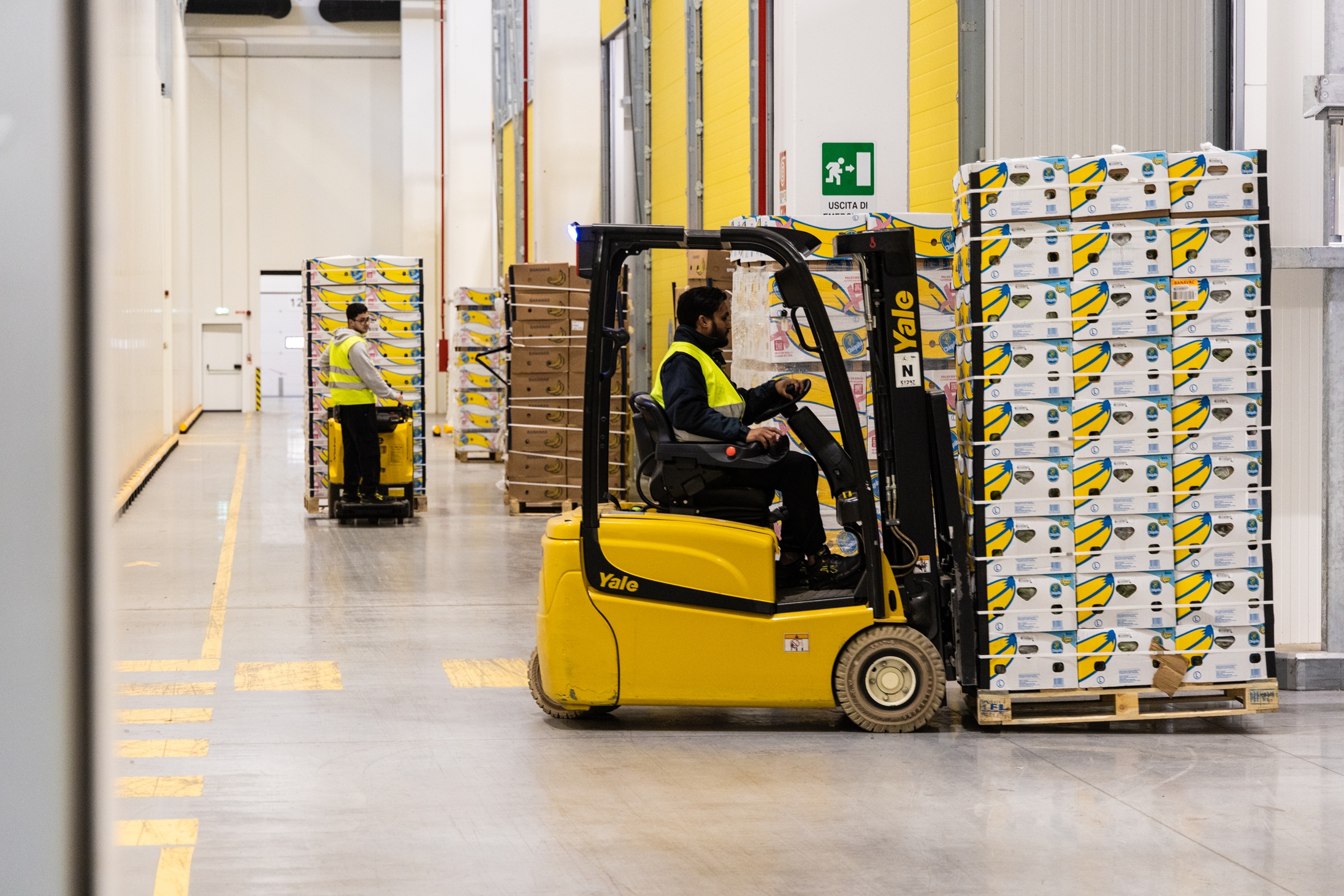
Cold storage conditions place specific demands on materials handling equipment, particularly when it comes to dealing with perishable food products which need specific processing. This insight has been a key element in the successful relationship between Yale Lift Trucks, its local dealer Unicar, and the Chiquita facility in Cortenuova, Bergamo (Northern Italy).


Chiquita, an international company producing and distributing bananas, opened a brand-new warehouse in April 2024. The plant is the biggest ripening centre in Europe, strategically located in the heart of Italy’s logistics operations.


The new site includes nine loading docks and 24 ripening rooms, each with a capacity of 48 pallets, and two packaging lines producing up to 45 trays per minute. The site features the latest cooling techniques, to minimise the dehumidification of internal air and consequently optimise fruit ripening conditions. The packaging operations and pallet handling both take place in a temperature-controlled area to keep bananas in an ideal environment. With loading docks on both sides, Chiquita has designed the optimum flow of daily operations, creating an efficient working environment and supporting site safety processes.

The facility operates 7 days a week running a single shift of 8-10 hours, with temperatures between 14°C and 18°C. Green bananas are received from the port, stored in ripening rooms, and dispatched to customers. The ripening rooms have narrow, off-centre aisles, making pallet handling a complex challenge. Furthermore, loading/unloading operations and the transport of pallets within the warehouse require efficiency and precision.


The primary challenge we face is manoeuvring pallets in and out of the ripening rooms, especially when stocking the upper levels. The narrow and offcentre aisles cause the lifting cylinders to occasionally touch the metal structures, so we needed an ergonomic and compact solution. The Yale trucks are performing well for these tasks, and we are maintaining efficient operational timings.

says Roberto Galdoni, Distribution Centre Manager.


The Yale ERP16VT and ERP20VT 3-wheel electric counterbalance forklifts, are at the heart of Chiquita’s efficient warehouse operations. These versatile machines are ideal for the indoor warehouse applications, which include loading and unloading incoming and outgoing trucks, managing the intricate operations within the ripening rooms, and transporting pallets throughout the warehouse. To meet Chiquita’s needs, these lift trucks have been equipped with clamp attachments to support precise picking and selection tasks and non-marking tyres.


Complementing the forklift fleet are the MP16 and MP20X low lift pallet trucks, with and without an operator platform. These reliable and efficient trucks are essential for horizontal transportation of pallets within the warehouse, enabling smooth and timely movement of goods.


The latest addition to Chiquita’s fleet is the innovative MO20X order picker pallet truck. Designed for optimal performance in confined spaces, this machine excels at picking and placing pallets at various heights within the warehouse. Its compact design and precise controls make it an invaluable asset for efficient order fulfilment.


Strategically deploying these Yale trucks helps Chiquita maximise productivity and minimise downtime within its warehouse. The combination of powerful forklifts, versatile pallet trucks, and efficient order pickers enables the company to meet the requirements of its intense operations while maintaining a high level of precision and adhering to site safety rules.


We selected Yale as our logistics equipment partner because of its reputation for building reliable trucks manufactured in Europe, delivering top-tier quality and longevity,

explains Roberto.

Moreover, their swift and efficient after-sales service was a crucial factor for us, as uninterrupted operations are paramount to our business. Additionally, Yale presented the most compelling return on investment, making it a financially sound decision.


“Our collaboration with Unicar, an experienced and independent Yale dealer, has been exceptionally positive. The service provided has been consistently excellent and highly efficient. This level of support and responsiveness has significantly contributed to our overall satisfaction with Yale,” concludes Galdoni.
Climbing the Complexity Ladder

Peter MacLeod hears how Locus Robotics leverages AI and data to optimise warehouse operations, boost efficiency, and deliver measurable ROI.


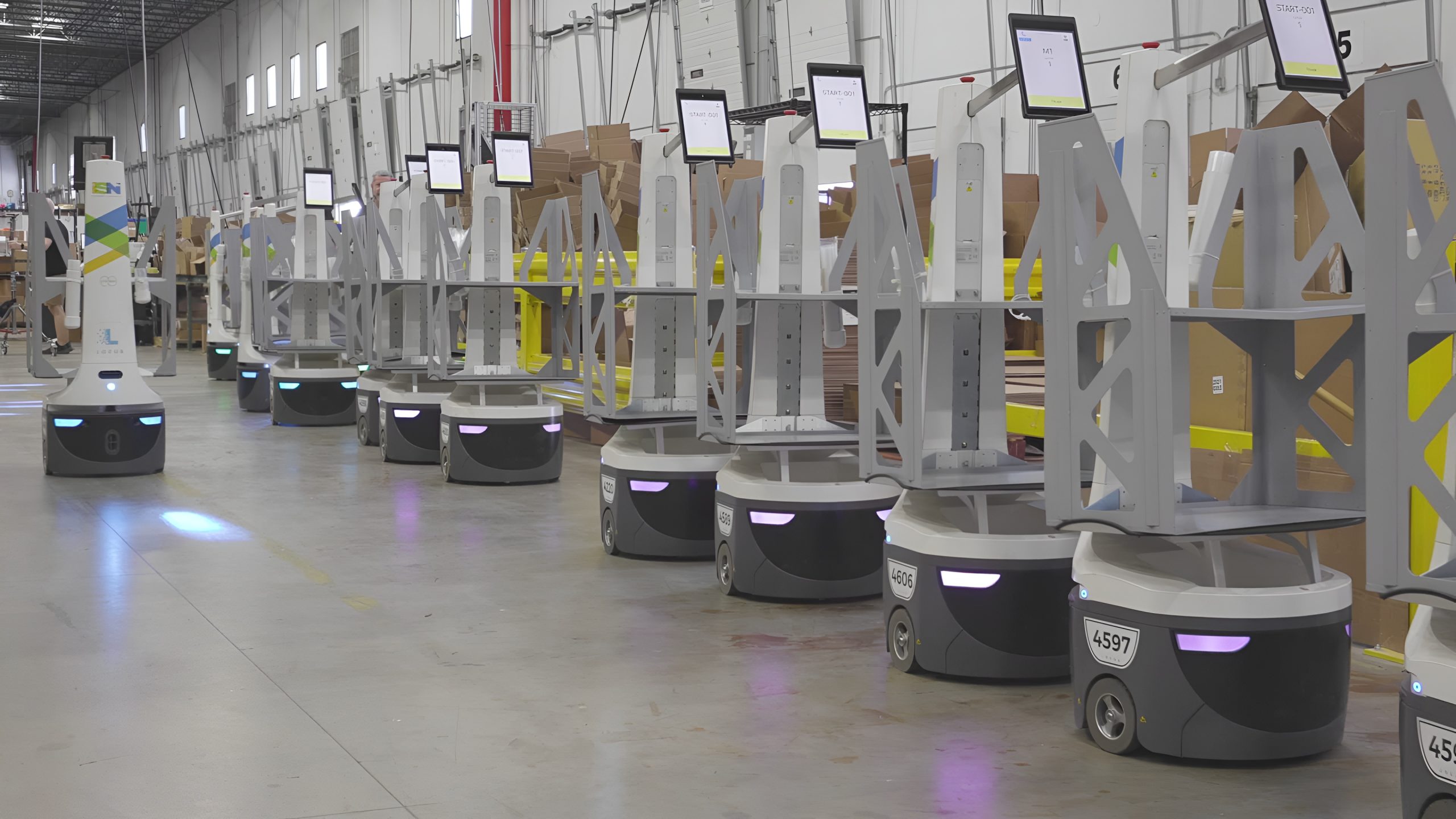
AI is becoming increasingly embedded in warehouse operations, driving efficiency and delivering measurable return on investment (ROI). It is therefore unsurprising to learn that Locus Robotics, a company renowned for its global deployment of autonomous mobile robots (AMRs), is at the forefront of this transformation, leveraging AI to optimise warehouse workflows and enhance operational performance.


Dr. Oscar Mendez Maldonado, director of AI and data science at Locus Robotics, brings a unique perspective to the table. Having spent a decade in academia running a robotics and AI research lab, Mendez transitioned to the commercial sector two years ago, drawn no doubt by the sheer volume of operational data Locus collects. “Data is the thing that you want. Ninety per cent of AI is just data science – manipulating data, getting data, understanding it, and then building AI on that,” he explains. His academic background informs the company’s sophisticated approach to AI, blending research-grade expertise to create and develop practical warehouse applications.


Within logistics, Mendez is quick to highlight the nuances within the AI sphere: “AI means different things to different people. It’s a bit of a moving goal post, or a marketing term,” he observes. The current buzz around language models and generative AI mirrors earlier waves of excitement in computer vision, he says, with companies initially adopting AI as a black-box replacement for existing processes. “You will get to a point where you have to crack open that black box and inject some domain expertise,” he warns, emphasising that understanding operational workflows is key to extracting genuine ROI.

Performance Gains


At Locus, AI is designed to deliver tangible benefits across the warehouse floor to its customers. One example is System Directed Labour, a software-driven approach that guides associates’ picking routes in real time. “From the user’s point of view, it’s a very small change. All they get is a screen that says, ‘Go to aisle eight,’ or ‘Go to aisle seven,’” Mendez explains. Behind the scenes, a sophisticated AI engine optimises routes based on the location of all robots and personnel, yielding performance increases of five to 10 per cent on deployed sites. Beyond productivity gains, the system also reduces training time for new associates, supporting flexible labour models and accelerating onboarding.

Core Principles


AI’s impact extends beyond picking efficiency. Locus employs AI for obstacle detection, enhancing robot navigation in complex warehouse environments, and for improving responsiveness in customer service by parsing large datasets to enable quicker decision-making. “It ranges from really hard, lines-per-hour increases, all the way to soft benefits, improved robot navigation and improved response times,” says Mendez.


Mendez describes three core principles underpinning Locus’s AI development: physical, trustworthy, and holistic. Physical AI must manifest tangible improvements in operations, directly affecting robot behaviour and interactions within the warehouse. Trustworthy AI ensures explainability and accountability; every component can be tested and understood, avoiding opaque black-box solutions. Holistic AI considers the warehouse as a whole, optimising performance for the site rather than individual pickers. “Sometimes that means a picker might have to walk a longer way, but overall you’re increasing the throughput of the warehouse,” Mendez explains.

“AI Sprinkles”


A key focus for Locus is the ability to be able to demonstrate early ROI. Mendez outlines two strategies: what he calls “AI sprinkles” and climbing the “ROI complexity ladder.” AI sprinkles target specific operational pain points rather than overhauling entire processes. “You build something that is targeted to just fill that gap… that bit in the system that doesn’t have a good analytical or optimal solution,” he says. This approach allows rapid deployment, efficient use of data, and the delivery of immediate value to customers while maintaining system explainability.


The ROI complexity ladder involves layering AI capabilities incrementally, building on smaller interventions to enable more sophisticated applications. A simple object detector, for example, can improve robot navigation and safety, while successive layers of AI can achieve pixel-level segmentation and advanced environmental reconstruction, ultimately contributing to a fully agentic, AI-driven warehouse. “Each one of them is delivering ROI. Each one of them is training your teams. And as you build more of those, they unlock new capabilities,” Mendez notes.


Despite the sophistication of the technology, customers do not need to understand AI to benefit from it. Locus operates on a Robotics-as-a-Service (RaaS) model, delivering performance enhancements without requiring clients to be AI experts. “They don’t need to know about AI. They need to know about their operations, which they do. And then we build them AI that accounts for these things,” says Mendez.


The company’s approach appears to be giving it a competitive edge. Locus currently operates 350 sites with 120 customers and 15,000 robots, collecting continuous operational data. “That gives us a huge advantage when it comes to building AI,” Mendez explains. Compared to industries like autonomous road vehicles, which face a vast open-world problem with far fewer miles of training data, Locus benefits from a controlled yet highly variable warehouse environment and rich contextual information, creating an ideal setting for AI optimisation.

Ongoing Progress


Even as the company achieves milestones, such as recently surpassing six billion picks, Mendez stresses that progress is ongoing. “There are always huge advances to be made when it comes to AI. The field moves incredibly quickly, and there’s always something new around the corner,” he says. The combination of abundant high-quality data and constrained operational environments provides fertile ground for innovation and continuous improvement.


For those hesitant to embrace AI, Mendez offers pragmatic advice: start small. “You don’t have to start with the most complicated, giant AI system you’ve ever heard of. You can start small, with really small bits of AI that unlock tiny bits of value, and build capability from there,” he says. This incremental approach enables companies to realise benefits at every stage, avoiding the risks of wholesale replacement.


One of the most compelling examples of Locus’s AI vision is ARRAY, a platform designed to manage the entire warehouse workflow. It exemplifies what Mendez calls “physical AI,” integrating autonomous robots, AI-driven decision-making, and real-time optimisation across the logistics pipeline. ARRAY demonstrates how a thoughtfully constructed AI system can enhance efficiency, safety, and adaptability while remaining transparent and accountable.


Locus Robotics is one of those companies which appears to be defining what it means to integrate AI in logistics. By combining extensive data, targeted interventions, and a commitment to explainable and holistic systems, the company provides customers with measurable performance improvements while paving the way for increasingly autonomous warehouse operations. As Mendez observes, AI is not a threat but a transformative tool: “It’s here to stay. It’s an incredibly powerful technology, and it’s going to keep giving better ROI to the people that actually engage in it.”

Next Generation AI Solutions for Business

Today, at Amazon Business’ Reshape conference, Amazon announced a number of new AI-powered solutions including the Amazon Business Assistant to help organizations discover savings, automate routine tasks, and make spending easier and more efficient. Daid Priestman reports from the event.

These innovations, all powered by Amazon Bedrock, AWS’s fully managed service for building and scaling generative artificial intelligence (AI) applications, represent the next step in Amazon Business’ smart business buying journey. Amazon Business tailors the best of Amazon — everyday low prices, vast selection, and a convenient shopping and delivery experience — alongside a diverse supplier network, reliable and adaptable global logistics system, customizable workflow features, and intelligent automation tools to meet the needs of all organizations, including 97 of the Fortune 100 companies and hundreds of thousands of small business customers worldwide.


“For over a decade, we’ve redefined how organizations manage purchasing by delivering a faster, smarter, and more transparent buying experience,” said Shelley Salomon, vice president of Amazon Business. “Amazon Business combines vast selection and competitive pricing with enterprise-grade tools — multi-user accounts, approval workflows, and deep analytics — to help companies manage business buying and operate more efficiently. Now, with new, AI-enhanced tools, we’re empowering organizations to reduce costs, make data-driven buying decisions, and get support when and where they need it.”


Conversational Business Buying Experience


Starting today, U.S. Amazon Business users can access the Amazon Business Assistant at no extra cost. The assistant combines Amazon’s deep understanding of purchasing with smart conversational support to provide organizations with instant, interactive, and easy-to-follow recommendations on using and configuring an Amazon Business account. The assistant also recommends ways to buy more efficiently based on past purchase history and will continue to learn over time through user interactions and feedback ratings. Users can access the Amazon Business Assistant by clicking on the orange icon at the bottom right corner of their Amazon Business account page on desktop or laptop. When an opportunity is identified to make purchasing easier or more efficient, the tool appears on the account page and provides support based on account settings.


AI-Enabled Savings Opportunities through Business Prime


In the coming weeks, U.S. Business Prime members will have access to Savings Insights, a new Amazon Business Analytics feature that reduces time spent uncovering buying trends and discovering savings. This AI-enabled tool analyzes purchase history, pricing patterns, and account settings to make recommendations via an easy-to-read, ready-to-use dashboard. Business Prime members with paid plans can log into their Amazon Business account and navigate to the Amazon Business Analytics tab to access Savings Insights. From there, members can select the Savings Insights tab to view a comprehensive dashboard that highlights eligible savings opportunities including Quantity Discounts for buying in bulk, lower price options from the same seller, higher value pack size options, and Subscribe & Save.


Spend Anomaly Monitoring


U.S. Business Prime Enterprise plan administrators can automatically detect and manage unusual purchasing patterns with Spend Anomaly Monitoring. This capability helps administrators efficiently monitor their organization’s purchasing without implementing restrictive controls. The easy-to-use dashboard analyzes past purchases, pricing, and account settings and alerts administrators about potential irregularities in four key areas: orders from rarely purchased categories, irregular repurchases of items, excessive daily spend patterns, and split purchases that may bypass approval thresholds. To use Spend Anomaly Monitoring, Business Prime Enterprise plan administrators can log in to their Amazon Business account and navigate to the Business Analytics tab. From there, account administrators navigate to the Insights tab and select Spend Anomaly.


Elevate Business Operations from Reactive to Predictive Decision-Making with AI-Driven Solutions
Amazon Business and Amazon Web Services (AWS), in collaboration with Deloitte, are announcing two new intelligent solutions designed to optimize industrial business buying and sourcing operations. Built on Deloitte’s IntelligentOps platform and enabled by Amazon Bedrock and Amazon SageMaker AI, these solutions are designed to help users shift from reactive problem-solving to proactive decision making. These industry-specific solutions leverage Amazon’s logistics expertise, AWS’s AI capabilities, and Deloitte’s industrial knowledge to streamline business sourcing operations through proactive AI-driven decision making in manufacturing and energy sectors.


Supply Chain Optimization

Available to select manufacturers in early 2026, this AI-powered solution will analyze patterns and make predictions about potential parts and inventory disruptions before they happen. The industrial manufacturing solution uses AI agents to simplify order management, supplier quality oversight, and demand forecasting, helping to improve transparency and control. If a potential disruption is identified, the solution will alert manufacturers and make recommendations, such as reallocating existing inventory or expediting shipping for compatible parts to minimize production delays. The solution will expand to industrial sectors later in the year. Plant managers will be able to log in to the dashboard via their Amazon Business account to manage orders, review material needs, and proactively plan for production timelines.


These AI-powered solutions represent a significant leap in how industrial manufacturers and utility providers can operate more efficiently and reliably. As these solutions evolve and expand across sectors, they will empower businesses to make more informed decisions, better serve their customers, and build more resilient operations for the future.


From Solopreneurs to Fortune 500

Since launching in the U.S. in 2015, Amazon Business has empowered businesses of all sizes through unmatched selection, deep discounts, and smart capabilities. Amazon Business continues to be a priority for the company, driving over $35 billion in annualized gross sales, with strong adoption and positive feedback from customers. Amazon Business actively serves more than eight million organizations globally, excluding emerging geographies, including 97 of the Fortune 100, 66 of the FTSE 100, and 38 of the DAX 40 companies. Procurement and business leaders benefit from convenient shipping options on hundreds of millions of supplies across categories like office, IT, janitorial, and food service, along with business-tailored features including a curated site experience, Business Prime, business-only pricing and selection, single- or multi-user business accounts, approval workflows, purchasing system integrations, payment solutions, tax exemptions, and dedicated customer support. Working closely with customers to understand their business buying challenges, Amazon Business continues to develop new technologies that make it easy for organizations and administrators to define, meet, and proactively measure progress toward their purchasing budgets and goals. Amazon Business is now a strategic partner to businesses in 11 countries including Australia, Canada, France, Germany, India, Italy, Japan, Mexico, Spain, the United Kingdom, and the United States.

New AI ecosystem unveiled to drive logistics efficiency

Samsara’s Go Beyond 2025 event at London’s Tobacco Dock felt less like a traditional B2B tech conference and more like an Apple product launch. From the slick stage design to the polished live demos, the connected operations platform provider clearly wanted to make a statement: AI isn’t coming to logistics, it’s already here.

Throughout the morning, Samsara executives unveiled what they called the next evolution of connected operations: a deeply integrated AI ecosystem that helps logistics operators plan smarter routes, navigate safely, automate customer communication, and simplify compliance. All of these new capabilities are built directly into the Samsara platform, with no extra modules or bolt-on software.

“We’re not just imagining what’s next… we’re building it… And we’re bringing this technology into the real world so that you can operate smarter.”

said Ryan Yu, VP of Product at Samsara, to an audience of logistics and fleet leaders.

Smarter route planning

The biggest applause of the day came when Yu demonstrated Samsara’s upcoming AI route planning feature. Using live operational data from within the platform — including delivery times, vehicle capacity, and traffic patterns, the system automatically generated optimal routes in seconds.

In the demo, 75 orders were condensed into five efficient routes, reducing both vehicle usage and overtime.

“Imagine efficient routes that delight your customers, more on-time arrivals, fewer vehicles, fewer hours, less fuel,”

Yu told the audience. The feature, arriving in early 2026, showed just how far logistics automation has come from traditional route optimisation software.

Navigation built for fleets

Equally impressive was the debut of turn-by-turn commercial navigation, fully integrated into the Samsara Driver App. Unlike consumer tools such as Google Maps or Waze, this version understands the realities of logistics, height and weight limits, hazardous goods restrictions, low-emission zones, and live traffic data.

“This isn’t about sending a truck through a shortcut meant for a horse and buggy,”

joked Yu, after the system avoided a century-old tunnel during a demo. The feature promises fewer fines, safer journeys, and less driver frustration; a clear step forward for compliance-focused fleets.

AI that talks to your customers

One of the more unexpected reveals was Samsara’s new voice-based AI agent, capable of making thousands of customer calls simultaneously, providing personalised delivery updates during disruptions. In a playful live example, the AI called “Poppies Fish & Chips” to inform them of a weather delay. The AI answered questions naturally, re-routing the driver to the back door as requested by the customer, and even sending a live tracking link by text.

This glimpse of conversational AI felt distinctly consumer-grade, the kind of seamless experience logistics customers rarely see but increasingly expect.

AI for safety and compliance

Samsara also showcased AI-assisted driver walk-arounds, which use image and location verification to ensure accurate inspections. The system detects reused or irrelevant photos and even transcribes spoken notes. Combined with the Samsara Assistant, which interprets vehicle fault codes and recommends repair actions, and Smart Compliance, which unifies tachograph and trip data, the platform aims to make compliance proactive rather than reactive.

The age of intelligence

Throughout the event, Samsara framed its latest innovations as part of what it called the “age of intelligence.” Its AI models are based on platforms such as ChatGPT and Google Gemini but retrained and customised for Samsara’s logistics use cases, all included as part of the subscription, with no add-on costs.

Leaving the venue, it was clear Samsara isn’t just positioning itself as another telematics or fleet software vendor. The company is creating a unified, intelligent ecosystem that feels a lot like the Apple of connected operations: sleek, intuitive, and deeply integrated.

“AI can now help logistics operators move faster, stay safer, and operate more efficiently… all within a single, connected platform,”

said Yu.

And for the logistics industry, that message resonated: the next wave of innovation won’t come from adding more tools, it will come from platforms that make those tools disappear.

Subscribe

Get notified about New Episodes of our Podcast, New Magazine Issues and stay updated with our Weekly Newsletter.