Reliable Voice Recognition while Wearing a Mask

The coronavirus has taken hold around the world, and all parts of the economy have a duty to help slow the spread of the virus. An increasing number of logistics firms are implementing measures to maintain operations and protect their workforce. Masks, or even simple face coverings, are now standard items of clothing in many warehouses, as they are in everyday life. But what impact do they have on voice recognition when working with pick-by-voice systems? EPG has looked into this very question and has conducted a computer-based test to assess recognition rates when staff are wearing a mask.

“I’d first like to share the findings: When working with voice-controlled systems while wearing a mask, the speaker-independent system Lydia® Voice once again demonstrated its strengths compared with systems based on personal voice profiles,” says Tim Just, CEO of EPS (Ehrhardt + Partner Solutions, a Member of EPG). “We invested a lot of development work into the latest version of our voice software and that’s really paying off in the crisis: With the aid of our technology, we’re helping logistics companies to maintain their operations and avoid any shortfalls in picking productivity despite the safety measures in place.” The test was conducted using the latest version of the system, Lydia® 8, which is based on neural networks and the deep learning concept. This concept resulted in a 25% improvement in recognition security, representing an important advantage primarily for employees with dialects or strong accents. “The test shows that precise recognition is still very much achievable even when the speaker is wearing a face covering, with no system adjustments required. In addition, voice training – and subsequent training with a mask – is not necessary, as can be the case with speaker-dependent pick-by-voice solutions,” says Just.

The standardized, computer-based test evaluated the impact of wearing N95, FFP2, paper or cloth masks on voice recognition rates while using the latest version of Lydia® Voice. The test was initially carried out with three different types of headset. The results for all types of mask showed roughly the same recognition rate (99.75% to 100%) as picking without a mask. Even with the FFP2 masks, which are generally reserved for healthcare professionals, there were practically no measurable shortfalls when using Lydia® Voice. Picking with the Lydia® VoiceWear® also passed the mask test, with the results similar to those achieved with the headset. N95, cloth and paper masks had hardly any measurable impact on voice recognition quality in this test either, with no declines in productivity. “Only the FFP2 masks in combination with Lydia® VoiceWear® showed some minor deviation, although it was still at a tolerable level,” Tim Just adds. “This deviation is due to the fact that FFP2 masks have a greater impact on acoustic signals due to the way they are made.”

Hyundai Partners with KT to Advance Smart Logistics Solutions

Hyundai Construction Equipment was the first company in Korea to develop driverless autonomous forklift trucks – HCE is now planning to progress its smart logistics solutions using KT’s (Korea Telecom) 5G communication network and artificial intelligence (AI) technology.

Hyundai CE announced that it signed a Memorandum of Understanding (MOU) with KT on12th May, 10 officials were in attendance, including Hyundai CE President Kong Ki-young and KT Vice President Jeon Hong-beom (Head of the AI/DX Convergence Business Group), to witness the joint development of the 5G technology-based solutions, for smart construction equipment and material handling.

This MOU will enable the two companies to combine their technologies, the autonomous vehicle technology of Hyundai Construction Equipment, and KT’s ICT (information and communications) technologies, such as 5G communication and AI, to supply the advanced smart logistics solutions to the market.

This technological collaboration will improve the remote management and the level of control of the autonomous forklift, which will also benefit from a remote service system that is operated by an AI voice control solution, video, and augmented reality (AR).

Hyundai CE’s autonomous forklift technology is a state-of-the-art logistics solution that autonomously recognises the environment, and obstacles in the workplace, and is able to navigate through the best routes on its own, which greatly increases productivity, with enhanced navigational speed and efficient use of logistics within the workspace.

The risk of accidents in the workplace can be significantly reduced because the work is carried out along a planned path. The interest for this ‘no contact’ technology has significantly increased, largely due to the COVID-19 pandemic, where social-distancing is key in the workplace.

Kong Ki-young, President of Hyundai CE, said, “A large number of officials from the automobiles and electronics companies attended our recent demonstration of autonomous forklifts held at the Eumseong Global Logistics Center in Chungbuk, and their wishes for introducing the technology demonstrated, have been pouring in. In addition to autonomous forklifts, we will supply the entire logistics solution covering the control system, charging facilities, warehouse management system (WMS), and manufacturing execution system (MES) to lead the market.”

Jeon Hong-beom, Vice President of KT, also said, “This cooperation will be a springboard, to advance material handling using the new technologies, such as 5G and AI, and we expect this innovation in manufacturing and logistics fields to become a reality. KT will continue to push ahead with digital transformation of Korean industries by use of our ICT capabilities.”

Meanwhile, the Hyundai Heavy Industries Group continues to work with KT to upgrade its smart factory and smart shipyard business through a combination of its robot development technology and shipbuilding technology with KT’s 5G, big data, and AI technologies.

TT Club Welcomes Electronic Bills of Lading Target

The target of 50% of all bills of lading to be electronic within the next decade has been set by the Digital Container Shipping Association (DCSA) in an announcement made last week. International freight transport insurer TT Club welcomes the commitment by the group of container shipping lines that together operate nearly 70% of the world’s capacity. The initiative is consistent with the increased trend towards digitisation across the industry to improve efficiency and reduce costs. However, the current pressures felt through the supply chain as a result of the COVID-19 pandemic have no doubt spurred the action.

In its role as liability insurer and adviser on risk management throughout the container industry, TT Club is active in encouraging digitisation, including the cumbersome bill of lading processes. Additionally, the mutual has been providing valuable guidance to operators on the unique practical issues that they are experiencing with the physical transfer of bills of lading and other documentation due to lockdowns, government restrictions and other COVID-19 related disruptions. The Club has compiled a dedicated COVID-19 webpage¹ to communicate such advice, including numerous briefings, FAQs and links to further regulatory information.

Peregrine Storrs-Fox, TT Club’s Risk Management Director comments, “As early as the late 1990s TT Club recognised the substantial benefits that would accrue to the entire international unitised supply chain, as well as liner shipping businesses, through the adoption of electronic documentation, taking its part in the foundation of bolero.net². This initiative also understood that the bill of lading is but one component in much broader trade practices, including buyers and sellers and, critically, banks. As a result bolero.net has developed a significant array of trade offerings that wrap around the fundamental characteristics that are fulfilled legally in the traditional bill of lading.”

TT Club is concerned that there continues to be such significant reliance on paper-based processes, whether certification, checks, or the range of contractual documents in international trade. The opportunity for seismic efficiencies and broader benefits were extensively explored in TT Club’s joint work with McKinsey & Co, ‘Brave new world? – Container transport in 2043’³ which adamantly concluded that the future for the container shipping industry was digital.

Some advances towards true digitisation have been made over the last two decades, including the formation of DCSA itself, with a mission to bring efficiencies through standardised messaging amongst shipping lines. More pertinent to the electronic bill of lading (ebsl) itself, the last few years have seen a proliferation of options being brought to market, mostly embracing to greater or lesser extent the much-vaunted distributed ledger technologies, or Blockchain. It is also clear that TradeLens, the consortium founded by Maersk and IBM, also has ebsl in sight.

Storrs-Fox concludes, “The current pandemic has inevitably advanced the digital cause. It is entirely reasonable for DCSA to grasp this particular nettle, taking full advantage of the lessons learned over the last two decades. Indeed, the plethora of physical documentation and ‘chops’ for every international transport involving sea carriage remain fertile ground for further efficiencies that may yet dwarf those immediately in view.”

¹https://www.ttclub.com/news-events/coronavirus-guidance/
²https://www.bolero.net/
³https://www.ttclub.com/news-events/brave-new-world/

New Commercial Leadership for GEFCO Air & Sea

GEFCO’s Air & Sea business has announced new leadership and a reorganization to boost customer-centricity and accelerate business in three key sectors: industry, automotive and life science/healthcare.

Since February, Paul-Henri Fréret (above), Executive Vice President has been leading GEFCO’s Air & Sea division. With broad experience at GEFCO, he has managed all areas of the business in Asia and Latin America in addition to Groupe PSA operations at Group headquarters. He has also held global corporate management functions at GEFCO in warehouse logistics and road transport.

In May, Cyril Lefebvre was promoted to Global Sales and Marketing Director for the Air & Sea division, from Managing Director of French operations. With in-depth experience in Air & Sea operations at GEFCO and other Freight Forwarding companies, he will shape and drive the division’s commercial and marketing strategy worldwide.

Air & Sea has also reinforced its organization to drive business in three key sectors: industry, automotive and life sciences/healthcare. Serge Kisselevsky is now Industry Market Line Manager, while Adrian Draghici is Market Line Manager for Automotive. Karin Van-Den Brekel will continue to lead the Life Science and Healthcare business, a role she has occupied since 2019. These areas will be strongly supported by a new trade lane manager, Amer Benouda and tender centre manager, Romain Bérard.

Interroll and Teknokom Install Automated Material Flow System in Turkey

Interroll and Teknokom, an innovative system integrator for complete warehouse automation solutions, have installed an automated order picking system for Cookplus in Istanbul, Turkey. Essential elements of the new material handling solution are the RollerDrive EC 5000, MultiControl, and the Modular Conveyor Platform (MCP) from Interroll. The system combines advanced features such as travel control, automatic invoice printing, dynamic volume measurement, with cargo label applications and real-time monitoring.

The order picking automation system which was delivered and installed by Teknokom is a key part of Cookplus’s modern, 6,000-square-metre distribution centre of Cookplus in Hadimköy near Istanbul which serves customers all over the country. Cookplus is the e-commerce brand of Karaca Group, a leader in the tableware, kitchen and home textile market, operating with 2,700 dealers and shops in 27 countries. The zero-pressure-accumulation conveyors used for this material flow solution have a length of more than 220 metres interconnecting a variety of picking stations with the packaging and shipping areas on two floors of the facility. The efficient and extremely energy-saving conveying of totes and parcels uses about 190 RollerDrive EC 5000 units being controlled by 60 Interroll MultiControls cards connected to a programmable logic controller (PLC) and a warehouse management system.

“With our new solution we dramatically increased the performance and capacity of our distribution and fulfilment centre by avoiding a variety of complex manual internal processes. Just as important to us as increasing our efficiency was further improving customer satisfaction through very fast and reliable deliveries,” says Ertugrul Celebi, Chief Operating Officer, Logistics & Supply Chain, at Karaca A.S.

The advanced conveyor system is entirely managed by software developed by Teknokom, a long-standing member of the Rolling On Interroll program, Interroll’s international partner network. The software applications use the data gathered by Interroll’s MultiControl cards for controlling and monitoring purposes. One example is an intelligent travel control feature which allows bypassing picking stations or a complete floor if no action from operators is needed. Moreover, at the end of the picking operation, before packaging, a printer automatically equips every order with the respective invoice. Upon entering the shipping area, a label applicator automatically pastes to each order a barcode label for the forwarding agent; this label contains all of the necessary information, including the order destination, volume information and a list of content.

“To fulfill the demanding needs of our customer, we used our long-standing cooperation with Interroll and smoothly integrated different state-of-the-art technologies in this automated material flow system. The complete project was very carefully and holistically executed, from planning and installation up to maintenance and support. For example, our customer is now able to monitor the operation of his system in real time via an online application—whenever and wherever he wants,” declares Mustafa Hisim, Deputy General Manager at Teknokom A.S.

Teknokom’s software application allows for monitoring the whole material flow process for maintenance and support purposes via a user-friendly interface which offers controlling as well as reporting features. For example, the locations of the totes, the actual status of the orders, and the picked items in a single tote can be seen for both floors. Moreover, operation managers can receive live as well as time-frame-based reports about order fulfillment capacity, bottlenecks in the picking stations, error reports, and detailed performance information.

EPG | CnB Aims to Help Navigate the Contract and Billing Jungle

EPG | CnB (Contract and Billing) is the comprehensive solution for digital contract and billing management for all logistics services. From contract creation through comprehensive records of performance to contract assignment and automatic invoicing, this tool provides powerful modules for all work and process steps. The main advantages: EPG | CnB ensures that all services under the agreed contracts are billed quickly and in full at the correct price. EPG | CnB also documents and reliably bills for any services provided beyond the original contract. Invoice verification by the customer is then carried out in a time-efficient manner in the customer web portal. Expensive adjustments of invoices and cancellations are therefore a thing of the past. With the verification process significantly shortened, invoices are paid faster.

Logistics service providers – whether in warehouse logistics, transport management, air freight or rail transport – provide a variety of services to their customers on a daily basis. This cooperation is based on contracts containing the services specifically agreed, including billing conditions – across a thick jungle of information and individual agreements. Errors can creep in quickly. Often, however, services that go beyond the contractual agreements are not documented at all – and, as a result, not billed after the fact. This results in complex invoice corrections and not infrequently in high monetary losses on the part of the logistics service providers.

Smart contract management: digital contracting
EPG | CnB digitizes and organizes management of contracts, including the agreed conditions and catalogues of services. This also includes creating specific customer and supplier contracts to the required degree of detail. EPG | CnB has an integrated contract template manager. Users can easily create their own custom templates for contract creation. Additional activities can also be documented quickly and securely and saved as an annex to the main contract The software automatically inserts the information in the correct place in the document based on the customer agreements. EPG | CnB also supports version management including tracking changes and it provides an internal approval process. The contract is then sent in advance to a defined group of recipients for verification via e-mail link before it is sent on to the customer. This minimizes the risk of errors from the outset.

Cross-supply chain record of performance and automated invoicing
EPG | CnB records all services performed along the supply chain for all areas. CnB records warehouse activities, such as goods incoming, stock transfers and picking, as well as services related to road, rail, sea and air, such as container unloading or toll charges. These are transmitted to the software or, alternatively, simply recorded directly on site using the mobile app. EPG | CnB then takes over the fully automated recognition and assignment of the service to the correct contractual conditions. This is based on a commercial rulebook, including price index clauses for automatic price adjustments and foreign currency management. The invoice is then generated digitally and automatically. The EPG | CnB system also supports automated billing runs. Generated invoice documents can be printed and automatically sent to the customer by email. The customer can then easily verify the invoice on the web portal, significantly reducing the number of customer complaints and queries and providing greater transparency throughout the process. Using EPG | CnB, customers reduce the complexity of their ERP system, as complex and expensive changes to processes are no longer necessary.

Konecranes and Fluidmesh Join Forces with 100% Wireless ARTG Crane System

Konecranes and Fluidmesh Networks announce that they have joined forces and successfully carried out proof-of-concept testing of fully wireless communication for the Konecranes Automated RTG system. This breakthrough allows container terminal operators to roll out remote control and automation to RTGs in the container yard without running fibre or cable spools, with substantial savings in cost and time.

Port and container terminal operators have been embracing automation to increase productivity and give better working conditions to their employees. Many of the newest and largest container terminals have been adopting some level of automation and support for remote operations: from ship-to-shore cranes, to horizontal transport, to automated stacking cranes. However, this has not been the case for RTGs, which are widely used in container terminals around the world. Much of the world’s RTG fleet is diesel-powered, and there have been limited options for automating RTGs given the fact that running cables to them is costly and often unpractical. Konecranes and Fluidmesh have been working closely to solve the connectivity challenge, creating a new opportunity for container terminal operators.

The automation solution for RTGs comes as part of the Konecranes ARTG 2.0 system update, which was in development for over two years with thousands of hours of field testing. Fluidmesh MPLS-based wireless technology has been used to guarantee low latency and high throughput to the RTGs for control and live-video data. The system has been designed to operate on licensed as well as unlicensed frequencies around the world, providing north of 99.95% uptime in real working conditions.

“We are thrilled to have been given the opportunity to work with a leader like Konecranes and contribute to a system that helps container terminal operators around the world to embrace automation and drive the productivity of their RTGs,” comments Cosimo Malesci, Fluidmesh Co-Founder and EVP Sales and Marketing. “Our wireless MPLS-based technology has been proven in many vehicle automation systems around the world where 802.11 WiFi or LTE haven’t been able to deliver. Our focus on seamless roaming, extremely low latency and high throughput wireless networks to drive productivity, safety, and security continues to pay off. We are truly honored to have been able to deliver such performance to the container terminal space.”

This cooperation with Fluidmesh is part of Konecranes’ path to port automation, where container terminals improve productivity and safety in manageable steps. From smart features up to full automation, the path can include supervised operation and remote operation to smoothly introduce the power of automation. The path to port automation applies to all container handling equipment brands. Full automation can be the final goal but it doesn’t have to be. Flexibility is the key, says the company.

RFID Case Study: Can a Supply Chain be Digitised?

Can a supply chain be digitised? Experts from German RFID specialist Kathrein Solutions say yes:

The global market is setting new standards for a more intelligent supply chain. A Stuttgart-based automotive manufacturer wanted to lead the way regarding digitisation and introduced RFID[1] as the basic infrastructure technology in its manufacturing plant. The aim was to define the factory of the future and to implement its products in the digitised factory. In order to realise this vision, it was also important to integrate the suppliers from the very beginning. The use of RFID technology in the competition for future orders was a decisive criterion for automotive suppliers. Reliability was to be created through a more intelligent supply chain with new tools and valid real-time insights. The supply chain consequently improves the way of collaborating and achieves an unprecedented level of transparency.

Initial situation: Supply chain management before

Logistical challenges were normally solved using barcode-based systems. However, the aim was to make companies in the automotive field also replace the old barcode structure with specially modified RFID tags. These radio-readable information carriers were used to automate localisation and identification along the entire supply and marketing chain. The Association of the Automotive Industry (VDA) described and defined this years ago by “RFID for Tracking Parts and Components in the Automotive Industry.” Up to 65 percent of the value of goods or services in a company comes from working with suppliers. This is what the “Cross-Industry Report of Standard Benchmarks” by CAPS Research states. Functioning, intelligent supply chains are, therefore, a decisive factor for a successful digital transformation of a company. What matters is speed, a complete overview of complex processes, and, of course, a maximum focus on the customer.

Solution: RFID hardware components

The car manufacturer relies on the use of certified RFID hardware components from Kathrein Solutions, as well as on a well-established software solution for a simple and reliable supplier connection.  All relevant positions in the supply chain of the “RFID end-to-end process” were equipped with certified RFID hardware.  In some cases, the hardware was specially adapted. Simple assembly and effective maintenance of the components were required and were implemented accordingly. Process security, reliability, and cost-effectiveness were the focus throughout the entire conception.  All acquisition components were linked to one another using standard software to enable a simple and stable data connection. The centrepiece of the concept is the “intelligent load carrier.” All these load carriers already carry an RFID tag and a unique identification number when sent. Both processes, sorting at the crossdock as well as the transport, are carried out with RFID support. Automatic identification in the supply chain takes place wherever it is technically feasible and process-relevant. This also applies to the section incoming and outgoing goods. Storage and retrieval, loading of the route cars, and supply at the assembly line are largely automated and documented. Even the empties at the assembly line are automatically recorded on the shelves using special KanBan antennas in order to enable automatic material retrieval.

Result: A Supply Chain can be digitised!

Here, IoT digitalisation has been implemented efficiently and practically into the supply chain. Standardised RFID technology was adapted to specific requirements in a cooperative partnership with Kathrein Solutions. For example, the automated KanBan shelf was implemented successfully and cost-effectively into the system landscape. Here, an automotive manufacturer has created the perfect base for digitised manufacturing in the future and has once again proven that innovation means progress.  The aforementioned aim of defining an automotive manufacturing plant of the future was achieved. Unobstructed, predictable cycles and the reduction of waiting times have been successfully and significantly improved throughout the logistics process.

[1] Radio-frequency identification

Industry View: Retailers Propel Use of Robotics to Survive Post-Corona

Automated warehouse experts Element Logic reports increased demand for robotic warehouse solutions after the outbreak of the pandemic. While many are in crisis, time is being used to strategically plan for the future. And the future is robotic.

“Covid-19 is an eye-opener for so many businesses who simply weren’t prepared for large scale disruptions like a pandemic,” says UK Managing Director Jeremy Clouston-Jones.

While many retailers are in crisis as physical shops close or face massively reduced visits, managers take the time to see what they could have done differently – and what their next moves should be.

Element Logic is experiencing an influx of requests from companies who are now considering robotic solutions or scaling their current automatic warehouses.

“The situation has caused many more to realize that planning for uncertainty is necessary. With robotic warehouses, it is much easier to scale up or down and it makes your operations a lot more flexible,” Clouston-Jones said.

Physical sales have dropped after the outbreak of the pandemic, but online sales are growing, in the UK reported between 10-25%.

One Element Logic customer, sports equipment retailer XXL, is expanding its robotic system to handle 150,000 bins and consolidate shipping through one central hub.

“Robot picking is 3-5 times more efficient than manual solutions. Sales have dropped, but online sales are growing and in part makes up for the physical decline. For us, having a flexible and modern warehouse has been vital. We were less dependent on people when quarantines and social distancing rules were applied,” Geir Nielsen, Nordic Warehouse Manager at XXL said.

The robots make it easier for retailers like XXL to quickly ship the correct orders to empty shop isles and impatient online shoppers.

“It also helps us scale as we grow, without any downtime. We have expanded 7 or 8 times since we first installed the robots, but not one time did we have to shut down operations. Our warehouse is always running, close to 100% of the time,” said Nielsen.

Element Logic´s customers report differences from vastly increased sales due to their products being even more in demand during the pandemic, to a complete shift where different product areas are less coveted than under normal circumstances, or dramatically reduced sales and operations.

“What we can see is that the Covid-19 situation has expedited processes that otherwise would have taken much longer. Whatever the situation is, a lot of managers are now planning for the future in a way that they never had before. And there is no doubt that robotics is on the charts for all of them,” Element Logic MD Clouston-Jones said.

New Linde Tow Tractors Suit Confined Spaces

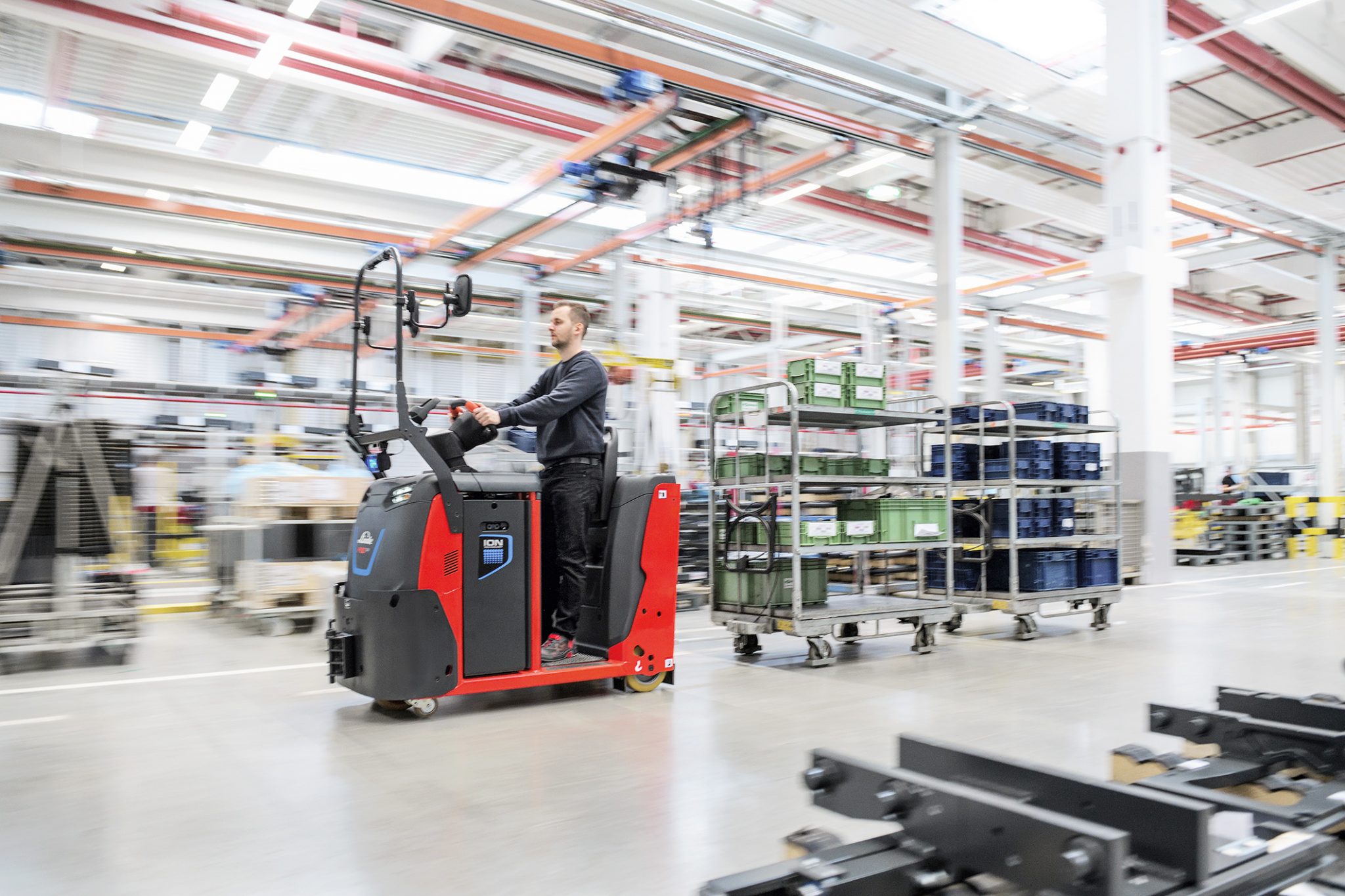
Linde Material Handling says its three new tow tractor models make moving loads more comfortable, safer and more efficient, even in confined spaces. The P40 C, P40 C B and P60 C have a narrow chassis and offer outstanding manoeuvrability, versatile equipment features and a wide range of safety systems.

Tow tractors have become indispensable in many transport processes. These all-rounders are mostly used as towing vehicles for logistic trains, for example to supply production in industrial plants, deliver goods to shops in airport terminals, serve meals in hospitals – or as ‘shelves on wheels’ in warehouses and distribution centres.

Linde Material Handling is presenting three new tractor models, each of which offers a choice between lithium-ion and lead-acid batteries:

– The Linde P40 C with four tons load capacity, 800 Newton nominal tractive force and a maximum travel speed of 8/13 kilometers per hour (with/without load).
– The Linde P40 C B with four tons load capacity, 800 Newton nominal tractive force and maximum travel speed of 8/10 kilometers per hour (with/without load).
– The Linde P60 C with six tons load capacity, 1200 Newton nominal tractive force and a maximum travel speed of 8/13 kilometers per hour (with/without load).

All models have a width of only 800 millimetres and can be easily manoeuvred even in narrow aisles. From the operator’s platform, the driver has an unobstructed view of the working environment, trailer, coupling and load – ensuring maximum visibility and safety.

The tow tractors are designed so that the driver’s torso and limbs remain within the protective vehicle contours at all times. In the event of a collision, robust bumpers absorb the force effectively.

The vehicles are equipped with numerous safety systems as standard. An example is the Linde Curve Control which reduces speed when cornering, depending on the steering wheel angle. The optional Linde Blue Spot projects a blue point of light onto the ground in front of the tractor, thus warning pedestrians of the approaching vehicle. Glare-free LED headlights give the driver an excellent view of the road ahead, even in poorly lit aisles.

The vehicles are brought to a standstill by three independently operating brake systems. The electromagnetic servo brake (Linde Brake Control) is connected to the emergency stop switch and automatically acts as the so-called dead man’s function when the driving switch is released. The vehicle stops also automatically when the driver steps off the platform. The hydraulically assisted braking system in turn reacts proportionally to the load weight: the heavier the load, the more braking force.

Other advantages of Linde tow tractors include the optimised platform suspension which reduces human vibrations up to 30 percent compared to previous models. For best possible shock absorption, it can also be adjusted depending on the weight of the operator. The wide, low entry, the height-adjustable steering wheel and an adjustable backrest with folding seat offer the operator a high level of comfort. Double castor wheels ensure optimum stability and traction in all driving situations. Four types of wheels offering different material and grip properties are available, depending on the ambient conditions as well as the conditions of the ground to be driven on. If the tow tractor is part of a logistic train (“Linde Load Train”), there is an optional remote control available for the trailers.

The optional, modular Linde Connect fleet management is used for access control, vehicle and driver administration, maintenance planning, shock sensors and usage analysis as well as zone-dependent speed adjustment.

Subscribe

Get notified about New Episodes of our Podcast, New Magazine Issues and stay updated with our Weekly Newsletter.