Senior Appointment for Warehousing Firm

Big Box Group UK is pleased to announce the appointment of Stuart Rathbone to the role of Buildings Division Lead, reporting to Managing Director, Iain Gillard.

Stuart, pictured, brings extensive managerial experience from senior industry roles incorporating sales, operations and project management. This experience, which includes the delivery of one hundred successful projects in under three years, allied with a wealth of technical knowledge, will help Stuart to develop the expertise Big Box Buildings offers.

Big Box Buildings provide both temporary and permanent structures. The buildings division works closely alongside Big Box Intralogistics to provide racking and mezzanine, whilst incorporating the expertise of Big Box Automation.

Commenting on his new role, Stuart said, “My immediate priorities are to use my experience and knowledge to underpin technical expertise within the buildings division, introduce protocols and set up instinctive systems that the team can pick up and easily manage. If one benefits, we all benefit. This is a rapidly expanding sector and I’m excited to be a part of such a dynamic company with a big future.”

Commenting on his appointment, Big Box Group Managing Director, Iain Gillard said, “We are constantly striving to attract and retain outstanding talent and Stuart’s appointment marks an important milestone on our journey. It reinforces the experience and expertise we are building across our major operational areas, contributing a wealth of skill and experience that will help grow the company.”

Port’s Zero Emission Material Handler Swings

Port of Tilbury’s new Liebherr zero emission material handler was officially welcomed into the port this week. The new Liebherr LH 150 M HR, is the first of its kind to operate in the UK and joins the busy port’s fleet of material handlers including Sennebogen 870 and 875 machines.

The new handler, which is to be known as ‘Big Giraffe’ following a naming competition with local schools, is the most advanced model with strong sustainability and net zero credentials which support’s the port drive to greener operations.

The machine which will work across the port estate including bulks and general cargo, uses the latest Tier V engine capable of running on HVO100 fuel which ensures zero CO2 emissions. An Energy Recovery Cylinder (ERC) is fitted to the main boom which will deliver up to 30% of fuel saving. The model also has low energy LED Lighting throughout and will contribute to the port’s ongoing commitment to ISO 14001and ISO 50001 accreditation.

Paul Dale, Asset and Site Director at the Port of Tilbury said: “Across our ports, we are investing in greener technology to ensure that our operations are sustainable and moving towards zero emissions. We have worked with Liebherr over the years and we are pleased to be the first in the UK to use their most advanced model of material handler.”

Mike Hanlon, Ports and Re-handling Specialist at Liebherr Great Britain, commented: “In line with our commitment to continuously reduce our environmental impacts and to shape long-term industry trends, we are driving forward the electrification of our machine portfolio. Many ports are increasingly demanding minimal CO2 emissions and a significant reduction in noise pollution for round-the-clock loading and unloading. Our emission-free material handlers respond to these challenges.”

The winning name, ‘Big Giraffe’ was the firm favourite with the port judging team, but they also awarded a runners up prize to the name ‘Big Claw’. The winner was Rebekah Oppong, aged 10, from Lansdown Primary Academy and Kitty North, aged 8, from Tilbury Pioneer Academy was the runner up.

Commenting on the competition, Peter Ward, Commercial Director at the Port of Tilbury said: “We wanted to get the local community involved in naming our new machine and were very impressed with all the creative ideas that the school children came up with. The name ‘Big Giraffe’ is a fitting name and we hope that Rebekah will get to see the new machine for herself at the port soon.”

Additional Supply Chain Network Visibility

E2open has announced that Samsara has selected its Advanced Supply Chain Planning and Collaboration for network visibility and to help manage its demand, supply, and inventory across its operations. Samsara, the pioneer of the Connected Operations™ Cloud, has become a system of record for tens of thousands of customers. By harnessing IoT data from trucks, warehouses, and heavy equipment, Samsara’s integrated platform provides actionable insights to run safer, more efficient, and more sustainable operations.

“At Samsara, we look for technology solutions that support our pace of innovation and commitment to providing the best possible experience for our customers,” said Jeff Faulkner, VP of Operations at Samsara. “With increased visibility and automated workflows, e2open can help us stay ahead of potential disruptions and enable a quick supply chain response to changes in customer demand.”
With e2open, Samsara will be able to automate more tools and communications across its supply chain network, potentially providing greater visibility into its operations. A metrics-driven command centre and external connectivity offer opportunities for improved collaboration, while meaningful simulations and scenarios can be leveraged to drive decisions.

“We’re thrilled to welcome Samsara as a client leveraging e2open’s Planning and Supplier Collaboration suites, to support their growth and customer journey,” said Michael Farlekas, CEO of e2open. “Samsara is on an exciting trajectory, and we look forward to working together to help them realise the benefits of outside-in planning, collaboration, and visibility across their entire supply chain network.”

Samsara is the pioneer of the Connected Operations™ Cloud, which is a system of record that enables organisations that depend on physical operations to harness Internet of Things (IoT) data to develop actionable insights and improve their operations. Samsara operates in North America and Europe and serves tens of thousands of customers across a wide range of industries including transportation, wholesale and retail trade, construction, field services, logistics, utilities and energy, government, healthcare and education, manufacturing, and food and beverage. The company’s mission is to increase the safety, efficiency, and sustainability of the operations that power the global economy.

Mission Zero Touch Robotics

Cost pressures, lack of space and personnel shortages are major issues needing a solution. One key to solving these issues is intelligent robotics. KNAPP’s innovative robot solutions help lower costs in logistics processes while increasing shipping capacity. KNAPP calls this new approach zero-touch fulfilment.

The goal of zero-touch fulfilment is to increase the degree of automation while minimizing the number of manual work steps, allowing employees to work efficiently and be relieved from physically demanding and repetitive tasks. At LogiMAT in Stuttgart, Germany, KNAPP presented technologies that help companies meet these goals.

There is no zero-touch fulfilment without robotic picking. KNAPP’s Pick-it-Easy Robot (pictured) will pack and pick diverse items into different containers in a live demonstration. AI-based object recognition and grip point determination allow the robot to handle a wide array of items. The intelligent KiSoft software suite functions as the brain of Pick-it-Easy Robot. It is used to design made-to-order software solutions for all processes and across all levels.

Autonomous mobile robots (AMRs) handle in-house transport jobs and offer many benefits that conventional conveyors simply cannot provide. After being configured, which is quickly accomplished, they move about freely and independently. They don’t require any changes to the warehouse and the fleet can be expanded rapidly when there are more transport tasks. AMRs are versatile and can be used for transport from goods-in to the storage system, cross docking and supplying work stations. One of KNAPP’s series of AMRs, the Open Shuttle Fork, handles the transport of pallets automatically, space-effectively and flexibly.

These autonomous mobile robots are controlled by the intelligent fleet control system in the KiSoft suite. The travel paths and processes of the AMR are easy to model and adapt in the software. KiSoft functions like a navigation system with specific route planning, analogous to the GPS in a car, and its obstacle detection ensures complete safety for people and equipment.

The best automation solution is only as good as its master data. In order for robots, shuttles and the like to work in a way that creates value, they need good-quality master data. This is exactly what MultiScan does best: collect high-quality master data, which is then saved by the software KiSoft Genomix. MultiScan easily and precisely captures morphological data, such as the volume or weight of items as well as quantities, stacking data, EAN barcodes and much more. The software solution KiSoft Genomix digitizes all the relevant item attributes, from their weight, dimensions and packaging type to their contents, centre of gravity, tilting behaviour and much more. This type of information is critical for smooth operation in the robotic warehouse and is what a robotic system needs to precisely process and handle various types of items.

Even the smallest items, such as jewellery, watches and their parts need to be securely stored. For this application, KNAPP offers the InduStore, which stores and handles items up to the size of a shoe box and up to 5 kg (11 lb) as standard. The InduStore uses its intelligent image recognition system to automatically identify each item. A conveyor brings small items to the robot, which picks them up and places them on the shelves in a compact, space-saving way.

For today’s warehouse logistics, three areas of expertise make all the difference: machines and robots, service and consulting, and finally, software. Each of these areas can of course stand alone; however, when combined, they provide an incredible advantage. This is exactly the combination KNAPP focuses on. This approach using integrated intelligence connects all the disciplines to provide customers with an all-in-one solution. For example, the KiSoft software configures the AMRs, so they go where they are needed, and also trains the KNAPP Pick-it-Easy Robot picking robots so they continually improve. It’s quite an impressive interplay of robots and software. With its business intelligence products, KiSoft provides the information needed to make strategic decisions. KNAPP has modules in KiSoft for resource planning, data analysis for strategic decision-making, predictive maintenance and life cycle management.

Forewarned is Forearmed in Supply Chain

In uncertain times, supply chain planning is paramount, says Stephan Heessels (pictured), Director, BEUMER Group Logistic Systems. He explains why increased use of automation and digital technologies is essential and talks about how he saw the industry developing over the course of 2023, particularly in terms of the way in which e-commerce affects the material handling and logistics business.

“The major disruptions caused by the Covid pandemic may now be largely behind us, but that does not mean that everything will be smooth sailing from now on. Even as that memory recedes we find that there is still plenty to concern us, with geopolitical conflicts, high inflation, energy insecurity and nervousness around a pending global recession heading the list. For the logistics operator, increased automation and use of digital solutions will be more important than ever in order to respond and modify their processes to meet evolving circumstances.

“For years, the cornerstones of supply chain management have been globalisation, low-cost supplies and minimal inventories. Covid had a major deleterious effect on global supply chains and with the current global geopolitical and fiscal outlook, major upheaval is still possible. Experts predict that systems could return to pre-Covid ‘normality’ in 2023, but even so, the global logistic network will be vulnerable to future political instability, natural disasters and regulatory changes. Building supply chain resilience and assessing how future interruptions can be avoided is therefore critical.

“For an industry that has relied on volume growth, it will be difficult to attain revenue increases in these circumstances. Indeed, we are already witnessing stagnation in parcel volumes and some major logistics service providers are reporting financial losses and tumbling share values. However, on the positive side one of the forces driving the growth of online retail commerce is the global use of smartphones and tablets. Both retailers and shoppers are increasingly using mobile shopping apps, with one in five US shoppers reporting using them multiple times per day.

“Mobile commerce is estimated to have been 6% of total retail sales in 2022, a rise from 4.1% in 2019. And by 2025 social commerce sales – those taking place on platforms such as Facebook, Instagram and TikTok – are estimated to triple.

“In concert with the rise in m-commerce is the increasing popularity of live shopping, whereby retailers can digitally broadcast their products via video and connect directly with consumers online. This is an emerging phenomenon that first appeared in China and can be thought of as the digital, mobile phone based version of TV shopping channels. It is set to become a major driving force in e-commerce, with the 2023 market size projected to reach US$600 billion in China and US$25 billion in the USA.

“Nevertheless, amid this forecast bright outlook for growth there are some shadows. The distribution sector is having to grapple with a difficult labour market as the talent shortage in the supply chain, end to end, reaches a crisis point. Postal distribution centres are struggling to ensure timely and cost-effective last-mile deliveries in the face of an unprecedented lack of workers.

“To stave off this attrition, the industry will also need to deploy strategies that attract, retain, develop and motivate its workers in the digital era. In light of this, we expect to see companies being more conservative when it comes to capital investments, while the focus on digitalising their processes – both back and front-end – will be even stronger, with the adoption of automation tools and advanced data analytics. We have seen much development in the digitalisation of the costly last mile, but hubs will be looking to find ways to digitalise all their processes and become less dependent on human resources through digital insights.

“In consideration of all these factors, I conclude that despite facing some headwinds, the market will continue to grow, providing e-commerce fulfilment facilities with plenty of opportunities for increased growth. In servicing this market, however, it will be important that fulfilment centres work to optimise their operations to reduce costs and resources through increased use of automation and digital technologies.”

Combi-CUBE Launched in Stuttgart

As Combilift celebrates 25 years of innovation, the company plans to ensure that 2023 will be a year to remember, by launching multiple products across various exhibitions on a global scale. To kick off, the newest product – the COMBi-CUBE was launched at the LogiMAT International Intralogistics show in Stuttgart.

This new electric model incorporates a host of technological and design features that not only enhance handling procedures but also offer a high level of driver comfort. Immediately noticeable is the new vibrant colour – a hi-vis green shade will contribute to improved safety as the trucks will be easily visible in their operational environment. This colour may be extended to all Combilift products.

Aside from optics however, a focus is on a number of ergonomic features. The driver’s position is in the centre of the cab, hence the ‘cube’ name. It offers generous room and excellent all-round visibility. The angle of the telescopic steering column can be adjusted and the Grammer MSG65 seat, combined with hydraulic cabin mounts guarantees a comfortable ride. An adjustable arm rest is mounted to the seat suspension which incorporates a multi-function joystick and an LCD colour touch screen.

Combilift’s unique dynamic 360 steering that enables seamless directional change while on the move can be integrated into the Combi-CUBE as an optional extra, making it one of the most manoeuvrable counterbalance forklifts on the market.

Further notable features are the large rear wheel and rubber tyres on all three wheels. This means that, unlike certain other brands of electric multidirectional trucks, this model is not restricted to super flat floors and is eminently suitable for working indoors and out, ensuring that semi-rough terrain is no impediment to reliable operation. And for quicker battery changeover during heavy shifts, two new easy-change roll-out batteries are provided (Overall Design Copyright 015019216-0001)

Combilift CEO and Co-Founder Martin McVicar said: “Our engineers and R&D department have been tirelessly preparing for a year of new launches, and the Combi-CUBE is proof of our continued commitment to provide the best and most innovative handling solutions for our worldwide customers.

“The forklift operates like a hovercraft. It does all the work of a regular forklift but then takes long loads too because it moves sideways, handling pallets or long loads laterally.”

Design-Solution for Warehouse Automation

Jungheinrich AG chose Configura to be a strategic partner for the development of various product and system configurators for highly complex customer solutions for its logistics systems division. The aim is to jointly establish an all-in-one plant-design-solution for customer projects which cover Jungheinrich’s entire process from initial planning to calculation and the creation of a bill of materials.

“Configura has officially been awarded the contract as the central software solution for the ‘System CPQ’ topic at Jungheinrich, which covers our fully automated intralogistics solutions and several other products,” said Dr. Florian Kuzmany, Head of Business Tools Sales Warehouse & Automation Projects at Jungheinrich.

The cooperation between Jungheinrich and Configura began in 2020, starting with a pilot project for the configuration of automated pallet racking systems. With the latest development in this strategic collaboration, further racking systems as well as materials handling components will be added to Configura’s CET Material Handling planning software, providing Jungheinrich’s sales department with an efficient, intuitive and cross-product project planning solution.

“We value Jungheinrich’s continued commitment to Configura,” said Rich Trahey, VP Sales & Marketing at Configura. “This strategic collaboration enables Jungheinrich to take full advantage of our software ecosystem—enabling them and their network of partners to concept and engineer warehouse systems with speed, accuracy and efficiency.”

As one of the world’s leading providers of intralogistics solutions, Jungheinrich has been advancing the development of innovative and sustainable products and solutions for material flows for 70 years. As a pioneer in the sector, the Hamburg-based family business is committed to creating the warehouse of the future. In 2022, Jungheinrich and its workforce of about 20,000 employees generated revenue of 4.76 billion euros. The global network covers 11 production plants and service and sales companies in 42 countries. The share is included in the MDAX.

Charge Management Controls Energy Costs

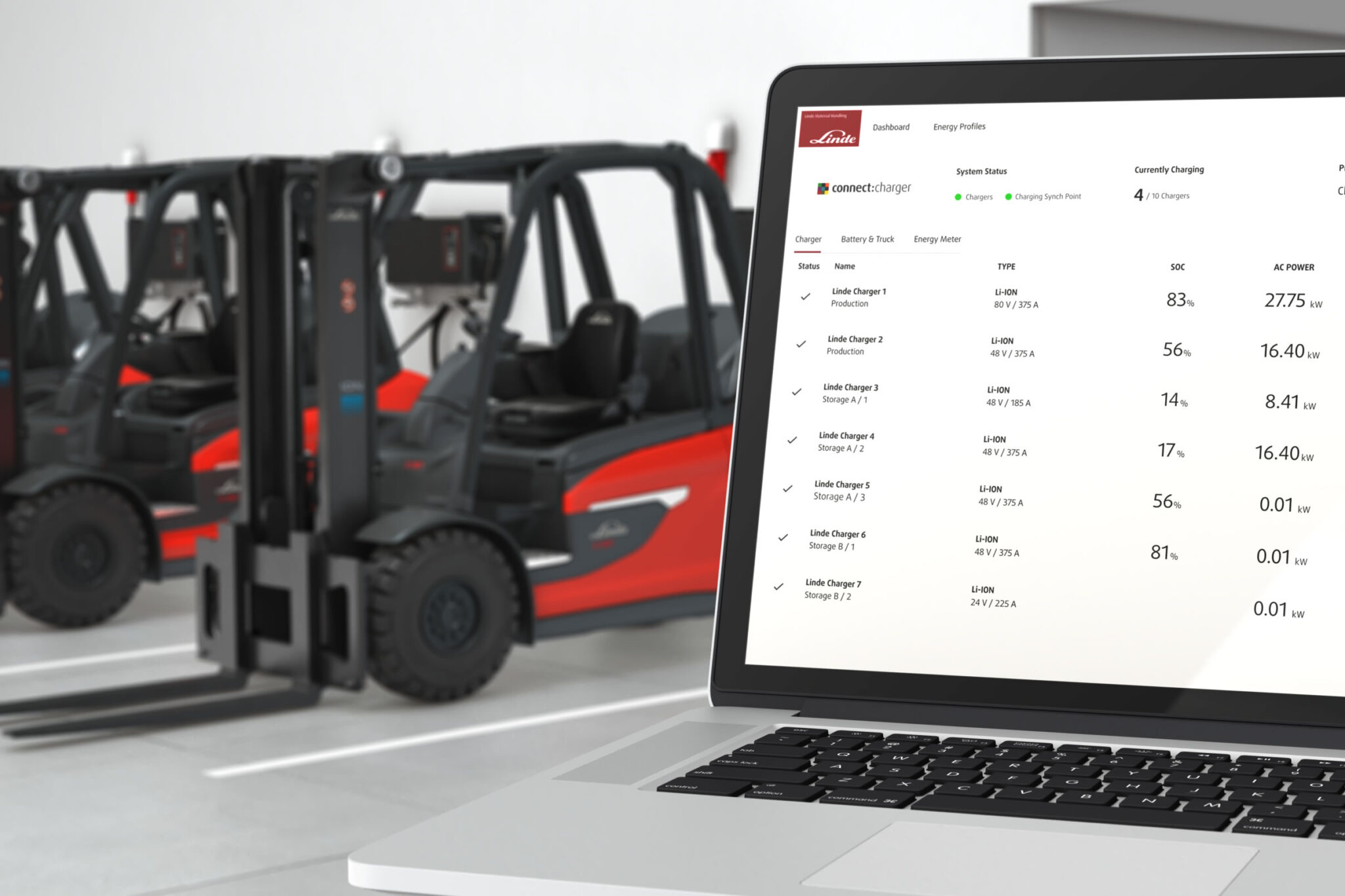
The new “connect:charger” module as part of Linde Material Handling’s (MH) fleet management solution makes the charging processes of battery-powered industrial trucks transparent and reduces electricity costs while maintaining consistent, high vehicle availability through prioritization, defined charging time slots and power limits. Suitable for use across industries, the quick-to-install software and hardware solution proves its worth even with small fleets and will be launched in time for the LogiMAT trade show.

“Peak demands in energy are among the main causes of skyrocketing costs when it comes to operating electric industrial trucks,” says Stefan Roth, Product Manager Energy Systems at Linde Material Handling. Operators of forklift trucks and warehouse equipment powered by lithium-ion batteries are especially likely to experience this because part of the concept with these applications is to charge the batteries regularly during the day in order to continuously extend their runtime. However, if too many employees connect their electric vehicles to the chargers at the same time, for example during breaks or after the end of the work shift, the power demand increases rapidly. In the case of lithium-ion batteries, this is compounded by the fact that fast charging is associated with significantly higher power demand than with the lead-acid variant.

“As the number of consumers increases, so does the risk that peaks in power consumption will occur,” Roth points out. “These short-term peaks can lead to permanent cost increases if the electricity tariff is linked to compliance with certain limit values,” he adds. But even if there are no limit values involved, with larger fleets it can be difficult to decide when to charge which vehicles in order to ensure their availability or to move charging to daytimes when electricity rates are cheaper. “All these requirements can be handled quickly and easily when using our digital charge management system, connect:charger,” explains Stefan Roth.

Intelligent charging

To do this, the new Linde system links up to 50 chargers in a network with a central hardware unit, which automatically controls the power demand according to predefined rules. Additionally, a dashboard allows forklift drivers and fleet operators to retrieve all the relevant information. For example, they can see when a particular industrial truck is ready for use again or how much energy the individual chargers have consumed over the course of the day. The dashboard also allows settings to be made with just a few clicks to adapt the charging behaviour to operational requirements. “Fixed charging times or maximum power levels can be defined. It is also possible for fleet operators to give individual chargers priority over others, for example, if a vehicle’s battery charge is below 50 percent,” explains product expert Roth. The intelligent charge management algorithm coordinates the various specifications and allocates appropriate capacities to the chargers.

There are two options as regards data transmission from the chargers to the control unit: Initially available at the market launch will be the wired solution (for up to 50 chargers). However, a wireless version will also be on offer shortly. Furthermore, there are plans to integrate additional software functions ranging from dynamic charge management and a cloud-based application to the integration of the charge management solution into a holistic energy management solution. The Linde connect:charger module can also be retrofitted, provided the charging devices feature an integrated interface (from year of manufacture 2018).

Robotics Solutions Unveiled at LogiMAT

Hai Robotics, a leader in Autonomous Case-handling Robot (ACR) systems, will introduce its new cutting-edge automation and robotics solutions at LogiMAT 2023 from April 25 to 27 in Stuttgart, Germany.

Hai Robotics is set to showcase its latest range of innovative automated solutions at Europe’s largest annual intralogistics exhibition. The exhibition will feature the highly anticipated HaiFlex and HaiPick A3 solutions. These new solutions are key additions to the company’s existing portfolio, both of which are set to bolster the company’s existing portfolio. In addition, attendees can witness two star products – the towering 10m tall HaiPick A42TD and HaiPort. This event offers a prime opportunity to experience first-hand how Hai Robotics is at the forefront of revolutionizing the intralogistics industry.

The HaiFlex is an innovative automation solution that allows warehouses to merge different zones, such as pallet areas, floor stacking areas, and racking areas, into a single automated picking warehouse area. The solution combines ACRs and AMR-type robots that work together to provide a more efficient way of order picking. The HaiFlex is designed to eliminate the inefficiencies of manually handling bulky goods and order consolidation, which can help reduce warehousing costs, including rental, labour, and management. It suits multiple industries, including apparel, retail, e-commerce, 3PL, and more. With HaiFlex, warehouses can handle bulky goods in one area while using ACR robots to take advantage of the available vertical space to pick, place, and store totes and cartons, thus increasing storage density and saving warehouse space. The solution also supports garment handling storage and oversized SKUs, making it versatile and efficient.

The Haiflex system is currently only available in the following countries and regions: EMEA, ANZ, SEA, South Korea, and China.

The HaiPick A3 is a forklift-type ACR that resolves stringent warehousing and compliance regulations challenges in the automotive and manufacturing industries. It enables the picking of various shapes of commercial materials, such as tyres, trays, and PCB materials, without needing totes or cartons. Furthermore, the HaiPick A3 can work with different types of shelves, conveyors, and other equipment. The software platform can integrate easily with almost any upstream software platform to orchestrate and automate processes within warehousing and manufacturing.

HaiPick A42TD enables the picking and storing of cases from shelves up to 10 m high (32.8 feet). The A42TD is equipped with a new double-deep picking fork, increasing storage density even further. Moreover, thanks to its 3D visual recognition, it can also handle plastic totes and cardboard cartons with a maximum weight of 30 kg (66.1 lbs). In addition, the adjustable fork enables automatic width adjustment to pick cases of different dimensions in mixed fields.

The HaiPort is an automatic loading and unloading machine that boosts throughput. It works with ACR robots to automate the loading, unloading, and transport of cases from the robot. Six cases (customisable up to eight cases) can be loaded in three seconds and unloaded in five seconds. A single workstation can handle up to 900 cases per hour. Order-fulfilment speed is 16 times faster than robot-to-conveyor belt transport enabling higher in/out efficiency in mixed fields.

With these new solutions, customers can further improve operational efficiency and storage density, meeting the needs of warehouses, DCs, and factories in the apparel, retail, e-commerce, and 3PL industries. In addition, Hai Robotics is investing heavily in creating a local network of system integrators, installation, and service partners so that any user of our solutions can expect rapid and high-quality service wherever they are in the EMEA region.

Experience the live demonstrations of our new solutions at LogiMAT, Stand 6A51, Hall 6. April 25 to 27, 2023. Stuttgart, Trade Fair Centre.

Edeka and Cimcorp: Future of Fresh Food Distribution

Part of Edeka Group, the largest German supermarket chain, Edeka Freienbrink is on a mission to distribute fresh food to its 488 stores around Berlin and Brandenburg quickly and efficiently. The goal is to deliver fresh produce to the stores within 4-5 hours of receiving the order, and Edeka is relying on the automation expertise of Cimcorp Group to achieve this. Edeka Freienbrink is one of five Edeka distribution centres Cimcorp has been modernizing with intralogistics automation designed for fresh food handling.

Mission to deliver fresh and fast

Order data is received at the Freienbrink DC around 11:30 a.m. and picking starts in the system at 12:00 p.m. The drivers arrive an hour later and wait for the goods to be loaded into their vehicles. They usually deliver the produce to the stores in Berlin first, and the goal is to have the goods in the stores by 8:00 a.m. the next morning.

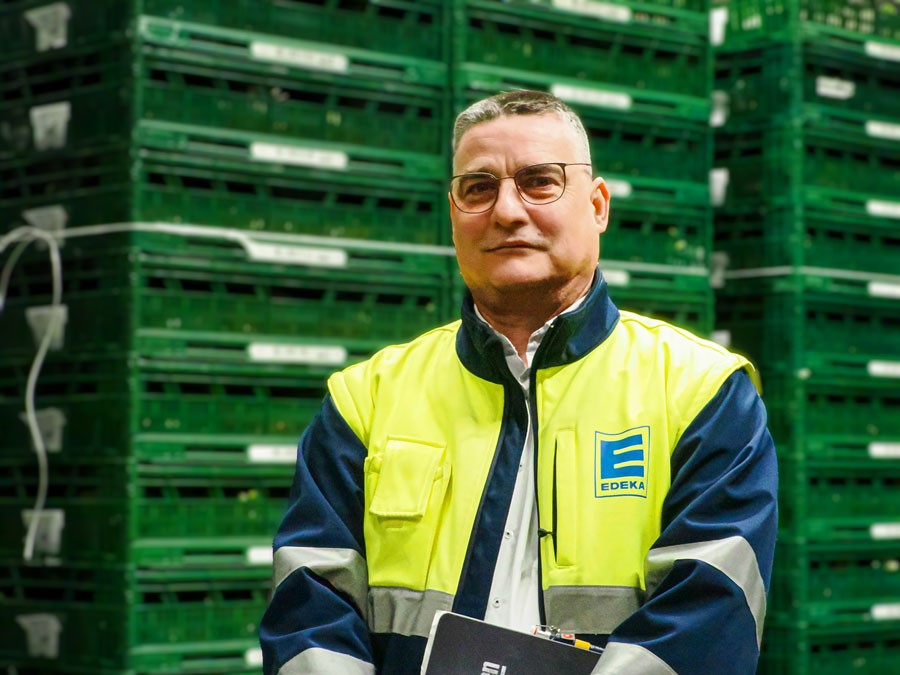
“From Freienbrink’s distribution centre, we serve a total of 488 stores, 416 of which have their fruit and vegetables handled by the Cimcorp solution,” explains Rene Klaus (pictured), Operations Manager at Edeka Minden-Hannover.

Getting fresh food delivered as quickly as possible from field to store is of paramount importance for ensuring its quality and safety. Fresh produce has a limited shelf life and the longer it takes to get to the store, the greater the chance that it will spoil or lose its nutritional value.

“The system has to run – we are very time-bound and any delay in the process could mean that we could not supply our customers with the quantity that they would like to have, and that cannot happen,” Rene Klaus continues.

With Cimcorp’s automation expertise, Edeka experiences fast and efficient deliveries of fresh produce without picking errors or delays.

Safer and healthier work

The system takes care of the heavy lifting and physical work, allowing Edeka to rely on fewer people at the facility and making it easier to manage.

“The picking must be done on time,” says Rene Klaus. “We work from Sunday to Friday. The produce always leaves in the afternoon. In terms of personnel, it means finding people to work weekends and holidays. These positions are becoming harder to fill.”

By taking over monotonous, repetitive and physically demanding tasks, automation can reduce the risk of injuries caused by manual labor. Overall, automation leads to a safer, healthier and more comfortable work environment for employees at Edeka Freienbrink, allowing them to focus on tasks that require problem solving and critical thinking.

Automation is the future

As the demand for faster and more efficient distribution of fresh food continues to grow, the Edeka Freienbrink DC is looking to increase automation. Rene Klaus predicts that all heavy lifting and physically exhausting work will be done by machines in the future, with people needed to handle the control.

“We have a vast quantity and range of products that we need to handle as fast as possible. The Cimcorp system is extremely helpful in moving, distributing and locating them. Automation is definitely the future,” he explains.

Automation in the distribution centre is crucial to meet the demands of Edeka’s customers and ensure that they receive fresh produce quickly and efficiently. As Edeka Freienbrink looks to increase its automation, Cimcorp’s expertise will continue to play a vital role in helping the company meet these demands.

Subscribe

Get notified about New Episodes of our Podcast, New Magazine Issues and stay updated with our Weekly Newsletter.