Libiao Robotics – Sorting Robot – Bin to Person Solution, a European supplier of intelligent intralogistics solutions, and Libiao Robotics, a global innovator in logistics automation technology, have entered into a strategic technology partnership. The collaboration aims to deliver scalable, flexible, and future-ready automation solutions for warehouse operations across Europe.
This partnership combines Europa Systems’expertise in designing and integrating comprehensive intralogistics systems with Libiao Robotics’ advanced AGV/AMR and automation solutions, known for its efficiency, reliability, and seamless integration into existing warehouse infrastructures.
Partnering with Libiao Robotics is a key step in our strategy to shape the smart warehouses of the future. By combining our strengths, we can offer even more agile and effective solutions that meet the evolving demands of Industry 4.0
“Europa Systems is the ideal partner for us – a company with deep integration know-how and a strong presence in the European market. Together, we can accelerate the digital transformation of internal logistics in the region,” said Huilin Xia, CEO, Libiao Robotics.
The partnership will focus on joint deployments in key sectors such as e-commerce, retail, contract logistics, and manufacturing. Solutions will include AMR/AGV-based sorting systems, intelligent internal transport systems, and integrated fleet management platforms.
Europa Systems is a European provider of intelligent intralogistics solutions, supporting the digital transformation and automation of processes in warehouses and production facilities. The company delivers end-to-end systems – from concept and design to implementation and service.
Libiao Robotics is a global specialist in intelligent logistics automation, specializing in flexible storage and sorting solutions for intralogistics and warehousing. Operating across Asia, North America, and Europe, the company delivers cutting-edge technologies that drive warehouse automation forward.
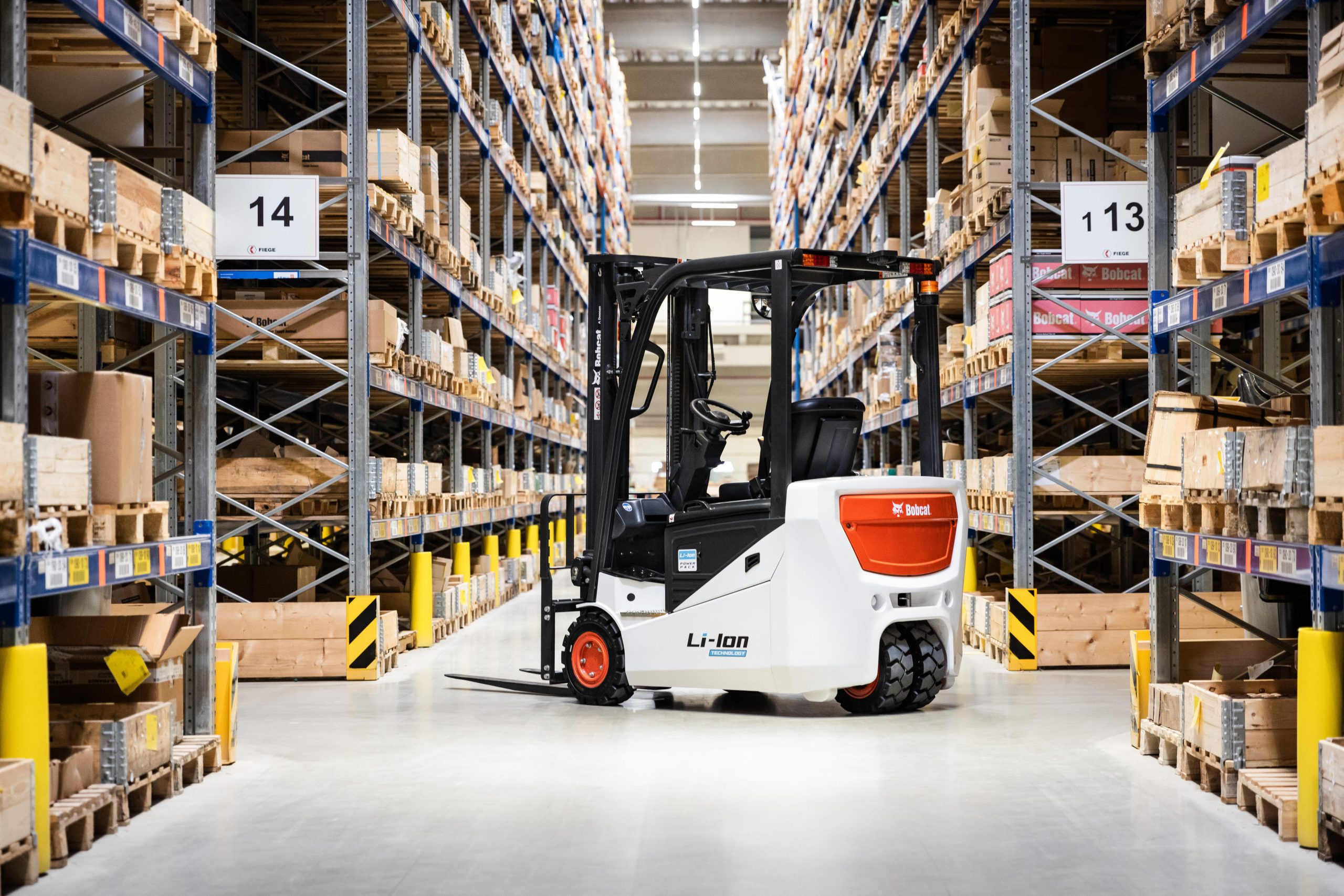
The new B16-20-NT series is the first 3-wheel forklift from Bobcat to be based exclusively on the latest lithium-ion technology. The B16NT, B18NT and B20NT models are specially designed for light to medium-duty use. Thanks to their combination of compact design, high manoeuvrability, and an emission-free drive, the series is a future-proof investment for in-plant logistics.
Features of electric forklifts: agility and ergonomics
The compact 3-wheel forklifts in the NT series offer load capacities of 1.6 to 2.0 tons with a load centre of 500 mm. Equipped with a 4.5 kW dual drive, a 12 kW hydraulic motor and a maintenance-free lithium-ion battery, they boast high performance capabilities. The models are particularly impressive in narrow warehouse aisles thanks to their excellent manoeuvrability and small turning radius.
Ergonomically designed driver’s seats with generous legroom, a low entrance and modern controls – including the intuitive colour display with onboard diagnostics and optional fingertip controls – ensure a high level of comfort and safety in daily use. The electric parking brake including ramp stop completes the safety concept.
Launch of new lithium-ion batteries
Alongside the market launch of the new B16-20-NT series, Bobcat is also introducing its own lithium-ion batteries. These can be ordered as an alternative to the lead-acid energy pack for the existing electric forklift product range. The new batteries are available in 400 and 600 Ah versions – regardless of voltage and series – and can be seamlessly integrated into the forklift’s CAN bus, making a separate display redundant. Lithium iron phosphate (LiFePO4, also known as LFP) is used as the cell chemistry, ensuring high safety and a long lifespan. Thanks to the integrated thermal management system, operation is even possible at temperatures as low as -18°C. The Machine IQ telematics and diagnostics system, which allows important system data to be read out in real time, provides additional transparency and control.
Not only is the service life of Bobcat’s lithium-ion batteries two to three times longer than that of conventional lead-acid batteries, they also require significantly less maintenance and offer higher efficiency. The Bobcat Machine IQ app can be used to easily monitor and analyse operating data, charging cycles and the battery status. The warranty of 5 years, or 10,000 operating hours, is another plus.
Smart charging infrastructure
Bobcat has developed its own series of powerful charging solutions for use with the new lithium-ion batteries. These are designed for efficiency and speed. Depending on the model, a full charge takes around two hours at a charging capacity of up to 300 A. The chargers are available for both 51.2 V and 80 V systems and cover capacities from 400 to 600 Ah. Thanks to their flexible connectivity (e.g. 16A/32A plugs) and robust design, they are ideal for a wide range of applications, whether in existing charging premises or distributed throughout the application environment. Thanks to the smart charging electronics, the charging process is always safe and adapted to the current status of the battery, thus extending its service life.
Focus on the future
With the new Li-ion forklifts in the BNT series, the new Li-ion batteries, and the corresponding fast chargers for the existing range, Bobcat is clearly demonstrating its commitment to sustainable and efficient intralogistics. The combination of zero-emission technology, high user-friendliness, and modern energy management makes the B16-20NT series and Bobcat’s Li-ion energy packs the ideal solution for forward-looking companies.
Technical highlights of the B16-20NT series at a glance:
• Load capacity: 1.6–2.0 t at 500 mm • Dual drive motors (2x 4.5 kW) • Maintenance-free Li-ion battery (277–412 Ah / 14.18–21.09 kWh) • Charging time: approx. 2 hours (with 150–200 A fast charger) • CAN bus integration • 5-year/10,000-hour warranty on battery • Standard electric parking brake including ramp stop • Ergonomic operator cab with optional fingertip system • Proportionally controlled lift speed
Peter MacLeod talks with Transporeon boss Philipp Pfister about how its cloud-based transport management platform can help build resilience in supply chains.
In his opening keynote at the recent Transporeon Summit in Amsterdam, Trimble CEO Rob Painter quoted US General Shinseki saying: “If you don’t like change, you’re going to like irrelevance even less.” It served as an apt theme, coming at a time when AI is sweeping across all areas of our industry, with companies such as Transporeon keen to showcase why it is at the forefront of this change. Later that day, I sat down with Philipp Pfister, Sector Vice President at Transporeon, for an exclusive interview.
The event in the Dutch city brought together hundreds of logistics leaders to discuss digital transformation, collaboration, and the future of transport management under the magnificent roof of the city’s former stock exchange, the Beurs van Berlage. Alongside high-level presentations, Transporeon unveiled new enhancements to its transport management platform.
Pfister, who has been with Transporeon for 13 years, now leads the business within Trimble Transportation. “I joined when the company was around 200 people,” he recalls. “I started as a project manager, building customer solutions on our platform. Over the years I was trusted with more responsibility, leading teams in professional services, support, platform management and freight auditing. At the beginning of this year, following Transporeon’s integration into Trimble, I was asked to take over the whole organisation.”
Navigating Crisis
The logistics sector has been in near-permanent turbulence since 2020. Pfister is clear about Transporeon’s role in helping companies adapt. “Since Covid, we’re seeing multiple crises all the time – Covid itself, the war in Ukraine, capacity shortages, inflation, and now Germany’s recession. Our solutions help customers stabilise. We remove manual work, automate processes, share information, and foster collaboration. This enables teams to focus on what really matters in an ever-changing environment.”
Transporeon’s longevity and scale are central to that mission. “We have 25 years of history, the biggest network in Europe, and a customer base that is motivated to collaborate,” Pfister notes. “And with Trimble, we’re uniquely positioned not just in Europe but also expanding strongly in North America.” One of the Summit’s recurring themes was openness. Pfister explains: “It’s about interoperability. Our platform lives with multiple partners, so we need easy connections and standardised data in the middle to enable smooth collaboration. We take an API-first approach – making it easy to connect – while still respecting data confidentiality. The goal is not to share everything with everyone, but to share with the right partners in the simplest way possible.”
This philosophy underpins the latest platform enhancements launched at the Summit. Highlights include advanced load planning, more efficient dock and yard management, and AI-driven optimisation, all designed to reduce empty miles, increase truck utilisation and cut emissions.
AI in Action
Pfister stresses that AI is no longer just in pilot mode for Transporeon. “What is definitely coming at full force is everything around our data insights and benchmarking tools. We have 110,000 transport slots transacted daily. That data fuels benchmarking, predictive analytics, and AI-driven decision support. Another area is autonomous quotation, bringing spot bidding into the AI era with machine learning and rule-based automation. This is being widely adopted globally.”
Yet AI adoption is not without challenges. “You need good data quality to train models,” he says. “Some companies are still working with ERP systems from 20 years ago. But that’s not a blocker – you can start small, with isolated use cases. The bigger challenge is change management. We can build great tools, but we must help people use them effectively. That’s why our Customer Experience team supports carriers and shippers throughout their digital journey.”
Decarbonisation & Security
The industry’s drive toward sustainability is another focus. “The carbon footprint of transport starts with utilisation,” Pfister argues. “If a truck carries 10 pallets instead of 30, energy is wasted. Our planning tools and procurement solutions help reduce empty mileage, consolidate loads, and cut waiting times at docks. The best reduction of emissions is when a transport can be avoided altogether.”
Cybersecurity, meanwhile, remains non-negotiable. “We deal with very sensitive data and must protect it at all costs. We’re ISO-certified, we run penetration tests, and we train staff against phishing. Security is everyone’s responsibility, not just the IT team.”
We’re a logistics software company, so we hire both tech specialists and people from the industry. The younger workforce wants purpose. What we do – helping reduce costs, emissions and inefficiencies – has real impact. And we’re already seeing an ‘AI-native generation’ enter the workforce. They’ll supervise AI agents as colleagues in the same way today’s managers lead people.
Competitive Edge
Asked to define Transporeon’s advantage, Pfister points to the power of the network. “We have the largest network and the highest data density in the market. We’re leading in AI capabilities and continuously growing with our customers. Many have been with us for decades and are still expanding their use of our platform. This shows that Transporeon is not just a tool but a long-term partner.” With resilience, openness, and AI-driven efficiency at its core, Transporeon looks to me to be well positioned as a critical enabler for customers whose supply chains face constant disruption. In Pfister’s words, “Wherever the starting point of their journey is, we need to help them to get on this AI journey while the finishing line is constantly moving”.
The latest episode of Logistics Business Conversations takes listeners inside one of the industry’s most remarkable success stories, as we welcome Martin McVicar, co-founder of Combilift, into our studio for an in-depth and highly engaging conversation.
We explore how a small Irish start-up, born in 1998, grew into a €500m global manufacturer, producing over 100,000 vehiclesand supplying customers in more than 85 countries.
Combilift is marking this milestone with a gold, fully operational truck raffled for charity—offering one lucky winner a unique machine or a buy-back option.
🚀 From start-up grit to global scale
Martin reflects on the company’s early days, first exports, and the customer-led innovation that shaped Combilift’s multi-directional, articulated and pedestrian ranges.
📦 Growth in key sectors
From warehouse optimisation to data centres and heavy modular handling, Combilift continues to expand into fast-growing markets worldwide.
🎪 The famous ‘dancing forklifts’
We revisit the demonstrations that helped showcase the manoeuvrability of the Combi-CB to global audiences.
📈 A strong 2025
The business reports 11% growth in the UK and continued international expansion.