
If you ask any supply chain professional what the biggest hidden cost in their operation is, few will immediately point to the humble pallet, writes Dan Starnes (pictured, below), Sales Director, Go Plastic Pallets.
In a world where warehouses, and the equipment within them, are becoming increasingly sophisticated, handling and storage solutions such as pallets and boxes are rarely spoken of in the same breath as complex automation systems requiring at least a six-figure investment. Yet for businesses relying on single-use wooden pallets, that unassuming piece of equipment could be quietly costing them tens of thousands of pounds, long before anyone thinks to question it.
The logic of a reusable, closed-loop system is simple enough in theory. Rather than buying cheap pallets, using them once, and never seeing them again, more businesses are now opting to have their pallets and containers circulate within a controlled loop. This retains their value trip after trip, instead of them ending up as waste after a single journey. For this to work, pallets need to be viewed as a long-term investment, rather than an unavoidable consumable.
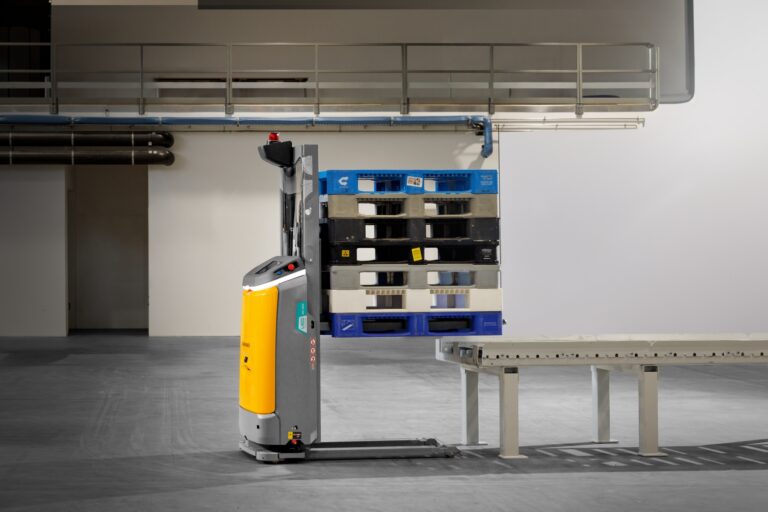
While more expensive initially, a well-made plastic pallet can be used every day for up to 10 years, offering far greater value than a wooden pallet, which may only last two to three years. In addition, many plastic pallets can be printed with a company logo, marking them clearly as company property and making them far more likely to be returned rather than lost within the wider supply chain.

Kimal, a UK manufacturer and supplier of specialised medical procedure packs and vascular access devices, found this out the hard way. The company had previously used wooden Euro pallets to send its products from its Bromsgrove clean-room facility to an external sterilisation provider. Once packs were sent for sterilisation, the majority of pallets were not returned. This meant that the business was having to purchase around 250 wooden pallets every week to maintain day-to-day operations, which led to annual pallet spend increasing to approximately £80,000. The wooden pallets brought other problems too, including breakages and splinters, which could pose health and safety risks to staff and potentially damage any automated equipment.
We worked closely with Kimal to rethink its pallet strategy. A heavy-duty pallet, manufactured from 100% recycled HDPE, was chosen to match standard Euro dimensions. This particular model also featured an open deck, which allowed sterilising gas to pass through effectively.
Kimal took delivery of 1,095 plastic pallets, which are now used exclusively within an internal loop. They transport packs from clean-room manufacture to sterilisation and then, when that process is complete, to Kimal’s distribution hub in Worcester. Once returned, the plastic pallets are removed and replaced with low-cost wooden pallets for outbound customer deliveries, ensuring the reusable assets remain under Kimal’s control and can be redeployed quickly.
In the first year, after accounting for additional equipment and implementation costs, Kimal achieved savings of approximately £20,000. In subsequent years, annual savings are projected at around £84,000, which includes allowances for any replacement pallets and maintenance.
Weekly pallet deliveries were consolidated into a single annual shipment, cutting transport movements and delivering a CO₂ saving that will reach 1,200kg a year. In addition, because the new pallets weigh roughly 16kg, 10-14kg lighter than the wooden pallets, the risk of manual handling injuries has dropped significantly too.
Creating a closed-loop system should not just start with a recycling policy or a sustainability target. It must start by choosing equipment that is robust enough to earn its place in the loop. If you get that right, the cost savings, safety improvements and environmental benefits will almost certainly follow.