As 3PLs, retailers and ecommerce operators face tighter service levels, labour pressure and unpredictable demand, the value of automation is shifting from reducing travel to orchestrating the entire operation. By Mike Harris (pictured, below), Vice President, Ocado Mobile Robot Systems, Ocado Group
Warehouse operators do not have a shortage of technology. They have a shortage of connected decision making.
Autonomous mobile robots have already proved they can reduce walking and improve picking productivity. But removing travel is only one part of the challenge. Orders, labour, congestion and exceptions demand intelligent coordination. Picking, replenishment, returns, sortation and dispatch must operate as a single continuous flow rather than five separate processes that happen to sit under the same roof.
When these decisions remain fragmented across systems and teams, automation simply moves the bottleneck. A robot that picks faster helps little if the pallet it depends on is still waiting at the dock, or if the exception it just created sits unresolved on a supervisor’s list.
That is why the next phase of warehouse automation will not be defined by how many robots an operator deploys. It will be defined by how intelligently the operation coordinates people, robots, tasks and workflows.
From task execution to orchestration
Many AMR systems are designed to receive a task and execute it efficiently. That delivers value, but it leaves the most important operational decisions elsewhere, often with the warehouse management system or the supervisor, who is left reconciling robot activity with operational needs. Chuck AMR, powered by Ocado IQ, takes a different approach.
Ocado IQ continuously evaluates factors such as order urgency, pick location, available resources, workload and congestion. It groups, prioritises and reallocates work as conditions change. The system does not simply direct a robot to the next location; it determines what the operation should do next and adjusts as soon as that answer changes.

The Ocado IQ App extends the same system directed logic into manual and hard to reach areas, including mezzanines, high shelves and bulky item zones. The Bridge gives supervisors live visibility across the whole operation – pick rates, queues, priority order tracking, fleet availability, congestion and service level performance.
Together, these capabilities turn Chuck from a point solution into part of a coordinated fulfilment system. The value of that coordination is felt most clearly in the way the floor runs day to day.
What a leaner fleet feels like on the floor
A smaller, smarter fleet is not just a lower capital cost. With fewer robots competing for the same aisles, congestion eases, idling decreases, and there are fewer near misses and collisions. A fleet sized to the work rather than the floor also needs fewer chargers and less parking, handing that space back to the operation. The result is a floor that runs smoother, safer and more predictably, not because it is emptier, but because everything on it is working harder.
One platform for three very different challenges
For 3PLs, variability is the business model. Different customers bring different order profiles, seasonal patterns, workflows and service level commitments. The automation platform must be configurable enough to support that complexity without turning every new customer or peak period into another technology project.
For retailers, the challenge is omnichannel coordination. Distribution centres may be supporting store replenishment, direct to consumer orders, marketplace fulfilment and returns at the same time. Optimising one workflow in isolation is no longer enough.
For ecommerce operators, the defining pressures are volatility and speed. Order volumes change quickly, carrier cut off times are unforgiving and common exceptions cannot be allowed to interrupt the flow of work. The operating realities are different, but the requirement is the same: an intelligent system that adapts continuously, rather than one that depends on static task lists and manual replanning.
Why mixed warehouses need mixed picking methods
A warehouse is not one uniform environment. It contains wide and narrow aisles, fast- and slow-moving products, dense and sparse pick faces, mezzanines and traffic patterns that shift by the hour. Applying one robot behaviour everywhere inevitably creates compromises.

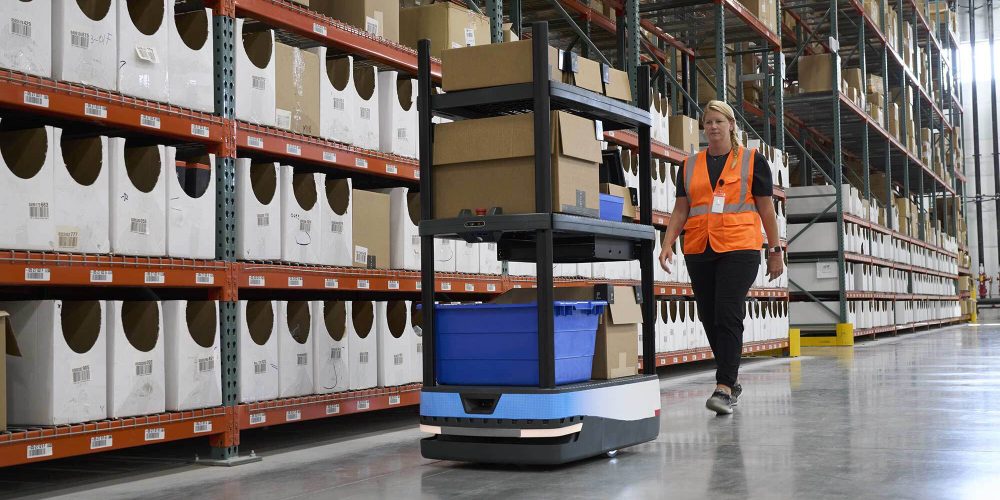
Chuck supports two intelligent picking modes, configured by aisle. In Sweep, an associate works with one robot through an aisle, a focused pairing that keeps picking orderly and traffic flow in narrower aisles. In Rendezvous, multiple robots are positioned at controlled points (no congestions or blockages) along high velocity aisles so associates can move straight from one assignment to the next.
Crucially, these modes operate concurrently. The behaviour belongs to the aisle, a single robot adapts as it moves, pairing closely with an associate in a narrow Sweep aisle, then shifting into Rendezvous in a wider one. No bot is tied to a single mode, and no part of the floor is fenced off for one behaviour.
Integrated pick-to-light guidance directs every pick with immediate visual feedback, ensuring speed and accuracy.
A better way to evaluate AMR platforms
The AMR category has matured quickly, and operators now have real choice in the market. That is a good thing, but it means evaluation criteria need to mature alongside it. Deployment speed, robot count and travel reduction are no longer the questions that separate a genuinely intelligent platform from a well-engineered task executor.
Chuck is designed to coordinate people, robots, orders and manual workflows as one system. That makes it a strong fit for complex 3PL, retail and ecommerce environments, where sustained performance depends on more than moving a tote from one location to another.
Scale through intelligence, not robot count
When demand increases, adding robots may be part of the answer, but it should not be the entire strategy: add capacity when the work genuinely calls for it, not by default.
That is why the Chuck fleet is built in layers: core bots for the everyday baseline, flex bots switched on for ordinary spikes like a busy Monday or a promotional bump, and peak bots for the events you plan around, like Black Friday. You scale up deliberately, in step with demand, never carrying the cost and congestion of a peak-sized fleet on an average Tuesday.
That only works if the platform underneath is built to scale, improving how work is allocated and prioritised before it starts counting robots, letting operators add or remove capacity without disruptive reprogramming, and keep benefiting from new software capabilities rather than being locked to the specification it shipped with.
Ocado mobile robot systems can deliver two to three times the productivity of manual cart-based picking, reduce labour costs by as much as 50%, go live in as little as 14 weeks and achieve payback in just six months. The platform has been deployed across more than 120 sites to date, spanning 3PL, retail, ecommerce, pharma and apparel operations.
The winners in the next era of fulfilment will not be the businesses with the most robots. They will be the businesses whose systems make the best decisions and turn those decisions into action across every workflow and every shift.