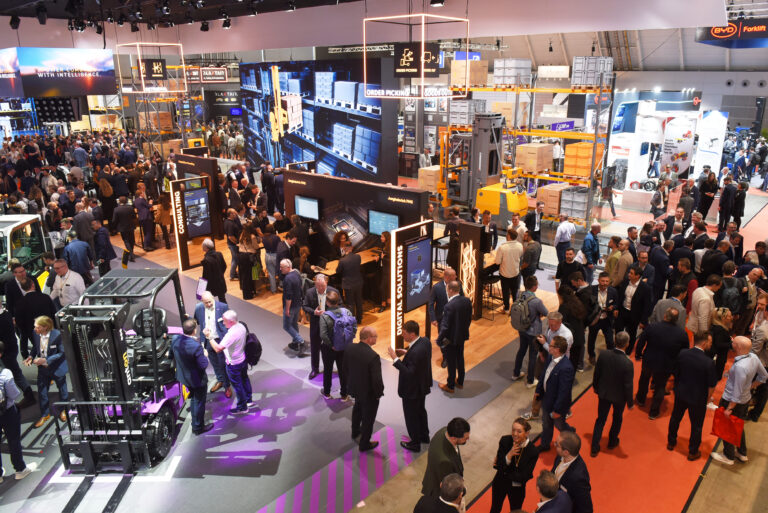
At the recent European Supply Chain Summit in Düsseldorf, CILT International President Jan Steenberg (pictured, below) spoke to Peter MacLeod about AI, skills and the changing shape of logistics.
With AI taking more operational decisions, people entering logistics may have fewer chances to build experience in the traditional way. For Steenberg, President of the Chartered Institute of Logistics and Transport (CILT) International, that makes education and professional standards more important.
“An AI cannot be held accountable,” he told me. “Someone else needs to make the decision that makes them accountable.” As automation becomes more capable, planners and managers will need enough commercial and operational understanding to assess its recommendations and take responsibility for the decisions made.

That challenge sits alongside geopolitical uncertainty, decarbonisation and the need to attract new talent into a sector many people still discover only by chance. CILT’s role, Steenberg says, is to connect professionals and provide recognised training and education. “We connect people, we educate people,” he said.
Global Institute
CILT traces its origins to 1919 and received its Royal Charter in 1926. CILT International operates as a federation, setting education and membership standards while national institutes adapt their work to local conditions. It has representation in about 40 countries across every continent except Antarctica.
The Charter’s purpose is ‘to promote the arts and the science of our profession’. CILT offers training and internationally recognised qualifications in logistics and transport, supporting people from entry into the profession through to strategic leadership. Across the global CILT network, up to 10,000 students undertake studies each year. Student membership also provides opportunities to connect with fellow learners and professionals, joining a network that Steenberg says younger people increasingly value.
A membership collaboration app is in development to make those connections easier, including through specialist groups in rail, passenger transport, ports and shipping. Steenberg expects a wider rollout in 2027. “We are about networking, we are about connecting people, we are about learning from each other,” he said.
Skills for an Automated Industry
Steenberg worries that new entrants may know how to use automated systems without understanding their operational context. For CILT, the challenge is how to teach and assess knowledge that previous generations often gained through experience. The answer will help determine whether AI supports logistics teams or widens the gap between those who operate the tools and those who understand the business.
Members are also concerned about jobs being replaced and the effects of geopolitical change on sourcing, manufacturing and transport. Cost pressures are driving consolidation, but smaller operators being forced out can leave customers with less choice.
Steenberg sees collaboration as one way to use existing assets more effectively. European manufacturers are pooling transport requirements and fleet capacity. He cites a major Australian retailer that has opened its distribution network to other users. In the UK, a telecoms company and an energy provider have combined parts of their field service operations. Such arrangements can reduce duplicated journeys, although they depend on trust and workable commercial agreements.
Technology and the Workforce
The economics of lower-carbon transport remain unsettled. Steenberg points to investment in ammonia-based shipping and says hybrid vehicles may be more likely than pure electric trucks in the near term, given current cost and range constraints. “Right now, these vehicles are incredibly expensive,” he said of electric trucks. Automated road transport could bring further change, particularly on trunk routes.
The driver workforce is ageing in many markets, while long periods away from home make the job harder to attract younger and more diverse people. To address this, CILT’s Turkish branch has started a programme, with Mercedes-Benz Trucks and government support, aiming to train and recruit 5,000 women into professional driving roles over five years.
Last-mile delivery will need different solutions for different needs. Parcel lockers can consolidate deliveries, but collection does not suit everyone, everywhere. Ageing populations and care delivered at home may increase demand for direct delivery of prescriptions and medical supplies.
Where roads are poor, drones can serve another purpose. Steenberg describes operations in Ghana delivering urgent supplies such as blood or medication to health centres. He says drones can reach destinations within a 100-kilometre radius in about an hour. “You couldn’t do that in Ghana with someone on a motorcycle,” he said.
As logistics becomes more visible, data-driven and automated, it will still need professionals who understand how supply chains work, recognise when assumptions fail and take responsibility for what happens next.