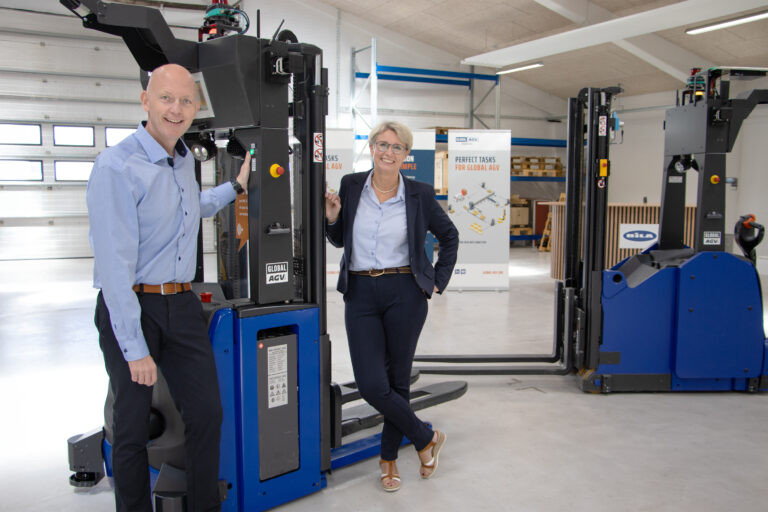

Deployment speed, robot count and travel time used to be the main criteria when assessing autonomous mobile robot (AMR) platforms, but they are no longer the questions that matter most, writes Jeff Larson (pictured, below), Vice President, Solutions Architecture, Ocado Group.
A few years ago, choosing an AMR platform was mostly a question of whether it worked. Could it navigate the floor safely? Could it cut walking time? Could it go live without disrupting the operation for months? Over recent years the AMR category has matured quickly, and most credible platforms now clear that bar. As a result, operators now have a real choice in the market, which is a good thing. But how do they now evaluate which is the right AMR for their operation?
Speed of deployment and reduced travel remain important, but they do not reveal whether an AMR system will improve performance across the whole operation. Success should not be measured by how many robots are deployed. The more useful question is how effectively the platform coordinates the right number of robots, people, and workflows to deliver higher throughput, greater accuracy, and more reliable service.
Most AMRs can transport goods and reduce walking. The real differentiation lies in the intelligence behind them. Can the system prioritise work as conditions change? Can it balance activity across the floor, manage exceptions, and keep orders moving towards dispatch? Can it help operators achieve more without continually adding hardware or supervisory effort?
Why conventional assessments fall short
Traditional assessments often focus on hardware-level metrics such as travel time, robot utilisation, and deployment speed. These measures can show that goods are moving faster, but they do not indicate whether the operation is making better decisions.

An AMR platform may reduce walking while still relying on supervisors to resolve exceptions, reprioritise urgent orders, rebalance labour, or prevent congestion. In that case, automation has shifted the work rather than removed the underlying complexity.
The difference becomes clearest when pressure builds. Multiple orders may compete for the same aisle, an unexpected issue may interrupt a workflow, or changing service priorities may require work to be reassigned immediately. An intelligent platform responds by replanning routes, reallocating tasks, and giving teams visibility into what needs attention.
This is where system architecture matters. Strong orchestration helps every robot movement contribute to the wider operation, allowing businesses to increase productivity, protect service levels, and often achieve more with fewer robots.
The five questions that actually separate platforms
These are architectural questions, not feature checklist items. Ask them of any vendor, and the answers will tell you more than a robot count ever could.
- Can it run more than one picking method at once?
A warehouse is not a uniform environment. It has wide aisles and narrow ones, fast-moving lines and slow ones. A platform that forces every aisle into the same behaviour is trading performance somewhere on the floor for simplicity in the software. The better question is whether the system can run different picking methods concurrently in different areas, or whether it only ever applies one method everywhere. - Can it reprioritise while the clock is ticking?
Orders do not arrive in the sequence anyone planned for. A platform that can only follow a task list built an hour ago is already behind by the time conditions change. Ask whether it can reprioritise work during the run, or whether it waits for another instruction from the warehouse management system before it moves. - Does the system’s intelligence reach where the robots can’t?
Most operations still have work that no robot will ever do directly: very narrow aisles (VNAs), high shelves, bulky item zones. A platform that goes quiet the moment a task becomes manual is only solving part of the floor. Ask whether its intelligence extends into those manual zones, or stops at the edge of what the robots themselves can physically reach. - Can it resolve its own exceptions?
Missing items, incorrect quantities, and overfilled totes are everyday realities in fulfilment operations. A platform that treats every issue as a ticket for a supervisor is quietly converting automation savings back into headcount. Ask whether it can resolve common exceptions automatically, or whether it simply adds them to a queue for a person to work through later. - Does it know if the operation is still on pace?
This is the question most evaluations skip entirely. A robot can complete its assignment perfectly and still leave the operation off pace, because nobody connected that task to what the day’s service commitments actually required. Ask whether the platform coordinates downstream activities and service level performance, or whether it primarily executes individual robot tasks in isolation.
Why this matters most under pressure
These questions matter most under exactly the conditions operators actually face: peak volume, when everything above happens at once and there is no slack to absorb a bad decision; mixed order profiles, when a 3PL, retailer or ecommerce operation is running several very different workflows through the same floor at the same time; and tight labour markets, when there are fewer people available to catch what the system misses.

Under those conditions, the gap between a platform that executes tasks and one that orchestrates the operation stops being theoretical. It shows up as a missed cut-off, a supervisor’s afternoon spent firefighting exceptions that should never have needed a person, or a fleet that looks busy while the metrics that actually matter, on-time dispatch, service level attainment, cost per order, quietly slip.
What whole-operation orchestration actually looks like
This is the difference between task execution and whole operation orchestration, and it is worth being specific about what the better answer looks like in practice, not just naming the gap.
Chuck AMR, powered by Ocado IQ, is designed to coordinate people, robots, orders and manual workflows as one system, rather than as a robot fleet with everything else bolted on around it. It groups, prioritises and reallocates work as conditions change, extends the same system-directed logic into manual zones through the Ocado IQ App, and gives supervisors live visibility across pick rates, queues, fleet availability and service level performance through The Bridge, so exceptions and service risk surface before they become a missed order rather than after.
Get all five of those right, and the effect compounds: platforms built this way have shown 2–3x the productivity of manual cart picking, because the gain comes from coordination, not from robots simply moving faster on their own.

That combination is what makes a platform a strong fit for complex 3PL, retail and ecommerce environments, where sustained performance depends on more than moving a tote from one location to another. A 3PL running five customers through one floor, a retailer balancing store replenishment against direct-to-consumer orders, an ecommerce operation racing a carrier cut-off, all have the same underlying requirement: a system that adapts continuously, rather than one that depends on static task lists and manual replanning.
Ask the harder questions before you invest
Deployment speed, hardware requirements, and reduced travel still matter. But they should be treated as the baseline, not the full measure of an AMR platform. Operators should ask those questions, then go further. Few vendors can answer every question with confidence. That is precisely why these capabilities need to be tested before deployment, not discovered after the robots arrive.
Getting the decision right can deliver value quickly. Operators using intelligently orchestrated platforms have achieved payback in as little as six months because the return comes from better decisions across the entire operation, not from the performance of any single robot.