

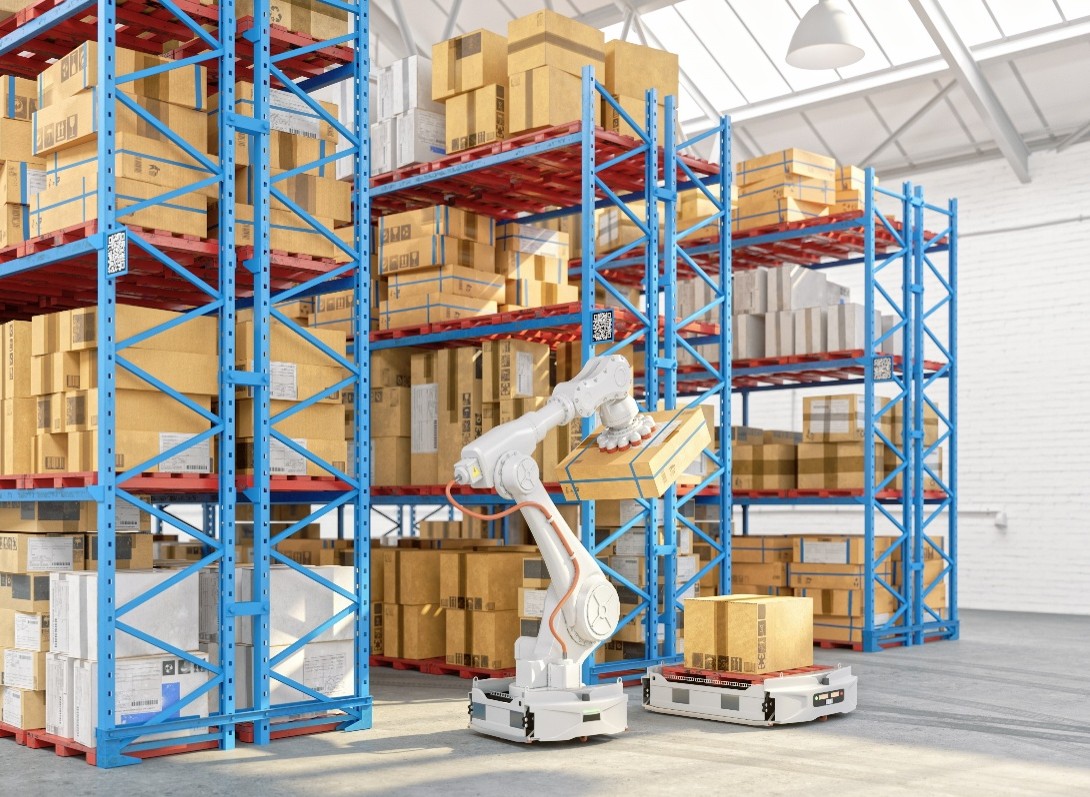
Warehouses are facing mounting pressure to handle growing order volumes and demand for space, while processing smaller, more varied orders and delivering them faster. Labour shortages and rising wage costs make it harder to expand capacity, write Florian Funke (Partner), Charles Sealey (Principle), and Harpreet Singh (Partner) at L.E.K Consulting.
Automation is helping address these pressures across the operation: robots are taking on more tasks, high-density storage is creating capacity in existing buildings and software is coordinating how equipment works together.
The global warehouse automation market is forecast to grow from around €21 billion in 2025 to €42 billion by 2030. Increasingly, automation is reaching beyond large new-build sites to the warehouses operators already use. Automation is giving warehouses a new way to grow, helping operators handle more orders, faster, from the space they already have.
Robots take on more of the work
Labour shortages and rising costs, alongside cheaper and more effective automation, are strengthening the case for robots across a wider range of tasks, as advances in gripping, machine vision and AI enable them to handle both heavy and lighter items. Applications are becoming more advanced and capable of delivering greater benefits to operators. Early humanoid work has centred on moving cases and transferring goods between equipment. Warehouses offer a suitable setting because their layouts and workflows are relatively structured and repeatable.
Across robotics more broadly, advances in AI, sensing and robotic tools are extending automation into picking, stowing, depalletising and packing. This shift from transporting goods to manipulating them opens more of the warehouse workflow to automation, although humanoid adoption remains at an early stage.
AI meets more complex orders
Fulfilment is becoming more complicated. Ecommerce and omnichannel retail are driving smaller orders, faster delivery expectations and more returns, while operators manage more products and variable order profiles. AI is helping warehouses make real-time decisions about where products are stored, how goods are routed and which tasks are assigned to robots. In high-density storage, software can also sequence retrieval, so goods are brought to people for picking. Together, these capabilities can help operators handle more varied demand without increasing labour in proportion to volumes and variety.
Making more of existing space
Growth in warehouse stock is expected to slow from around 5% a year in 2020-25 to 3-4% a year towards 2030 across Europe, the US and Asia-Pacific. Modular automation offers a way to increase throughput within existing sites without a full-site transformation. Operators can add capacity by workflow or zone; there is growing interest in retrofit projects.
High-density matrix (or cubic AS/RS systems) are a type of modular automated storage and retrieval system that can be configured to a wide range of size and capacity specifications and are suited to ‘goods to person ‘automated storage and retrieval with high SKU and lower load applications. These systems can be integrated with existing warehouse automation technology, making them applicable to both ‘full facility’ and ‘upgrade’ projects. Adoption is estimated to grow at a rate of 20-25% over the next five years.
Connecting the warehouse
Customers increasingly want end-to-end solutions that simplify supply chains. System integrators and platform-agnostic software providers are therefore playing a growing role in connecting equipment from different suppliers, including robots, storage, sorters and conveyors, with warehouse management and control systems.
Orchestration platforms coordinate robot fleets, task allocation and material flows in real time. Seamless integration is especially important in retrofits, where new technology must work around existing infrastructure. Operators need to assess how the complete system improves throughput and use of space. Looking ahead, the ability to connect and coordinate an expanding range of technologies will be key to creating warehouses that can adapt as demand continues to grow.
