
Sustainable packaging can be viewed as its own collaborative ecosystem. This is the concept of one major supplier, CMC Packaging Automation, an on-demand packaging company that customizes box dimensions to items for each order. This results in accurately sized packages that eliminate the need for single-use plastic padding while still protecting items during shipping. David Priestman attended the company’s Innovation Day (CID) in Umbria.
I’m not superstitious, so being informed that CMC have been involved with packaging machinery specifically for logistics and warehousing for thirteen years now (though it is over 40 years in the trade) just reinforces the fact that this Italian, family-run firm are truly immersed and centre-stage in the applications it turns its not inconsiderable inventiveness to.
“We listen to what the customer wants and don’t follow the competition,” says CEO Francesco Ponti. His company reported revenue of €170m last year and has 650 employees and an incredible 600+ patents. Following investment from KKR (global impact portfolio) in 2020 and via the Amazon Climate Pledge Fund in 2021 the company has been on a steep trajectory. Half of all sales are now in the USA.

Packaging Compliant
Complexity in picking and packing comes from having multiple items per box to be shipped. And today’s fulfilment centres face various challenges, including regulations, streamlined flows, labour shortages and reduced human touches, cost of consumables and transport, multi orders, same-day orders, oversized boxes and damaged returns.
Transition from Plastic to Paper
“There is too much packaging,” Tim Werkhoven of Mondi Packaging told the audience, to universal agreement. The EU’s Packaging and Packaging Waste Regulation (PPWR) is a comprehensive law that replaces the former directive. Waste is now legally defined and a potential liability. “We have a material choice based on machinery compatibility, not just a procurement issue,” Werkhoven added. “Cut waste, re-use and recycle.”
By the 2030s the recyclability of packaging must be greater than 70%. This will mean, for example, replacing rigid plastics with paper solutions and ending single-use plastics. “Minimal packaging and void space will therefore become bindingly provable,” Werkhoven concluded, preaching to the converted. “We need re-use targets for transport packaging and should only use recyclables.”

Scale Down to Minimum Size
Box-first or box-last? Pre-formed boxes are used when operators fill them with items so they can be used for multi-item orders. This set-up is often cheaper but means completed boxes are often not the right size as it is dependent on accurate dimension information and box-flow sequencing.
With a box-last format items usually travel via conveyor to the packaging machine, which automatically scans and measures so as to form a customised box. This saves on consumables costs, providing precise right-sizing without process errors (e.g. the wrong sized box arriving).
Shuttle Integration Synergy
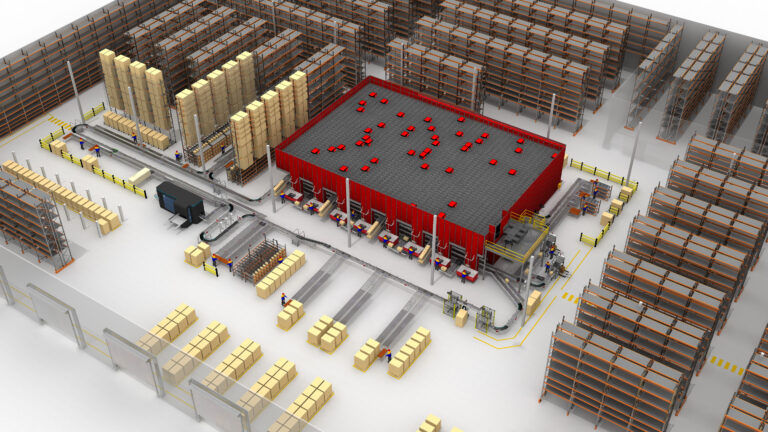
Picking and consolidation with CMC’s plastic Vary-Tote enables packaging automation machines to be integrated with ASRS, AGVs and shuttle systems, with integration projects completed with Libiao, Exotec, AutoStore, Jindong and others.
The Vary-Tote is a real game-changer, with its unique design and functionality. It can fit inside the grid store and its base/floor/ opens automatically when the items inside are ready to be boxed by the automatic packaging machine, with the cardboard instantly and automatically catching and folding-close the order inside into a perfect, right-sized box, ready for labelling and despatch. Buffering and/or de-coupling of orders and end-of-line packing are carried out seamlessly – all possible with a ‘zero-touch’ process.

The AutoStore integration with CMC’s GeneSys machine has several major use cases, some as large as 50000 bins. In a goods-to-person system the Vary-Tote carries the items picked in the AutoStore to GeneSys and empties them onto the cardboard. This machine can package 800 cartons per hour and incorporates a weight scale, easy open function, dynamic box cutting, auto labelling and sorting. One GeneSys machine can replace four manual packers (assuming you can hire them in the first place), with a lower error rate.
The goal has been to make the integration between AutoStore and GeneSys leaner, particularly by utilising the Vary-Tote inside the grid, each placed inside an AutoStore tote. Users can execute several processes: order fulfilment, same day picking, multi-items. Buffering totes for despatch later means de-coupling pick and pack operations.
There is no conveyor between the grid and the pick face, only from the grid to GeneSys. Each Vary-Tote is brought to the pick station for inserting items, either by a worker or a robot. Single item orders can be picked and go straight to the packaging machine. All completed boxes head to the despatch area via sortation or AMRs for outbound. The result is a modular, extendable, less complex solution.
Less people, More skilled
Garden products company Neudorff is one happy customer. Tamer Memis, CEO of its ecommerce division, attended CID last year, saw and bought ‘CartonWrap’ machines to pack very small products, and is now recommending them. “We kill a lot, organically,” he joked, about herbicides! Neudorff’s ecommerce business only started in 2021 and only recently invested in automation.
“Packing is the most expensive process, with a time and cost per shipment. The cost per parcel is many times higher for packing than picking,” he explained.
Fit-to-size saves money in a fully automated set-up, from scanning to labelling. “We put the products on the conveyor and its gone. Fire and forget,” Memis enthuses. Less volume per parcel cuts courier rates. “Automation only succeeds if you treat software and hardware as one system. Our interface controls the order flow, with a tray split that maximises the machine’s share. We thought 75% of products would go on the CMC machine, but achieved 97%, so we can ship and sell even more.” The system can split an order into more than one tray if it means automating the process and no people packing the order. “Scale through tech, not people,” he advised.
One Vision (not fried chicken!)
CMC’s dream is to see a unified platform for adaptive, order-driven fulfilment: right size packaging, manual picking, robotic piece picking, storage and buffering – all orchestrated by software to reduce costs and manage configured execution paths, whether they be multi-item orders, single item or express. Sales Area Manager Marco Mozzaorecchi say the company offers, “a comprehensive, right-sized portfolio, with no void filling.”

Prima (verde) over Standard
The latest new machine from CMC is the GeneSys Prima. Francesco Ponti said, “we’re considered a ‘box last’ company, but brownfield sites often need ‘box first’ set-ups for manual packing. Right-size packaging is like playing Tetris, the data calculates the box size for every order.”
The new CMC cardboard box, also unveiled at the event, will be used for orders picked from the ASRS. The machine packs and closes the box without a separate lid, as the new internal flaps are incorporated into the cardboard in the side furthest from the picker. The machine closes and seals the box and the internal flaps also prevent shaking or movement of the products inside.
“The best thing about ‘box last’,” said Ponti, “is the code that calculates the volume.” The Super Vertical One, an ultra compact machine, is being launched. It does both ‘box first’ and ‘box last’. “It’s a game changer. It connects to anything. The product scan creates the data for packing.” The machine can be used for a peak-season boost to existing machines, or a standalone packaging ecosystem.