

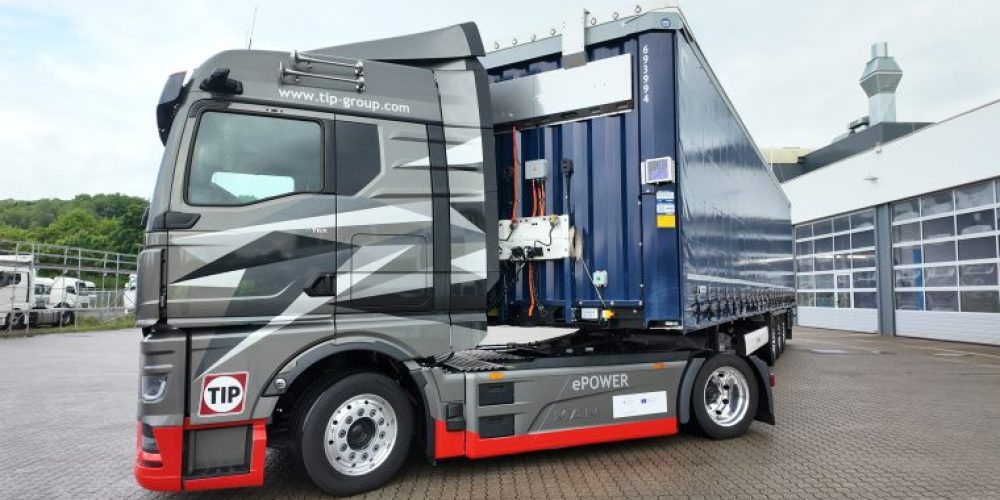
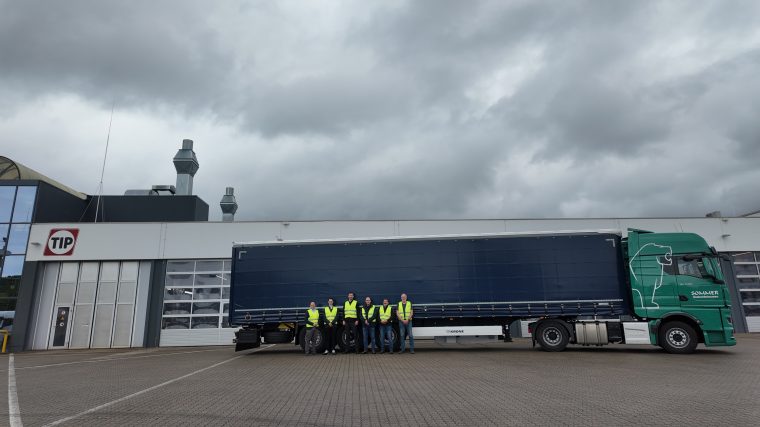
Transport equipment solutions provider TIP Group, electric powertrain specialist Nivalis Energy Europe, and leading trailer running gear specialist BPW, have announced the start of a pilot trial of a propelled semi-trailer without refrigeration for the German transport operator Sommer.
The pilot, which began at the end of May, tests a Nivalis Powered Trailer Kit fitted to a TIP Group trailer under real operating conditions with Sommer’s fleet. The kit transforms a standard trailer into an intelligent, self-assisting unit that actively contributes to its own movement – reducing the energy demand on the tractor engine, without adding significant weight, and without changing how the driver operates the vehicle.
The pilot will evaluate how energy-assisted trailer technology performs under real-world long-haul logistics conditions. The new system is targeting to reduce truck’s fuel consumption by up to 7,000 litres of diesel per trailer per year – a potentially significant operational saving for high-utilisation fleets – while cutting CO2 emissions by up to 18 tons per trailer annually.
How it works
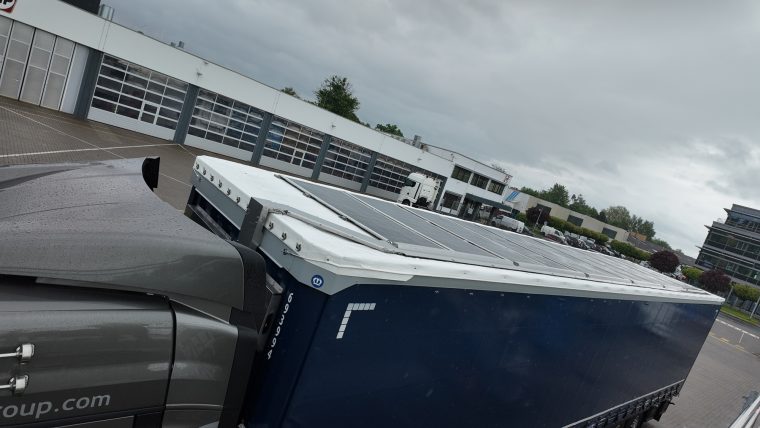
The Nivalis system integrates an electric axle (e-axle), a joint development of Nivalis and BPW, directly into the trailer chassis. Unlike the company’s electrified e-Reefer refrigeration platforms which focus on powering refrigerated transport, the Powered Trailer system is designed to reduce the energy demand placed on the tractor unit through propulsion assistance and energy recovery. The batteries receive energy from three sources simultaneously: the e-axle during braking, a full-roof array of photovoltaic (PV) solar panels during daylight, and a 32A AC three-phase grid connection during parking stops. The system generates, recovers and redistributes energy continuously across the working day.
An onboard Energy Management Unit (EMU) hosts all power electronic components and Integrated Power Distribution Unit (IPDU) orchestrates all power flows, while a compact Human-Machine Interface (HMI) display, readable from the cab’s side mirror, keeps the driver always informed of system status and battery charge level.
The system also feeds real-time and historical performance data into Nivalis’ telematics platform, giving fleet managers full visibility of energy generation, savings and system health. Predictive maintenance alerts and over-the-air software updates reduce downtime and enable integration with existing fleet management solutions.
The fuel saving and TCO
The Nivalis system has been designed to deliver meaningful fuel savings for long-haul routes, with projected fuel consumption reductions of up to 7000 liters of diesel, and 18 tons of CO2 per trailer per year. The rooftop PV array generates up to 3.7kWp, further reducing grid dependency.
”Our e-system is focused on 3 targets: fuel cost reduction, minimal intervention in customer’s operating processes and improved sustainability.” says Pavel Gilman, Vice President Sales & Marketing at Nivalis Energy Europe.
“We want to showcase how the transport industry can step-by-step release itself from fossil fuels without exceptional investments and changes to infrastructure. We think it is the right time for customers to make the change and gain important competitive advantages.”
“From an operational perspective, the key question is how the system performs in everyday transport conditions – across different routes, loads and driver behaviours. This pilot gives us the data and experience to assess that in a practical and real-world way,” shares Christian Schütz, Head of Fleet & Asset Management Central Region at TIP Group.
“By focusing on the use of harvested energy and following a strict down-scaling approach, the Nivalis system lowers the threshold to profitability and avoids dependency on electricity prices and charging opportunities. Smaller batteries and optimized drivetrain power reduce investment cost, weight and impact on vehicle stability. We think that the system operates in the economic sweet spot of TCO for propelled trailers and support the field test to validate our expectation,” says Hans Werner Kopplow, Head of R&D Customised / E&I-Solutions at BPW.
Homologated and road-ready
Especially with technical innovations and pilot vehicles, administrative requirements for registration and operation can be complex. TIP has successfully obtained the required approval for this trailer configuration, enabling its registration and use across EU and EFTA countries in line with applicable national regulations.
The Nivalis high-voltage Li-Ion battery packs are certified under UN 38.3, and the electric powertrain complies with UNECE Regulation No. 100. Drivers operate the trailer under standard European and national driving regulations, with no additional licensing or training required.
What this pilot means for the industry
For TIP, this pilot extends an active portfolio of sustainable full-service solutions already in commercial operation across Europe. The propelled trailer pilot opens a new front in that work: addressing traction energy at the trailer level, rather than solely through the tractor unit or ancillary systems.
“Our customers need solutions that improve efficiency without disrupting operations. This pilot allows us to evaluate whether propelled trailers can deliver measurable gains in day-to-day use and make a meaningful contribution to decarbonization” says Rogier Laan, Vice President Global Sales and Marketing at TIP Group. “Our role is to bring these technologies into real-world operation and help accelerate the transition to more sustainable transport.”
Interim findings from the pilot will be shared during the trial period. Subject to results, TIP and Nivalis plan to explore broader European deployment options.