Given the situation in the Middle East and restrictions affecting maritime traffic in the Strait of Hormuz, CMA CGM says its top priority remains the safety of its crews and employees. In this context of significant navigational constraints, the company is mobilizing to support its customers’ supply chains and ensure continuity of trade to and from the Middle East.
Leveraging the agility of its global network and its integrated logistics capabilities, the Group is deploying alternative multimodal solutions combining sea, rail, and road transport to maintain the smooth flow of logistics despite the situation in Hormuz.
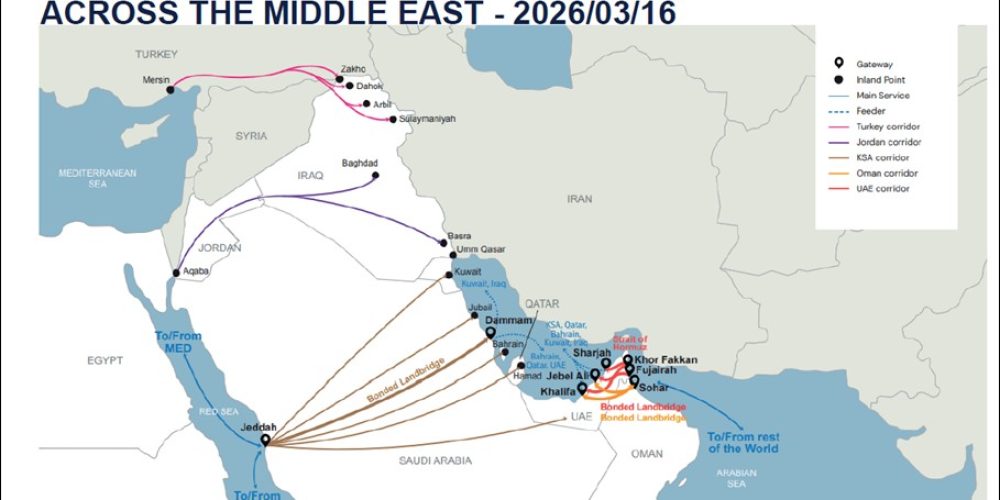
Secure logistics corridors via the United Arab Emirates: Located south of the Strait of Hormuz, Khor Fakkan, Fujairah, and Sohar serve as strategic entry points for Gulf-bound flows.
From these ports, CMA CGM offers logistics corridors to serve:
• The main hubs in the UAE (Khalifa, Jebel Ali, Sharjah)
• Other countries bordering the Arabian Gulf via a combination of regional road and maritime transport
This multimodal organization ensures continuity and efficiency of supply chains in the region.
Alternative road corridor via Saudi Arabia
The port of Jeddah on the Red Sea also provides an alternative to passing through the Strait of Hormuz. From Jeddah, CMA CGM has established road corridors, with or without maritime connections, for onward delivery to Saudi Arabia (Dammam), the UAE, Qatar, Bahrain, Kuwait, and Iraq. This setup also allows flows to connect to the Mediterranean and Asia without exposure to the strait.
Complementary road solution via Oman
CMA CGM also leverages Omani ports to provide a third major alternative road route. These ports enable road connections to the UAE and northern Gulf countries combining road and feeder services, offering a reliable alternative for regional and cross-border flows.
Through this setup, CMA CGM aims to use its ability to manage geopolitical risks and provide robust, flexible, and secure logistics solutions in support of international trade.