Complexity Defining Challenge in Vehicle Logistics

Vehicle logistics is entering a new phase defined less by growth alone and more by the challenge of managing increasing operational complexity. This is the central finding of the INFORM Trend Report 2026: IT in Vehicle Logistics, based on a survey of 111 industry professionals.

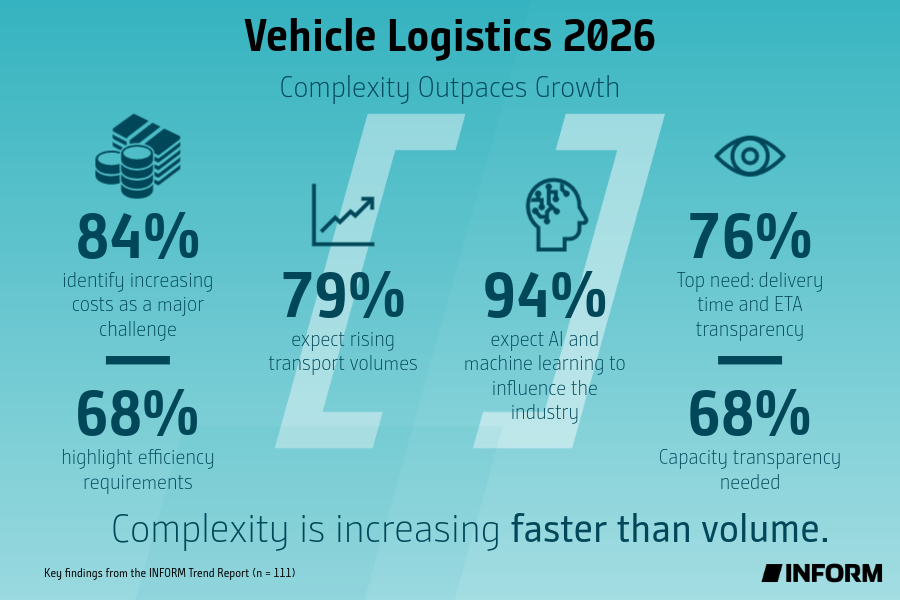
While 79% of respondents expect vehicle transport volumes (rather than overall production volumes) to increase over the next five years, a large majority simultaneously report continuously rising operational pressure. 84% identify increasing costs as the dominant challenge, followed by growing efficiency requirements (68%) and fluctuating volumes (52%).

Cost pressure remains the dominant operational challenge and has intensified compared to previous surveys. At the same time, limited transparency and increasing network complexity continue to impact planning quality and execution reliability. In many organizations, fragmented information still leads to reactive rather than proactive decision-making.

Management Summary: Growth Continues – Complexity Accelerates

The study highlights a structural shift in vehicle logistics:
• Most respondents expect transport volumes to grow.
• Operational pressure is intensifying across networks.
• Complexity is increasing faster than volume.
As a result, vehicle logistics is evolving into a decision-making challenge under cost and coordination constraints. Limited transparency remains a key barrier to efficient operations:
• 76% report insufficient visibility of delivery times and ETA.
• 68% see gaps in capacity transparency.
• 66% highlight missing transport status visibility.

At the same time, companies see a growing gap between operational requirements and existing IT capabilities. While 95% expect IT systems to improve operational efficiency, many organizations still struggle with fragmented data, limited integration, and insufficient decision support.

From Visibility to Decision Intelligence


Vehicle logistics networks involve multiple independent actors — from OEMs to carriers, terminals, ports, and dealers — each operating with their own systems and planning processes. As networks grow more interconnected, coordination becomes significantly more complex. Thus, the results indicate a clear shift in priorities: “Transparency alone is not the final objective. The real challenge is turning operational data into better decisions across the logistics network,” said Dennis Feddern, Senior Vice President Vehicle Logistics at INFORM.

Artificial Intelligence (AI) is widely expected to play a key role in addressing these challenges. 94% of respondents believe AI and machine learning will significantly impact the industry. It is expected to support the evaluation of complex scenarios and improve decision-making, with its primary role seen in augmenting human expertise rather than replacing it. However, the study also shows that immediate priorities remain more fundamental: better system integration, real-time visibility, and flexible planning capabilities.

A Long-Term Structural Trend

The INFORM study series (2013–2026) reveals a consistent pattern: vehicle transport volumes are expected to grow, while operational environments become more complex and volatile. Hartmut Haubrich, also Senior Vice President Vehicle Logistics at INFORM, added:

“While many companies still expect growth, what we currently observe in the market is a more differentiated picture across regions. Regardless of short-term developments, the need to improve planning capabilities and decision-making remains unchanged.”

The study is based on a survey conducted between December 2025 and January 2026, with 111 professionals and managers from the global vehicle logistics industry. Participants include representatives from: automotive manufacturers (37%), logistics service providers (46%), as well as carriers, terminal operators, and port authorities.

The majority of respondents are based in Europe (62%), followed by North America (18%), with additional participants from South America, Asia, and Africa. Most participating companies operate in finished vehicle logistics, with 98% handling new vehicles, 50% handling used vehicles, and 30% involved in high and heavy transport. The survey was conducted anonymously using a structured online questionnaire consisting of 25 questions.


Pre-retail Logistics needs to walk, before running

Paving the way for AI in supply chains requires foundational levels of digitalisation and connectivity, which are often lacking during pre-retail logistics. This needs addressing first, if businesses are to even get close to creating AI-assisted supply chains in the near future, writes Stuart Greenfield (pictured, below), UK and European Sales Director, for Advanced Supply Chain.

Embracing AI

There’s a growing consensus that AI is a strategic priority for transforming supply chains. Deloitte’s 2026 Retail Industry Global Outlook pinpoints AI as a key enabler for smarter, faster and more resilient supply chains, with 68% expecting agentic AI adoption in the next 12 to 24 months.

Data from Gartner suggests three quarters (74%) of supply chain practitioners identify AI as the primary driver of supply chain transformation in the coming years, while KPMG predicts supply chains this year will start embedding AI in planning and risk management.

Supply chain management and strategies are approaching a turning point, where the possibilities of AI are becoming more of a reality, rather than an aspiration. New opportunities are emerging to optimise stock inventory management, improve demand forecasting and strengthen scenario modelling to better manage supply chain shocks. However, realising such benefits will hinge on the flow of available, reliable data, and pre-retail processes could prove the weakest link.

Walking before running

Many pre-retail operations are still overly reliant on manual processes, often because warehouse operatives are constantly on the move. Paper stock logs and hand-written labels are typically commonplace during the stages of getting products ‘retail ready’ for sale. This causes a huge disconnect, which slows the flow of information and risks errors.

Stock inventory data is often inputted into a system at the end of a shift, meaning a lag of several hours between the processing and movement of goods, and the communication of data. By the time information is shared, it’s already likely to be outdated and unreliable, and possibly incorrect.

Illegible handwriting on labels can lead to mistakes, causing orders to be rejected and rerouted or held up in a distribution centre. The data lag stops real-time or near-time updates, limiting visibility and insight that can negatively impact the whole supply chain. Attempting to apply AI in such operating conditions is like trying to run before you can walk.

Creating connectivity

Manual processes during pre-retail logistics can be quickly replaced and enhanced by mobile, touchscreen kiosks and label printers, which enable automation and digitalisation. Connecting kiosks to a web-based supply chain management solution enriches the flow and accuracy of stock inventory data. Visibility and insight can be created, which, combined with the right IT capabilities and transport management systems, can be used to support end-to-end communication throughout supply chains.

From the moment labels are printed and scanned, information can be communicated to support supply chain optimisation. For example, it’s possible to maximise vehicle loads during both inbound and outbound logistics, while also scheduling vehicle movements to cut dwell time at warehouses and fulfilment centres. Mileage in supply chains and the number of vehicles in transit can be reduced to save carbon emissions and fuel costs. Just-in-time inventory management can also be better planned, minimising stockpiling and the associated energy consumption and costs of warehousing excessive inventory.

Replacing manual processes during pre-retail logistics can enhance efficiencies to help cut lead times and significantly boost speed to market. It’s a step that can yield many advantages from a relatively low investment, and a step that can get pre-retail logistics future-ready for the possibilities of AI.

Simulator Predicts Warehouse Performance

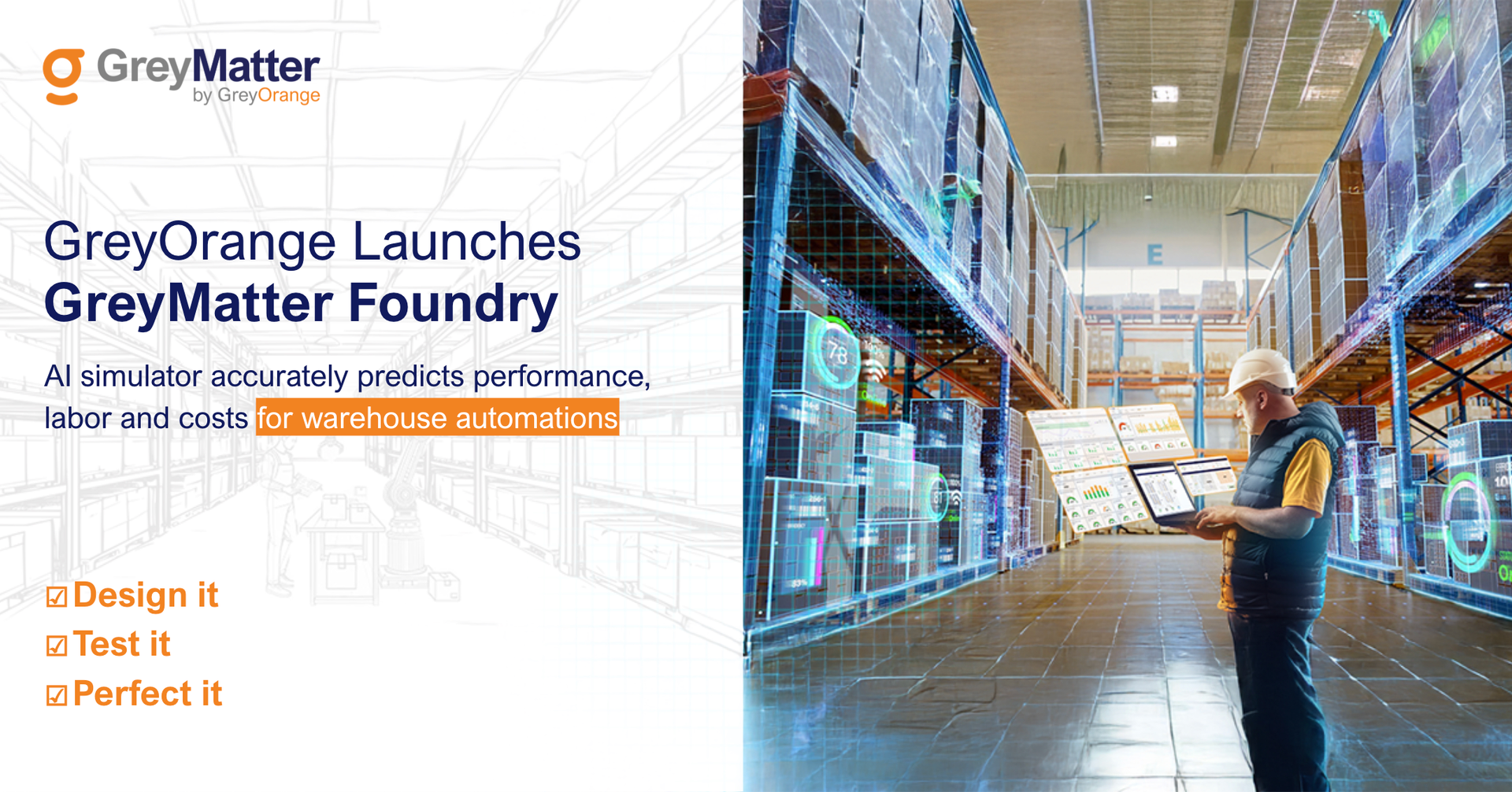
GreyOrange, supplier of AI-powered multi-agent warehouse orchestration and execution and store inventory software, has announced the launch of ‘GreyMatter Foundry’, an immersive AI simulator designed to unify warehouse flow design, technology sizing, and layout planning into a single, high-fidelity environment.

With GreyMatter Foundry, customers, systems integrators and in-house fulfillment teams can model complex automation scenarios to predict total system performance, estimate build-out costs, and visualize harmonious wall-to-wall orchestration before deploying a single dollar of capital.

Bridging the Gap Between Design and Reality

GreyMatter Foundry meets the growing need for AI tools that can manage complex, heterogeneous warehouse environments comprising fleets of robots from different vendors, other forms of automation as well as human associates. It is already deployed across thousands of warehouses. It is the ‘brain’ orchestrating a collective fleet of over 130,000 agents from GreyOrange’s Certified Ranger Network, making 250,000 trips per day and over 1 million optimizations per minute. With the addition of Foundry, supply chain leaders can now harness this unparalleled dataset to generate high-quality, accurate, wall-to-wall simulations for any design permutation in a matter of hours rather than weeks.

Key Features:
● Unlimited Heterogeneous Simulations: Unlike traditional toolsets, Foundry allows users to model unlimited robotic agent types and human-led processes simultaneously. Users can custom-specify robotic agents already in their fleet or those currently in production.
● AI-Powered Design Copilot: Using a simple conversational prompt or pre-set templates, users can intuitively guide the simulation. The AI Copilot helps tailor recommendations to specific throughput requirements without bias toward any specific robotic hardware.
● The CRN Advantage: While Foundry is vendor-agnostic, it delivers the highest-fidelity accuracy when simulating agents within the GreyOrange Certified Ranger Network (CRN). By drawing from over 1 million optimizations per minute performed by the CRN, Foundry provides unparalleled predictive reliability.
● Future-Proofing for 5- and 10-Year Horizons: Foundry comes equipped with pre-set scenarios for future growth, analyzing which combination of robotic agents and labor will meet demand cycles five to ten years down the road.

Foundry can be used to:
● Simulate the impact of labour challenges, plan staffing, or adapt day-to-day operations for any peak periods such as Black Friday
● Predict storage requirements and adapt workflows for seasonal SKU additions
● Model different layouts and flows to achieve specific throughput goals or financial efficiencies
● See 3D visualizations, walkthroughs, and ROI calculations for the entire warehouse
● Run multiple simulations in parallel, exploring thousands of potential outcomes to predict performance and costs with 95% accuracy or greater, even in the most complex heterogeneous automation environments both with the current rate of material flow and as the business expands

“Warehouse automation should not be a leap of faith,” said Saurabh Gupta, CTO for GreyOrange. “By putting the intelligence of our live, global GreyMatter network behind every simulation, we give distributors, 3PL’s, retailers and integrators a crystal ball grounded in real-world data. Whether you’re designing from a greenfield scenario or rethinking an existing operation, Foundry lets you test thousands of scenarios, stress-test for peak demand, and arrive at deployment day with confidence.”

PODCAST: Fulfilment at Speed and Scale

In the latest Logistics Business Conversations, host Paul Hamblin sits down with Russell Holmes of AutoStore to explore one of the biggest challenges facing modern logistics: how to achieve higher throughput without expanding your warehouse footprint.

From e-commerce fulfilment to grocery micro-fulfilment, the conversation reveals what “high throughput” really looks like in practice-think 10,000+ line presentations per hour, and in some advanced operations, far beyond that. Holmes explains how automation can deliver 5x productivity gains over manual picking, while also improving efficiency, accuracy and operator experience.

The episode also dives into the realities of investment decisions in uncertain times. Why are more businesses moving away from long-term, high-risk automation projects in favour of phased, scalable approaches? And how can software innovation-rather than new hardware—unlock significant performance gains, including faster pick times and increased output?

There’s also a look ahead at what’s next for warehouse automation, from AI-driven optimisation to increasingly hybrid, interconnected systems.

If you’re looking to increase capacity, maximise space, and future-proof your operation, this episode is packed with insight.

Listen now via the embedded player below.

Multimodal Services in the Spotlight

As global supply chains face mounting pressure from geopolitical uncertainty, shifting trade flows and rising customer expectations, logistics providers are increasingly being called upon to deliver more integrated, flexible solutions. The ability to combine multiple transport modes under a single, coordinated strategy is becoming a key differentiator, particularly for businesses moving complex or time-sensitive cargo across international markets.

Against this backdrop, multimodal logistics and 4PL models are gaining traction, enabling companies to streamline operations, improve visibility and reduce inefficiencies across the end-to-end supply chain. For operators with both global reach and in-house capabilities, this approach offers a way to balance control with adaptability.

Logistics Business spoke with a spokesperson from Spain-based logistics operator and shipowner Suardiaz Group to understand how the company is evolving its multimodal capabilities to meet these changing demands.

With more than 75 years in the industry, Suardiaz has grown into a global operator offering a wide range of services across maritime, air, rail and road transport, alongside customs, project cargo, warehousing and chartering. Backed by more than 1,000 employees and over over 30 offices across Europe, Africa and the Americas (Spain, France, UK, Morocco, Mexico, Peru, Dominican Republic), the company supports international operations through a combination of in-house expertise and a worldwide partner network.

A key focus for the group is door-to-door multimodal transport. As the spokesperson explained, this model places responsibility for the entire shipment, from origin to final destination, under a single operator, even when multiple transport modes are involved. By coordinating road, sea, air and rail movements within one contract, the company is able to offer customers greater visibility and control. “We provide this service globally,” they said.

coordinating international networks and partners to ensure seamless, efficient, and fully integrated transport solutions worldwide.

Suardiaz has also developed its role as a fourth-party logistics provider, combining brokerage with owned assets. While ocean and air freight are managed through strategic partnerships, the company retains direct control over its road fleet and a substantial warehousing footprint of more than 150,000 square metres. This hybrid approach allows it to balance flexibility with operational oversight across the supply chain.

The discussion also highlighted the group’s experience in project cargo, particularly in the renewable energy sector. Handling large, heavy components such as power transformers requires careful planning at every stage. According to the spokesperson, a detailed understanding of dimensions, weight distribution and handling requirements is essential, with transport drawings playing a critical role in ensuring safe loading, movement and installation, especially where the centre of gravity is offset.

Suardiaz works across a broad mix of industries, supporting businesses ranging from smaller enterprises to global manufacturers. Automotive, food and perishables, retail and renewable energy stand out as key sectors, although the company is equally active in infrastructure and industrial projects where tailored logistics solutions are essential. Flexibility, the spokesperson noted, is central to meeting these varied demands while maintaining efficiency and reliability.

When it comes to route planning, the company takes a consultative approach. While international sea and air corridors are well established, the emphasis is on selecting the right partners and combining transport modes in the most effective way. By doing so, Suardiaz aims to optimise both cost and transit time, ensuring each logistics operation is completed as efficiently as possible.

As supply chains continue to evolve, the company’s integrated model reflects a broader industry shift towards end-to-end logistics solutions that prioritise resilience, efficiency and global connectivity.

Subscribe

Get notified about New Episodes of our Podcast, New Magazine Issues and stay updated with our Weekly Newsletter.