


Artificial intelligence is moving from experimentation towards operational deployment in warehousing, according to Gartner, which has identified four AI trends set to transform warehouse operations.
Gartner says three forces are driving the shift: ongoing labour constraints, changes in capital models that provide lower-risk entry points for automation, and the increasing operational maturity of AI and autonomous technologies.
The four trends span different levels of AI maturity and application, ranging from enhanced optimisation through to physical AI agents capable of carrying out warehouse tasks.
Enhanced optimisation
The first trend is the evolution of traditional AI-based optimisation. Rather than relying primarily on rules and statistical models, newer systems can work with richer real-time data and more sophisticated algorithms.
Applications such as demand forecasting, labour planning, route optimisation and inventory management can continuously adapt to changing warehouse conditions.
The aim is to improve resource utilisation and operational performance while retaining the transparency and repeatability that have made traditional AI useful in warehouse environments.
Generative AI moves into operations
Gartner’s second trend is operational-driven generative AI, which uses machine learning models to turn unstructured and semi-structured data into operational content, plans and insights.
Potential applications include dynamically generated standard operating procedures, work instructions, exception-handling protocols and decision-support tools.
Rather than existing as a separate layer, these capabilities can be embedded directly into warehouse processes to support faster decision making.
AI agents keep humans in the loop
Suggestive and semiautonomous agents sit between manual operations and full autonomy.
These systems analyse operational data and can recommend or partially execute multistep workflows while maintaining human oversight. Gartner highlights applications including task assignment, exception handling, resource allocation and operational responsiveness.
This approach allows warehouses to introduce greater automation without immediately handing complete control of operational decisions to AI systems.
Physical AI takes action
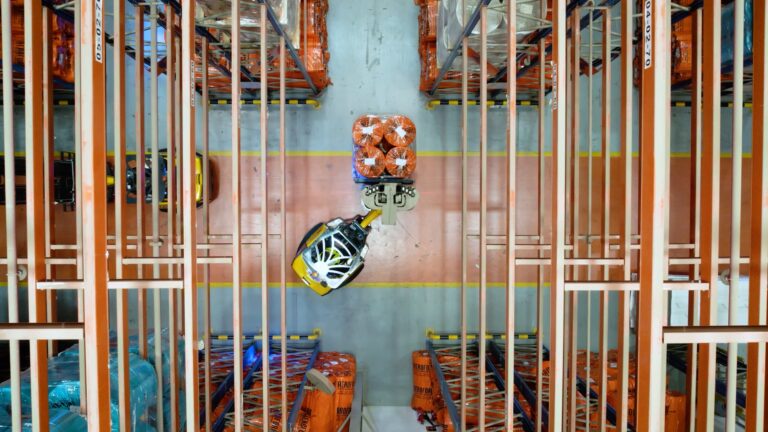
The fourth trend brings AI into the physical warehouse through the combination of artificial intelligence, robotics and advanced sensing technologies.
Physical AI agents can perform activities including picking, packing, sorting and material handling. Gartner says these systems can improve throughput and consistency while also supporting workplace safety and addressing persistent labour constraints.
Gartner advises supply chain leaders to take a pragmatic approach, beginning with proven applications such as labour forecasting and slotting before expanding into generative AI and agent-based systems.
Maintaining human oversight while evaluating new applications will remain important as AI moves further into day-to-day warehouse operations.