
Hyster delivers hydrogen ReachStacker to UK port

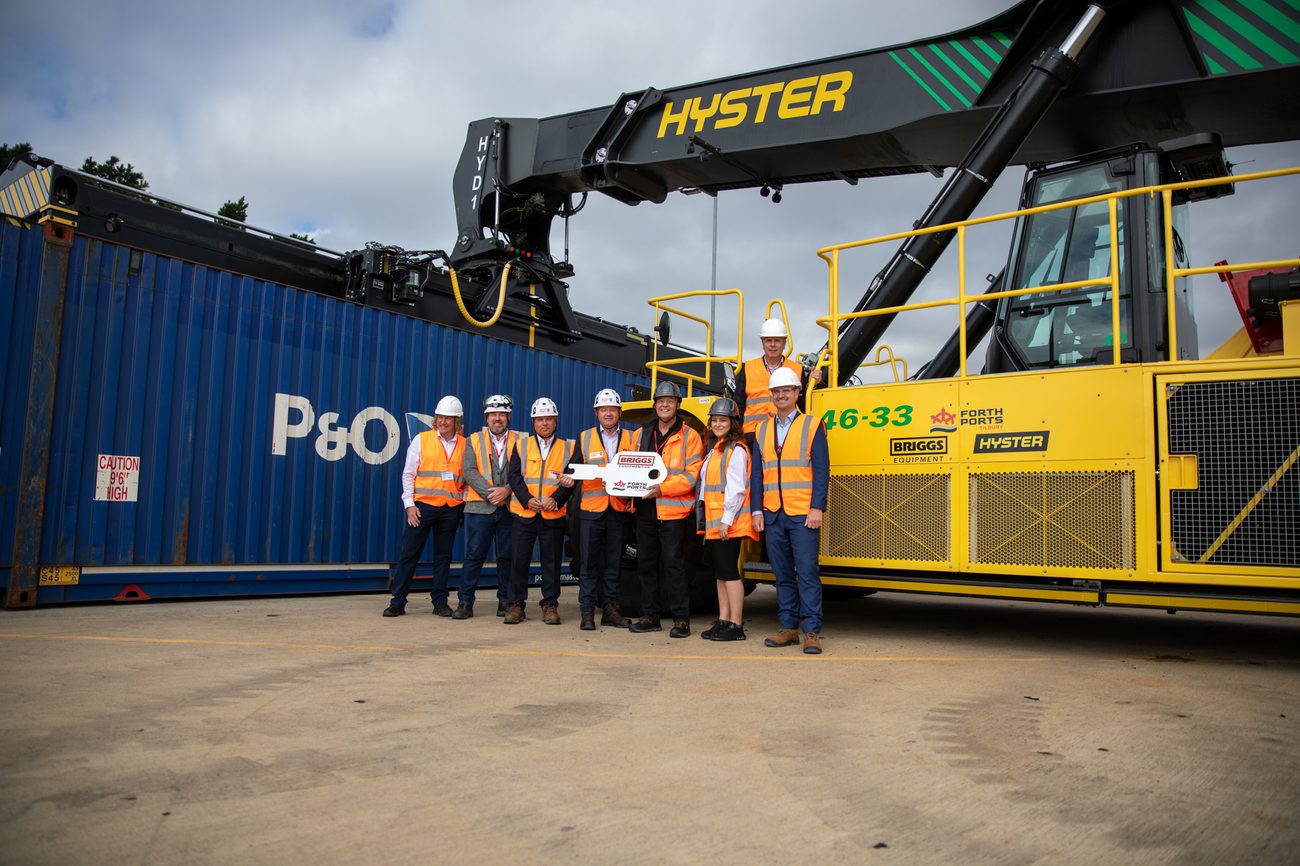
The UK’s first hydrogen fuel cell-powered ReachStacker has entered operational service at the Port of Tilbury in Essex, marking a step forward in the use of hydrogen for heavy-duty container handling.

Hyster has delivered the machine in partnership with local dealer Briggs Equipment UK. The pre-production ReachStacker will operate on green hydrogen produced on site, allowing the Port of Tilbury to trial hydrogen fuel cell technology in demanding port operations.

David Housden, Head of Engineering & Procurement at the Port of Tilbury, said:

“Today is an important milestone in the history of the Port of Tilbury as we welcome the UK’s first hydrogen fuel cell ReachStacker into our busy container operations. We are now delivering 100% green hydrogen-powered heavy lifting capability for our customers.”

The machine is expected to reduce the port’s carbon footprint by more than 107,000kg of CO2 per year, based on the diesel consumption of an equivalent machine.

Built for a full shift

The ReachStacker uses a 60kW Nuvera fuel cell engine to generate electricity, supported by a 130kWh lithium-ion battery.

Its high-pressure hydrogen tanks hold 32kg of fuel, providing the capacity to operate across a full 12-hour shift. Refuelling takes less than 30 minutes.

The fuel cell system has been developed using experience from previous pilot projects, including Hyster’s ReachStacker trial in Valencia, which concluded last year. Hyster says the system has been optimised and right-sized for the application.

“While eliminating tailpipe emissions has been the core driver of this pioneering collaboration, it was also critical to develop a solution that was up to the job and delivers performance and toughness comparable to an ICE-powered machine”

said Lucien Robroek, President of Global Big Trucks at Hyster.

The machine also incorporates Hyster’s standard software architecture used across its electric products.
Hydrogen for heavy-duty handling

For the Port of Tilbury, the project is intended to demonstrate whether hydrogen can provide the combination of zero tailpipe emissions, productivity and operational resilience required for intensive container handling.

The port is part of the Forth Ports Group, which has a target of achieving net zero greenhouse gas emissions by 2042.

“This pre-production trial marks a landmark moment for our business as we introduce leading alternative clean energy solutions into our port operations,” added Housden. “The project is supported by on-site green hydrogen production, supply, and refuelling infrastructure from GeoPura.”

Green hydrogen for the ReachStacker will be produced using an electrolyser supplied by GeoPura, with on-site production, supply and refuelling infrastructure supporting the project.

Briggs Equipment will provide frontline service and maintenance, while Hyster will provide specialist technical support for the fuel cell and high-voltage systems.

Mike Parkin, Ports and Big Truck Director at Briggs Equipment UK, said:

“We are thrilled to be part of this milestone and to welcome the UK’s first hydrogen fuel cell ReachStacker to the Port of Tilbury. This innovative hydrogen project shows what is possible when sustainability and innovation combine.”

The project follows two years of collaboration between the Port of Tilbury, Hyster and Briggs Equipment, with the partners now evaluating hydrogen technology under real operating conditions.

Gartner identifies four AI trends reshaping warehouses

Artificial intelligence is moving from experimentation towards operational deployment in warehousing, according to Gartner, which has identified four AI trends set to transform warehouse operations.

Gartner says three forces are driving the shift: ongoing labour constraints, changes in capital models that provide lower-risk entry points for automation, and the increasing operational maturity of AI and autonomous technologies.

The four trends span different levels of AI maturity and application, ranging from enhanced optimisation through to physical AI agents capable of carrying out warehouse tasks.

Enhanced optimisation

The first trend is the evolution of traditional AI-based optimisation. Rather than relying primarily on rules and statistical models, newer systems can work with richer real-time data and more sophisticated algorithms.

Applications such as demand forecasting, labour planning, route optimisation and inventory management can continuously adapt to changing warehouse conditions.

The aim is to improve resource utilisation and operational performance while retaining the transparency and repeatability that have made traditional AI useful in warehouse environments.

Generative AI moves into operations

Gartner’s second trend is operational-driven generative AI, which uses machine learning models to turn unstructured and semi-structured data into operational content, plans and insights.

Potential applications include dynamically generated standard operating procedures, work instructions, exception-handling protocols and decision-support tools.

Rather than existing as a separate layer, these capabilities can be embedded directly into warehouse processes to support faster decision making.

AI agents keep humans in the loop

Suggestive and semiautonomous agents sit between manual operations and full autonomy.

These systems analyse operational data and can recommend or partially execute multistep workflows while maintaining human oversight. Gartner highlights applications including task assignment, exception handling, resource allocation and operational responsiveness.

This approach allows warehouses to introduce greater automation without immediately handing complete control of operational decisions to AI systems.

Physical AI takes action

The fourth trend brings AI into the physical warehouse through the combination of artificial intelligence, robotics and advanced sensing technologies.

Physical AI agents can perform activities including picking, packing, sorting and material handling. Gartner says these systems can improve throughput and consistency while also supporting workplace safety and addressing persistent labour constraints.

Gartner advises supply chain leaders to take a pragmatic approach, beginning with proven applications such as labour forecasting and slotting before expanding into generative AI and agent-based systems.

Maintaining human oversight while evaluating new applications will remain important as AI moves further into day-to-day warehouse operations.

Loadsmart launches Opendock in Brazil

Loadsmart is expanding its operations in Brazil and has launched its Opendock freight scheduling and yard management platform in the country at Intra-Log Expo South America in São Paulo.

The move brings a platform already used across international logistics operations to a market where truck waiting times and yard congestion remain significant challenges.

Opendock connects more than 4,000 warehouses and 230,000 carriers globally, processing more than 14 million appointments each year. The platform is designed to coordinate truck arrivals and departures, providing greater visibility across gatehouse, yard and dock operations.

Loadsmart says its US operations provide evidence of the potential impact. Between 2022 and 2024, operations using Opendock recorded a 62% reduction in wait times, a 31% increase in dock turnover and an 88% improvement in punctuality, according to company data. The number of contacts required to confirm appointments also fell by 45%.

From scheduling to yard visibility

Opendock combines dock scheduling with gatehouse and yard management, allowing logistics operators to manage vehicle movements and appointments through a single cloud-based platform.

The system is designed to replace fragmented processes based around emails, telephone calls and spreadsheets. These can make it difficult to coordinate arrivals, create congestion at the gatehouse and limit visibility of what is happening elsewhere in the yard.

The platform also includes SmartGate, Loadsmart’s AI-powered computer vision technology. Cameras automatically record vehicle arrivals and departures and link visual evidence to scheduled appointments.

Other functions include real-time asset tracking, yard layout configuration and two-way communication with drivers.

Loadsmart says the platform is designed for rapid implementation, allowing customers to introduce the technology without a lengthy deployment programme.

A focus on Brazilian operations

The company sees Brazil as a strategic market for its expansion in Latin America. Loadsmart was founded in 2014 by Ricardo Salgado and Felipe Capella and has established its business primarily in North America.

According to figures presented by Capella, average waiting times at large Brazilian logistics centres can reach 11 hours, compared with less than two hours in the US. He also cited logistics costs equivalent to around 15.5% of Brazilian GDP, compared with 8.8% in the US.

The company says Opendock is intended to help operators turn these operational bottlenecks into measurable improvements in productivity and service levels.

At Intra-Log, Loadsmart demonstrated the platform at Booth 807, with its sales and product teams available to discuss applications with manufacturers, warehouses, distribution centres, logistics operators, carriers and shippers.

The company is also using the event to establish its presence in the Brazilian logistics technology market as it expands its operations in the region.

Subscribe

Get notified about New Episodes of our Podcast, New Magazine Issues and stay updated with our Weekly Newsletter.