Real-time shipment visibility no longer has to be a luxury. A pallet leaves a warehouse in Europe, bound for a customer on another continent. For the next three weeks, nobody really knows where it is. The buyer calls the supplier, the supplier calls the forwarder, and the forwarder relays an estimate from a carrier’s system or multiple transporters. Everyone is working from second-hand, often outdated, information. Meanwhile, the customer’s production line may grind to a halt, with losses that can run into millions.
This is what the industry calls the ‘logistics black hole’: the stretch of an international journey where goods are physically moving but their status is invisible to the people who depend on them.
Where the black hole comes from
The problem is not a lack of data, but a lack of continuity. An international shipment passes through a supplier, a road haulier, a port, customs, a shipping line, a forwarder and a last-mile carrier. Each one runs its own tools and shares updates on its own schedule.
The status of a shipment is therefore declared rather than observed. It depends on someone scanning a document or updating a system. Every handover point is a place where information can be delayed, lost or never recorded. The consequences are familiar. A misrouted or stolen consignment is often only noticed on the expected delivery date, when it is too late to act. Damage or temperature excursions cannot be attributed to a specific leg of the journey, which complicates insurance claims. And because transit times are uncertain, buyers hold extra safety stock, which ties up capital.
Why GPS never closed the gap
GPS trackers have been used for years on containers, trailers and high-value cargo. But they were designed for assets, not everyday shipments. A conventional GPS device needs a large battery, which adds weight and bulk, and it is expensive enough that it must be recovered at destination and sent back for reuse, creating a reverse logistics flow of its own. For a company shipping a hundred pallets of mid-value goods a month, the numbers rarely add up. Most freight still travels without direct visibility.
A lighter model of tracking
What is changing is the economics. Single-use Bluetooth Low Energy (BLE) trackers weigh a few grams and cost around a tenth of a typical GPS unit. Instead of carrying satellite and cellular hardware, they are detected by any surrounding smartphone, IoT gateways and networks along the route, which relay their position to a cloud platform.
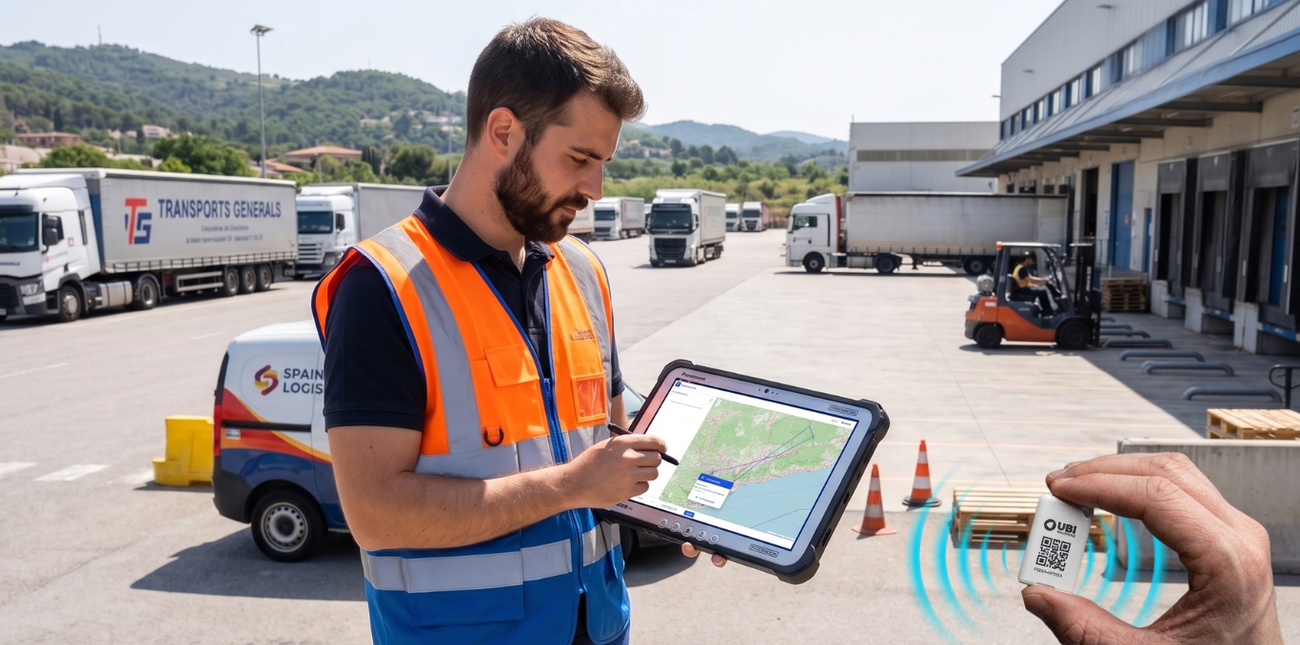
This is the approach UBI Solutions has taken with UBI Shipping Track. A tracker is attached to a carton or pallet in seconds and linked to an order by scanning a code. Because it is disposable and costs a few euros, there is no return flow to manage. Optional sensors record temperature, shocks or openings, and alerts flag a prolonged stop or route deviation while the shipment is still in transit.
Sharing visibility, not just collecting it
The most significant shift is in how information is shared. Rather than asking each partner to update a status, the shipper generates a secure web link, called UBI Tracklink, and sends it to the customer, forwarder or receiving site. Anyone with the link sees the live position of the shipment, without creating an account and without any operator entering data. The information comes from the goods themselves, not from a chain of intermediaries.
BLE tracking does not replace GPS everywhere. For very high-value cargo, or routes with poor network coverage or low smartphone density, a dedicated GPS device may remain the better choice. But for the large volume of regular, mid-value shipments that have so far travelled blind, low-cost tracking makes continuous visibility a realistic default rather than an exception.