How to Survive Packaging’s Peak Season

For ecommerce businesses facing the all-important Christmas peak, the combination of high demand, huge product variability and acute time constraints can create a packaging nightmare. Chris More, UK Sales Director at Packsize, suggests a simple way of securing process resilience.

The dedicated Christmas TV channels are listing on Freeview, so it’s time to check how prepared you are for the festive season peak. For many ecommerce businesses the ‘golden quarter’, up to and through Christmas and New Year, represents a disproportionate share of business revenue and, if handled effectively, profit too. But this comes with many challenges, many of which reveal themselves within the despatch packing operation.

Variability is the enemy of fulfilment efficiency, and the festive season has this in spades. Not only is the required throughput greatly elevated, and meeting delivery date promises more critical than ever, but there is often a much greater range of goods being handled – some only seen at this time of year. Even year-round staples may be presented by the manufacturers in seasonal product packs of novel size and shape. Many more orders will be for multiple, apparently random, lines which need to be consolidated and despatched together, and no two orders are alike.

Meanwhile, the operational constraints of fulfilment are mounting: labour availability remains poor and its associated costs are increasing significantly, rising diesel prices are heavily impacting transport prices – which are typically based on ‘volumetric weight’, so size matters – and packaging materials aren’t getting any cheaper, and are increasingly regulated. What’s more, with regards packaging waste, consumers do not welcome excesses of cardboard and bubble wrap when the next recycling bin collection may not be until the New Year.

Throwing casual or temporary labour at the problem, training them to select the right carton or how to manually form boxes, insert void fill properly, and so on, is costly, time consuming, and introduces more variability and rework – even if you can get the labour. Reliability and performance at this sensitive time is critical, failure to deliver on-time in the all-important Christmas peak can do significant harm to customer sentiment, repeat business and ultimately, overall profitability.

So how do you ensure process resilience at peak, without breaking the bank or eroding margin? The solution to the packing problem, the boxing bottleneck, lies in automation. But not all forms of transit-boxing solutions deliver the versatility, scale and exacting size requirements needed to cope with highly variable product shapes and order quantities. An oversized box is fundamentally wasteful. ‘Right-sizing’ each box for every order makes the most sense – saving on materials, transit volumes and packaging waste. And doing this at immense speed, with high reliability – backed-up by a 24/7 service hotline – is the key to building process resilience at peak.

Automated packing solutions from Packsize can create boxes ‘right-sized’ for each individual order, to be filled manually or erected around each selection of goods, closed, sealed and labelled fully automatically ready for despatch. Packsize customers experience an average 40% reduction in box size.

Automated ‘right-size’ packing systems address many of the challenges of peak. They dramatically reduce labour requirements, often replacing up to 20 manual packing stations, and eliminate the issue staff face in recognising what size and shape of carton is appropriate, and how to fill it efficiently.

Ending reliance on ‘briefly-trained’ casual staff greatly reduces product damage, both in the packaging process and later in transit. Also, the need to procure and store a wide range of preforms or erected boxes is eliminated, freeing up space and funds. ‘Right sizing’ yields significant economies in use of corrugate, up to 30%, while all but eliminating void fill – often bubble wrap, so there are environmental and consumer satisfaction gains as well.

Critically for peak season, automation converts a highly variable set of operations into one which can be predicted and planned, so that pick rates, movements, staff allocation and other factors can be optimised to meet demanding fulfilment requirements. New products with different optimal package shapes and sizes are readily accommodated from existing material stock, offering maximum flexibility.

Of course, not all businesses need high-speed, high-volume throughput. Right-sizing solutions are available for all businesses, large or small, with varying levels of automation, capacity and throughput.

But it’s worth remembering, automated packing stations aren’t just for Christmas. Even off-peak, savings in material inventory and usage, transport, and labour provide a solid RoI case. Automation can be integrated with warehouse management/control systems, conveying, sortation and picking processes, bringing structure and consistency to an otherwise variable and unpredictable environment.

Automated ‘right-size’ boxing technology offers the flexibility, speed and reliability to secure process resilience throughout the busiest peaks – and, of course, the rest of the year too.

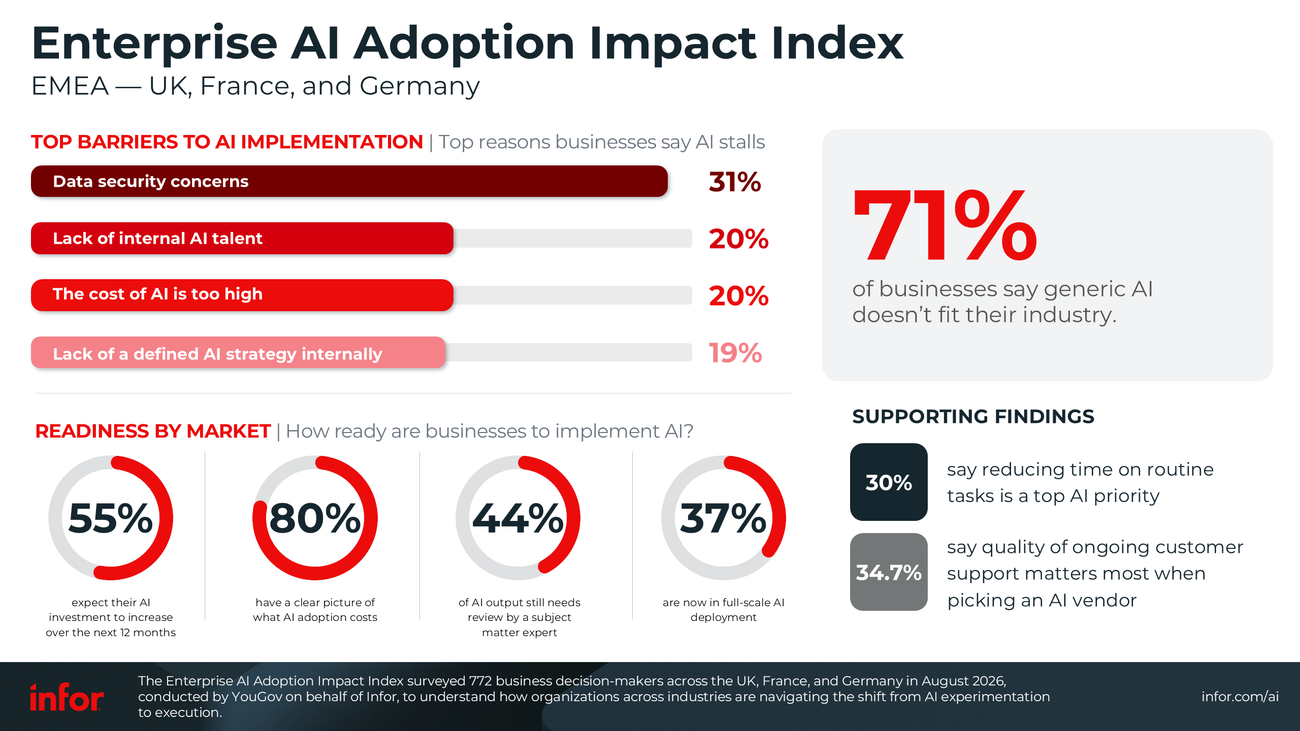
Opportunity for Better AI Adoption

The UK is lagging behind on AI, but it’s an opportunity for better adoption, writes Mark Hughes, VP Sales & Country Manager UK & Ireland, Infor.

We’ve just finished the second wave of Infor’s Enterprise AI Adoption Impact Index, our global survey of senior business leaders and AI decision-makers. This wave polled over 2,100 of them across seven countries – and the results stopped me in my tracks.
Of the seven major markets we surveyed (Australia, France, Germany, Japan, United Kingdom, United States of America, Singapore) the UK sits at or near the bottom on almost every measure that matters: how much return businesses are getting from AI, how much oversight it still needs, and how confident and comfortable they are running it.

Line up all the questions and the picture remains: the UK comes bottom in three and second bottom in eight more, finishing above only Japan. However, it’s not necessarily a verdict on UK business’ capacity to embrace the AI age, indeed it is far from it – the appetite is there. Rather it ought to be seen as an opportunity for better adoption of AI: addressing the demand for tailored, industry-specific tools that Infor provides, rather than generic (or ‘off-the-shelf’) tools which are burdening businesses with the workload of adoption to generic models, which impacts their ability to get on with the business of business and leaves them falling behind a market that is not slowing down in the slightest.

The UK is lagging behind. Let’s start with the headline figures – UK businesses using AI report an average efficiency gain of 23% over the past year. That’s the lowest of the seven markets we surveyed, against an average of 34% across the other six. The UK also reports needing more human review of what their AI produces – 53% in the UK, with the US next at 49%. This echoes our global findings of our first survey (published in April), but four months on, and across three more markets, it’s most acute in the UK.

Confidence in – and comfort with – AI tells a similar story. Since April, confidence in managing AI rollout without disrupting operations has fallen from 75% to 66%. Comfort with autonomous agents handling routine-to-critical processes has fallen from 11.7% to 6.3% (a 5.4pt drop). That decline in comfort matters as much as the return figures: it’s a sign that UK businesses want AI that stays accountable to the people running it, not just AI that moves fast.

UK full-scale AI deployment alone rose from 21.8% to 23.6% since April, and broader partial deployment lifts the total running AI in some form above 60%.

UK businesses aren’t short on ambition, they’re short on AI which is actually suitable for what they do. Off-the-shelf often doesn’t cut it. The ability to combine technology, industry expertise and operational control will increasingly be what sets successful AI strategies apart – and Infor’s industry-specific solutions are designed to help close that gap

Appetite isn’t the problem. Execution is. UK business hasn’t gone cold on AI – half of business plan to increase their AI investment further over the next 12 months. It’s the same ambition to execution gap we highlighted in April’s publication – it hasn’t closed yet. Meanwhile, ask what businesses want from AI and the picture is a practical one:

  • Cutting time spent on routine tasks (39%)
  • Operational costs (34%)
  • Automating workflows (26%)

Businesses seek solutions to day-to-day problems and frictions; they’re not chasing tomorrow’s hype. And today, generic off-the-shelf solutions aren’t meeting those needs, with 67% of respondents agreeing they don’t meet the specifics of their business or even industry.

Data, ownership and uncertainty

Beyond generic AI, there are broadly three issues sitting underneath the shortfall – data readiness, ownership, and uncertainty. All of which paint a picture of why UK businesses feel they are not seeing the returns from AI that they’re hoping for.

  • Data readiness: Only 62% of UK businesses agree their own data is mature and well-governed enough to support reliable AI – the second lowest of the seven markets, ahead of Japan only (and essentially unchanged since April). The US clears 74%, while the others are all above 80%. That’s a significant opportunity. Meanwhile, almost a quarter of UK business (24%) say that legacy or disconnected systems have driven higher integration and readiness costs, with 22% saying it’s slowed deployment.
  • Ownership: 14% of UK businesses (considerably above the global average) say that no single person is responsible for governing how AI is used, managing its risks, or ensuring it is compliant. Responsibility is instead split across the CEO, CIO, CTO or an AI committee – all with competing priorities and workflows. Singapore meanwhile is down at 3.5%.
  • Uncertainty: Uncertainty remains a concern with 28% of respondents pointing to compliance and regulatory concern. It’s a fast-moving picture and businesses don’t know how to best proceed.

More broadly (and perhaps unsurprisingly) there is a further divide for small UK businesses and larger ones in the UK with 40% of small UK businesses saying they have no AI deployment of any kind, against just 9% of large ones. When looking at large UK businesses, AI has delivered an average efficiency gain of 23% over the past year.

Why it matters

Infor has spent years working with UK businesses on this problem, and these findings corroborate what we have learned through these ongoing discussions – businesses aren’t asking whether to use AI, they’re asking what’s best to use, how to best use it, and, if they’ve already started their journey before engaging with Infor, why the “solution” provided by another vendor doesn’t actually fit their needs.

In our experience, generic AI, dropped into a specific business with specific processes, data, expertise and regulatory obligations, can deliver a smaller return and need more handholding before it can be used to any substantive effect. It can also undermine confidence.

With this, data, ownership, and uncertainty aren’t three separate problems. They’re just the same shortfall, showing up in three places. UK businesses can’t run AI on top of gaps that generic, one-size-fits-all tools were never built to close. This goes to demonstrate the value of purpose-built, industry-specific solutions – the solutions Infor provides customers. Rather than retrofitting generic software, Infor platforms are engineered around the precise operational processes that manufacturers, distributors, and retailers actually run.

Infor’s Velocity Suite is a great example. It’s an all-inclusive AI package built for specific industries, bringing an agentic layer, built on micro-vertical processes across manufacturing, distribution and service industries. This is also the direction the wider platform is heading. Infor’s Industry AI Agents – built around how an industry actually operates – are now generally available across CloudSuite, and our latest updates add AI Governance through Infor Governance, Risk & Compliance, designed so that agents can be registered, monitored and audited, and people stay accountable for the decisions that matter.

End of the ‘Logistics Black Hole’

Real-time shipment visibility no longer has to be a luxury. A pallet leaves a warehouse in Europe, bound for a customer on another continent. For the next three weeks, nobody really knows where it is. The buyer calls the supplier, the supplier calls the forwarder, and the forwarder relays an estimate from a carrier’s system or multiple transporters. Everyone is working from second-hand, often outdated, information. Meanwhile, the customer’s production line may grind to a halt, with losses that can run into millions.

This is what the industry calls the ‘logistics black hole’: the stretch of an international journey where goods are physically moving but their status is invisible to the people who depend on them.

Where the black hole comes from

The problem is not a lack of data, but a lack of continuity. An international shipment passes through a supplier, a road haulier, a port, customs, a shipping line, a forwarder and a last-mile carrier. Each one runs its own tools and shares updates on its own schedule.

The status of a shipment is therefore declared rather than observed. It depends on someone scanning a document or updating a system. Every handover point is a place where information can be delayed, lost or never recorded. The consequences are familiar. A misrouted or stolen consignment is often only noticed on the expected delivery date, when it is too late to act. Damage or temperature excursions cannot be attributed to a specific leg of the journey, which complicates insurance claims. And because transit times are uncertain, buyers hold extra safety stock, which ties up capital.

Why GPS never closed the gap

GPS trackers have been used for years on containers, trailers and high-value cargo. But they were designed for assets, not everyday shipments. A conventional GPS device needs a large battery, which adds weight and bulk, and it is expensive enough that it must be recovered at destination and sent back for reuse, creating a reverse logistics flow of its own. For a company shipping a hundred pallets of mid-value goods a month, the numbers rarely add up. Most freight still travels without direct visibility.

A lighter model of tracking

What is changing is the economics. Single-use Bluetooth Low Energy (BLE) trackers weigh a few grams and cost around a tenth of a typical GPS unit. Instead of carrying satellite and cellular hardware, they are detected by any surrounding smartphone, IoT gateways and networks along the route, which relay their position to a cloud platform.

This is the approach UBI Solutions has taken with UBI Shipping Track. A tracker is attached to a carton or pallet in seconds and linked to an order by scanning a code. Because it is disposable and costs a few euros, there is no return flow to manage. Optional sensors record temperature, shocks or openings, and alerts flag a prolonged stop or route deviation while the shipment is still in transit.

Sharing visibility, not just collecting it

The most significant shift is in how information is shared. Rather than asking each partner to update a status, the shipper generates a secure web link, called UBI Tracklink, and sends it to the customer, forwarder or receiving site. Anyone with the link sees the live position of the shipment, without creating an account and without any operator entering data. The information comes from the goods themselves, not from a chain of intermediaries.

BLE tracking does not replace GPS everywhere. For very high-value cargo, or routes with poor network coverage or low smartphone density, a dedicated GPS device may remain the better choice. But for the large volume of regular, mid-value shipments that have so far travelled blind, low-cost tracking makes continuous visibility a realistic default rather than an exception.

Could One Simple Packaging Change Save Your Business £200,000 a Year?

Think your packaging operation is already optimised? Think again. One business discovered it could save £200,000 every year without replacing its entire packaging system. So, how much money could your operation be wasting?

Packaging might seem like a relatively small part of the fulfilment process, but the true costs go far beyond cardboard boxes. Material waste, labour, storage, shipping charges and even customer returns can quietly eat into margins.

In the latest episode of Logistics Business Conversations, recorded at Parcel+Post Expo in London, host Paul Hamblin is joined by Victor Queiroz of CMC Packaging Automation to uncover the hidden costs of packaging and explain why simply producing smaller boxes isn’t necessarily the smartest solution.

A £200,000 Saving Hiding in Plain Sight

During the conversation, Queiroz shares a real-world example of a business that believed its automated packaging operation was already running efficiently.

However, a closer examination of its packaging data revealed an unexpected opportunity. By introducing an additional corrugated material width into its existing operation, the company could save approximately £200,000 in material costs annually.

And that’s just one example of the savings businesses could be overlooking.

The discussion explores how intelligent packaging automation can reduce waste, improve warehouse productivity and lower shipping costs, while also supporting increasingly demanding sustainability requirements.

Queiroz also explains why packaging needs to work seamlessly alongside warehouse automation, how businesses can avoid costly bottlenecks and what the rise of fully autonomous fulfilment could mean for the industry.

With some automated packaging investments targeting payback in as little as 12–18 months, the financial implications are difficult to ignore.

Could your packaging operation be costing far more than you realise? And what would it take to uncover those hidden savings?

Find out in the latest episode of Logistics Business Conversations.

Listen to the Full Episode Below

Subscribe

Get notified about New Episodes of our Podcast, New Magazine Issues and stay updated with our Weekly Newsletter.