

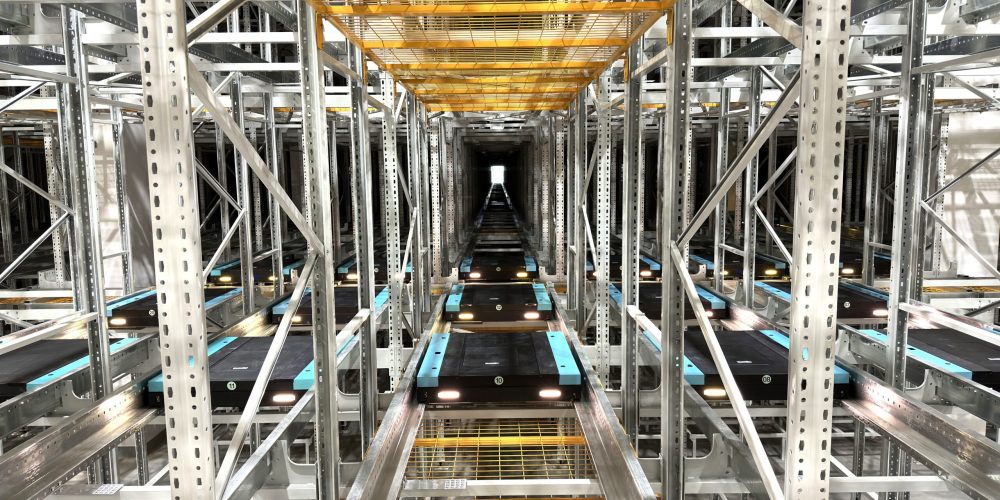
At LogiMAT 2026, pallet automation discussions increasingly reflected a maturing market. The focus is shifting away from labour replacement alone towards a wider set of operational priorities including space utilisation, energy efficiency, system safety, scalability and lifecycle serviceability.
Peter MacLeod spoke with Gianni Girolami of ZS Robotics at the Stuttgart exhibition, who highlighted how these factors are reshaping warehouse investment decisions across Europe, particularly in high-density pallet storage applications based on four-way shuttle systems.
Space efficiency is now the dominant driver
While labour availability remains relevant in markets such as the UK, Peter’s discussion highlighted that warehouse space constraints are becoming the primary automation driver in many European regions.
In major logistics corridors across the UK, Germany and Poland, rising land and building costs are pushing operators to prioritise storage density and cube utilisation. As a result, investment cases for pallet automation are increasingly built around throughput per square metre rather than workforce reduction alone.
Poland is a particularly strong growth market. Rapid e-commerce expansion, industrial development, and high demand for warehouse space around urban centres are accelerating adoption of compact automation systems. In some areas, flexible labour availability reduces immediate workforce pressure, which further elevates space efficiency and productivity as the key decision factors. This perspective is grounded in local market understanding, strengthened by our editor Peter’s direct familiarity with Poland, where he lives and closely follows the country’s industrial and logistics landscape.
Overall, pallet automation is increasingly being justified through a combination of higher density storage, improved scalability and reduced dependency on building expansion.
Safety and energy are increasingly influencing warehouse automation design.
Beyond space and labour, operators are focusing more closely on energy use and the trade-offs between crane-based systems and modular shuttle architectures, particularly around throughput, scalability, and uptime.
A notable engineering trend, reflected in solutions from ZS Robotics, is the return to mechanical fail-safe design. In multi-level shuttle environments, gravity-based locking mechanisms physically prevent shuttle movement unless lifts are correctly aligned, reducing reliance on sensors or software interlocks alone.
The same layered safety philosophy is extending to charging systems, where semi-enclosed, heat-triggered containment is helping manage thermal risks through independent physical protection.
Specialist shuttle suppliers are helping reshape the warehouse automation landscape.
ZS Robotics reflects a growing OEM trend: focusing on specialist four-way pallet shuttle hardware while relying on systems integrators for software, installation, compliance, and after-sales support. This separation of roles is enabling faster deployment, easier maintenance, and more modular warehouse solutions.
Application-specific engineering is also becoming a key differentiator. In cold chain environments, frost build-up can compromise traction and reliability, driving demand for enhanced shuttle designs such as multi-wheel configurations that improve grip in frozen storage. Heavy-load applications are also expanding, with pallet shuttle systems increasingly supporting payloads of up to 2.5 tonnes for industrial and high-throughput distribution use.
The next phase of competition is increasingly local as well as technical. ZS Robotics’ planned Netherlands base signals the growing importance of regional spare parts, service, and installation support as international suppliers compete in mature European automation markets.
More broadly, the sector is moving toward a model where specialist manufacturers drive advances in safety, density, modularity, and energy performance, while integrators concentrate on software orchestration and full-system delivery. For warehouse operators, these engineering fundamentals are becoming just as important as software capability in long-term investment decisions.