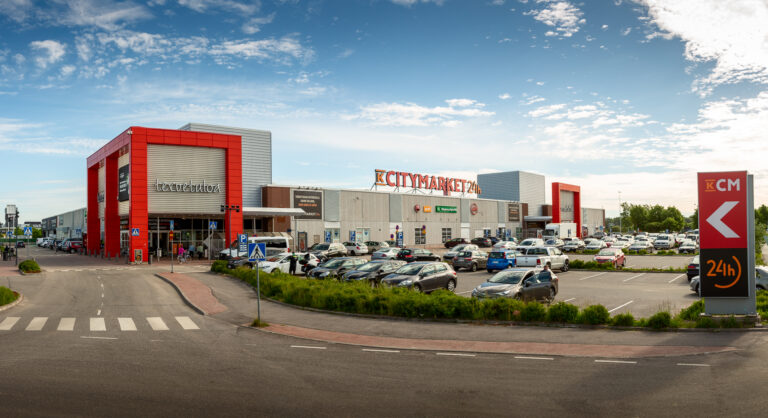


Having a unified platform of logistics software across supply chain operations could bring synergies. Manhattan Associates’ Exchange event in Milan was a gathering of users including ASDA, Bauhaus, CEVA Logistics and Nespresso looking for supply chain advantages, reports David Priestman.
Imagine a warehouse that solves problems before the manager notices? We’re in the agentic era, but it is also one of cyber risks, nearshoring, holding extra stock for resilience, thin margins and the need for cost-effective flexibility. Manhattan Associates have a well-earned reputation as a market leader in WMS, with an estimated 20% market share, but has broadened its suite in recent years, under the ‘Active’ name, with products for planning, order management, retail stores and transport management (TMS). These 5 come as a unified, cloud-native platform to orchestrate complex scenarios, called ‘Active Editions’, with ‘Essentials’, ‘Enterprise’ or ‘Enterprise Premier’ service levels.
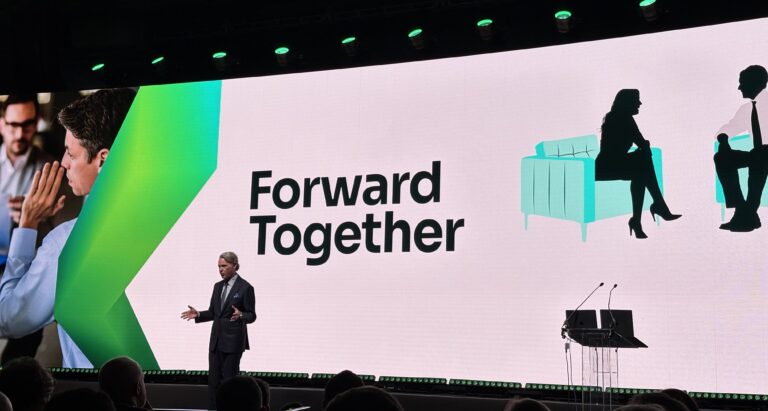
I asked Eric Clark (pictured, above), President & CEO, what emphasis he puts on these different products and how he seeks to position the firm. “The gap between us and our competitors is getting bigger,” he asserts. “We can show customers things they can’t see elsewhere. A less-siloed approach by customers helps us as we’re selling across all their processes.” Gartner estimates the logistics software sector will grow 15% p.a. and Clark is aiming for 20% growth for his company as there is a lot of addressable market to target, for example with small-medium sized users and cross-selling across the platform suite.
Pace of Deployment
Customers need fast ROI. “Our mantra is speed and simplicity,” Clark revealed. “While Manhattan has long been known for solving the biggest, most complex challenges in supply chain, if we don’t specifically focus on speed and simplicity our quarterly update releases just add complexity. So every new feature that we put in must help us deploy faster.” The target is to go-live in 100 days from signing.
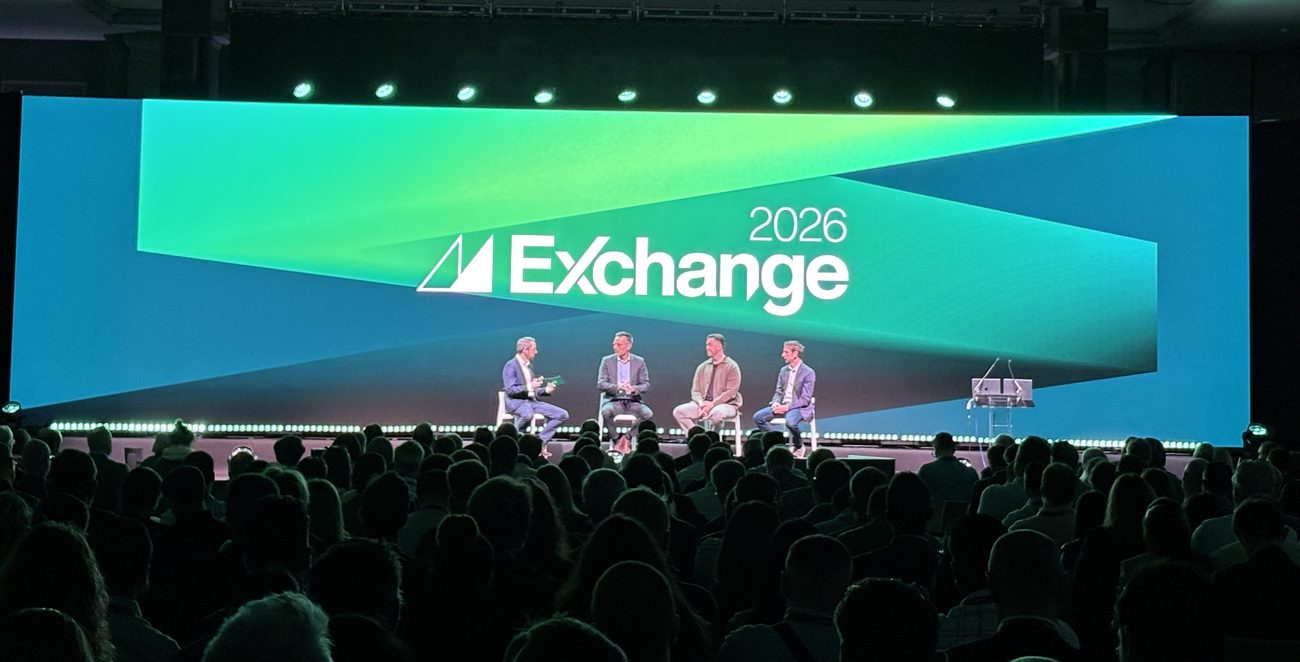
Manhattan used to just have one price-point, which was only affordable for larger, ‘blue-chip’ users. No more. The new ‘Essentials’ package is aimed at smaller and less-complicated supply chain needs. It runs on the same full product platform, but with limited features, appropriate to the company’s size, at a lower cost via a tiered subscription. Customers can vary the level of features they need. Chief Product Officer Brian Kinsella explained that, “the onus is on us to be consultative on that and study the value proposition to upgrade the offering quickly, when suitable. Our most engaged customers will come to us interested in adding new features, but they’re busy. We help them along the journey.”
Always Ahead
Does Clark see any acquisitions to further the company’s growth? “We’re always looking and paying attention to what’s on the market,” he told me. “We don’t need it and haven’t done lots, for a couple of reasons. One, we have a product footprint and have built a platform so buying other software suppliers isn’t necessary in order to grow at 20%. Two, we don’t want to take old code and re-write it for the cloud. Having this platform and sticking to it over the years enables us to move at a different pace when it comes to AI. If we acquired something we’d have to re-write it on our platform. We’re not going to bolt it on. For those reasons we’re focused on continuing to innovate on the platform that we have.”
Agentic AI going rogue has hit the headlines. How can it be stopped? “We use our own LLM harness,” says Sanjeev Siotia, Chief Technical Officer. “We control each API agents can access, just as for people, so it’s sandboxed completely. The AI cannot go outside pre-defined areas. They don’t have the ability to break the rules. Every action an agent does is through our APIs. It’s the same as humans have done, but faster. We’re designing software to calm the complexity.” Data must be strong. Manhattan can set the rules and guardrails, then let the AI autonomously orchestrate. However, “no model is going to replace instinct. We need human ingenuity,” Siotia reassures.
The message is not to bolt AI on, but build it into the core. Manhattan regenerates 75% of its 60 million lines of code every night. So the Active platform is effectively re-born each day. “We haven’t written code for 10 years, so its AI native,” Siotia informs. This simplifies the configuration and makes it consistent. “Otherwise, code will look like an archaeological site – layered to reveal when it was written.”
Cyber attacks on warehouses are a cause of anxiety for logistics teams. If one facility goes offline how would orders be fulfilled? Manhattan simulates the kinds of attacks that disrupt DCs and then provides various scenario planning for alternative fulfilment.
Get Active
Not every customer also uses Manhattan’s WMS. TMS, where the company has single-digit market share, has features including interactive insight. The transport planning agent works after shipment planning is done and there is also a scheduling agent and shipment tracking agent, all displayed within current dashboard screens to solve specific tasks rather than a Q&A chatbot. “The success we’ve had selling transportation to our warehouse customers far exceeded the success we’ve had before we had a unified platform in place, so the strategy works,” says Kinsella.
Back in the warehouse, Manhattan say that 100 new WMS customers have been onboarded in the last 12 months, most with multiple site go-lives. ‘Operational program monitors’ show where resolutions are needed and diagnose real-time analytics, such as labour management and dock assigning for outbound loading.
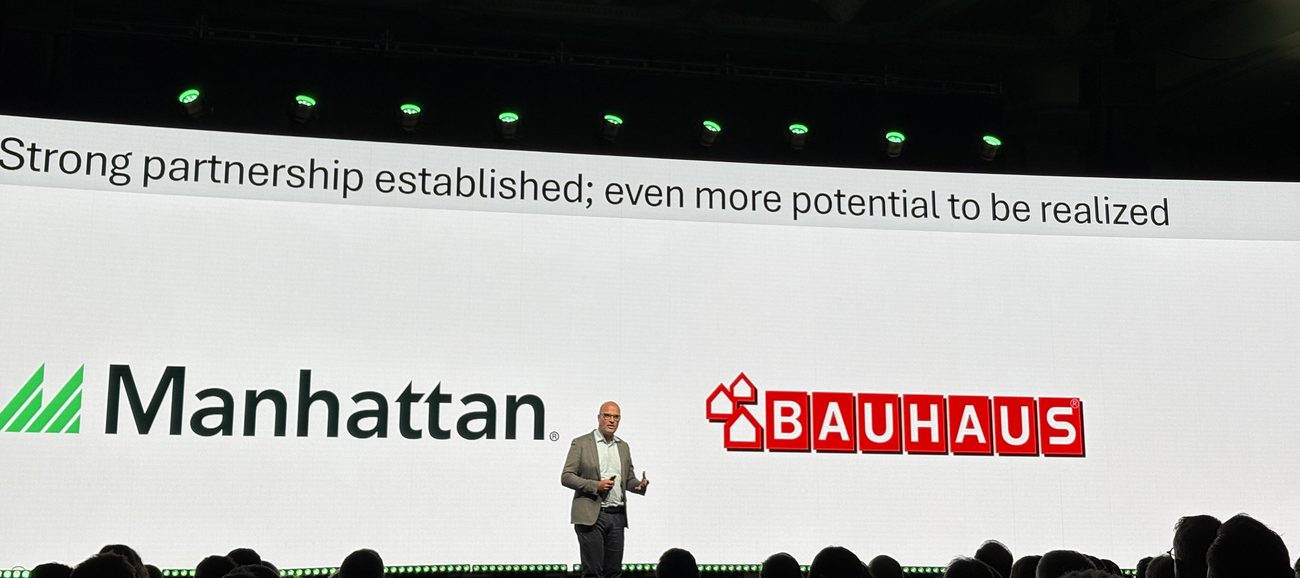
Four customer testimonial presentations added colour to the picture. Alex Yates (pictured, below), CEVA Logistics’ Head of Transformation, has committed to a strategic, ambitious programme to use Manhattan. With 11 million sq.m of DC space and 8000 warehouse staff the third party logistics giant needs a flexible template, with next generation software across all its facilities, modes of freight transport and vertical sectors. Having gorged on Gefco, Bollore, FM and FedEx Supply Chain in recent years CEVA has gone from multiple IT systems to one global system.

“What are the tools going to do in the future?” Yates needed to know from Manhattan. “We wanted a best-in-class WMS, which Manhattan is, reduce implementation times and reduce the variety of systems and processes.” Yates is now overseeing the introduction of physical AI and rolling-out AI agents. “Make them work across the system and then work with each other,” is the goal here. From insight to execution.
Brains of the System
Asda in the UK has 43 distribution centres. Its separation from Walmart required changing every IT system, front end and back end, including WMS. The supermarket chain chose Active, alongside ERP from SAP. This tumultuous changeover took place while the supply chain was fully operational, of course. Incidents (errors of some sort) have since fallen to below 500 per month on the WMS, with a 100,000 reduction in pedestrian trips in the DC. More optimisation and automation is the next phase, such as doing multi-store picks in one trolley, lean time replenishment and retail put wall batch picking. All this is to make life easier for the warehouse staff. Compared to under the Walmart ownership, Asda appreciate the flexibility of choosing their own configurations for better labour management.
Nespresso’s coffee supply chain goes from farm to cup. Beans come from 18 countries to three highly-automated plants in Switzerland. From there billions of capsules head to consumers in 80 countries, with 20 million deliveries daily. Manhattan’s Active was selected to solve four challenges: WISMO (where is my order) – the need for visibility; assurance – the promise of delivery; reliability – guaranteed delivery; and flexibility – where do consumers get their order from, store or ecommerce.
Manhattan is the brains of the system, according to Nespresso. 50% of all the empty aluminium capsules are recycled, either by postal collection (when a new delivery is made), at Nespresso stores or via local authority recycling centres. Problem solved.