DP World Aids Rory McIlroy’s Performance

DP World will manage the global logistics behind Rory’s mobile fitness and recovery environment, giving him a consistent space to train, prepare and recover wherever he competes across the season.

Rory McIlroy’s season takes him around the world, but his training and recovery environment doesn’t have to change with it. In a new multi-year global partnership announced today, DP World will take McIlroy’s personalised fitness and recovery environment from tournament to tournament, using its smart end-to-end global logistics network to give him and his team greater consistency wherever he competes.

At the heart of the partnership are two personalised fitness and recovery trailers that will travel with McIlroy across his PGA Tour and DP World Tour schedules. DP World will manage every stage of their journeys, from collection and customs clearance to storage and delivery, so everything McIlroy needs to train and recover is ready when he arrives at each tournament.

As part of the multi-year agreement, Mcllroy becomes a Global Ambassador for DP World, while the ports and logistics firm becomes his exclusive partner in logistics and supply chain globally.

One consistent performance environment

Elite performance depends on consistency. For a player competing across continents, that means being able to maintain the same training, treatment and recovery routine every week, whatever the time zone. The two trailers will give McIlroy and his team a familiar setup across his two principal touring schedules, while DP World manages the complex international movements behind the scenes throughout the season.

Each trailer is equipped with strength and cardio equipment, an infrared sauna, a cold plunge and a Hyperice recovery station, giving Rory and his team the facilities they need train and recover on site. Behind it all is the same challenge DP World solves for customers every day: connecting multiple stages of a journey, navigating borders and managing time-critical movements to ensure the right equipment arrives in the right place at the right time.

Rory McIlroy said:

When you’re competing around the world, consistency really matters. Having the same environment to train and recover in every week gives me and my team one less thing to think about and lets us focus on preparing and performing. DP World knows how to make that happen wherever I am playing. I am really excited to have DP World on the team as we continue to push the boundaries of performance together

Yuvraj Narayan (pictured above, with Rory), Group Chief Executive Officer, DP World, said: “Moving goods reliably across borders is what we do for customers in every corner of the world. Applying our global scale, network and logistics expertise to help Rory perform at his best is a natural fit, and a powerful way to show what a smart, end-to-end supply chain makes possible. It’s a groundbreaking partnership that sets a new standard for how a business can support an athlete’s performance. We’re proud to have him on our team.”

Moving something around the world reliably means managing far more than a journey from A to B. It means connecting transport, customs, storage and delivery against tight, fixed deadlines, while being ready to adapt when plans change. That’s what our teams do for customers every day, and it is what we will do for Rory throughout his season. I’m often asked what an integrated, end-to-end supply chain actually looks like. This is a great example of what that can make possible

Ganesh Raj, Global Chief Operating Officer, Marine Services, DP World

Transparency in Load Carrier Management

Loopario (formerly Logistikbude) is digitalizing load carrier management at the Fiege Group. The Dortmund-based tech company is initially introducing its Load Carrier Management System (LCMS) for the logistics service provider’s tyre racks. Fiege, which has a total of around 4.7 million load carriers in circulation, will thus gain an end-to-end digital representation of its processes as well as greater transparency on inventories, movements and costs. Following the successful completion of the first project phase, the solution is to be extended step by step to all load carriers from the second quarter of 2027.

“What convinced us was the holistic approach of the LCMS: Loopario covers the entire load carrier management process. Add to that the team’s proven expertise and the maturity of the solution,” says Oliver Hüttermann, Director Business Administration Transport at Fiege.

Connecting operational and commercial processes

At Fiege, large volumes of a wide variety of load carriers pass through numerous processes every day at a total of 131 sites in 15 countries. The range extends from Euro pallets, wire mesh boxes and H1 pallets to customer-specific special load carriers and racks for tyre logistics. Until now, the related information has been processed in different systems. Movement data from the transport management system is partly transferred automatically, while the monthly commercial valuation is still carried out separately. Going forward, Loopario’s LCMS will bring this information together and link operational load carrier movements with their financial valuation.

With Loopario, we can reliably determine inventories and costs, identify deviations early and manage processes in a targeted way – further professionalizing and expanding the range of services we offer our customers

explains Hüttermann.

In addition, processes are to become more standardized and recurring manual tasks are to be reduced. This frees up the teams for higher-value work. Because the partners involved are also integrated digitally, accounts can be reconciled more easily and discrepancies resolved more quickly. The company is pursuing three specific goals: First, Fiege wants to regularly and fully assess the commercial value of all pallet and load carrier movements, optimizing the profit and loss statement for its pallet operations with a holistic approach. Second, the level of automation is to increase – and third, the service offered to its own customers is to be expanded and further enhanced.

Zero tolerance for losses is firmly anchored in our corporate values. Loopario gives us the processes and data we need to live up to this standard

Starting with tyre racks

Back in November 2025, Fiege and Loopario launched a consulting project to examine the potential of the existing processes. Since the operational project launch in July 2026, the logistics service provider has been managing the tyre racks at all of its tire sites in Loopario, in parallel with the existing systems. Through the end of October 2026, the current processes are being captured, relevant information consolidated and workflows further standardized. Once this first phase is complete, the plan is to extend Loopario step by step to all other load carriers, based on an evaluation of the results achieved so far.

The two companies first came into contact through Fiege’s Ventures division: via F-LOG, the logistics service provider already holds a stake in Loopario. With the operational use of the LCMS, this relationship is now being extended to a concrete application at Fiege.

Markus Hüting, Principal at F-LOG, says:

We recognized Loopario’s potential early on, which is why we invested in the company through F-LOG. The fact that the technology is now also being used at Fiege itself underlines, in our view, how practical and mature the concept is

Rewiring Logistics for the AI Era

At the recent Trimble Insight event, Peter MacLeod heard that as AI advances, human oversight and trusted networks remain essential.

AI featured prominently in discussions about the future of freight transport at this year’s Trimble Insight event, formerly the Transporeon Summit, in Brussels. In an exclusive conversation with Logistics Business, Philipp Pfister, Sector Vice President at Transporeon, said the familiar challenges such as driver shortages, decarbonisation, and fragmented connectivity remain, alongside increasingly volatile markets. AI offers new ways to address them, he believes, but must deliver practical value rather than simply generate enthusiasm.

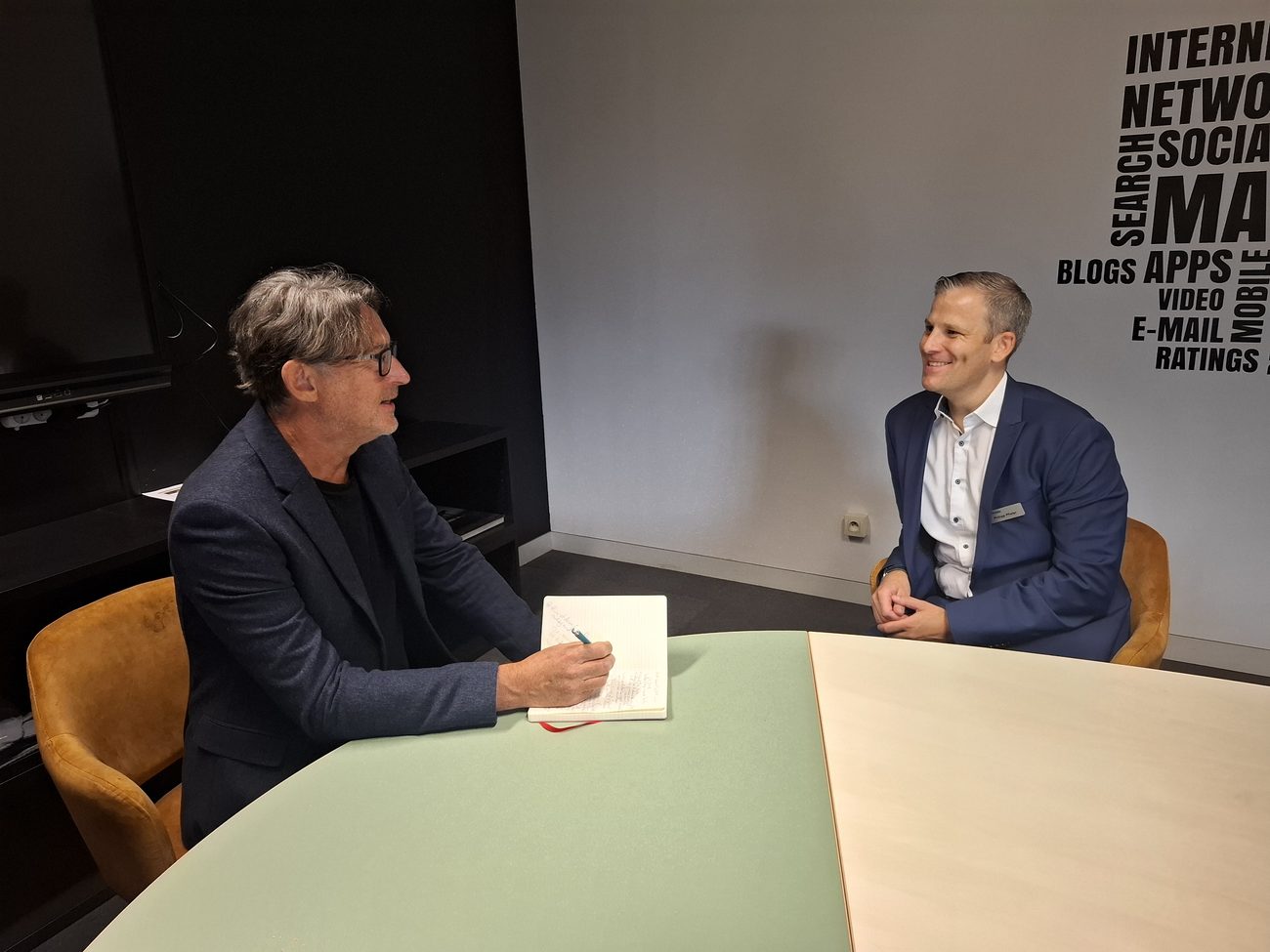
“We need to find the right angle to produce value through AI and also have the right boundaries around it,” Pfister told me in a quiet side-room away from the bustle of the main conference floor (see pic, below) at The Egg, which was once a goods warehouse in the centre of the city.

Practical Application

One of the key technologies discussed in Brussels was Trimble Arc, an AI solution designed to work with Transporeon’s existing products and help users carry out operational tasks. Rather than acting as a generic chatbot, it connects AI capabilities with the systems and information used in logistics. To me, this signals that agentic AI is has now become established a co-worker within existing operational frameworks.

Pfister describes Arc as a vertical AI solution that can interact with Transporeon’s software while retaining human oversight. Users can delegate tasks, with confirmation required before certain actions are taken – an important safeguard when an automated decision could commit a business to a freight rate or transport arrangement. I’m always banging on about keeping humans in the loop, and this technology puts them front and centre when needed, allowing intervention before AI executes a decision that looks right in the data but may not account for human factors.

“Safety is the biggest thing in our AI solution,” Pfister said, explaining that solutions undergo internal safety checks before reaching customers. Applications range from analysing freight markets to recommending procurement decisions and improving vehicle utilisation. He highlighted autonomous quotation, which enables carriers to respond to available loads, as one way AI can uncover opportunities that might otherwise be missed.

For smaller operators, the potential is significant. A carrier with a small office team may struggle to monitor spot markets while managing daily operations. An AI-powered digital colleague could take on some of this work, helping smaller businesses compete with the Big Boys. Autonomous procurement also allows buyers to set upper and lower pricing limits, helping avoid overpaying while reducing the risk of pushing carrier rates below sustainable levels. With margins under constant pressure, that balance matters.

Network Advantage

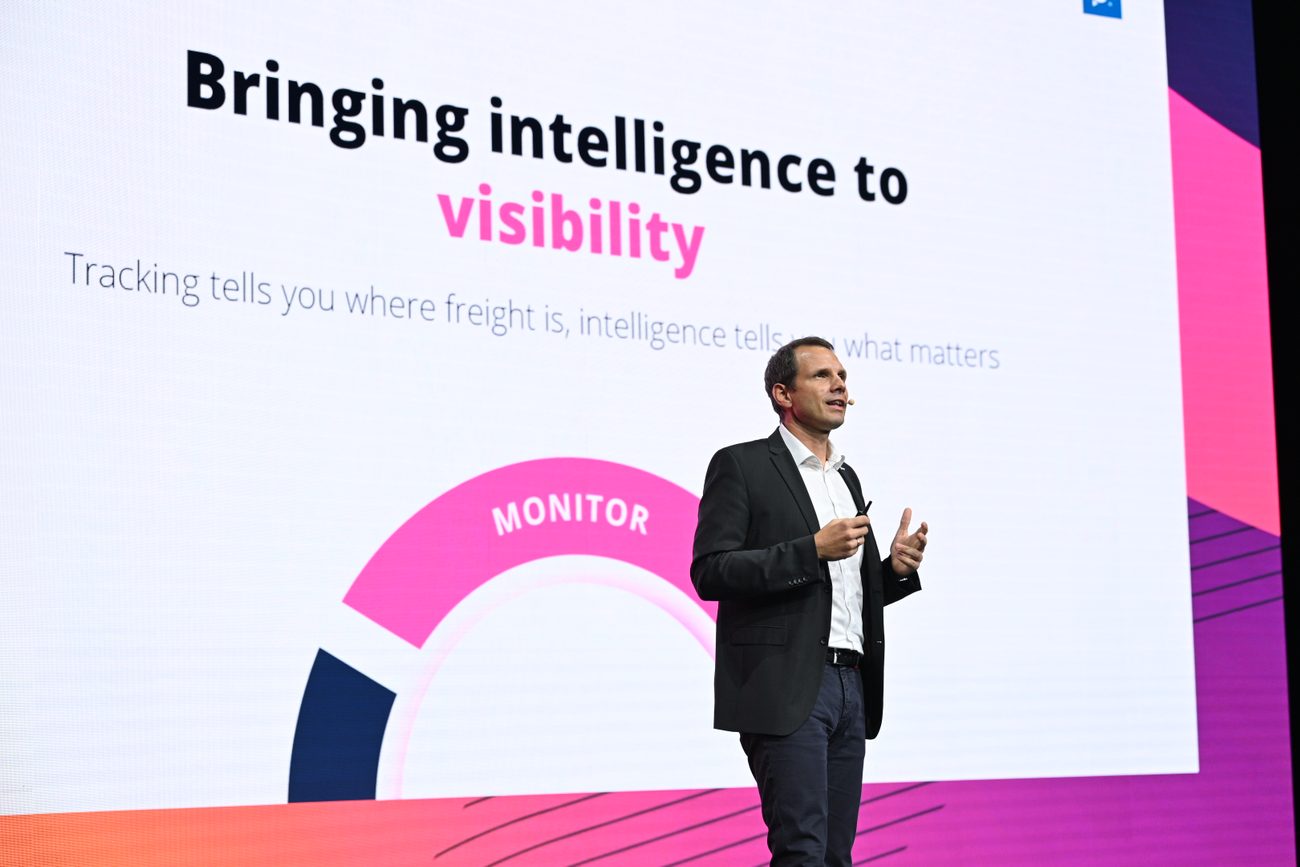
Bernhard Schmaldienst (pictured, below), Associate Vice President of Transporeon Products, said the next phase of AI will be less about isolated agents and more about connecting systems and coordinating work across them. He pointed to the administrative effort involved in transferring information between applications, updating systems from emails and reconciling data. AI agents could reduce this burden by working across connected platforms, rather than automating individual functions in isolation.

Disconnected AI tools risk recreating the silos that have long hindered logistics. The greater opportunity is to enable agents to work across an ecosystem of applications, data and business relationships.

Transporeon’s network provides a foundation, but digital maturity varies widely among its customers. Some are ready to introduce AI into core operations; others still need to connect systems and establish the digital foundations for more advanced applications. It is sometimes hard to believe that some operators still rely on Excel or pen and paper and have yet to embrace digitalisation. For Pfister, the AI journey therefore starts with digitisation for some businesses, while those further along can move towards greater automation.

Human Challenge

Trimble President and CEO Rob Painter offered a historical analogy in his keynote that I had not heard before in the context of AI. When electric motors replaced steam engines in factories, productivity did not immediately surge. Many businesses simply replaced the power source while keeping the same machinery, layouts and processes. The gains came when manufacturers redesigned their operations around the new technology.

Painter believes logistics faces a similar moment: adding AI to existing workflows may deliver limited improvements; greater benefits will come when businesses rethink how work is organised.

That is also a human challenge. Organisations must be prepared to change, experiment and learn while AI’s capabilities and limitations remain uncertain. This does not mean removing people from the equation. Pfister argues that automating repetitive tasks should allow logistics professionals to focus on work where judgement, relationships and problem-solving matter most.
Unexpected delays and changing commercial circumstances will still demand human intervention. Strong relationships between shippers and carriers remain valuable because not every problem can be resolved through software alone.

Sustainability Dividend

AI can also contribute to decarbonisation. Better planning and load optimisation can consolidate part-load consignments, improve vehicle utilisation and reduce unnecessary journeys. Pfister described combining loads that would otherwise require separate trucks as a straightforward way to cut costs and emissions. Such gains do not require every operation to adopt the latest AI agent; existing tools and established transport networks can also improve resource use.

The Summit’s message was pragmatic. Successful implementation depends on choosing the right applications, establishing safeguards and delivering measurable operational benefits – not simply pursuing ‘AI for AI’s sake’. For logistics, the reward is a more connected, responsive industry where automation handles routine work while people retain control of consequential decisions, helping businesses make better use of the capacity and information already available.

One Connected System Cuts Weekly Backorder

Infios has announced that Titan Brands, a $200 million-plus direct-to-consumer e-commerce and B2B retailer, has cut potential weekly sales lost to backorders by 64%, from $1 million to $360,000, after connecting Infios Order Management (OM), Warehouse Management (WM) and Transportation Management (TM) into a single operating system for fulfillment.

Running all three pillars together, rather than as separate systems patched together after the fact, Titan Brands has also lifted the in-stock rate across its top 100 products from 60% to 95%, improved warehouse pick rates by 133% and improved forecast accuracy from 65% to 70% — while doubling the pay of frontline warehouse workers and still reducing overall labor costs.

For an e-commerce and B2B retailer, an unavailable product is never just a missed order — it is a customer who may not come back. When a backorder hits, the sale is delayed or lost outright, creating a direct line between inventory visibility and revenue. Most retailers manage order, warehouse and transportation operations as separate systems that only compare notes after a problem has already reached the customer. Titan Brands took the opposite approach: connecting the three functions into one continuous flow of data and decisions, so inventory, cost and delivery information is known and acted on before the customer ever hits ‘checkout.’

Based in Memphis, Tennessee, Titan Brands operates four distribution centers across the U.S. and sells nearly 3,000 products across Titan Fitness, Titan Attachments and Ash & Ember Outdoors. Its portfolio includes fitness equipment, tractor and skid-steer attachments and outdoor gear, much of it heavy, bulky and irregular.

Before Infios, order management sat deep within the warehouse operation, making it difficult to see incoming inventory, understand shipping costs and delivery dates early enough to influence customer decisions. Teams relied on spreadsheets, tribal knowledge and manual coordination between order and shipping systems.

Intelligent supply chain execution in action

Titan Brands first implemented Infios OM and WM, moving order orchestration upstream so inventory availability, shipping costs and delivery estimates could be surfaced at checkout. After evaluating several transportation management systems, Titan selected Infios TM, which went live in January 2026, completing the connected environment.

Today, the three solutions exchange data in real time, connecting workflows across order, warehouse and transportation operations. Infios OM gives teams a single view of customer orders, while WM manages fulfillment for heavy and irregular products and TM rate-shops and books parcel and less-than-truckload shipments. The connected environment enables actions to flow across the operation in ways that were not possible when the systems worked in isolation: a label scan on the warehouse floor can now trigger a live carrier rate call and booking before the order even leaves the building, and a call-center module inside OM gives customer service a single place to see order status, distribution center activity and shipment tracking across all three systems at once.

Staff at Titan Brands now describe Infios OM as a ‘single pane of glass’ for the business. This is Intelligent Supply Chain Execution in practice: order, warehouse and transportation systems connected closely enough that a disruption anywhere in the operation is sensed and resolved in real time, rather than discovered after the fact.

“From a business strategy standpoint, having all three systems working together gives us one place to go for answers. That’s what makes Intelligent Supply Chain Execution so powerful.” — Jeff Hill, Director, Global Supply Chain, Titan Brands.

Warehouse productivity gains are also letting Titan Brands pay its workers more while managing growth more efficiently overall.
“Our efficiency has gone through the roof, while we’ve reduced our overall labour costs by half a percent.” — Jocko Briscoe, Sr. Director of Operations, Titan Brands.

“Titan Brands demonstrates the value of connecting intelligence and execution across orders, warehouse and transportation. By bringing these operations together in real time, Titan Brands can turn supply chain signals into coordinated action — improving inventory availability, productivity and customer service while creating a foundation for continued growth.” — Eugene Amigud, Chief Product & Innovation Officer, Infios.

Complete Door and Loading Bay Package for DPD

ASSA ABLOY Entrance Systems has supported the development of DPD’s major new distribution centre at Forrest Park, Newton Aycliffe (UK), supplying and installing a comprehensive package of sectional doors and loading bay equipment designed to maximise efficiency, safety and operational performance.

Developed by Barberry, constructed by Caddick Construction and designed by AJA Architects, the state-of-the-art logistics facility has been created to support DPD’s continued growth and provide enhanced parcel handling capacity across the North East. To meet the operational demands of a high-volume parcel distribution environment, ASSA ABLOY Entrance Systems delivered a tailored loading bay and level access solution.

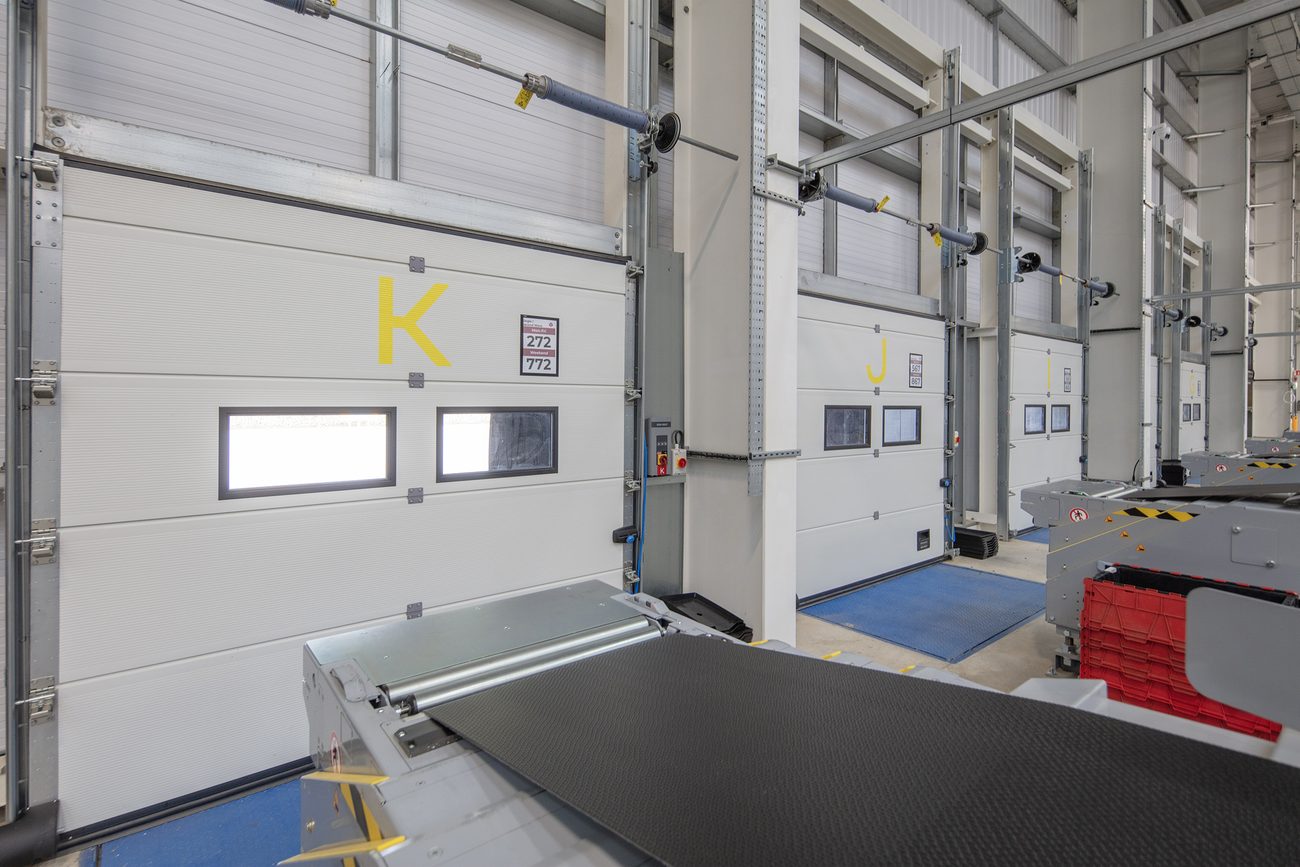
ASSA ABLOY Entrance Systems supplied and installed 32 ‘OH1042P’ insulated sectional overhead doors to provide secure and efficient level access throughout the facility. Designed to deliver excellent thermal insulation, durability and reliability, the doors feature a vertical lift track arrangement that maximises available internal space while providing unrestricted access for vehicles and operational equipment.

Among these installations, 25 level access sectional doors measuring 6,160mm wide were supplied to serve key warehouse access points. A further seven OH1042P doors were equipped with centrally mounted pass doors featuring low-profile 30mm thresholds, panic bars and integrated safety switches. Wind reinforcement trusses were also incorporated to provide enhanced structural stability and long-term performance.

To support efficient loading and unloading operations, ASSA ABLOY Entrance Systems also supplied and installed 11 complete loading bay solutions, each comprising an ASSA ABLOY OH1042P dock door fitted with two rows of vision panels to enhance visibility and safety. The bays were equipped with ASSA ABLOY DL6220T telescopic dock levellers, featuring a 6-tonne load capacity and a 500mm telescopic lip to provide safe and reliable vehicle-to-building access across a variety of trailer configurations.

Finished in standard RAL 5010 blue, the dock levellers were complemented by dock shelters, dock buffers and wheel guides, creating a fully integrated loading bay solution designed to improve operational efficiency, protect goods in transit and enhance safety for warehouse personnel and drivers.

The combination of insulated sectional doors and advanced loading bay technology provides the performance required within a fast-paced logistics environment, helping to optimise vehicle turnaround times while supporting the building’s energy efficiency objectives.

As the logistics sector continues to evolve, developments such as DPD’s new Forrest Park distribution centre highlight the importance of reliable entrance and loading solutions. By delivering a complete package of doors, dock equipment and loading bay accessories, ASSA ABLOY Entrance Systems has helped create a facility equipped to support the demands of modern parcel distribution for years to come.

Subscribe

Get notified about New Episodes of our Podcast, New Magazine Issues and stay updated with our Weekly Newsletter.