For years, logistics transformation has been built around visibility, writes Stuart Whiting (pictured, below) SVP Global Supply Chain at Schneider Electric.
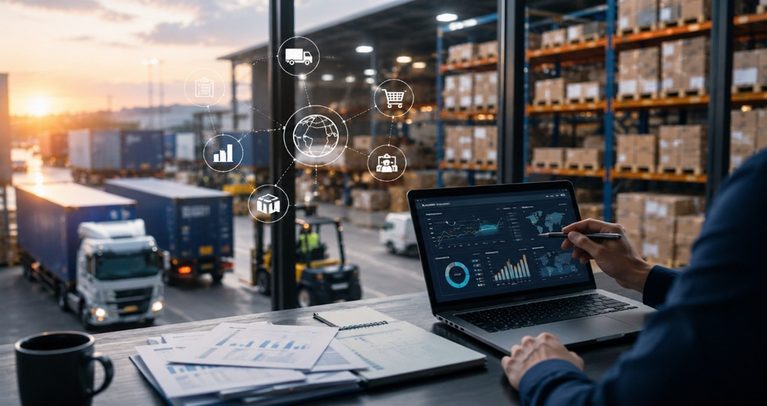
Companies invested heavily in control towers, dashboards, tracking technologies, and analytics platforms to gain a clearer view of increasingly complex supply chains. Visibility remains essential. But today, it is no longer enough. The real question is what organizations do with the information they can now access. Today, competitive advantage increasingly depends on the ability to turn data into action faster than everyone else. This is where artificial intelligence is changing the game.
From Insight to Action
The greatest opportunity for AI in logistics is to enable a shift from visibility to orchestration. Rather than helping organizations understand what happened yesterday, AI can help shape what happens next by sensing disruption earlier, supporting faster decisions, and triggering actions across the logistics ecosystem with greater speed and consistency.
As resilience moves higher on boardroom agendas, logistics is evolving beyond its traditional role of moving goods efficiently. It has become a strategic capability that helps organizations anticipate disruption, maintain continuity, and respond more effectively to changing market conditions. AI is central to this evolution because it can process signals and identify patterns at a scale and speed far beyond manual decision-making.
Building a Sense-and-Respond Supply Chain
Supply chains generate enormous volumes of information every day, but resilience depends on transforming that data into decisions that improve service, reduce variability, and optimize resources in real time. This thinking has shaped the evolution of our logistics control towers. By connecting data across logistics, inventory, planning, and execution, we enable faster and more coordinated decision-making across the network.
The objective is not better reporting. It is to create a sense-and-respond operating model that allows teams to focus their expertise on exceptions requiring judgment, escalation, and action.
The Value Race Has Begun
For logistics leaders, this also means redefining how AI success is measured. Instead of looking for sophisticated technology, the goal is to look for one that delivers tangible business outcomes. The AI adoption race is over. The real differentiator is measurable business impact, from more predictable deliveries to stronger resilience and better decisions.

For that, organizations need to scale the right use cases most effectively and embed AI directly into operational workflows.
Five Capabilities of Future Leaders
The supply chains that pull ahead over the next several years are likely to share five capabilities:
- Real-time operations. Leaders will move beyond passive visibility toward environments where disruptions are detected early and acted on quickly.
- 2. AI embedded in workflows. Intelligent decision support will become part of daily operations across transport, warehouse, planning, and compliance processes.
- 3. Scalable operating models. Technology alone does not transform logistics. Trusted data, standardized processes, clear governance, and accountability remain the foundations of successful AI deployment.
- 4. Human-AI collaboration. AI can analyze data, identify patterns, and recommend actions, but people remain critical when decisions involve trade-offs, customer relationships, ethics, safety, and accountability. The strongest operating model combines AI’s speed and scale with human judgment and responsibility.
- 5. Co-innovation ecosystems. Organizations, logistics providers, and technology partners must work together to continuously improve operating models and adapt to changing business conditions.
The Road from Visibility to Orchestration
Ultimately, AI is becoming less of an innovation layer and more of a core logistics capability. Across supply chains, technologies such as AI, digital twins, advanced analytics, and computer vision are already helping organizations sense disruptions, predict outcomes, and take action faster than before.
The opportunity for logistics leaders is clear: move beyond visibility and toward orchestration. The organizations that succeed will not simply react to disruption. They will sense it earlier, adapt faster, and build supply chains that thrive because of change, not despite it.