
Early Lunar New Year Means Planning Gap

Businesses sourcing goods from China and across Asia are being urged to bring forward their Lunar New Year supply-chain planning, after the 2027 holiday falls 11 days earlier than it did in 2026.

Lunar New Year will take place on Saturday 6 February 2027, compared with 17 February in 2026. The earlier date on the Gregorian calendar compresses the time available to businesses placing orders, completing production and securing freight before factories and logistics networks begin their pre-holiday slowdown. The date is confirmed by the Hong Kong Observatory’s Gregorian-Lunar calendar.

SEKO Logistics is warning that businesses which rely on the previous year’s dates when planning production and shipping could find themselves with significantly less runway than expected. SEKO’s existing Lunar New Year supply-chain planning guide outlines the wider production, freight and inventory considerations businesses should account for.

“Most businesses plan Lunar New Year from memory of the previous year. In 2027, that can leave them with almost two weeks less planning runway than they expect. Eleven days may not sound significant, but when those days come directly out of the production calendar, they can be the difference between an order being completed and shipped before the holiday or being pushed into an increasingly congested pre-holiday window. For businesses sourcing from China and Vietnam, the planning window for 2027 is already open.” – Paul Lockwood, Managing Director, SEKO Logistics UK & Ireland.

The 2027 Lunar New Year countdown has already begun

The earlier holiday date means key supply-chain milestones need to move forward accordingly and businesses should also account for a period of reduced production capacity after the holiday itself. The exact timing will vary by supplier, product and origin, but businesses should not assume that factories will continue accepting orders until the holiday itself or that production will immediately return to normal once the holiday ends.

Many factories begin reducing production capacity and closing production lines several weeks before Lunar New Year. Logistics networks can also experience increased demand as businesses bring shipments forward, while reduced trucking and warehouse capacity can create additional pressure on the journey from factory to port.

The disruption can also continue after the holiday. SEKO’s supply-chain guidance highlights the potential for production capacity to take several weeks to return to normal as workers travel home for the holiday and some do not return to their previous employers.

What the 11-day shift means for UK importers

The timing matters because China remains one of the UK’s most important trading partners. UK goods imports from China totalled £74.9 billion in the four quarters to the end of Q1 2026, according to the UK Government’s China trade and investment factsheet. For UK retailers, manufacturers and e-commerce businesses sourcing at scale, even a relatively small change to the production calendar can have consequences further down the supply chain.

A delayed production run can mean a later vessel departure. A later vessel departure can push inventory beyond an intended restocking date. And for seasonal or fast-moving products, a missed replenishment window can translate into lost sales or expensive last-minute freight.

The risk is particularly relevant to businesses sourcing products with long production lead times, customised specifications or limited alternative suppliers.

SEKO’s client solutions team works with importers throughout the year to build Lunar New Year contingency into production and freight planning. Dan Eckett, Client Solutions Group Director, SEKO Logistics UK & Ireland, said early engagement and realistic booking timeframes are the most common gap between businesses that navigate the holiday smoothly and those that do not:

“We advise clients to engage with suppliers well in advance of Chinese New Year and secure bookings at least three weeks ahead of shipment readiness to protect carrier capacity. It’s important to build contingency into planning, maintain visibility of production timelines and understand exactly when individual suppliers intend to close and reopen operations. Ideally, planning discussions should start three months before Chinese New Year. This provides sufficient time to review forecasts, align production schedules with suppliers and ensure inventory and transport plans are in place before the market begins to experience capacity constraints.”

Ocean freight is typically the first area to feel the pressure as it is heavily impacted in the weeks leading up to Chinese New Year. Exporters accelerate shipments ahead of factory closures. This creates pressure on vessel space, equipment availability and carrier schedules, so we typically recommend building an additional one to two weeks into transit plans and ensuring suppliers place bookings are confirmed well before that three-week threshold, not after it. Stock forecasting needs to extend beyond the shutdown itself, into the recovery period that follows.

“For UK importers, stock forecasting should account for both the shutdown period and the recovery phase. While factories may reopen shortly after the holiday, many operate with reduced staffing levels into March, which can affect production output and lead times. We encourage clients to hold appropriate inventory buffers to maintain product availability and avoid disruption to customer demand.”

For businesses sourcing from Asia, the key message is simple: Lunar New Year 2027 may be months away, but the planning deadline is not. The holiday arrives 11 days earlier than it did in 2026, and those 11 days are coming directly out of the supply-chain planning calendar.

Jungheinrich and Automha in Strategic Partnership

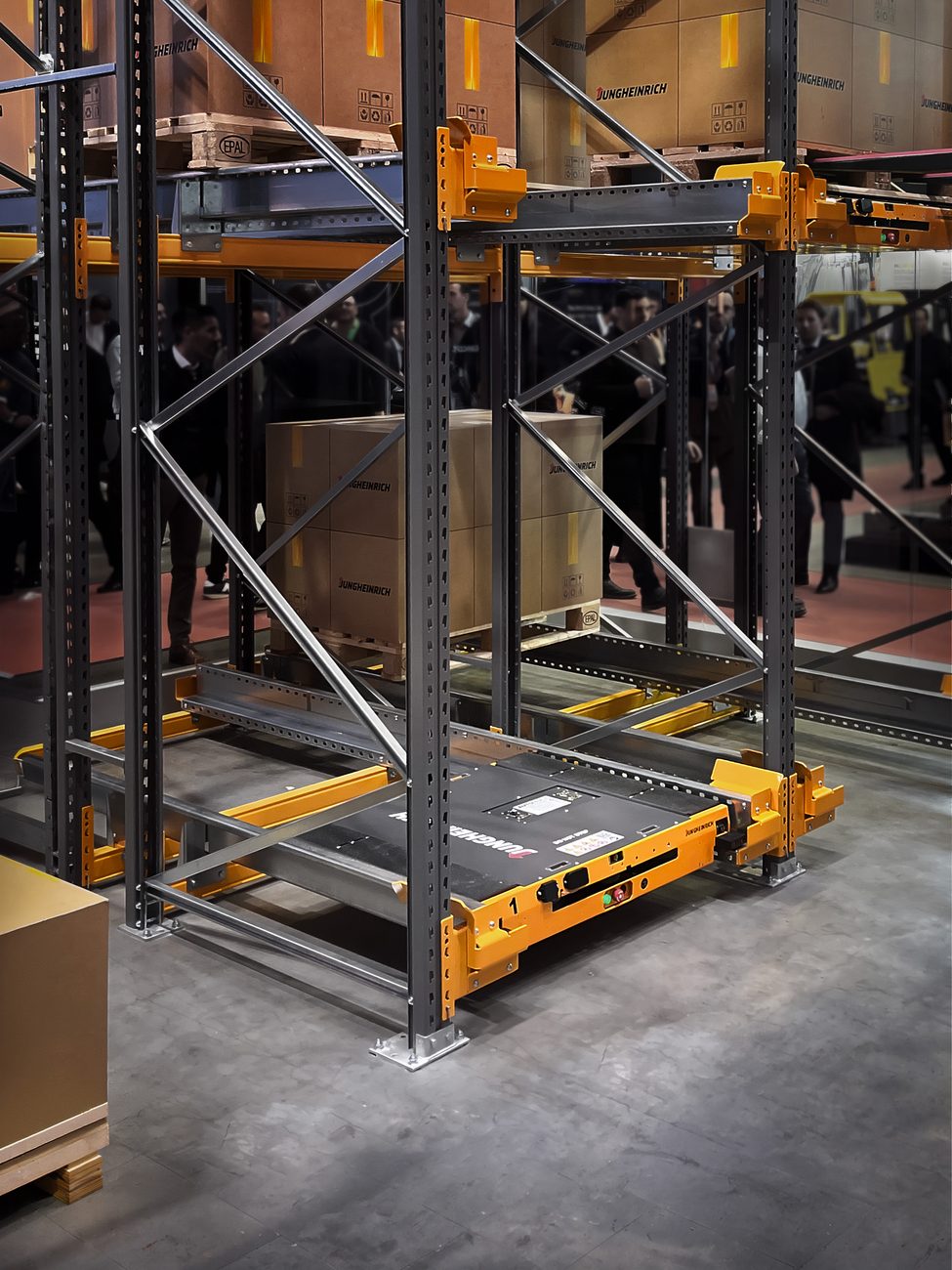
Jungheinrich and Italian warehouse automation and intralogistics specialist Automha are entering into a strategic partnership. Together, the two companies have developed a two-way pallet shuttle for high-density pallet storage. The solution combines Automha’s shuttle expertise with Jungheinrich’s strengths in system integration, software and lifecycle services. The aim is to provide companies with an economically viable entry point into warehouse automation while creating a development path towards more advanced automation in existing facilities

Shuttle Technology Gains Importance

Many companies face the challenge of increasing material flow performance without fundamentally modifying existing buildings or infrastructure. At the same time, requirements for space utilisation, productivity and process reliability continue to grow. Shuttle systems address these challenges and are therefore becoming increasingly important. The two-way shuttle jointly developed with Automha, the UP-Carrier GTJ, is designed to meet precisely these needs. The solution has been specifically developed as an entry point into warehouse automation. It can be integrated into existing warehouse environments and increases storage density without requiring major structural changes. Initially, pallet transport continues to be handled by industrial trucks. As operational requirements evolve and automation levels increase, transport processes can subsequently be automated. This creates a clear migration path from manually supported operations to a fully automated material flow.

From Brownfield Warehouses to Integrated Automation

The strategic significance of the partnership extends far beyond the shuttle itself. Through the close collaboration between Automha and Jungheinrich, customers benefit from a solution in which shuttle technology, racking systems, conveying technology, software integration and service are optimally coordinated. This enables projects to be planned more quickly, implemented more efficiently and supported throughout their entire lifecycle by a single partner. The solution can be integrated into existing IT and warehouse environments and, if required, expanded with additional automation technologies such as Jungheinrich Mobile Robots. With this offering, Jungheinrich expands its shuttle portfolio with a solution that provides an economical entry into automation while supporting customers across different stages of warehouse development, from existing warehouses to fully automated, high-density pallet storage systems.

“Not every company begins its automation journey with a fully automated warehouse,” says Dr. Tobias Harzer, Chief Automation Officer at Jungheinrich.

What matters is a development path that leverages existing infrastructure while opening the door to further automation. With this solution, customers can start where they are today, gradually develop their material flows and align investments with the growth of their business

Strategic Addition to the Shuttle Portfolio

The cooperation with Automha forms part of Jungheinrich’s technology-agnostic integration approach. Depending on customer requirements, Jungheinrich combines its own technologies with selected partner solutions to create end-to-end automation systems. While four-way shuttles, such as those offered by partner Movu Robotics, are primarily deployed in fully automated high-performance pallet warehouses, the solution developed together with Automha addresses applications in existing warehouse environments and customers seeking a gradual entry into automation. The shuttle was developed from concept to market readiness within nine months. Today, the solution is already deployed in more than 200 projects across over 25 countries.

“This partnership demonstrates how specialised shuttle technology and global integration expertise complement each other,” says Gianni Togni, VP Sales and Marketing of Automha.

Together, we are creating solutions that enable companies to modernise their warehouses in a targeted way and make more efficient use of their existing infrastructure

With Automha, Jungheinrich further strengthens its position as a system integrator supporting customers throughout their entire automation journey, from the first automation step in brownfield warehouses to fully integrated material flow systems.

Körber invests in NAiSE for Fleet Management

The international technology company Körber is acquiring a stake in NAiSE GmbH, a Germany-based software company specializing in vendor-agnostic fleet management. Together, the two partners are combining their capabilities to enable customers worldwide to orchestrate mixed vehicle fleets across production and warehouse environments.

By investing in NAiSE, Körber is strengthening its offering in fleet management for intralogistics while strategically expanding the software portfolio of its Supply Chain Business Area. Founded in 2017, NAiSE has been self-funded to date. Its Fleet Management Software (FMS) brings together AGVs and autonomous mobile robots (AMRs) from different vendors and manually operated industrial trucks on a shared control layer. Through this investment, Körber is elevating the existing collaboration between the two companies into a strategic partnership thereby supporting NAiSE as it enters its next phase of growth.

As automation grows, companies are increasingly relying on larger vehicle fleets from different vendors. Without a higher-level control layer, these fleets remain isolated stand-alone solutions, limiting efficiency, transparency and scalability. This is where NAiSE comes in: the platform connects different vehicles and systems via a standardized integration layer that can be configured efficiently with integrated tools, regardless of which WMS, Warehouse Execution System (WES), or Warehouse Control System (WCS) is running in the background.

Together, the two companies aim to combine their know-how and forces to unlock the full potential of OEM-agnostic fleet management in the warehouse environment, deepening the connection between NAiSE’s platform and Körber’s warehouse solutions. NAiSE will continue to serve and further develop its platform for productions logistics and related applications, while making its existing ecosystem of AGV and AMR partners available to joint and new customers. Together, NAiSE and Körber also intend to develop new use cases for intralogistics applications, including humanoid robotics.

“With NAiSE, we are gaining a partner that addresses the orchestration of mixed fleets with an approach that is vendor-agnostic, standardized and field-proven, exactly what the market needs today. Together with the founding team, we will unlock this potential and offer our customers an end-to-end automation solution,” says Dr. Helena Garriga, Körber Executive Board Member and responsible for the Business Area Supply Chain.

“We deliberately chose a partner that respects our independence and also helps us scale internationally,” says Kai Przybysz-Herz,
Co-Founder and CEO of NAiSE GmbH. “Körber brings deep industrial experience, a global customer network and a genuine understanding of entrepreneurial thinking. At the same time, we remain positioned as NAiSE – open to working with additional system integrators and vehicle manufacturers. For us, this is the foundation of our growth model.”

NAiSE will continue its business with existing and new partners unchanged. Operational management of the company will remain with the founding team of Kai Przybysz-Herz, Robert Libert and Raphael Kusumoto. Körber will act as a strategic investor and sparring partner, supporting NAiSE’s in its next phase of growth.

Subscribe

Get notified about New Episodes of our Podcast, New Magazine Issues and stay updated with our Weekly Newsletter.