Despite ongoing geopolitical tensions and operational disruption, the air cargo sector continues to adapt to an increasingly complex trading environment. Airports and logistics hubs are balancing shifting freight flows, fluctuating belly capacity and evolving trade routes while investing in infrastructure to support long-term growth. Brussels Airport’s latest cargo figures reflect this trend, with freight volumes rising during the first half of 2026 despite the challenges facing the wider aviation and logistics industry.
Against this backdrop, Brussels Airport strengthened its cargo operations during the first half of 2026, supported by the continued expansion of its cargo network and wider international connectivity. The airport’s latest results reinforce its position as one of Europe’s leading logistics gateways.
The first half of the year was marked by several external events affecting the aviation and logistics industry, including industrial action and the conflict in the Middle East. The conflict disrupted air services to parts of the region and impacted belly cargo capacity, highlighting the wider challenges facing global supply chains.
Cargo volumes continue to grow, up 8.3%
During the first half of 2026, Brussels Airport handled nearly 420,000 tonnes of cargo, representing an increase of 8.3% compared to the same period in 2025. This performance confirms Brussels Airport’s position as one of Europe’s leading cargo gateways and highlights the resilience of its development model, built on diversifying both the goods transported and the markets served.
The increase was driven by growth across several cargo segments. Total flown cargo volumes rose by 7%, while the full freighter segment recorded growth of 16.7%. Trucked cargo volumes increased by 16.2%, reflecting continued demand for multimodal logistics solutions. Belly cargo posted a slight increase of 0.1%, although this segment remains the most affected by the conflict in the Middle East due to the suspension of certain routes and reduced frequencies to destinations across the region.
Growth in cargo volumes was supported by the continued expansion of the cargo network, alongside increased frequencies and higher volumes on existing routes. Brussels Airport also continues to invest in the modernisation and optimisation of its cargo zone to sustainably support growth and respond to the evolving needs of logistics operators and the wider supply chain industry.
June 2026: Cargo volumes continue their growth trajectory (+12.2%)
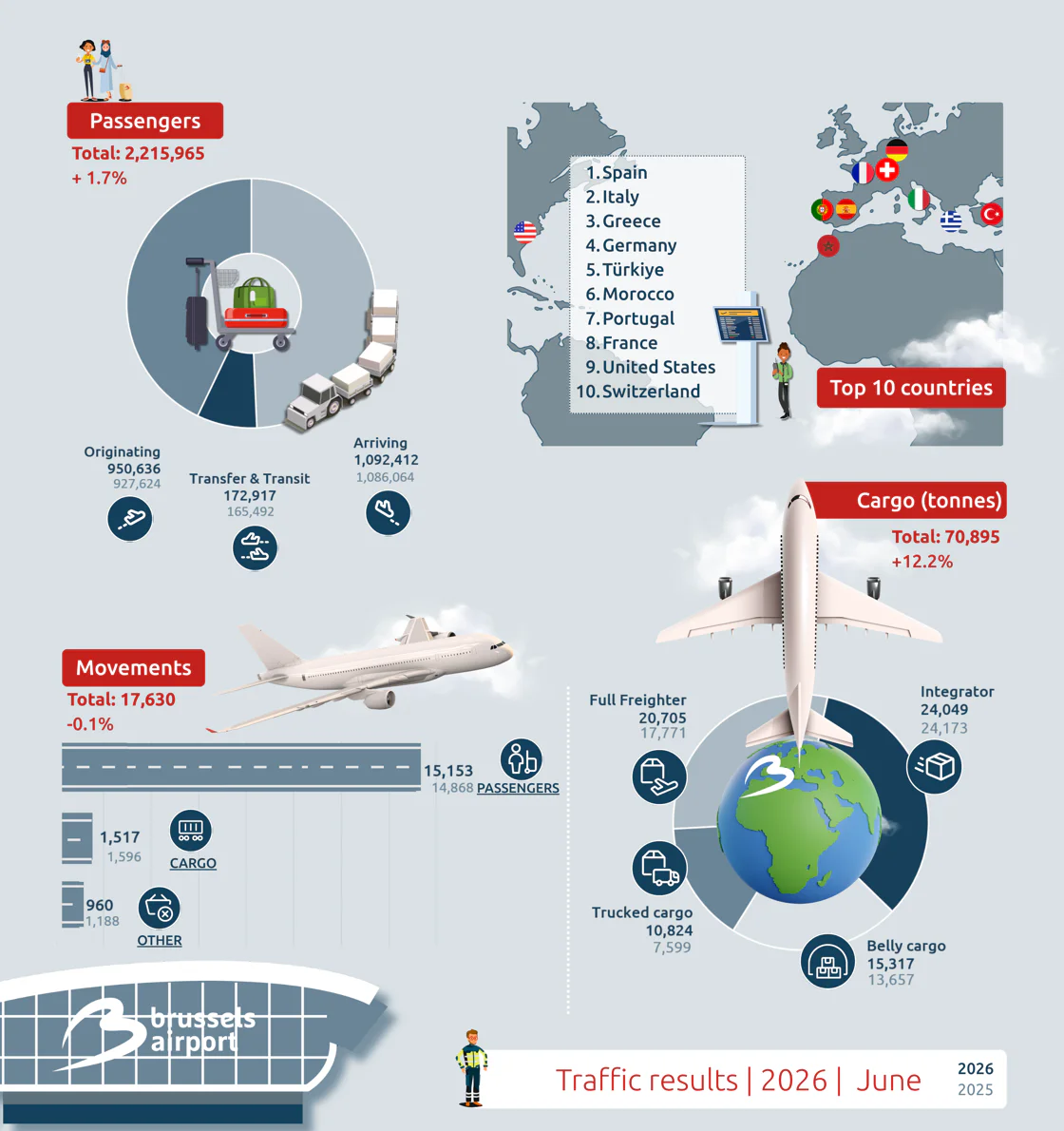
Total cargo volumes through Brussels Airport reached 70,895 tonnes in June, representing an increase of 12.2% compared to the same month last year. Flown cargo grew by 8%, driven in particular by continued growth in the full freighter segment (+16.5%), while trucked cargo volumes increased by 42.4%. After a slight decrease in May, belly cargo rose by 12.2%. Only the integrator segment recorded a slight decrease of 0.5%.
The main import regions remain Asia and North America, with North America recording the strongest growth. Africa saw a slight decline in imports. These three regions also remain the main export markets, with North America showing modest growth.
While overall commercial flight movements were broadly stable in June, cargo flight movements declined by 4.9%. Despite this, cargo throughput continued to increase, underlining the efficiency of existing operations and the ongoing demand for air freight services across the logistics industry.