Cargo Volumes Surge Despite Global Disruption

Despite ongoing geopolitical tensions and operational disruption, the air cargo sector continues to adapt to an increasingly complex trading environment. Airports and logistics hubs are balancing shifting freight flows, fluctuating belly capacity and evolving trade routes while investing in infrastructure to support long-term growth. Brussels Airport’s latest cargo figures reflect this trend, with freight volumes rising during the first half of 2026 despite the challenges facing the wider aviation and logistics industry.

Against this backdrop, Brussels Airport strengthened its cargo operations during the first half of 2026, supported by the continued expansion of its cargo network and wider international connectivity. The airport’s latest results reinforce its position as one of Europe’s leading logistics gateways.

The first half of the year was marked by several external events affecting the aviation and logistics industry, including industrial action and the conflict in the Middle East. The conflict disrupted air services to parts of the region and impacted belly cargo capacity, highlighting the wider challenges facing global supply chains.

Cargo volumes continue to grow, up 8.3%

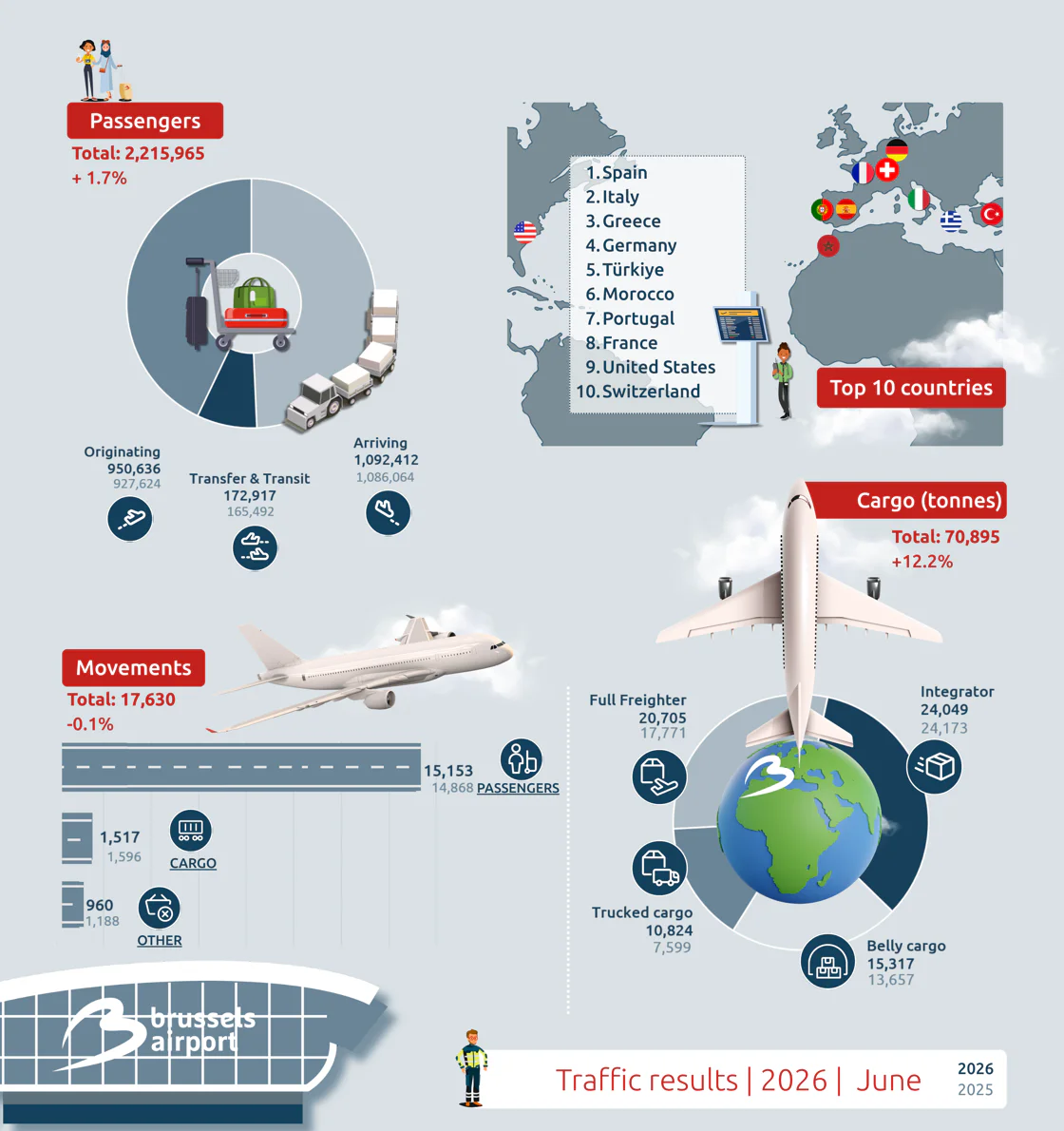
During the first half of 2026, Brussels Airport handled nearly 420,000 tonnes of cargo, representing an increase of 8.3% compared to the same period in 2025. This performance confirms Brussels Airport’s position as one of Europe’s leading cargo gateways and highlights the resilience of its development model, built on diversifying both the goods transported and the markets served.

The increase was driven by growth across several cargo segments. Total flown cargo volumes rose by 7%, while the full freighter segment recorded growth of 16.7%. Trucked cargo volumes increased by 16.2%, reflecting continued demand for multimodal logistics solutions. Belly cargo posted a slight increase of 0.1%, although this segment remains the most affected by the conflict in the Middle East due to the suspension of certain routes and reduced frequencies to destinations across the region.

Growth in cargo volumes was supported by the continued expansion of the cargo network, alongside increased frequencies and higher volumes on existing routes. Brussels Airport also continues to invest in the modernisation and optimisation of its cargo zone to sustainably support growth and respond to the evolving needs of logistics operators and the wider supply chain industry.

June 2026: Cargo volumes continue their growth trajectory (+12.2%)

Total cargo volumes through Brussels Airport reached 70,895 tonnes in June, representing an increase of 12.2% compared to the same month last year. Flown cargo grew by 8%, driven in particular by continued growth in the full freighter segment (+16.5%), while trucked cargo volumes increased by 42.4%. After a slight decrease in May, belly cargo rose by 12.2%. Only the integrator segment recorded a slight decrease of 0.5%.

The main import regions remain Asia and North America, with North America recording the strongest growth. Africa saw a slight decline in imports. These three regions also remain the main export markets, with North America showing modest growth.

While overall commercial flight movements were broadly stable in June, cargo flight movements declined by 4.9%. Despite this, cargo throughput continued to increase, underlining the efficiency of existing operations and the ongoing demand for air freight services across the logistics industry.
Transport safety: don’t replace, but upgrade

As the freight and haulage sector continues to strengthen vehicle safety standards, Human Form Recognition (HFR) technology is becoming an increasingly important consideration for fleet operators seeking to reduce collision risks.

HGVs frequently operate in environments where pedestrians, cyclists, loading staff and customers are present, making blind spot management and driver support a critical challenge for operators.

Many transport businesses are now looking for practical ways to introduce Human Form Recognition technology without replacing existing camera systems across large fleets.

Jordan Marshall, Brigade’s UK marketing manager, says:

“Human Form Recognition is becoming an increasingly important consideration for operators looking to improve safety around vehicles and equipment… As the industry continues to strengthen its safety expectations, many operators are looking for practical ways to prepare for these evolving requirements without the disruption and cost of replacing entire camera systems… This is where Brigade’s new AI HFR Box comes in as a cost-effective, practical and sustainable solution for upgrading existing systems to HFR.

Brigade’s recently launched AI HFR Box enables fleets to upgrade existing safety camera systems with AI-powered Human Form Recognition technology, allowing operators to retain their current camera infrastructure while adding intelligent people detection capabilities.

This retrofit approach offers significant advantages for operators, particularly for those managing large numbers of vehicles already equipped with safety cameras.

By avoiding the need to remove and replace functioning hardware, businesses can reduce installation costs, minimise vehicle downtime and extend the lifespan of existing safety systems, helping support both financial and environmental objectives.

The approach also aligns with the industry’s growing focus on sustainability, circular economy principles and reducing unnecessary electronic waste across fleet operations.

Jordan continued:

The Brigade AI HFR Box provides a more cost-effective and sustainable route to introducing Human Form Recognition technology because it allows operators to upgrade existing safety cameras with AI capability rather than starting from scratch. That means less downtime, less waste and a more accessible way for fleets to improve safety standards across their operations.

The system uses AI-powered analysis to identify human forms around vehicles and provide real-time visual and audible alerts to drivers, helping reduce the risk of collisions in high-risk environments where visibility can often be limited.

Designed for demanding operational conditions, the system supports drivers where interactions between vehicles and pedestrians are common.

As the industry continues to prioritise safety, retrofit Human Form Recognition technology is expected to become an increasingly valuable tool for helping future-proof fleets while supporting both safety and sustainability targets.

Warehouse Gamification Platform Finds New Home

As warehouses become increasingly automated, logistics businesses are recognising that technology alone is not enough to maximise operational performance. With labour shortages, rising customer expectations and pressure to improve productivity, many organisations are investing in digital tools that not only optimise processes but also enhance workforce engagement. Gamification and real-time performance insights are emerging as effective ways to motivate frontline employees while improving warehouse efficiency.

Infios is the latest company to invest in this approach, announcing that vaibe will join its suite of Intelligent Supply Chain Execution solutions. The gamification platform is designed for warehouse environments, using game mechanics to increase frontline engagement, motivation and productivity while strengthening the Infios portfolio with workforce performance capabilities.

Originally developed through Körber’s internal digital innovation process, vaibe has evolved into a differentiated solution that addresses the critical human dimension of supply chain operations. Now joining Infios—a joint venture of global technology company Körber and global investment firm KKR—vaibe further strengthens the company’s ability to deliver measurable improvements in both workforce engagement and operational productivity.

Vaibe brings a highly practical dimension to how we think about performance in the warehouse… It strengthens our ability to connect system intelligence with day-to-day execution, helping customers drive better outcomes not just through technology, but through how work actually happens.

said Eugene Amigud, Chief Innovation Officer at Infios.

From a technology perspective, vaibe was designed to integrate seamlessly into warehouse workflows while delivering real-time feedback that drives behavior… Becoming part of Infios allows us to scale that architecture, embed deeper into operational ecosystems and accelerate how data translates into meaningful action on the floor.

said Tiago Sottomayer, Chief Technology Officer at vaibe.

This integration reflects a shared commitment to purposeful innovation, leveraging technology to make supply chains more efficient, agile and intelligent. Together, Infios and vaibe will help organisations strengthen the connection between frontline workforce engagement and measurable business outcomes across the supply chain.

Vaibe started with a clear focus—make work on the warehouse floor more engaging and impactful… Joining Infios gives us the opportunity to expand that mission globally and bring those benefits to many more customers.

said Nick Retzmann, Chief Growth & Product Officer at vaibe.

The announcement marks the next stage in vaibe’s evolution—from an internal innovation initiative to an established solution within the Infios portfolio—further strengthening Infios’s commitment to modern, human-centred supply chain operations.

New £5M dry bulk rail terminal at the Port of Middlesbrough

AV Dawson has announced a £5 million investment in a new dry bulk rail terminal at the Port of Middlesbrough, reinforcing its long-term commitment to Teesside and creating additional capacity to support UK manufacturers, importers and exporters.

The facility will increase unloading speeds by 40% to 500 tonnes per hour, significantly increasing capacity and improving overall operational efficiency. The terminal will also feature five rail lines, with additional rail sidings to feed rail wagons into the new unloading pit and conveyor system.

The family-run business, which owns and operates the Port of Middlesbrough on the River Tees, is expanding its multimodal logistics hub by developing its fifth rail terminal to unlock valuable supply chain opportunities for North East freight businesses, enabling them to engage more easily with national and international clients.

Specifically for the dry bulk market, the new facility will expand the company’s rail freight capabilities, the new facility will expand the company’s rail freight capabilities, increasing capacity for customers and supporting the efficient movement of freight by road, rail and sea. With direct access to the East Coast Main Line and key road links via the A19 and A1, the site offers excellent connectivity. The rail network also provides a direct connection to the port’s quayside operations, enabling seamless rail-to-port transhipment supporting both UK and international trade.

As the owner of the largest independent rail freight facility in the North East, AV Dawson has made its latest investment to enable innovation in its 120-acre Middlesbrough-based logistics hub and provide efficient, sustainable solutions for its customers.

Charlie Nettle, Group Managing Director at AV Dawson, said:

For more than 85 years, we’ve invested in Teesside, continually evolving to meet our customers’ changing needs. This latest investment reflects our confidence in the region, our people and the future growth of rail logistics… Our fifth rail terminal strengthens our multimodal offering by expanding our presence in the dry bulk market and reinforces our commitment to delivering integrated logistics solutions across rail, land and sea.

The project is being delivered alongside two other family-run businesses, Seymour Construction from Hartlepool and Atherton Material Handling. Construction includes a new unloading pit, rail line, bespoke conveyor system and dedicated storage warehouse. A new concrete loading pad will provide customers with both indoor and outdoor storage options.

Charlie continued:

Rail has a vital role to play in the future of UK freight, and with the Government setting ambitious targets to increase rail freight by 75% by 2050, investments like this are key to enable this… With rail producing around 74% less carbon than road freight, we work closely with customers to help them reduce both emissions and costs through greater use of rail, while combining it with our own road haulage fleet to deliver seamless, integrated logistics solutions 

The terminal will support the handling of commodities including fertilisers, aggregates, salt, industrial minerals, steelmaking raw materials and energy products, further expanding the Port of Middlesbrough’s capabilities for UK manufacturers, importers and exporters. The project is scheduled for completion in spring 2027.

Extending The Lifecycle Of Specialised Trailers

Logistics and supply chain operators face a lot of pressure to keep specialised trailers moving while capital budgets stay tight. At the same time, trailers sit at the centre of safety, compliance and uptime strategies. More than interchangeable assets, they work as engineered platforms for very specific loads and operating environments. 

Deciding whether to repair or replace a specialised trailer no longer hinges on age only. It requires a lifecycle view that weighs operating hours, route severity, corrosion exposure and evolving cargo profiles. 

The decision also intersects with broader fleet strategy, including: 

  • Whether the operation needs standardised specifications across locations 
  • How quickly regulations and customer requirements change 
  • What level of redundancy the network can tolerate 

When logistics professionals treat maintenance data, downtime metrics and structural inspection results as core planning inputs, they turn the decision to replace or repair from a reactive debate into a predictable component of asset strategy. 

Understanding Specialised Trailer Lifecycles 

Specialised trailers typically move through three broad lifecycle phases: 

  • Early Use: Focuses on inspections, lubrication and tightening critical fasteners, which sets a baseline for predictive maintenance and helps catch manufacturing or spec issues before they turn into chronic failures. 
  • Mid-Life Wear: Usually years four through seven for high-utilisation assets. This period brings visible component fatigue, such as recurring brake replacements, alignment issues and door or ramp problems that begin to influence uptime. 
  • Long-Term Structural Risk: Attention shifts to the core structure, including floors, frame rails, suspension hangers and electrical systems. This type of wear directly affects the integrity and safety of the trailer. 

Maintenance Intervals and Uptime 

Most fleets treat structured inspection intervals as non-negotiable and often combine pre-trip checks, monthly or quarterly inspections and yearly deep structural inspections. Regular service every three to six months, adjusted for mileage and duty cycle, allows technicians to detect corrosion, cracks and suspension or brake degradation before they trigger read failures or roadside inspections. 

Documented schedules that track what technicians inspect at each interval also help asset managers correlate certain duty patterns or lanes with accelerated wear and refine replacement forecasts over time. 

When Repair Makes Strategic Sense 

Repair delivers the greatest value when a specialised trailer still aligns with current and near-term operational requirements and retains sound structural bones. Component-level work, such as brake system refreshes, suspension rebuilds, landing gear replacement or targeted electrical reharnessing, often restores reliable performance at a fraction of the replacement cost. 

In corrosion-heavy environments, targeted steel replacement, seal replacement and anti-corrosion treatments can stop deterioration and push the useful life of the trailer for several more years, especially when the original specification fits the cargo mix. 

Refurbishment also plays a role in sustainability and standardisation initiatives. Planned mid-life refurbishment programs that include structural reinforcement, floor replacement, lighting upgrades and updated conspicuity markings allow fleets to modernise safety performance while avoiding the full embodied cost of a new trailer. Skilled welding and fabrication shops can reconstruct damaged subframes, coupler structures or custom mounting points to original or improved specifications, which often matters for highly specialised equipment carriers or tank applications. 

Indicators That Replacement Creates More Value 

Certain indicators consistently suggest that replacement, not further repair, will better serve uptime and total cost goals. When a trailer spends more time in the shops than on the road, with one failure after another in unrelated systems, repair bills and lost utilisation usually outstrip the asset’s remaining economic value. Frequent structural work, such as repeated crack repairs, patching rusted frame sections or addressing sagging decks, signals that the asset has likely reached the end of its safe structural life. 

Misalignment between trailer capabilities and current freight also pushes replacement to the forefront. If operators routinely overload a trailer, lack tie-down points for present cargo or struggle with outdated interior configurations, no amount of repair will resolve the underlying mismatch between asset design and operational reality. 

Finally, trailers without modern safety technologies or current regulatory features, such as adequate conspicuity, appropriate brake performance or compatible load securement geometry, may expose fleets to compliance risk that new designs mitigate more efficiently. 

Balancing Lifecycle Cost, Safety and Fleet Strategy 

Effective repair-versus-replacement decisions combine engineering judgment with asset-level economics. Many fleets use a threshold, such as when projected repairs over the next 12 to 24 months approach a fixed percentage of replacement cost, while also factoring in expected downtime, resale value and the strategic value of newer specifications. 

Newer trailer designs may bring lower tare weights, better aerodynamics, improved corrosion resistance and standardised components that simplify parts inventory and technician training, all of which influence total cost per loaded mile. 

The most resilient logistics operations integrate trailer decisions into broader network planning. That planning extends beyond individual assets to include standardised specs across terminals, alignment with tractor technology and planned refresh cycles that avoid large one-time capital shocks. 

When maintenance teams, safety leaders and fleet planners share data and align on risk tolerance, they extend the lifecycle of specialised trailers where it makes sense and replace them where modern designs, safety gains and compliance advantages will deliver measurable returns. 

Subscribe

Get notified about New Episodes of our Podcast, New Magazine Issues and stay updated with our Weekly Newsletter.