Companies such as Nomagic are really pushing the boundaries when it comes to order picking technology. Peter MacLeod found out more.
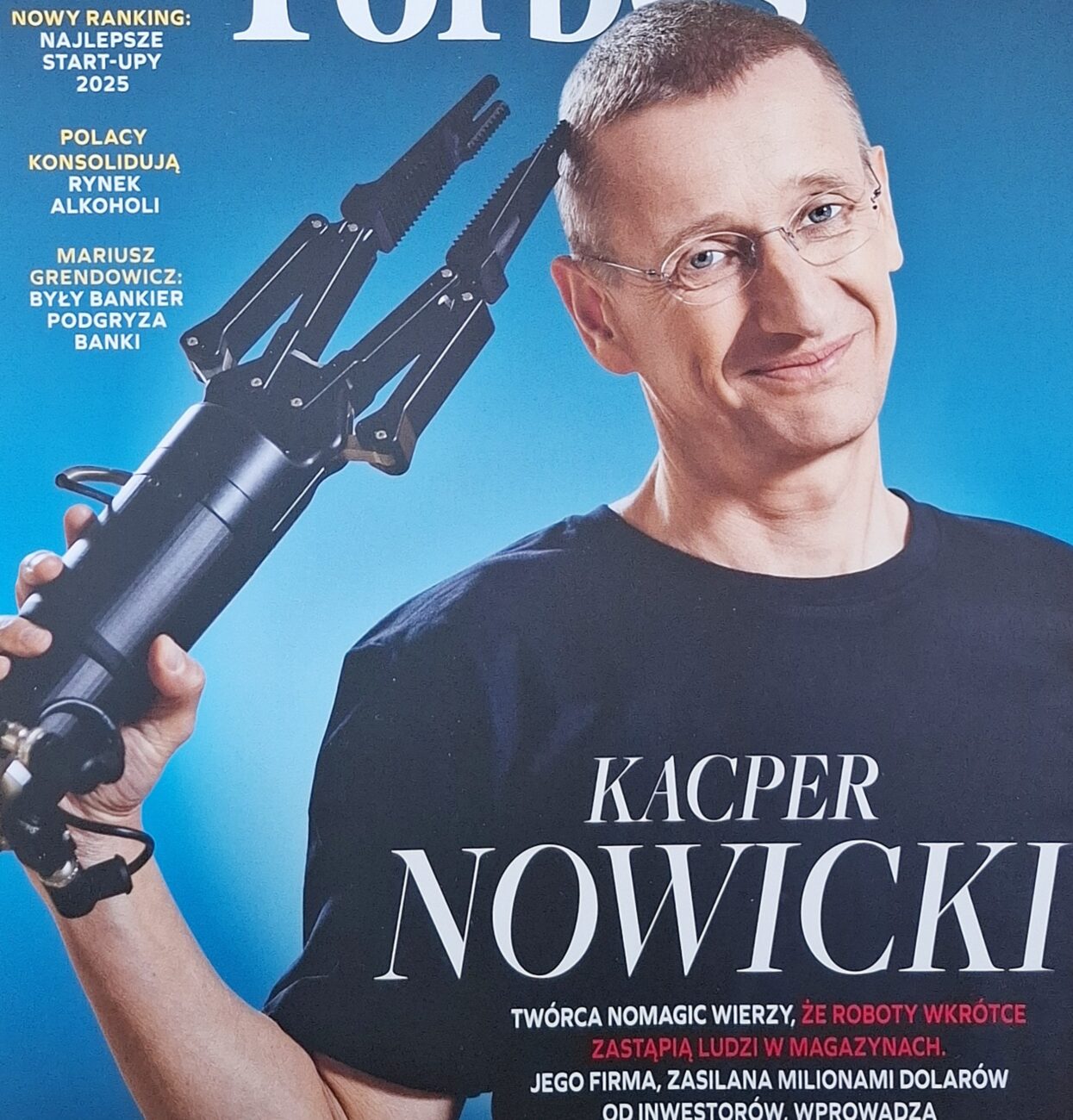
Amid the usual blur of automation demos and bold claims, one presentation in particular cut through with unusual clarity at LogiMAT. Kacper Nowicki (pictured, below), co-founder and CEO of Nomagic, wasn’t just showcasing another robotic picking system. He was making a broader argument: that the next phase of AI is not about better answers on a screen, but about reliable action in the physical world.
That idea – what Nowicki calls ‘Physical AI’ – underpins Nomagic’s latest launch, the IFOY Award-nominated Shoebox Picker, unveiled at the Stuttgart show. On paper, automating shoebox handling might sound niche. In reality, it has long been one of the most stubborn gaps in warehouse automation.
Deceptively Complex
Shoeboxes are deceptively complex. They come in endless variations of size, weight and lid design, and unlike sealed cartons, many are unfastened. In fashion e-commerce, they typically account for around 20% of items – enough to disrupt automation flows if they cannot be handled reliably. Until now, they have largely remained a manual task.
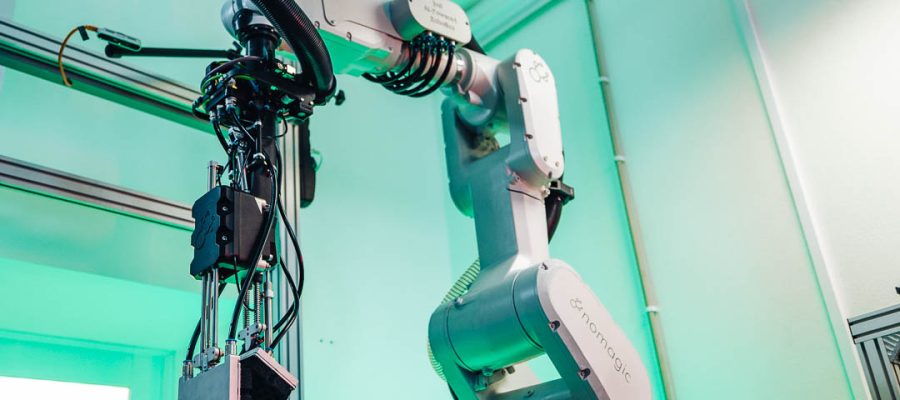
Nomagic’s Shoebox Picker is designed to change that. Combining AI-driven perception with a specialised end-of-arm gripper, the system identifies each box’s characteristics, such as lid orientation, and determines how to pick it securely. The key innovation lies in how it grips: often by a corner or edge, applying controlled pressure to prevent the lid from separating.
The result is a system capable of handling mixed, densely packed bins without requiring items to be pre-orientated or sealed. It can pick both vertically and horizontally placed boxes, achieving throughputs of up to 450 units per hour for shoebox-only operations, and up to 600 units per hour in mixed scenarios. Nomagic claims coverage of more than 98% of shoebox SKUs.
Operational Impact
“The Shoebox Picker is a great example of the embodiment of Physical AI,” Nowicki said during the presentation. “It combines the intelligence of AI with a physical system to solve real-life physical problems.”
What makes this particularly significant is not just the technical achievement, but the operational impact. As Nowicki emphasised, automation in logistics is not judged by novelty, but by return on investment. He outlined three factors that ultimately determine success: utilisation, throughput and reliability.
Utilisation reflects how often a system is used, with robotics typically making most sense in multi-shift operations. Throughput must approach human performance, often exceeding 90% to be viable in space-constrained facilities. But it is reliability, he argued, that remains the real barrier. “If the robot stops every 10 minutes, it’s a toy,” he said bluntly.
This is where many robotics solutions have struggled, caught in what he described as ‘pilot purgatory’ – impressive demos that fail to translate into dependable, large-scale deployment. Warehouses present a near-infinite variety of edge cases: items sticking together, packaging failures, unexpected orientations, badly-placed labels. Handling these consistently is what separates a prototype from a product.
VLA on the March
Nomagic’s approach is to combine highly optimised robotic systems with emerging AI models, including so-called Visual Language Action (VLA) models. These allow robots to interpret visual input, understand instructions and adapt to unforeseen situations – though, as Nowicki acknowledged, they are not yet fast or reliable enough to operate alone in high-throughput environments.
Instead, they are being deployed selectively, particularly for handling exceptions, seemingly a pragmatic step towards more generalised automation.
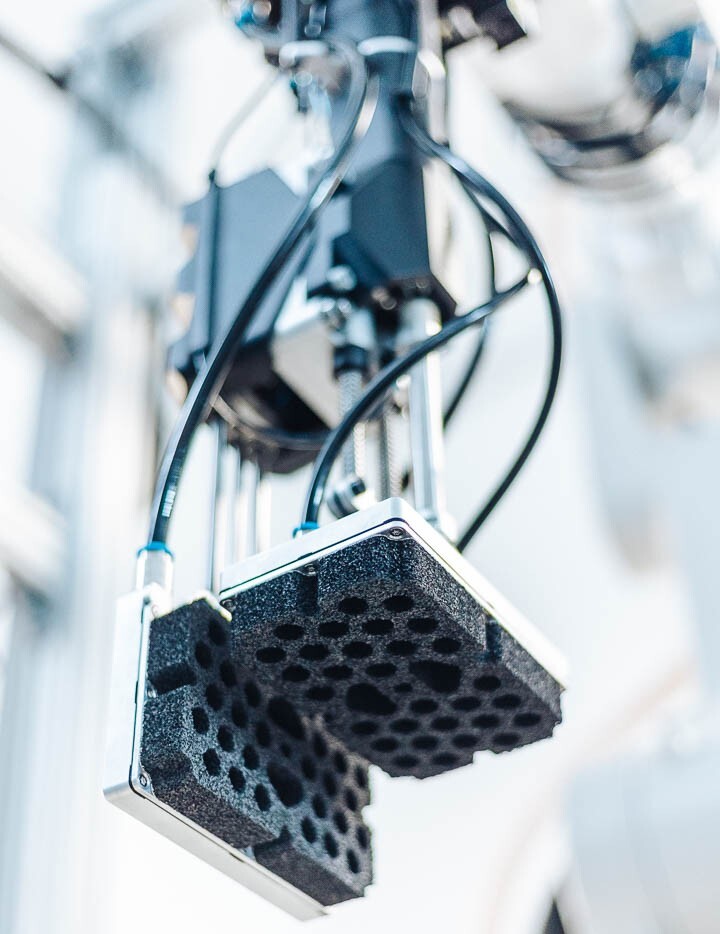
The Shoebox Picker itself reflects this philosophy: not a humanoid generalist, but a purpose-built tool designed to outperform humans in a specific, high-friction task. As Nowicki noted, humans have always advanced through specialised tools – and warehouse robotics is no different.
Zero Churn
Beyond the technology, Nomagic is also positioning itself as a service provider rather than a hardware vendor. Its systems are delivered via subscription models with SLAs, guaranteeing performance metrics such as uptime and throughput. Customers can opt for full Robot-as-a-Service (RaaS) or purchase hardware alongside ongoing support.
This model appears to be gaining traction. The company reports zero churn across deployed systems, with some robots operating in production for nearly seven years. A recent agreement to scale deployments with Zalando further signals growing confidence from major e-commerce players.
For me, there is also a more personal angle. Nomagic’s headquarters are just around the corner from where I’m based in Warsaw, and it’s not uncommon to see their team grabbing lunch at the same local café. There is something quietly satisfying about watching a company tackle global logistics challenges from such an unassuming, everyday setting.
That blend of ambition and pragmatism was evident throughout Nowicki’s presentation. In an industry often drawn to futuristic visions of humanoid robots, Nomagic is taking a more grounded route – focusing on the hard, messy realities of warehouse operations.