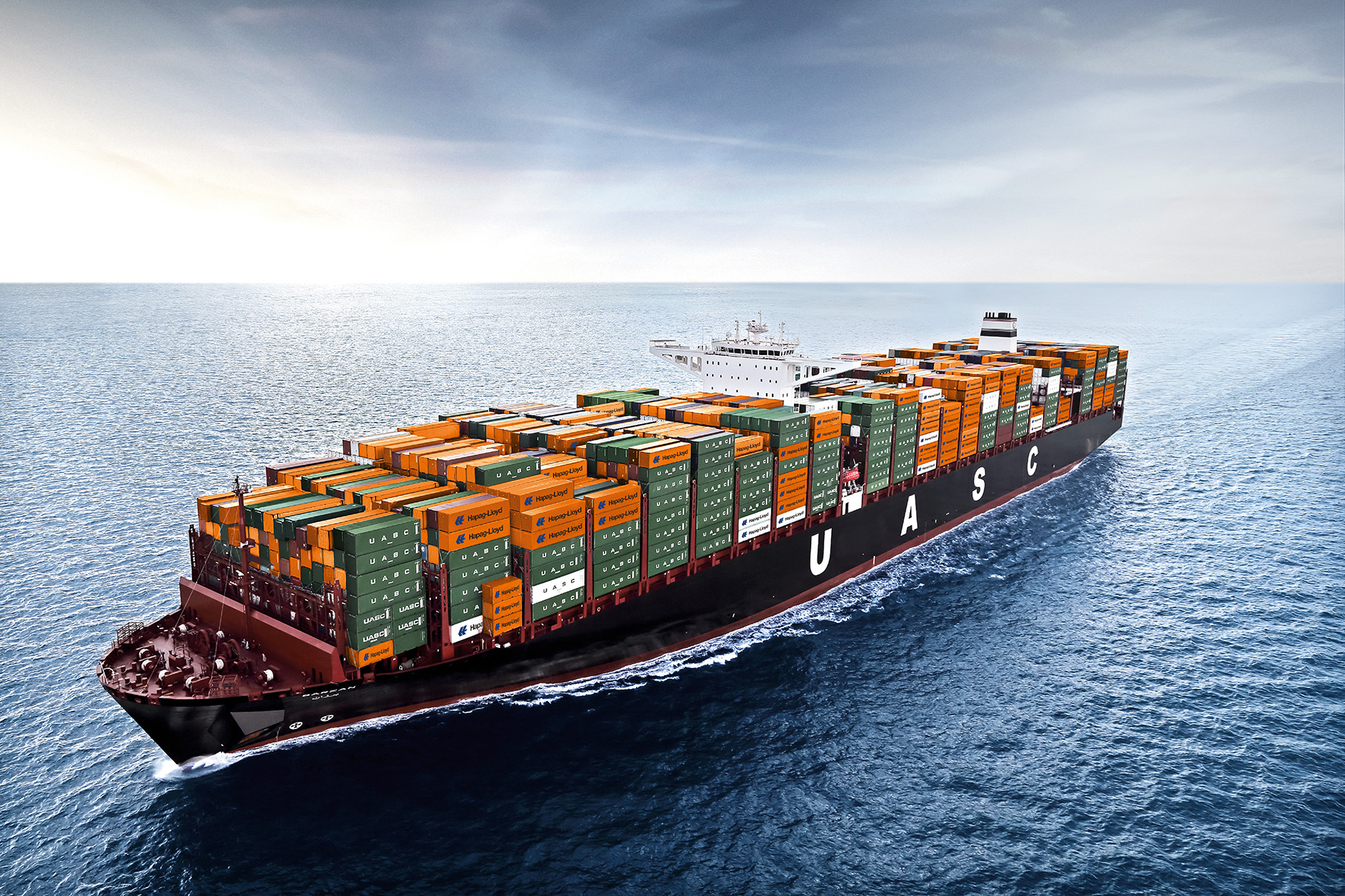
Peace on the world’s oceans is over for the time being. This was the unanimous consensus among speakers at the Albert Ballin Forum hosted by Hapag-Lloyd in Hamburg. Around 100 guests from the shipping industry and academia gathered at Kühne Logistics University (KLU) on May 12 and 13, 2026, to discuss how merchant shipping can respond to massive threats from wars, hybrid attacks, and geopolitical tensions.
Germany needs more sea power and maritime resilience
Hybrid attacks in the Baltic Sea – combining military strikes with cyberattacks and sabotage – and military confrontations in the Strait of Hormuz: Maritime security is currently under threat to an extent not seen since the last world war. What do solutions for security on the world’s oceans look like? This question is becoming increasingly urgent for vital supply chains: 60 percent of German imports and exports currently travel by ship, as do 90 percent of global trade and 80 percent of Europe’s energy supply.
“The discussion on the use of the seas is urgently needed and must be multi-perspective. It requires exchange between historical, legal, political, and ethical viewpoints, among others,” says Nils Haupt, Senior Director Group Communications at Hapag-Lloyd. “Especially in times of crisis that demand well-considered decisions, our long-standing collaboration with a business school like Kühne Logistics University and its supply chain expertise proves particularly valuable.”
Panelists discussing the security of merchant vessels and shipping routes agreed: Germany can no longer remain blind to maritime affairs. Moritz Brake, Managing Director of consulting firm Nexmaris, Senior Fellow at the Center for Advanced Security, Strategic and Integration Studies (CASSIS), and reserve officer in the German Navy, called for clear consequences for Germany: Security at sea must be understood as a national interest, and maritime resilience and defense capabilities must be strengthened. “Those who do not possess sea power themselves are at the mercy of other nations.”
Warning against rhetorical militarization of merchant shipping
For Irina Haesler, member of the executive board of the German Shipowners’ Association (VDR), security is also a central concern. However, she advocates against falling into war rhetoric: “We just want to transport goods from A to B and thus ensure the world’s prosperity–yet shipping is being drawn into war and used as a pawn.” Short-term preparation for this is not possible; rather, it is about better implementing the maritime spirit domestically. At the EU level, independent, practical solutions must be developed. The International Maritime Organization (IMO) of the UN could play a central role in the coordinated resolution of the naval blockade in the Persian Gulf.
Persian Gulf: Seafarers’ trust as the highest priority
Silke Lehmköster, Managing Director Fleet at Hapag-Lloyd and responsible for seafarers, reported on what it means for crews ashore, but especially for those aboard vessels in the Persian Gulf, to be exposed daily to the dynamic tension between military presence and fragile information situations. The detained ships in the Middle East are operated with minimal crew, and daily communication with crews is open and transparent. The crisis manager emphasizes: “Security must not be compromised; the trust of seafarers is our highest priority.” Consequently, Hapag-Lloyd continuously conducts risk assessments and no longer calls at crisis regions–the situation in the Strait of Hormuz came too suddenly for that.
Prof. Dr. Gordon Wilmsmeier, Director of the Hapag-Lloyd Center for Shipping and Global Logistics (CSGL) and expert in maritime logistics at KLU and Universidad de los Andes, Colombia, summarizes on maritime security:
“We are surfing on a wave that is too high–no one knows when it will break. Individual interests dominate the actions of political and economic actors. Who must and can take responsibility for maritime security today? We must confront this question. It is already difficult enough to guarantee security on land–at sea, without cameras, public scrutiny, and witnesses, it is almost impossible.”
Award for Global Action goes to Colombia
Hapag-Lloyd hosted the two-day symposium ‘War and Peace at Sea’ as part of the third Albert Ballin Forum Hamburg, in cooperation with the German Port Museum, KLU, the Museum of Hamburg History, Sigmund Freud Private University Vienna, and the German Shipowners’ Association (VDR).
At a ceremonial evening event, the ‘Albert Ballin Award for Global Action’ was also presented. The winner of the €50,000 prize is Pedro Salazar, founder and director of the Colombian foundation Fundación Amigos del Mar. This year’s ‘Albert Ballin Advancement Awards for Globalization Research,’ each endowed with €5,000, were awarded to Dr. Clara Baumann, Dr. Marlene Gärtner, and Dr. des. Bertille James.