The UK operates the largest cold storage market in Europe by capacity, and it is under pressure. The temperature-controlled sector contributes £14 billion in gross value added to the economy, according to the Cold Chain Federation, yet operators are absorbing sharp cost increases: the Federation reported cold-chain energy costs rose 46% in 2023 alone. For logistics operators running chilled and frozen distribution, energy is no longer a background overhead. It is a defining operational and competitive variable.
Much of the industry conversation focuses on the storage side, on refrigeration plant, insulation, and set-point management. But in a distribution centre, the bigger and more overlooked energy drain is movement. Distribution facilities are defined by constant door activity, frequent openings, and the transfer of goods between zones held at different temperatures. Ambient goods-in, chilled pick faces at up to 8°C, and frozen areas at −18°C or below often sit within the same building footprint, and every uncontrolled opening between them costs money.
Where the energy actually goes
The scale of this is not marginal. The ASHRAE Handbook of Refrigeration notes that heat gain from infiltration air can amount to more than half the total refrigeration load of distribution warehouses. That figure is specific to high-throughput, high-door-traffic facilities, which is exactly what a modern fulfilment or 3PL distribution centre is. In other words, in the buildings logistics operators actually run, air movement between zones can be the single largest driver of refrigeration demand, ahead of the storage envelope itself.
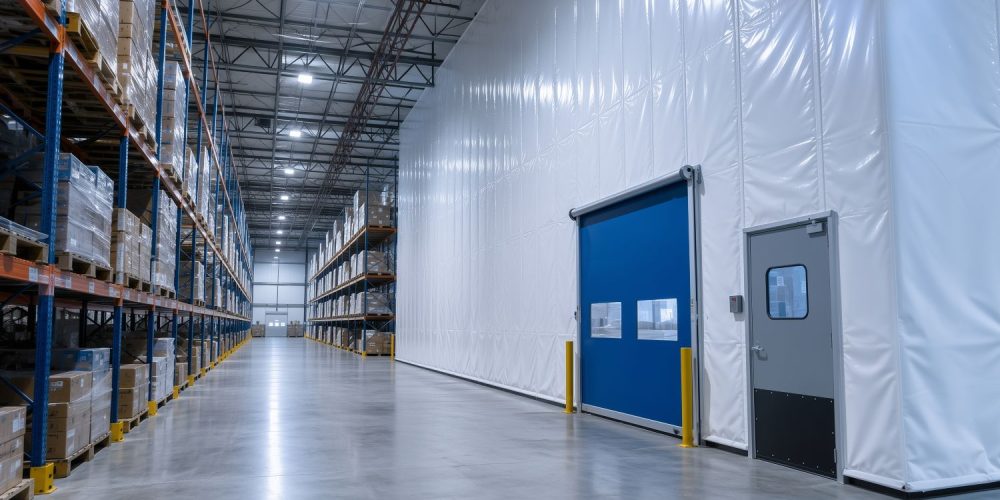
This is where physical zone separation earns its place. Temperature-separating curtain walls and PVC strip curtains reduce the uncontrolled exchange of air at openings and between zones, so each area is held only as cold as it needs to be rather than bleeding cold air into warmer neighbours or over-cooling on rebound. Peer-reviewed research has measured strip curtains in good condition reducing doorway air infiltration by around 90%, though effectiveness falls sharply when curtains are damaged, gapped, or poorly overlapped, which makes condition and maintenance part of the energy strategy, not an afterthought.
Flexibility as an operational advantage
The other reason curtain systems suit distribution rather than fixed storage is change. Fulfilment operations reconfigure constantly, with zones expanding and contracting by season, by contract, and by product mix. Warehouse curtain dividers and insulated partition systems can be repositioned as those needs shift, letting an operator create or move a chilled zone without a construction project. For 3PLs in particular, whose space requirements change with every new client, that adaptability protects both capital and continuity of operation.
It also aligns with where the sector is heading. The Cold Chain Federation’s ongoing Cold Chain Net Zero work, alongside the UK’s legally binding 2050 Net Zero target, is pushing operators toward measurable energy reductions. Reducing refrigeration load through better zone separation is one of the more straightforward interventions available, requiring no plant replacement and no operational shutdown.
Specifying responsibly
Any internal partitioning must be designed around the building’s fire strategy. Curtains must not obstruct escape routes or fire detection, and must not impede sprinkler coverage under BS EN 12845, in line with duties under the Regulatory Reform (Fire Safety) Order 2005. Fabric should be certified to BS 5867 Part 2 Type B, with a BS EN 13501-1 Euroclass rating where required, and operators should check the manufacturer’s actual test certificate rather than assume a classification. Handled properly, zone separation is a rare thing in cold-chain logistics: a meaningful energy saving that does not require rebuilding the facility to achieve it.
By Scott Fullerton, Operations Manager, AKON Curtains Limited