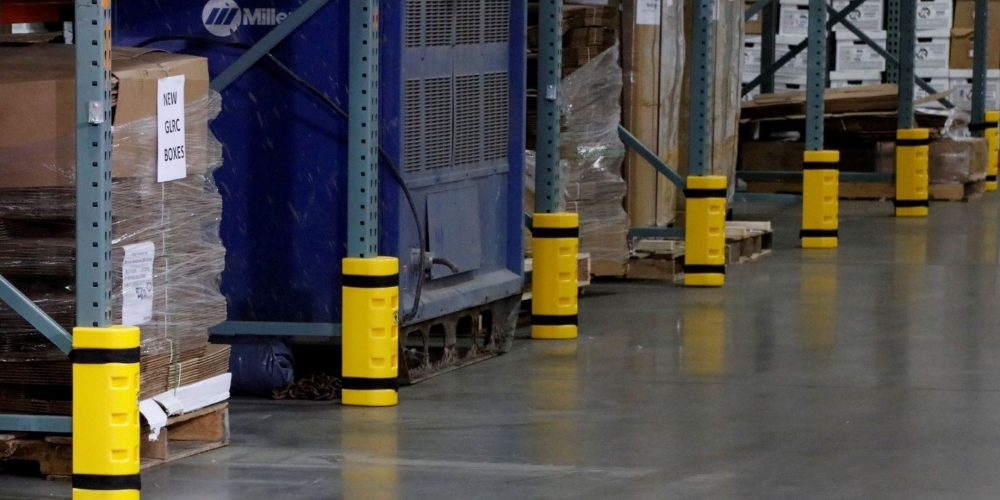
Protecting warehouse infrastructure shouldn’t come at the expense of operational efficiency.
Warehouse managers face a daily balancing act. They are expected to improve safety, increase storage density, speed up throughput, reduce operating costs, and maintain productivity all within the same four walls. However, in the real world those objectives cannot and do not always appear to sit comfortably together.
Take rack protection, for example. Protecting warehouse infrastructure from forklift impacts is widely recognised as good practice, yet some operators remain reluctant to install rack protectors because they fear they will reduce valuable aisle space, restrict manoeuvrability, or simply become another obstacle for forklift drivers to negotiate.
Sentry Protection Products believes that doesn’t have to be the case.
There has always been this perception that adding protection somehow means compromising efficiency… People think they’re giving something up. In reality, well-designed protection should allow a warehouse to operate more confidently, not less.
says Jim Ryan, founder of Sentry Protection Products.
Modern warehouses are operating under greater pressure than ever before. Driven by rising customer expectations, operators are processing more orders, handling greater inventory volumes, and making increasingly efficient use of every square metre of available space. Narrower aisles, higher racking, and faster vehicle movements all contribute to improved productivity, but they also increase the likelihood of accidental impacts. The question therefore becomes not whether protection is required, but how to provide it without creating new operational constraints.
The best safety products shouldn’t get in the way of the job… If a rack protector takes up unnecessary space or creates new hazards, you’ve simply replaced one problem with another.
Ryan continues.
That philosophy has shaped the development of Sentry’s Rack Sentry CONTOUR system. Designed with a slimmer profile than conventional rack protectors, it increases the clearance available to forklift drivers operating in confined spaces while continuing to provide effective impact protection for vulnerable rack uprights.
CONTOUR also incorporates a dedicated cut-out to accommodate horizontal rack beams, allowing the protector to sit neatly around the upright without compromising installation or performance. Every design decision, says Ryan, was driven by the realities of warehouse operations, rather than simply producing another variation of an existing product.
“We spend a lot of time talking to customers about how they actually use their warehouses,” he says. “The people driving the trucks every day understand where the
challenges are. If we can make their job just a little easier while improving safety at the same time, everybody benefits.”
That approach reflects a broader shift, whereby warehouse operators are recognising that protecting infrastructure actually contributes directly to operational performance, whereas before they tended to view safety more as a cost centre or a ‘box-ticking’ compliance exercise.
Every avoided rack repair means less disruption. Every prevented collision reduces maintenance costs. Every protected upright helps preserve the integrity of the storage system and reduces the likelihood of expensive downtime.
“Productivity and safety aren’t competing priorities,” Ryan says. “Done properly, they support one another. A safer warehouse is usually a more efficient warehouse because people can work with greater confidence and fewer interruptions.”
As warehouses continue to evolve, the industry will undoubtedly continue searching for ways to maximise capacity while maintaining the highest possible safety standards. The most successful solutions will be those that complement the operation rather than complicate it.
“Nobody wants to choose between protecting their people and protecting productivity,” concludes Ryan. “The goal should always be to achieve both.”