Modular Automation for Efficient Logistics

Smart automation solutions for the entire inbound and outbound logistics and intralogistics process are the key to increasing efficiency while reducing complexity for customized implementation. Bosch Rexroth offers a wide range of modular automation solutions with hardware and software as well as open interfaces and engineering environments with no/low coding for quick project planning.

EcoShape: The quick way to a stable shop floor solution

With the further developed EcoShape tubular framing system, users can now plan and build shop floor solutions such as shelving and material trolleys even more efficiently. The new system offers a tenfold increase in dynamic load capacity. Additional connecting elements with internal clamping improve the frictional connection and provide more useful space, for example for supermarket shelves or material trolleys. The free MTpro planning software speeds up engineering, for example with quickly adaptable models. EcoShape is compatible with many other Rexroth components from the aluminum profile toolkit.

Linear motion technology: Quick commissioning

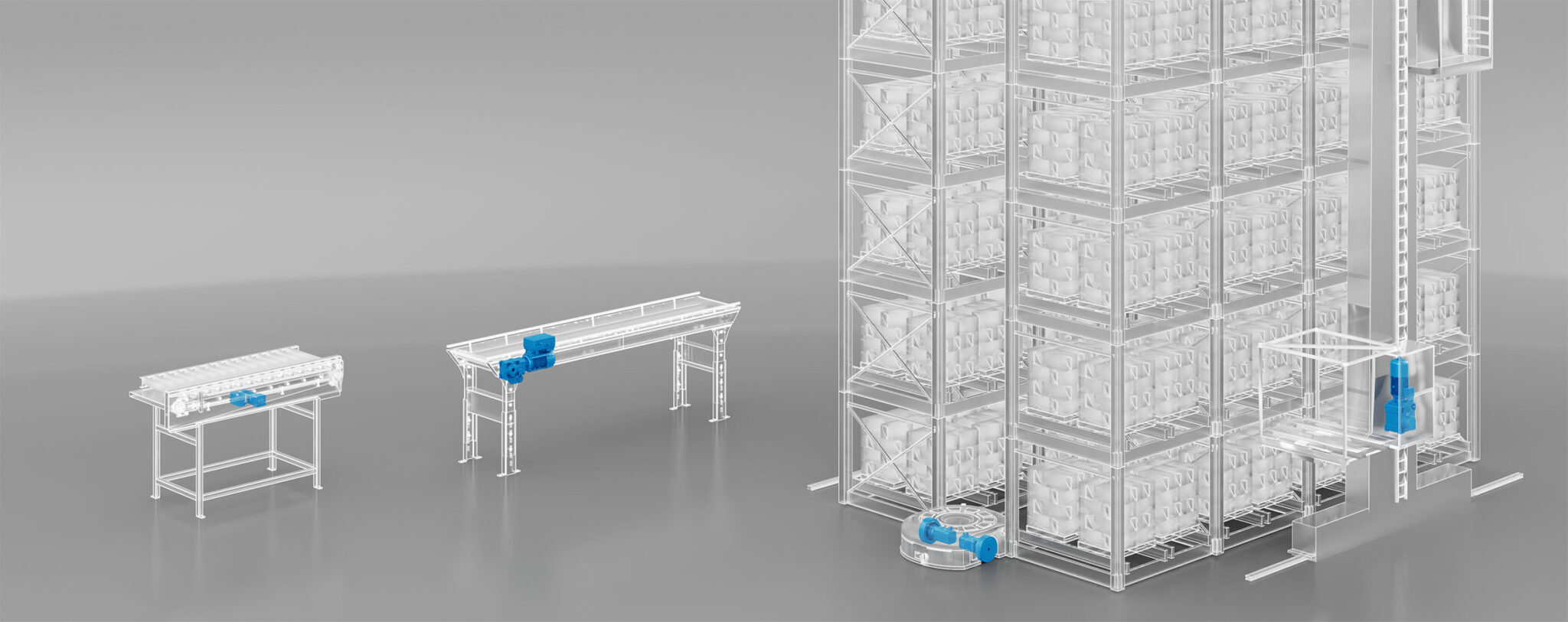
In new, highly automated small parts warehouses, linear robots pick goods around the clock. Cost-effective linear modules or complete multi-axis systems from Bosch Rexroth help to speed up the construction of dynamic pick-and-place systems. Low-maintenance electromechanical cylinders ensure the availability and controllability of the lifting systems of autonomous mobile robots (AMRs) and automated guided vehicles (AGVs). Small modules (SMS), small electrified linear axes, transport masses of up to 88 kg in an energy-efficient manner. For all solutions, Bosch Rexroth offers smart e-tools for design, configuration, ordering and commissioning.

ACTIVE Shuttle: Ready for mixed operation with other mobile robots

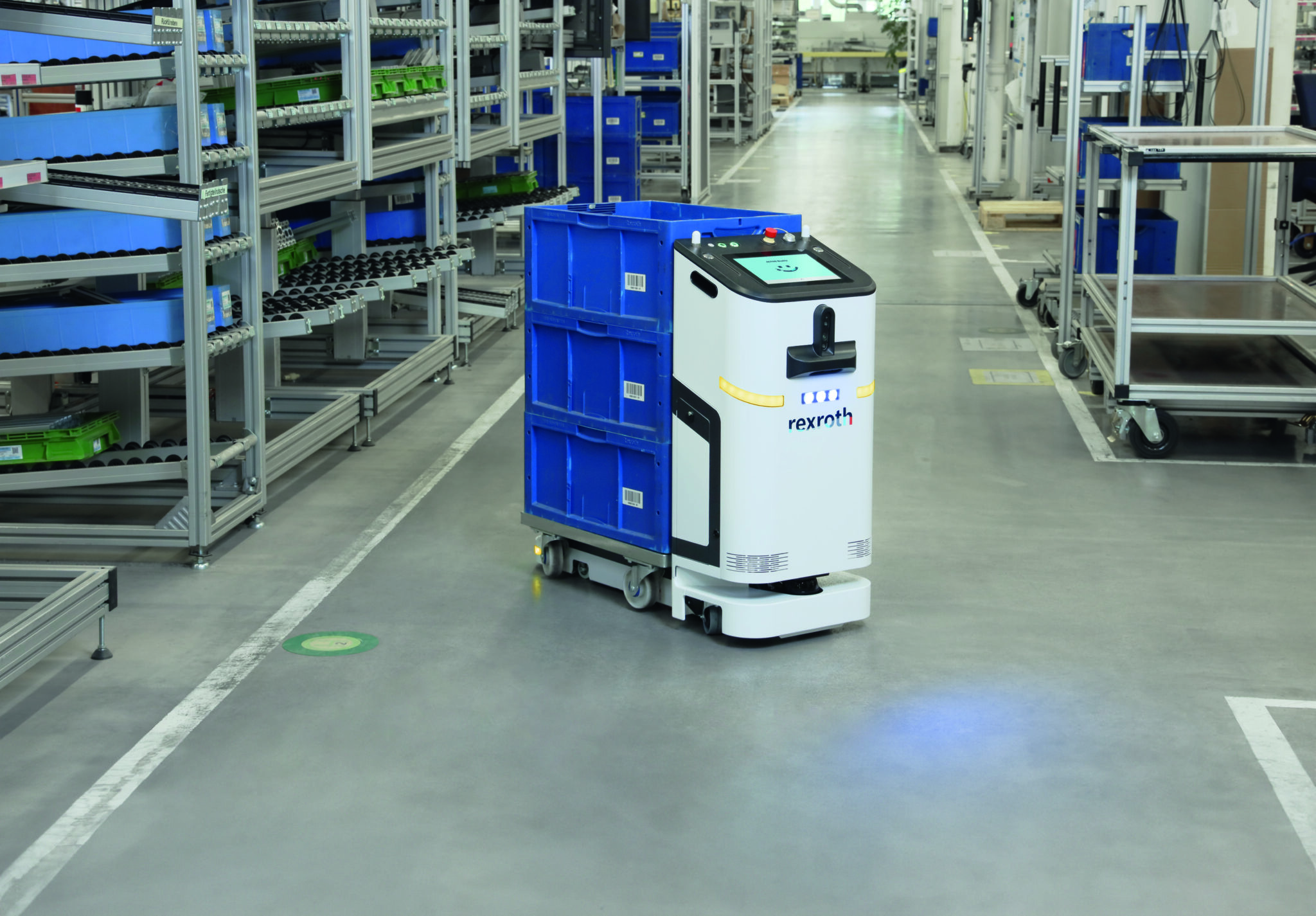
The ACTIVE Shuttle autonomous mobile robot increases flexibility in intralogistics for multi-variant production. It communicates with the master control system in a future-proof manner via the standardized VDA 5050 interface. This interface, which is defined across manufacturers, is the result of a collaboration between the German Association of the Automotive Industry (VDA) and the VDMA’s Materials Handling and Intralogistics group. It simplifies mixed operation with mobile robotic systems from other manufacturers. With the help of the associated fleet manager, the ACTIVE Shuttle Management System, users can also control and track a large number of transport jobs and their robots.

Flexible robotics: Software recognizes new products without having to be taught

Order picking is one of the core processes with the greatest shortage of workers. Smart Item Picking, the intelligent software toolkit for common industrial robots, recognizes a large number of objects to be gripped without models and without teaching. The software provides a full range of modules – from image processing and object recognition to path planning in a secure IPC environment. The hardware-independent solution combine high pick rates with significantly reduces error rates.

Comprehensive automation portfolio: The success factors modularity and openness

Modularity is the key to automating mobile robots quickly and easily. With the modular and efficient automation kit for warehouse and intralogistics applications, manufacturers of automated guided vehicles (AGVs) and autonomous mobile robots (AMRs) can implement their know-how quickly and easily. As a result, they reduce the time to market for customer-specific solutions.

As an open complete solution, ctrlX AUTOMATION provides all the elements for integrated automatic control, regulation, connectivity, monitoring and optimization of intralogistics systems. The modular overall system provides hardware and software as well as services. In addition, ctrlX AUTOMATION reduces the engineering work for intralogistics solutions by 30 to 50 % and allows efficient automation, for example in combination with the ROKIT robotics kit. Its components – ROKIT Locator, ROKIT Navigator and ROKIT Motor – handle localization, navigation and movement execution of mobile robots and can be controlled and linked via the intuitive aXessor graphical user interface.

Localization: A one fits all module for simple localization

The ROKIT Locator is an intelligent localization software and records the position of manually operated vehicles such as forklift trucks, automated guided vehicles and mobile robots of all kinds in real time in dynamic environments. No reflectors or markers are needed. The high-performance algorithm in the real-time localization system (RTLS) uses the information from a laser sensor on the vehicle and automatically records and maps the natural surroundings. During operation, the ROKIT Locator recognizes changes in the environment, automatically updates the map of the surroundings and then makes it available to the entire fleet. Thanks to the flexible integration options, straightforward commissioning and intuitive use of the software components, manufacturers can reduce their development and application costs as well as their service requirements at the end customer.

read more

AMR Provider Geek+ Teams Up with Drive Technologist Bosch Rexroth


ecommerce Transforming Express Courier Services

Online to inflight, ecommerce is transforming international express courier services, writes Matthew Ware, CEO at CFL, Chairman at Aviation Services UK.

It is widely believed that Sting’s “Ten Summoner’s Tales” was, in 1979, the first ever item purchased online – marking the birth of ecommerce. Today, the global ecommerce market is simply vast; in 2019, ecommerce value was estimated at $26.7 trillion, about 30% of world GDP, according to a 2021 report by UNCTAD, the United Nations Conference on Trade and Development. But it is a fragmented, complex market; B2B, B2C, and more recently growing C2C purchases combine to create a demand on the global delivery ecosystem that today is still soaring.

Build it and they will come

There are over 5 billion people connected to the internet today. Consumers can shop anytime, from anywhere, using virtually any device, as businesses can order raw materials, components, and finished goods. This extraordinary expansion has created a near-insatiable demand, the impacts of which are felt in every corner of the globe. The airline industry is the key element – IATA says 80% of e-commerce goods by value travel by air.

But it’s not all driven by consumer and business demand; as express air connections are made, markets are opened and trade flows. For example, there has been significant growth in imports from India over the last two years, largely by growing capacity at Indian airports and an increase in the number of direct links to Heathrow.

What can be measured

The proliferation of mobile apps and online platforms has given customers accurate tracking, real-time updates, and personalised communication – in short, much greater control and visibility over their shipments. These digital solutions streamline order placement, payment processing, and returns management – still a critical element when buying online. Most airlines cargo handling technology remains behind developments in their passenger businesses.

General cargo products inability to easily capture and track item level data sets is problematic for ecommerce shipments where you have consolidations that contain many thousands of different items going to many hundreds of different recipients. Capturing key data around customer preferences, speed of on and off-boarding, the online selection and ordering process, and other metrics, results in an increase in the ability to manage or influence these key measures. Only by knowing how you’re doing today can you hope to do better tomorrow.

B2B 2 C2C

The ability to source from literally anywhere enables organisations to optimise the balance between price, quality and choice. – B2B ecommerce typically involves larger volumes, higher average order values, and longer-term contracts compared to B2C transactions. B2C ecommerce is facilitated by global marketplace platforms such as Amazon and Alibaba, which connect consumers with sellers and merchants from around the world. C2C e-commerce platforms enable individuals to buy and sell goods directly from/to other consumers. Online marketplaces, such as eBay and Craigslist, support these peer-to-peer transactions.

All of this is dependent upon a fast, reliable, secure, convenient and affordable courier network that spans the globe yet reaches right along that famous last mile to your doorstep. Meeting all these requirements sounds like Mission: Impossible, especially when you add in regulatory complexities, lack of cargo capacity and shortage of nighttime flying slots. So, how do you make the seemingly-impossible possible? In simple terms, you automate and innovate. Automation, artificial intelligence (AI), and machine learning algorithms optimise route planning, package sorting, and delivery processes, reducing transit times and costs.

Room to grow

Airfreight in general accounts for only around 0.5% of UK total international movements by weight but about 45% by value, according to a report by the Freight Trade Association. There are around 70,000 domestic SME businesses online that don’t trade internationally but would like to, according to a report prepared by the Social Market Foundation, and supporting them to access global markets would be a hugely positive development both for the logistics sector and the wider UK economy.

The government has set up an ecommerce trade commission to explore how to support this, and many interested parties, including CFL, are engaging with the commission to support this ambition. One solution could be to extend express courier facilities to other, smaller airports around the country. Cargo in and out of Heathrow is more than the sum of all other UK airports cargo shipments taken together. Manchester or Gatwick could offer useful gateways with a dedicated courier facility – something that was actively discussed before the pandemic and may well emerge again soon.

Going further, a greater number of overseas facilities like those at Heathrow could create a network whereby ecommerce importers and exporters would have greater access to integrator-like services, with wider choice and greater certainty over service consistency. However, airfreight is predicated on large consolidations that do not sit comfortably with tracking individual parcels or items – a critical requirement for ecommerce shippers. So express courier providers must develop systems to support their customers and affiliated airlines in capturing this data, to accelerate clearance, customer visibility, and support returns and duty and taxes recovery.

Cross-border ecommerce is a heady mix of B2B, B2C, and C2C transactions, combining to create an enormous global flow of raw materials, components and finished goods. While B2B transactions traditionally dominated, the growth of B2C and C2C ecommerce has expanded the scope and scale of international commerce, creating new opportunities for businesses, consumers, and the delivery ecosystem.

Expansion of capacity and cargo flight slots will help meet the surge in demand, as will the expansion of express courier facilities around the world. However, obstacles such as regulatory complexity, data security risks, and supply chain disruptions, create constraints within which the industry must operate. ‘twas ever thus. As ever, the answer is to innovate, and the industry is trying to find ways by adopting and adapting technology. But the wide technology disparity across the ecommerce ecosystem has led to serious fragmentation – a situation not helped by the perpetuation of legacy systems.

We’ve come a very long way from that single, insecure, slow purchase of Sting’s album in 1979.

read more

NL ranks first for courier innovation


Operator Assistance Optimises Warehouse Practices

Yale Lift Truck Technologies has launched Yale Reliant – an advanced suite of operator assistance technologies that help reinforce lift truck best practices in warehouses and intralogistics operations. The innovation was shown for the first time in Europe at LogiMAT 2024.

At the heart of Yale Reliant is advanced dynamic stability technology. This adjusts performance of the lift truck or warehouse equipment in real time, assisting the operator to not exceed the truck’s capabilities. This may be a reduction in travel speed or truck acceleration, or a reduction in lift speed or tilt speed. Whatever movement may potentially lead to an instability incident can be reduced in intensity or blocked altogether, all while the operator remains in ultimate control of the equipment. Yale Reliant also provides audible and visual alerts to aid compliance with best practices.

“Warehouse environments are often complex, and operations are increasingly under pressure to increase throughput and orders picked. However, companies also cannot ignore the importance of occupational safety for everyone working on, or close to, warehouse equipment,” says Ron Farr, Director, Warehouse Sales, EMEA from Yale Lift Truck Technologies. “The Yale Reliant Operator Assistance System (OAS) is a result of more than 29,000 hours of research and development, giving us the expertise and insight to deliver a scalable solution, driven by the real challenges of diverse intralogistics operations.”

The power of Yale Reliant comes from three core technologies. Proximity detection is provided by local or real-time location technologies that use tags on equipment, pedestrians, and infrastructure. This enables truck-to-truck, truck-to-pedestrian, and truck-to-beacon detection. Lidar-based technology (light detection and ranging) is leveraged to detect obstacles without proximity tags in the path of travel. Meanwhile, advanced dynamic stability provides advanced traction, hydraulic, and overload control to support truck stability.

Operator Assistance

These integrated technologies combine to give warehouses different ways to harness the benefits of Yale Reliant. For instance, a warehouse may use the system to control equipment speed in order to maintain a specific following distance between equipment. If required, location-based rules can also be set. For example, limiting travel speed at the end of aisles or excluding certain equipment from pedestrian areas. Warehouses can also set up the system to restrict travel and lift functions or reduce speed to avoid stability issues.

“Intralogistics applications are increasingly looking for technologies that support efficiency now, but also enable their operations to be ready for the future as warehouses evolve,” explains Ron. “Our network of independent Yale dealers are local experts who can provide insight on the right solution for the specific operation, from selecting the right truck fleet, to implementing Yale Vision telemetry, or advising on the optimal suite of operator assistance technologies – such as Yale Reliant.”

read more

Premiere for Yale Reliant Lift Truck


Digitalisation Journey of Transportation

We can observe that all small or large scale businesses are in a serious search for the digitalisation of transportation, writes Oğuzhan Karaca (pictured). We can also notice from their questions and views that they cannot find a clear answer to their search. In terms of B2C logistics, it is obvious that they complain about the slowness in the reflection of rapid digitalisation on B2B processes. They seem to ask why it is not possible to see the rapid digitalisation experienced in last mile delivery, micro distribution and cargo processes also in FTL (Full Truck Load), LTL (Less than a Truck Load) and Partial Loads.

Although entrepreneurs and start-ups have not yet made a serious presence in the road transport segment, they are still not discouraged, they continue to focus on the subject, but on the contrary, investors seem to stay away from this segment. In fact, although it has much simpler processes than last mile delivery, investors seem to be hesitant to foresee the effects of the re-sistance of the carriers to digitalisation. The lack of a success story in the digitalisation of road transportation segment also affects the decision of investors, or the bad taste left on the palate by the many failures still prevails.

Let’s take a look at the digitalisation journey of transportation together. Actually, everything has started and developed with the introduction of TMS (Transportation Management Sys-tems) into our world. Let’s take a look at what the major ERP players say about TMS and how they define it.

Oracle defines TMS as ‘‘A Transportation Management System (TMS) is a logistics platform that utilises tech-nology to help businesses plan, execute and optimise the physical movement of goods, both inbound and outbound, ensuring that the entire transportation pro-cess complies with applicable laws and that appropriate documentation has been obtained. Such a system is often part of a larger supply chain management (SCM) system.’’

The definition of SAP is as follows: SAP Transportation Management application integrates fleet and logistics management throughout your network, helping you to reduce complexity, increase efficiency, and improve agility for a more sustainable, risk-resilient supply chain.
In fact, both definitions draw a picture of digitalisation that supports process management and presents the efficiency that will arise from the organisation of work-flows as a value proposition. It is difficult to observe that TMS has been actively used outside of large corporate companies.

At the SME scale, it would be correct to say that TMS does not exist at all. We know that a simpler version of TMS is used as a fleet management tool in logistics companies. It mostly serves as an algorithm focused on repair, maintenance, service and consumables man-agement of assets and fuel expenses. In addition to this, they also provide support for driver work planning, calculation of overtime, per diem and premiums. TMSs also have menus for customer invoicing and document management. Then, why have TMSs not been able to go beyond large corporate companies?

The answer to this is actually simple, because TMSs do not reflect the reality of the field, cannot show the big picture, and cannot offer a value proposition to companies outside of process management.

Shannon Vaillancourt, in one of her articles, lists 3 reasons why the TMS has failed, among them, the third one attracted my attention the most: “Your TMS isn’t providing the complete picture. When you don’t have the data you need, the promised analyt-ics are either unavailable, insufficient, inaccurate or late. The data you require to improve your efficiency is not available through current sources. If you have data, it’s likely uncleansed, unstructured, and unstandardized. Or, your TMS is incapable of ingesting, processing, and reporting it. You’ve created a data lake but are drowning in data and starving for intelligence.

Plus, data collection is only part of the problem. Your system needs to be able to process the voluminous da-ta, identify trends and provide actionable insights. What analytics you do have are historical, and by the time you identify a problem or issue, it’s too late. The money is already out the door, the marketplace has changed, or your processes have not kept up, and you have new problems. Your TMS has value but not the answer.”

I agree with Shannon Vaillancourt’s view; in fact, existing TMSs have not gone beyond being a Business Process Flow Management tool. It has failed to produce an an-swer for users from the processed data and to show the big picture. In short, it remained passive rather than proactive. It could not proactively strengthen itself with data analytics and smart decision support mechanisms.

Behind TMSs, the development of Load Boards catches our eye. What is the role of load boards, which are very actively used in America, in the digitalisation of transportation?

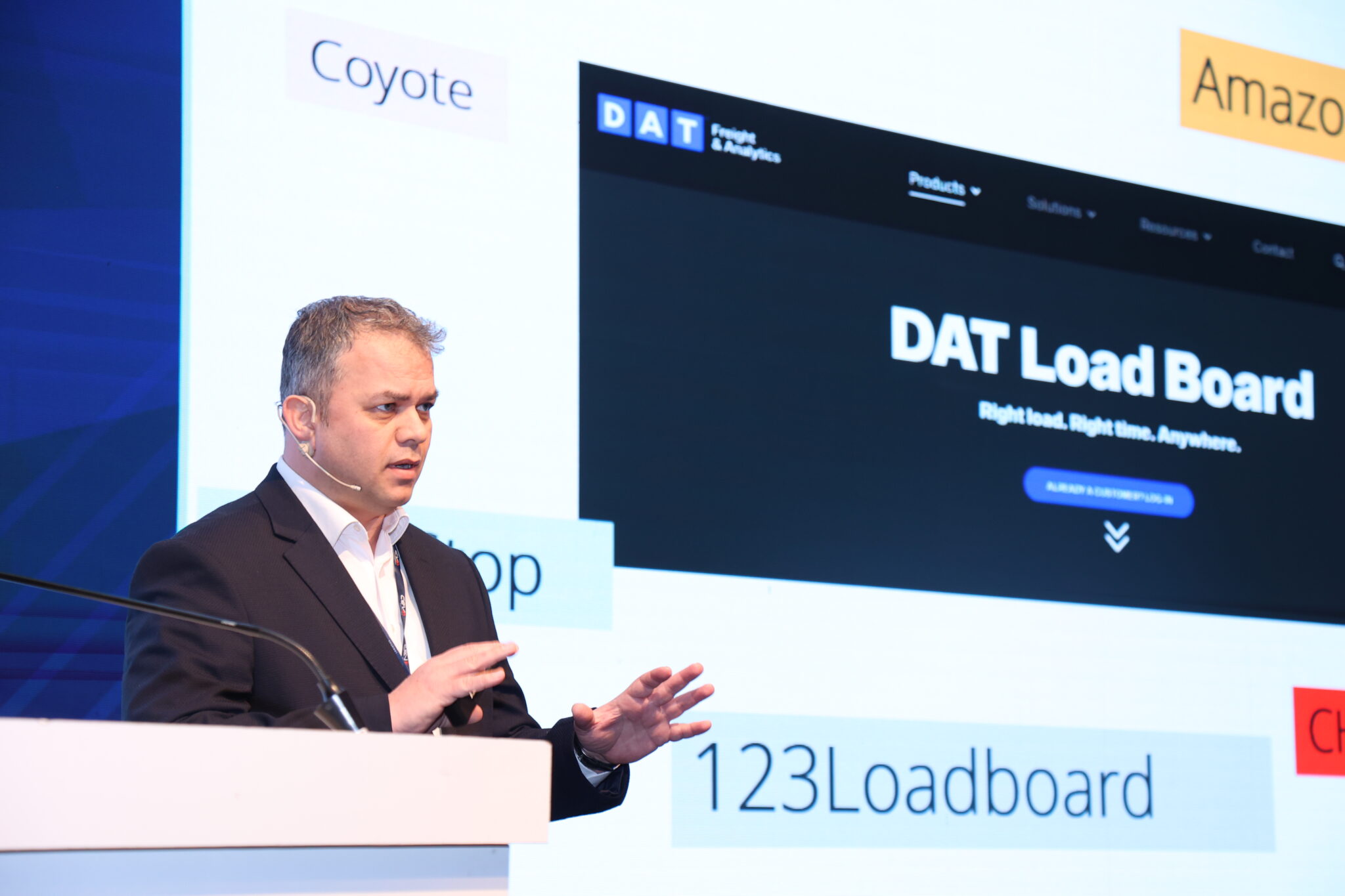
Let’s see how ‘‘DAT Load board’’, one of the most widely used load boards in America, defines itself. “The DAT load board is more than just a list of loads. The DAT load board is a place to develop relationships with freight brokers and shippers — and your key to building a smarter trucking business. Access the most comprehensive freight listings anywhere in the industry. Make the most of pricing tools to find your best rates. Re-search broker credit history for trustworthy transactions.”

When you think of a load board, you actually imagine a world where the shipper posts its load, the carrier plac-es an offer, and the carrier that offers the best price at the end of the tender receives and successfully performs the work, right?

We observe that both the shipper and the carrier utilise load boards as a means of gaining access to data. It would not be wrong to say that if there is big data, there is a need for data mining, otherwise no value can be generated from the data.

So, who mines this data? ‘‘brokers’’ and ‘‘forwarders’’ perform the mining on behalf of the shipper; ‘‘dispatchers’’ (fleet managers, mediators) perform the mining on behalf of the carrier, and at the end of the day, they call everyone on the short list created through the load boards by phone and attempt to finalise the sale. In other words, we can think of load boards as places where the buyer and seller can access potential jobs as a result of data mining and where each opportunity must be manually handled one by one.

In other words, it is an important source of data in the journey towards the digitisation of transportation, but that’s it – the rest is up to your data processing capability. In fact, DAT expresses itself very well in its explanation: it defines itself as a place where shippers and mediators can develop a business relationship, which actually coincides with our evaluations; the job is finalised with phone calls and emails.
The Truckingoffice.com website has listed the advantages as well as the disadvantages of load boards as follows:

Disadvantages of Load Boards for Freight Management

Although load boards can be helpful in many ways, they are not a good long-term strategy. Why? For one rea-son, they are not very profitable. You’ll be better off get-ting direct contracts so you are in control and can keep all of the revenue.

Other disadvantages of load boards include:
• You’ll be dealing with strangers (who you hope are trustworthy).
• Lots of competition for loads.
• Freight brokers take a lot of the revenues.
• Their rates for your work are low.
After the experience of load boards, we witness that ‘‘Digital Freight Forwarders’’ are becoming widespread. So, what is the difference between a normal ‘‘forwarder’’ and a ‘‘digital forwarder’’?

Actually, at the end of the day, both produce the same service, however, ‘‘digital forwarders’’ have the ability to manage all business processes digitally, have reduced telephone and email traffic, offer instant invoicing, archiving, document management, traceability and opportunities to benefit from the benefits of artificial intelligence. The most important feature that distin-guishes normal forwarders from digital forwarders is the capability of instant pricing, but the number of digital forwarders who can provide this service seems to be quite small. ‘‘Digital forwarders’’ that have improved this capability seem to be one step ahead of the others.

Well, why is there hardly any example of a very successful ‘‘digital forwarder’’ on a global scale? Let’s take a look at the example of ‘‘CONVOY’’, which was supported by Jeff Bezos as an investor, which has reached a value of 3.8 $ billion. Then, why was the ‘‘digital forwarder’’, which reached such a high value, suddenly shut down by the end of 2023?

Mark Solomon, published an article on freight-wave.com on Monday, October 23, 2023 with the following title:
“Convoy’s tech focus may have obscured importance of human element.”

C. Thomas Barnes, a longtime transport executive who today is an investor in transport logistics companies, said Convoy failed because it didn’t have enough people with insider know-how to counterbalance the new ideas that typify an outsider’s mentality. “Is there a need for technology? Hell yes!” Barnes said. At the same time, it is vitally important to have traditional problem-solvers on the inside to make everything work, he said. Convoy’s failure is a microcosm of a larger problem, Barnes said. Many good outsider ideas go by the board because the insiders’ capabilities to support them are not there or because a balance between the two mindsets hasn’t been struck, he said.”

In fact, we see that the excessive technology focus of ‘‘digital forwarders’’ has overlooked the human resource factor in supply chain management and logistics. Both in the modelling of the process and in the management of the micro-operations. Therefore, there is a clear need for a hybrid model that will integrate both the digital and the human talent factor.

‘‘The best answer to the question of what will be the future of digital forwarders can be found in Prof. Dr. Stefan Iskan’s article Start-up or Old School Freight Forwarder? Who is in the best shape to win?

“We will see some of them unfortunately disappear from the market. Others will evolve into software pro-viders. Others will be acquired by logistics giants. Offer: Startup reaches out to SMEs for cooperation. Medium-sized companies, please take this opportunity. After all, startups will evolve into a new kind of software provider and TMS provider. Cooperate. Whoever manages to perform this incredible integration job will catapult itself to the top of the supply chain with its customers.“

Although this is a bit pessimistic, it is a very strong interpretation of reality. It seems that especially the focus of start-ups on SMEs will be a real starting point for them. There are serious opportunities in the SME segment, and the future of start-ups lies in digital integration with SMEs.

Up to this point, we have discussed the transformation of ‘‘TMS’’ into ‘‘Load boards’’ and then into ‘‘Digital forwarders’’, I believe it is necessary to address the financing dimension of the business a little bit.

In America, the factoring service is very intertwined with the transportation sector. In the ‘‘Rate confirmation’’ document signed between the shipper or broker and the carrier, the shipper offers the ‘‘Quick Pay’’ alternative to the carrier as well as the 30/60/90 days late payment terms and the majority of carriers prefer to receive their payments in cash from Factorings despite a financial cost amounting to 2-4%.

The answer to this question is actually simple, it is obvious that the carrier needs cash flow in order to cover its operational expenses. Fuel, repair, maintenance, porterage and similar expenses arise in every transportation and the carrier has to pay these expenses in cash in order for the trade to continue. And carriers, of course, prefer to receive their money from factoring for a rea-sonable price rather than collecting it from the shipper on a deferred basis.

We cannot ignore the importance of freight payment and payment speed in transportation. Digital forward-ers should not isolate themselves from the payment and financing dimension of the business. They need to offer alternative modes of payment to both the shipper and the carrier and use them effectively.

In the light of all these developments, the DIGINAK.com initiative has introduced a new concept: “Digital Freight Ecosystem”. The initiative promises an ecosystem where all players in the supply chain sector can work with each other in a healthier and more efficient manner rather than merely bringing the shipper and the carrier together.

DIGINAK proposes a supportive model that is not aimed at eliminating mediators for all parties but rather at enabling intermediaries to better manage the micro-operation rather than creating a disruptive effect. A transportation model is proposed in which all parties can invite their immediate circle into the DIGINAK eco-system and work effectively with each other.

Shippers, forwarders, brokers, mediators, brokers, carriers, banks, financial institutions, insurance companies and all other parties are part of this ecosystem. DIGI-NAK does not believe that the need for matchmaking in B2B transport processes is at a high level, on the contrary, it believes that the parties are highly integrated and connected with each other. However, based on the determination that a sustainable relationship cannot be achieved due to the lack of a healthy working environment, it has focused on improving the working conditions between the parties.

In countries where the asset investment is made by the owner operators (this is the case in many countries except the European Union), the effort to bring the shipper and the owner operators together does not yield the desired result. In fact, it is also a myopia to present this effort as the digitalisation of transportation.

The load finding behaviour model of the owner operators involves a unique ecosystem and sociology. In America, freelancers, who are called ‘‘dispatchers’’ but do not have a full legal equivalent, offer services to the carriers in finding the freight. On the shippers’ side, brokers manage the whole pro-cess and ensure its optimisation. The micro-operations of brokers are managed by independent freight agents.

This is where we see DIGINAK act as a marketplace for mediators managing micro-operation in the journey of the digitalisation of transportation. After registering with DIGINAK, we see that independent freight agents can act as brokers through DIGINAK’s licences and financ-ing. Dispatchers, on the other hand, are no longer free-lancers, but they do the data mining of carriers through DIGINAK and ensure that the carriers meet with the most accurate load and manage the next micro-operation.

The DIGINAK ecosystem has developed a unique eco-system pyramid with Financing at the bottom, Hybrid integration in the middle and Optimisation at the top. DIGINAK regards the improvement in freight payment processes as the primary concept that mobilises the ecosystem. Next, with hybrid integration, it includes the mediators that manage micro-operation with the power of digitisation. At the top of the pyramid, algorithms equipped with artificial intelligence provide users with optimisation and efficiency.

It is apparent that the value proposition of DIGINAK and the newly developed concept of ‘‘Digital Freight Eco-system’’ will bring a significant breath of fresh air to the digitalisation of transportation. DIGINAK, which is the largest ‘‘Digital Freight Ecosystem’’ in Türkiye, has set its sights on expanding into the Gulf region, particularly Saudi Arabia.

Digital transformation in transport seems inevitable, and there is no doubt that supply chain managers, shippers, carriers and mediators will successfully accomplish this process with their cooperation.

read more

Key Trends for Freight Forwarders

 

Trailer Truck Loading, Unloading

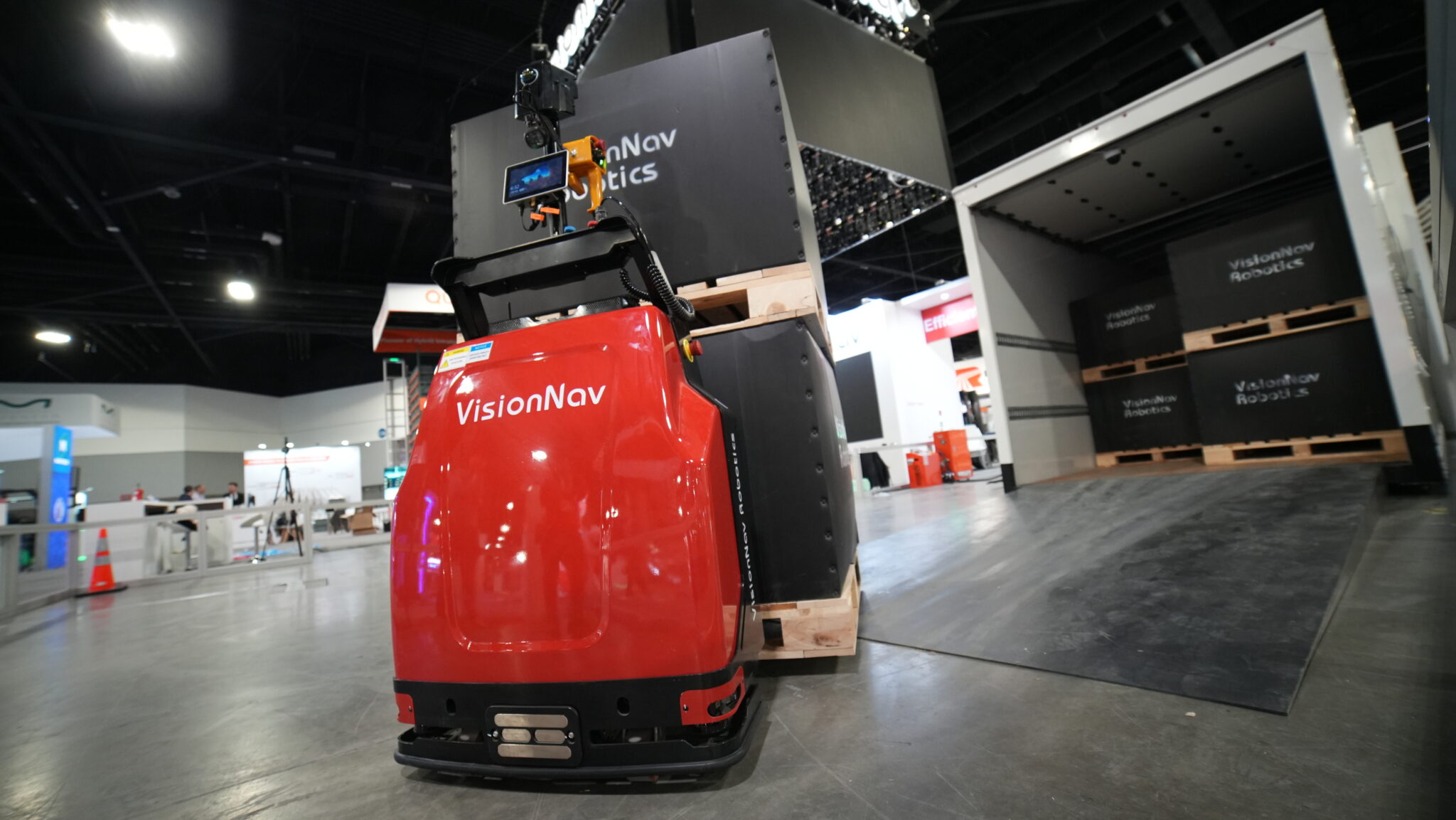
VisionNav Robotics launched its latest automatic trailer truck loading and unloading solution – featuring the newly unveiled VNST20 PRO AGV robotics – to a European audience at LogiMAT 2024, the international trade show for intralogistics solutions and process management in Stuttgart, Germany. The European premiere of the pioneering solution from the materials handling robotics specialist saw demonstrations of how it is capable of loading and unloading trailer trucks in just 45 minutes.

VisionNav’s high performance autonomous forklift VNST20 PRO combines an advanced Robot Control System (RCS) for fleet scheduling and 3D LiDAR SLAM positioning technology for market-leading accuracy. The VNST20 PRO has been designed specifically for floor handling and now enables us to load and unload trailers.

At LogiMAT 2024, VisionNav’s stand featured an immersive display allowing a technologically advanced exploration of the capabilities of VNST20 PRO, which marks an evolutionary step in the development of trailer truck loading and unloading.

Powerful 3D perception, state-of-the-art mapping, and market-leading accuracy

Fitted with a powerful RCS which utilizes state-of-the-art 3D perception, mapping, localization, and routing technologies, the VNST20 PRO generates efficient loading and unloading strategies.

Featuring 3D LiDAR SLAM positioning, the dedicated, proprietary system delivers increased space utilization, high scenario adaptation, high compatibility, and reliable solution redundancy to provide fast, safe, and efficient cargo handling.

Available in Europe from 2025, the VNST20 PRO can adapt to diverse trucks, goods, and environments, utilizing self-adaptive perception for diversified environments and dynamic mapping for dynamic routing in container. It is compatible with a wide range of trucks in Europe and North America, and can be tailored to a variety of pallets, including EPAL and CHEP. VNST20 PRO is easily switched into manual mode to prevent operational delays.

Key features of VisionNav’s VNST20 PRO:

– Rated load capacity of 2000 kg
– Minimum turning radius of 1,431 mm
– 3D LiDAR SLAM Technology

Enhancing work efficiency and safety, the VNST20 PRO represents the pinnacle of AGV robotics, transforming cargo handling by enabling rapid loading or unloading of trailer trucks in just 45 minutes. This groundbreaking approach revolutionizes traditional methods of trailer truck operations.

read more

VisionNav introduces driverless forklifts to Europe


Digital Compressed Air Monitoring Cuts Costs

SICK has unveiled a pioneering compressed air monitoring system that accurately predicts where significant energy cost-savings can be made by fixing air leaks and removing wastage across entire logistics facilities.

SICK’s Monitoring Box FTMg Premium is a digital and scalable service that can be used by production planners, energy managers and maintenance engineers to make compressed air cost savings of up to 30%, as well as to eliminate costly manual maintenance regimes.

The enhanced digital Monitoring Box Premium service analyses and displays accurate data from SICK’s FTMg multifunctional flow sensors that measure the compressed air usage of machines and processes. Compressed air consumption data is visualised in easy-to-use graphic displays, while alarms can be set up to alert when new leaks occur.

By interpreting the data, leaks and inefficiencies are easily eliminated, users understand their processes better and can make around-the-clock decisions to optimise their energy usage. They can make their production processes more sustainable, for example by reducing their CO2 consumption. The data insights also contribute towards ISO50001 Energy Management certification.

Expensive Resource

Compressed air is one of the most expensive resources used in production, and energy prices have risen sharply. Identifying and correcting leaks is a time-consuming and labour-intensive process of routine checks that can still only ever identify leaks at one fixed point in time. Charlie Walker, Digital Solutions Consultant with SICK UK, explains:

“Even if you walk around the factory today and identify and fix all your leaks, tomorrow there might be three more you will not have found. Now you can drill down using precise real-time data to discover exactly when, and where, you are producing air and wasting it. The system will tell you how much wastage is going on, and what that’s worth in real money. So, you know when to take action.

“Ultimately compressed-air costs could be reduced by up to 30% delivering a significant Return on Investment, while reducing your CO2 footprint and making servicing both more efficient and effective.”

Enhanced Digital Service

Already, the Monitoring Box FTMg Premium is being used successfully by SICK customers who have welcomed the easy-to-use data visualisation and scalability of the system. They have been able to set up specific alarms to indicate leaks or inefficient machine consumption. By comparing compressed air data from each measuring point, machine, and production line, cost drivers or over-consumption have been identified, for example, by comparing a machine type with the same function on two production lines. Compressed air efficiency comparisons can similarly be made across plants.

The SICK FTMg which stands for Flow Thermal Meter for inert gases, uses the dynamic calorimetric principle for precision measurement, enabling it to detect even the smallest changes reliably. Its straight measurement channel design ensures highly-accurate measurement with almost zero pressure loss as gases flow through the sensor during measurement.

The SICK FTMg enables measurement of live values for compressed air energy in kWh. Data from the FTMg flow meter is presented via the SICK FTMg Monitoring App, which has been developed from SICK’s proven Industry 4.0 Monitoring Box condition monitoring platform. As well as values for pressure, temperature, flow velocity, mass flow rate and volumetric flow rate in real time, the sensor provides totals for energy use, volume and mass over a pre-defined period.

The user-friendly dashboard makes it easy to interpret data to detect leaks or overconsumption and to look for changes and trends. Email alerts can be set up for maintenance reminders or to give pre-defined warnings with job recommendations, for example when data strays beyond pre-defined limits. Users can drill down to identify costs, for example for individual production centres or by shift.

‘Bolt-on’ Transparency

Up to eight FTMg flow meters can be configured via each SICK Smart Services Gateway, which collects data, aggregates and encrypts it before sending it securely via the customer’s own IT infrastructure through a firewall to the SICK cloud. Alternatively, it is possible to by-pass the IT infrastructure by using mobile communications over 4G. Individuals then have access through a personal SICK ID from any device with a web browser.

read more

Atlas Copco delivers 50 tonne compressed air package to Shah Deniz oilfield in the Caspian Sea


Solutions for Intralogistics Needs at LogiMAT

Bonfiglioli boosts its intralogistics participation at LogiMAT with two booths: the first, in the Hall 10, is dedicated to Solutions for Mobile Intralogistics (Booth 10D13), the second, in the Hall 7, is focused on Logistics Automation Solutions (Booth 7F09). This double presence holds significant strategic importance, reflecting the company’s steadfast commitment in the development of complete cutting-edge solutions for warehouse operations, under the sign of efficiency and sustainability. Showcased is a wide array of systems for belt and roller conveyors, AGVs, AMRs, forklifts and automatic storage systems, as well as an IoT platform.

In the Hall 10, Bonfiglioli dedicates ample space to the 600F series, electric drive axles for forklifts, which makes a significant return. The series is equipped with planetary axles and drives featuring integrated high-performance electric motors and low-maintenance braking systems, and it can be applied to 3- and 4-wheel counterbalance lift trucks and ground support equipment. These drives are available in different sizes, also for bigger forklifts, and offer reduced energy consumption, resulting in longer battery operating times, extended service intervals and a lower overall cost of ownership.

The EL Series which identifies steerable powertrains for pallet trucks, stackers, reach trucks and other types of warehousing machinery, has been expanded this year into the new size EL 16. Developed for heavy load warehouse equipment, it is equipped with a multifunction unit that ensures the complete control of acceleration, steering and braking. It can carry a vertical load up to 4.5 tons and thus represents the best choice for the most demanding warehousing applications.

BlueRoll is also on display. This innovative platform features wheel-mounted gearmotors tailored for AGVs and AMRs, boasting an ultra-compact and energy-efficient design to ensure prolonged operational cycles. The modular drive system offers three configurations – Basic, Advanced, and Compact – with customizable single gearbox loads ranging from 360 to 1020 kg and a maximum speed of 2m/s.

In Hall 7, Bonfiglioli unveils three solutions that improve efficiency, boost productivity and reduce downtime. An AGV solution featuring the platform BlueRoll is also present at this booth.

The first intralogistics solution showcased at the Booth 7F09 and which has been specifically developed for post & parcel handling systems, combines high efficiency and reliability, low maintenance costs and a wide torque range. It consists of a compact right-angle A gear unit available in a wide torque range, an IE4 certified reluctance synchronous motor of the BSR series – an ecological and high-performance product (thanks to the absence of magnets) – and a DGM decentralized inverter, fitted with a sensorless vector operation for an optimal dynamic control. The right angle layout between INPUT and OUTPUT makes the A Series particularly compact. The gear set combination makes this right-angle product the most efficient and durable in Bonfiglioli’s light and medium-duty portfolio. The A Series can be completed with a wide range of electric motors entirely manufactured by Bonfiglioli.

For heavier applications, i.e. logistics and transport on roller conveyors carrying out bulky parcels and pallets, Bonfiglioli has developed the second combined solution featuring a helical in-line CP47 gearbox, a MXN 20 asynchronous reluctance motor and a DGM decentralized inverter. Indeed, DGM inverters offer many benefits in terms of efficiency, reliability and safety, because wiring and troubleshooting costs are reduced, while product modularity and interchangeability are enhanced. Moreover, real time check of main gearmotor parameters is guaranteed through fieldbus interfaces or protocols.

Intralogistics at LogiMAT

The third solution boasts a BMD servomotor – a permanent magnet synchronous motor with highly compact dimensions and low inertia – combined with an A20 helical bevel gearmotor and the inverter AxiaVert. Top-level functional safety and high control performance for a wide spectrum of applications are the key benefits and features of the AxiaVert platform. A drive which offers seamless integration into automation networks and compatibility across an extensive range of fieldbus protocols, both on a serial and on an Ethernet basis, fostering production optimization in accordance to Industry 4.0 standards. Its different Functional safety variants allow to optimize configuration, reducing the need for external safety components and ensuring a safe and controlled operation to minimize hazards. Additionally, precise motion control for open and closed loop applications maximizes efficiency and productivity, for a wide range of motion requirements. Its modular structure allows flexible adaptation to diverse applications by selecting appropriate hardware modules and customizing operational behavior through user-level PLC software programmability. Available in different selectable cost and performance related variants – Basic, Standard and Motion: the latter including the networked safety protocol FsoE (Fail Safe over EtherCAT). AxiaManager is the comprehensive engineering software designed for the planning, commissioning, operation, and monitoring of the AxiaVert inverter series. Furthermore, Users can count on support from a Bonfiglioli expert from commissioning to troubleshooting thanks to an online remote assistance function.

Finally, Bonfiglioli presents its Condition Monitoring and Predictive Maintenance services, which respond to the necessity of maintaining comprehensive control and visibility over machinery. The former allows customers to know the overall status of their equipment by regularly collecting real-time data and identifying significant changes in parameters through an IoT platform equipped with sensors that measure performance, consumption and real duty cycle of the machine. The latter helps prevent damages and downtime by providing key information about, for instance, oil change intervals and hence planning the necessary technical operations in advance.

read more

Italian Specialist Bonfiglioli to Present Electric Drives at LogiMAT


Sustainability and Communications Manager at RCP

Rubbermaid Commercial Products (RCP) has announced the appointment of Adriana Olaya Rodriguez as its new Sustainability and Communications Manager.

The multi-lingual author of Make them Behave Sustainably, takes on the newly created position at the global waste and recycling, cleaning and hand hygiene manufacturer. She will be spearheading sustainability strategy in the EMEA, LATAM and APAC regions, looking to drive positive change through actions, communications and engagement, and supporting RCP’s customers and distributors to do the same.

Adriana brings with her a wealth of experience having worked with some of the biggest names around the globe in a variety of sectors from food and beverage to pharmaceuticals and cosmetics. She has provided strategic guidance to a diverse range of businesses, helping them to define, shape and implement intelligent and credible environmental sustainability programmes that engage stakeholders to drive real change.

Emilio Capelli, Vice President Sales & Marketing at RCP said of the appointment:
“We’re delighted to welcome Adriana to the team. As a business, we understand our responsibility to operate as sustainably as we can so bringing on board someone of Adriana’s calibre is a real step in the right direction, enabling us to make strides forward on our award-winning Love Sustainability Journey.

“Not only will Adriana’s expertise help us to define, shape and implement our own sustainability goals, but her work will also allow us to further support our customer and distribution partners to drive real change in their own organisations.”

Adriana said of her new role:
“I look forward to bringing my expertise to RCP and helping to implement a strong sustainability strategy to shape our business to operate within planetary boundaries. I have been impressed by the commitment of the RCP team and the progress made so far in its journey to reduce RCP’s and our customers environmental impacts. I look forward to building on these foundations to bring RCP sustainability efforts to the next level, challenge the status quo, engage and excite our customers, distributors and my colleagues through actions and communications, so that we can all make long-lasting change.”

read more

RCP launches new sustainability vision and roadmap


Operationally Carbon Neutral Warehouse

DHL Supply Chain announces the opening of a new multi-user facility in Coventry. The new building is entirely powered by renewable electricity and is the first operationally carbon neutral new build DHL site in the UK.

The building, which has been certified as BREEAM ‘Outstanding’, features an air source heat pump which provides all the warehouse and office heating and cooling requirements. This system will save approximately 135 tonnes of CO2 annually compared to a gas-powered system. Meanwhile, 3000 solar panels, supported by a custom onsite battery storage system developed by DHL’s in-house Digital Manufacturing team, provide over 40% of the site’s electricity, and has increased energy self-sufficiency on site. The site load has been intuitively configured to use stored electricity via the battery storage solution and shift peak demand to off-peak; whilst a real time Building Management System allows continuous visibility of the system’s overall performance. The site features 30 electric vehicle charging spaces and uses all-electric material handling equipment as well as a brand new fully electric tug.

With 900,000 square feet of operating space, the site has been configured for retail and consumer brands with omnichannel requirements thanks to high-capacity racking, a state-of-the-art pick to light system and three levels of mezzanine flooring for lightweight goods. Additional automation features include autonomous cleaning robots, a mobile wrapping robot, and a dimension system to automatically measure the dimensions and volume of parcels and pallets for faster categorisation and sorting.

Natalie Frow, Managing Director Ecommerce & Retail, DHL Supply Chain UK & Ireland said: “As a warehouse that is fully powered by renewable electricity, our new Coventry operation sets the standard for the industry. The highly considered design and fit-out is centred on our three priorities, our people, our customers, and our environment. We’ve created an operation that is not only highly efficient at meeting the demands of omni-channel brands, but it’s a positive space to be in. Since opening applications for vacancies, we’ve had more candidates than any other site which really shows that we’re meeting the needs of the modern workforce and I’m delighted to be welcoming so many new people into the DHL family.”

Andy Street, Mayor of the West Midlands, said: “DHL Supply Chain’s new facility at Coventry Cross Point is certainly impressive, especially in terms of its eco credentials. That’s important because the private sector’s role will be mission critical in helping us achieve our ambitions to be a net zero region by 2041.

“Two other things stood out for me. First was the state-of-the-art service being provided to business, crucial given how the supply chain is such a competitive part of the business world. Second was how this new facility is yet another example of the high levels of inward investment we are seeing across the West Midlands right now, which is providing thousands of good quality jobs for local people.”

The building has been designed with employee wellbeing front and centre. It includes biophilic interior design features to improve employees’ connectivity to the natural environment through features such as side panel windows to bring in natural light, living walls and plants, as well as the use of sustainable, recycled, and natural materials throughout the building. The site also features a contemplation room, a quiet room and a live kitchen serving freshly cooked, healthy meals.

The facility has been built in line with DHL’s Carbon Neutral Building Framework and supports DHL’s Sustainability Roadmap. By the end of 2025, all of DHL Supply Chain’s warehouses will be operationally carbon neutral.

The new warehouse is part of the expansion of the DHL Fulfillment Network (DFN) in the UK.

read more

Podcast: Energy Usage and Carbon Neutral Supply Chains


New AI Technology for Warehouse Optimization

UK-based robotics and data intelligence company Dexory is introducing a first of its kind, AI-powered logistics engine to help warehouses maximize operational efficiency, optimize inventory management, and enhance the overall warehouse agility and responsiveness.

Through its multi-site, digital twin platform, DexoryView, Dexory will now enable warehouse operatives to process millions of precise data sets captured daily across warehouses via its autonomous robots, providing real-time access to insights and predictive analytics that enable businesses to make smarter, faster decisions.

The combination of computer vision, machine learning, NLP (natural language processing) and LLM (large language models) will allow warehouse operators to maximize efficiency across critical drivers such as space utilization, inventory, working time and machinery utilization.

AI-powered applications will transform three key parts of the users’ business:

• Warehouse performance: Implementation of slotting methods, consolidation of stock, space optimization and path planning will maximize warehouse value to enhance revenue and drive cost optimization. Rapid audit and analysis of inventory across reserve, pick and bulk locations will drive operational efficiency by saving thousands of hours yearly.
• Advanced issue detection and response: State of the art image analysis and machine learning models will automatically detect and address issues like damaged stock, fallen inventory and rack infrastructure damage to enhance compliance.
• Environmental monitoring: Sensor fusion across various data sets, including temperature, humidity and gas detection will track and address critical surrounding factors over time to control if goods are stored in the correct conditions.

Global challenges such as the pandemic and geopolitical issues, require businesses to operate highly resilient supply chains. Yet, according to Gartner, 60% of leaders say their supply chains have never been designed for resiliency. Traditional systems have severe limitations on both the volume and frequency of data captured, forcing blind decisions, based on stale or incomplete data, resulting in a growing data gap – the Visibility GapTM. Last year, the global research and advisory firm IHL Group estimated the combined cost of stock mismanagement at $1.77 trillion.
Eliminating this gap helps companies react faster and make fact-based decisions on how to manage supply chain disruptions and where to focus their investments (Accenture).

The new AI functionality unlocks the next level of intelligence in DexoryView. The platform combines the use of autonomous robots to scan warehouses of 1 million sq ft and over 100 000 pallets in a day, providing accurate, instant, real time information on goods and assets across the sites it operates in. Leveraging AI algorithms, alongside the use of enhanced sensors across Dexory’s robots, DexoryView will now power logistics teams with accelerated time to insight and action to make better data-driven informed decisions on operations, expanding outside of inventory – all through one intuitive and interactive cloud platform.

“Traditionally the logistics industry relies heavily on historical data snapshots, making it highly reactive and prone to error,” says Andrei Danescu, CEO and Co-founder at Dexory. “The pandemic started a major shift towards real-time, actionable insights. Our autonomous robots already give an unprecedented level of visibility on inventory within warehouses. Now combined with AI, we’re allowing our customers to enter a new era of efficiency and productivity. Dexory is thrilled to be leading this transformation.”

By addressing critical use cases with cutting-edge technologies, Dexory is helping to propel the industry forward, making supply chains more efficient, agile, and responsive to emerging challenges.

read more

Dexory Raises $19M for Warehouse Visibility


Subscribe

Get notified about New Episodes of our Podcast, New Magazine Issues and stay updated with our Weekly Newsletter.