Commercial Vehicle Driver Communication

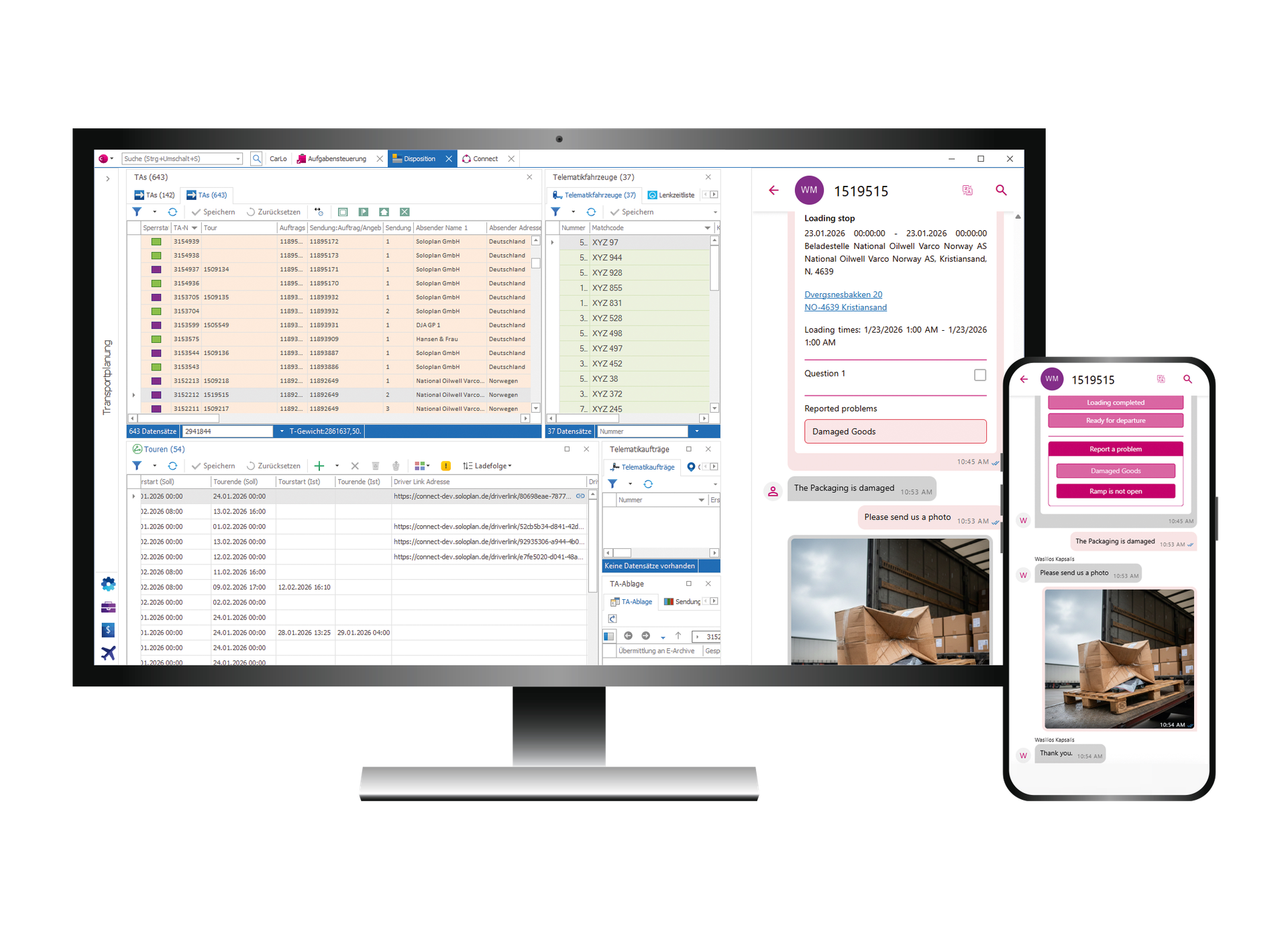
A communication tool called ‘Connect Driver Link’ has been launched by German software supplier Soloplan. With this tool, dispatchers can easily exchange digital information with drivers – even if the drivers work for subcontractors. The new development is part of the current version 3.06 of the transport management system (TMS) CarLo.

The organisation of transports is the core competency and one of the central fields of action of forwarders and logisticians. The planning and execution processes are often not clear and transparent enough as every company and every subcontractor uses different communication channels. But different contact persons and scattered information complicate the process and may cause delays.

Direct communication with drivers

With that in mind, Soloplan has implemented a new communication feature in the latest version 3.06 of the TMS CarLo. With Connect Driver Link, dispatchers have the possibility to communicate directly with drivers or others involved in the order. Connect Driver Link serves as a link between the order overview and the in-house chat tool Connect.

So far, Connect is mainly used as an integrated messenger service between dispatchers who work with CarLo. A direct communication with drivers was only possible via the telematics app inTOUCH or similar telematics systems or chat services.

The new Connect Driver Link simplifies and consolidates the contact process by collecting tour-related data and providing it via a one-time link. This type of link creation is called tunnel link. It is used to send tour data to the receiver in a secure way, just as in a tunnel tube. It is thus an uninterrupted and interface-free link.

Gap closer between planning and driver

A Connect Driver Link can be created very easily: The dispatcher selects the relevant order in CarLo and, with a single click, creates a Driver Link which is then sent to the driver or subcontractor. The receiver can open the link with any internet-capable device – without needing a Connect account, registration or app. The link directly opens in the Web browser and opens a Connect chat with the dispatcher.

To protect personal data, anonymous use is possible. The transmitted tour data is displayed as a message in the chat. The driver thus receives a compressed version of the order including times, location information and other relevant data. Additionally, you can send status queries that the receiver can answer with one click on previously programmable buttons.

This transmission in both directions is called bidirectional communication. Using the text entry, the receiver can send questions or general messages. A special highlight is the automatic translation of texts. Depending on the language that has been set, messages are correspondingly translated automatically. Misunderstandings can be reduced and manual transfer to the translation tools is not necessary. This allows for a fast and efficient exchange of knowledge.

High-performance Flat Belts

In today’s fast-moving logistics environment, every minute of downtime costs money. Ammeraal Beltech’s RAPPLON® flat belts are engineered to keep your operations running at peak efficiency — from receiving and order picking to sortation, consolidation, and storage.

Maximum uptime with roller drive belts

The RAPPLON® roller drive belts are designed for reliability across both heavy and light-duty applications. The heavy duty roller drive belts are made with a strong aramid tensile member that combines exceptional flexibility with dimensional stability, making them well suited to handling heavy loads. Their unique construction keeps the belt lying flat and adds rigidity along the tensile member, while the high flexibility of the material contributes to low energy consumption. The belts are also universally compatible with major heavy-duty live roller OEM equipment, simplifying integration into existing systems. For lighter applications, the light roller drive belts feature fabric tensile members and a polyurethane cover, available in standard thicknesses. These belts are impervious to moisture and offer excellent dimensional stability, ensuring consistent performance and a long service life.

Elastic belts for segmented conveyors and robots

The RAPPLON® elastic belts deliver reliable, low-maintenance performance across a wide range of intralogistics and robotics applications. They are the ideal solution for slider bed applications or segmented belt-over-roller conveyors. The new elastic segmented belts can run bi-directionally and are highly energy efficient, making them particularly well suited to AGV robot load-carriers and next-generation logistics robots operating in advanced fulfilment centres or warehouses.

Manufactured entirely from extruded polyurethane with no fabric reinforcement, these belts eliminate the risk of edge fraying and are easy to clean. The high-elastic polyurethane construction also reduces load on shafts and bearings and simplifies tracking. High-grip top surface options and anti-static coatings are available to meet specific application requirements.

Quick installation and global support

Both product lines are compatible with the QuickSplice joining method, allowing simple and reliable belt installation in under 15 minutes. For customized solutions or expert advice, Ammeraal Beltech operates a global service network with more than 150 contact points worldwide.

Ready for an Electric Vehicle Revolution?

Earlier this month the British Government announced a £1 billion investment to help businesses make the switch to electric vans and trucks, in an attempt to combat the effects of fuel price uncertainty amidst ongoing turbulence in the Middle East. Eddie Richards, Partner, and Sadie Pitman (pictured below), Associate, both in the Real Estate team of international law firm Charles Russell Speechlys discuss.

During its General Election campaign Labour promised to make Britain a clean energy superpower and, since coming into power, it has enacted the Great British Energy Act 2025 to establish a publicly owned clean power company. The Government has therefore long been aware of the need for Britain to become independent from other nations and to accelerate investment in renewable energy technologies – but whether we are now ready to encourage reliance on electric vehicles (EVs, including commercial vehicles in logistics such as eHGVs and electric vans, is another question entirely.

Quite simply, the UK does not currently have the right infrastructure to meet an increased demand for EVs, commercial or personal. For every 24 EVs registered last year, only one public charging device was added. (China has more than one charger for every 10 EVs).

This is not a new issue. The previous Conservative Government set itself a target for every motorway service station to have a minimum of six rapid chargers (with rapid chargers adding up to a 100 miles of range for an electric vehicle), however by the end of 2023 less than half of all stations had the required number – no doubt contributing to the Government pushing back its target date for phasing out petrol cars by 2030. The Labour Government seems keenly aware of the issue – reinstating the 2030 phase-out target (albeit allowing hybrid vehicles until 2035). There is no shortage of EV charging companies with substantial capital investment behind them looking to expand into a potentially lucrative market but the lack of infrastructure and the hurdles in installing the same make it difficult to create scale. The proposed reforms to the National Planning Policy Framework that would include a new requirement for local development plans to identify areas suitable for electricity network infrastructure could go some way to solving this issue.

Industrial road users therefore face a dilemma – do they invest in EVs now or ride out the storm until UK infrastructure is where it needs to be? Marks and Spencer set itself a Net Zero target of 2040 and is therefore continuing to invest in its fleet of EVs yet many automakers are scaling back their EV production due to a lack of uptake – with less than a quarter of UK road users expecting their next car to be electric. But who can blame them when even in London (where there is one of the highest concentrations of electric chargers in the UK) users now face the added cost of a congestion charge? The conflict in the Middle East and the resulting rising fuel prices have created a surge of interest in EV vehicles but these spikes are often followed by dramatic falls when the market stabilises and so it’s unlikely to be enough for automakers to perform another U turn and start ramping their EV production back up.

Some companies are turning to biofuel as a low-carbon alternative – the Royal Mail used 27 million litres of hydrotreated vegetable oil between 2024 and 2025. Again, there is difficulty with scale. Hydrogen was at one point being touted as a credible alternative fuel for vehicles (as well as the more obvious uses in industry) but a lack of funding and mature market has led to a number of high profile schemes being withdrawn or mothballed recently in the UK with other European countries attracting significant investment instead. The Government’s reluctance to back these schemes together with their substantial investment in EV from the government suggests that they are all in on the electric horse.

The Government needs to find the correct balance of incentives and policy to drive up usage and facilitate EV reliance. Elsewhere in Europe, charge point operators can claim credits for the clean energy it sells – perhaps one measure the UK Government will consider introducing. Indeed, some of its European neighbours are leading the field – Norway has the highest per-capita number of EVs, which has evolved through a mixture of consumer incentives (low taxes, free parking, use of bus lanes etc), consistent Government policies and an impressive charging network. The UK has some way to go.

Subscribe

Get notified about New Episodes of our Podcast, New Magazine Issues and stay updated with our Weekly Newsletter.