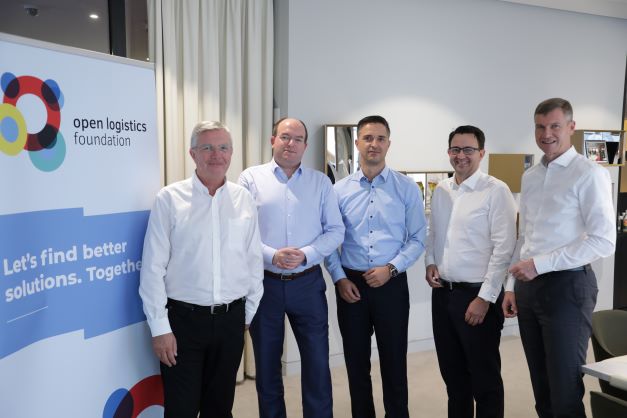
Four big names, one big project: Anchoring open source in logistics across the globe. Dachser, DB Schenker, duisport and Rhenus have jointly founded the Open Logistics Foundation to open the next chapter of digitisation in logistics. A technology initiative of this kind is not only unique in logistics to date, but the founders are also taking on a pioneering role in the future topic of open source. However, this shall only be the beginning.
A conversation with the founders and the person who brought them together about their motives, thick planks that must be drilled, and what open source has to do with the World Logistics Championship.
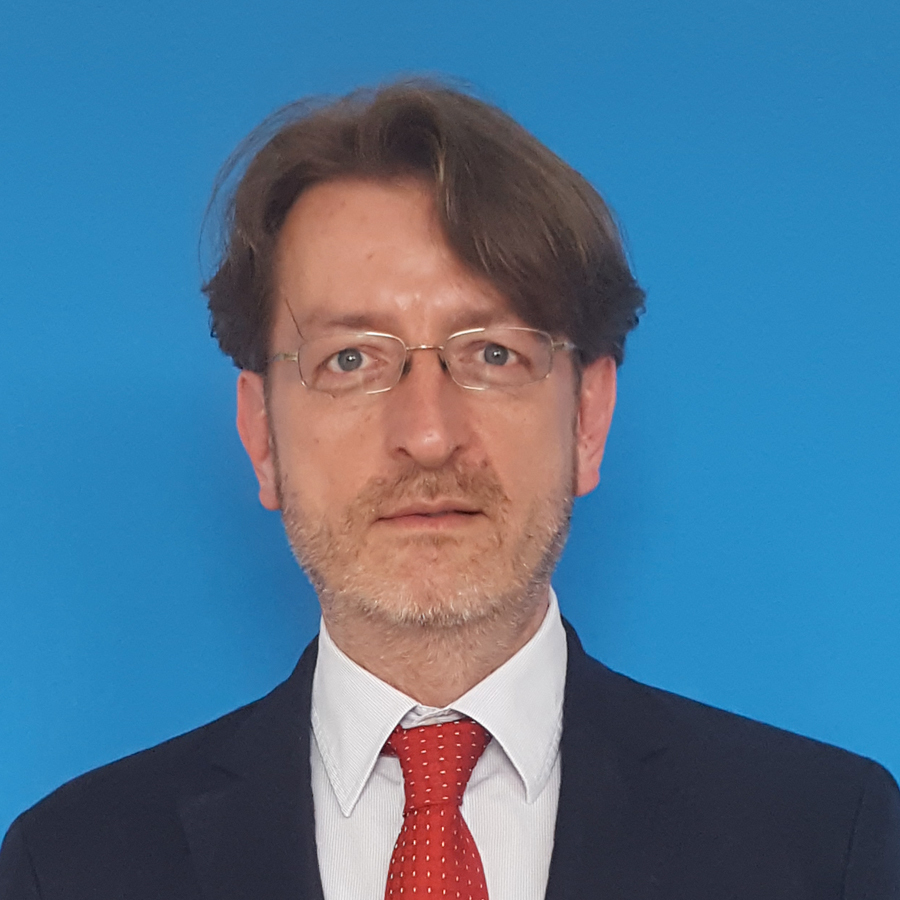
In the interview (pictured from left): Prof. Dr. Dr. h. c. Michael ten Hompel (Managing Director of the Fraunhofer Institute for Material Flow and Logistics (IML), Chairman of the Board of Trustees of the Open Logistics Foundation); Markus Bangen (CEO of Duisburger Hafen AG (duisport), Member of the Board of Trustees of the Open Logistics Foundation); Christian Bockelt (Executive Vice President Global IT Land and Digital Solutions, DB Schenker); Stefan Hohm (Chief Development Officer, Dachser SE, Vice Chairman of the Open Logistics Foundation); Dr. Stephan Peters (Member of the Board of Management of Rhenus SE & Co. KG, Vice Chairman of the Open Logistics Foundation).
The Open Logistics Foundation joins the ranks of the large non-profit open-source foundations. Open source means that the source code of a software is publicly accessible. This is not new; many successful business models are based on this principle. We all use open-source produced services every day. Web browsers like Firefox or Chrome and most of all programming languages are so. Linux, the world’ s most used operating system, is open source. It runs on all Android smartphones and on countless servers worldwide, in our Internet routers and even in smart light bulbs. Open source is everywhere, except in logistics, as it seems. So, the question is not “Why open source?” but “Why only now?”
Bangen: With open source, Michael ten Hompel has placed a topic in logistics of which everyone knows that it is overdue. We all know that we must develop commodities together. We just have not been able to get over the threshold of competitive thinking. There were just always too many buts. Pooling resources and themes give us a unique opportunity to set de facto standards instead of creating more monoliths.
Bockelt: To actively drive truly disruptive innovations, you need the right companions and a serious push. Fraunhofer IML has recognised that this constellation can be effective and brought us together.
Hohm: The digitisation tasks are too big for one company to solve alone. It can only be done together. Open source has a very decisive advantage: it simplifies the entry into digitisation and is therefore an important success factor for the entire logistics industry. At the same time, open source is a driver for a standardised process landscape in digital value chains.
Peters: After all, you often need a momentum. Especially in the weeks leading up to the founding, it became clear to us that the Foundation brought together exactly those who have been researching on innovations in the innovation environment in Dortmund and at Fraunhofer Labs for years. We have brought together what fits together and what we have been developing for years. Because of this innovation research, there is a trust and a natural affinity. When the critical phase of setting up the foundation with the legal experts began, you could clearly feel that.
The right people, at the right time, with the right mindset in the right place. Sounds reasonable. But as we all know, the devil lies in the details. In-house IT development is something like the holy grail of logistics. Is this sector ready for open source?
Bockelt: A large part of our software is already built with open source. Now it’s all a matter of enriching open source with logistics aspects and creating standards. That’ s an extremely exciting aspect…
Peters: …and bringing logistics expertise together in a repository, in an open-source community, is a crucial argument. This open-source approach guarantees an open standard for the digitisation of logistics processes and at the same time offers a high degree of flexibility for individual adaptations.
Hohm: Intelligent logistics is based on powerful IT systems. At Dachser, this principle has applied for decades and will continue to do so. That is why Dachser is also well known for its in-house IT development. However, it makes little sense to program every line of code in a standard application in-house. This is neither economical nor does it offer a competitive advantage. On the contrary, it often even prevents the pragmatic networking of partners and customers. Therefore, it is advantageous for all supply chain parties, if in the future, that selected software components are available to everyone free of charge as open-source elements and continuously updated via a neutral authority.
ten Hompel: The logistics sector must become more software-driven to play a role in the forthcoming platform economy and to self-determine its future based on European legal standards and values. Digitisation is the goal, and open source is the key to taking all companies along this journey, regardless of size and sector.
The first step has been taken. Now it’s time to drill some thick planks so that open source goes viral in logistics. The founding members declare: “We consider the Open Logistics Foundation to be the first step towards a platform economy based on European legal standards and values. It is both a beginning and an appeal to the logistics sector to think of technology and processes together and actively participate in the open-source community”. Open-source community: participate, preferably everyone – is the motto. Why should they do so? What is the added value?
Bockelt: This approach will replace individual investments in the digitisation of commodities. Every company involved will benefit from this.
Bangen: In a classic port like duisport, just a few years ago it would have been “waste of time and money” to talk for example about a joint slot system for all terminals. Today we are doing it. The psychological strain is higher, and we have simply realised that we will only succeed together; we won’t achieve anything with isolated solutions.
Hohm: Acceptance in the logistics industry will depend very much on which use case we place first. Let us take the truck driver app – we already have one or two of them (everyone laughs). That is the best example of wasted resources. Every company builds its own app, and every driver has countless apps on his mobile device. An enormous effort is put into this, but no company generates any added value through it. With such simple but widespread use cases, the realisation will catch on quickly.
Peters: The use cases we are talking about are obvious: e-pallet bill, e-delivery bill, driver app, ETA, and a few others. But the thickest plank will be getting the logistics and software industries enthusiastic about using and collaborating on the open-source repository. We could reduce complexity and be so much more innovative, faster, and better if there were no longer one hundred completely incompatible individual solutions to such problems, but one common standard.
ten Hompel: That’s exactly how it is, and creating this common basis is the core goal of the Foundation. There is always a tendency to tie the Foundation and open source to specific applications, it’ not about four competitors doing something together. It is about raising the jump height into digitisation because many people still underestimate the complexity that is coming with AI and predictive algorithms as a basis in data-based business models. This change – and this is important – is also a cultural change. Many companies have long since understood that they can generate added value for themselves if they do not have to take care of every interface themselves but can create value-added software.
Catchword cultural change: The willingness to share is growing in general. Not because sharing is trendy now, but because the success of the company’s own business models is at stake. Business has recognised that AI-based platforms will not get them far, since the chain is only as strong as its weakest link. Moreover, business leaders know very well that even the most valuable services do not make money these days unless they are perceived as a differentiator. And in the logistics sector, valuable services are just teeming. Everyone uses the same consignment note, everyone plans tours in the same way, calculates the ETA or offers tracking & tracing. However, cultural change also means adopting a different internal structure if you want to be successful with open source. Sounds so easy and harmless. But if you think about it more closely, it is a call for a paradigm shift. Is the motto meant to be that disruptive? How do the developers or IT service providers feel about the project?
Bockelt: Logistics has always been innovative, and IT played a key role early on. Today, almost all logistics processes are based on digital solutions, but the era of large software monoliths is about to end. We are thinking in terms of end-to-end supply chains, and the key here is to make processes more efficient and secure. If we use modular, standardised components for this purpose, we will be much faster and more agile when it comes to implementing truly value-creating ideas. In any case, you are preaching to the choir.
Peters: Logistics is very fragmented, both geographically and structurally. If we want to inspire people from the logistics sector to join us, we need to have an open mindset right from the start and not get bogged down in committees and bureaucracy. Incidentally, we are also unattractive as an industry if we are not open source. Many of our employees aspire that go beyond Rhenus. They want to be part of a bigger picture and drive the innovation of an industry and society forward. We are much more attractive as an employer if we can offer the big picture.
Bangen: Our developers also immediately said, yes, we will do that. So far, we have been using software that only we have – and if you take a closer look, 80% of it is already open source. The fraction of those who rely on exclusive specialised applications is becoming smaller, because at today’s speed of innovation, all of this will no longer be compatible in just two years.
The foundation’s offer is more than tempting. It is good to have confidence and be transparent but how do you guarantee neutrality in the development and participation for interested parties?
ten Hompel: The Open Logistics Foundation is the ultimate transparency. It is clear from the outset that there is no business purpose behind it or a single company that wants to monopolise the market on its own. Everything is completely open down to the very last detail, is accessible free of charge, and anyone can use it. The foundation’s purpose can be defined in terms of support for small businesses or start-ups. Here at the table, everyone is big enough to compete in the platform economy. But it is about bringing along those we work with. Start-ups or medium-sized companies are much faster if they have a basic software on which they can build their business models.
Bangen: In terms of confidence, however, logistics still has room for improvement. There are industries that are much further along in this understanding that you must sit in the same boat on the one hand and develop USPs as a competitor on the other.
Peters: Start-ups are much more disruptive here, and with a level of commitment that will probably challenge us quite a bit. We’ve talked about culture change. One of the main things here is to stop the feeling that the last 10% is not being disclosed. For example, we are all able to find the next flight connection from Berlin to Papua New Guinea on our mobiles in 30 seconds, including prices. Try that for intra-European transport. Why is there no rate transparency? Why does everyone have different interfaces for exchanging data? It is piecemeal and not very customer friendly.
Bangen: Our customers also want to be able to switch service providers at any time without having to rebuild the entire IT structure. They no longer accept raising the switching level via the complexity of the IT connection. On the contrary, it challenges them to switch in any case.
Hohm: Nevertheless, we clearly separate content and application. The content, for example the amount of prices as well as data, will continue to be exchanged between companies confidentially and inaccessible to third parties, for instance between the customer and the logistics service provider. We are focused on the ways and means of exchanging this information. That is what we are focusing on.
ten Hompel: You can compare this development with the introduction of an e-commerce. The consumer interface became simpler, and at the same time the algorithm ensured that people got the right offers. That is where we are headed in logistics as well. We come from a business that has lived very much on know-how and are going into a world that lives on algorithms. With their platforms, start-ups are suddenly making dominant knowledge freely available. Success is determined not by better information, but by better algorithms.
Let us talk about time and money. How much time and money can you save developing with open source?
Peters: In our case, it depends very much on the application, but the expectations are clearly in the double digits. Digitisation is not an end in itself. It overcomes interfaces and pays off in terms of higher-level goals such as transparency, efficiency, and sustainability. However, it must also be economically feasible and successful to the market.
Hohm: Dachser’s focus is on the business case. For us, it is about making on-site applications leaner and more standardised. For us, IT is an orchestrator. It uses a variety of building blocks. There are applications which scream out to be downloaded from a repository and made available to a large community. And more people thinking about the same topic usually results in something better.
Bockelt: There are topics that we can only solve together and there are differentiating topics for which you build your own software. And there will be algorithms that we donate to the repository, and thus to the public. For us, it is important to give access to all players in the industry.
Peters: We can only achieve that by transparency, and the basis for it is trust. We must communicate that, in addition to what we initially place in the repository.
In 2022, the setup of the logistics repository is high on the agenda. For the minutes: For the record: A repository is a database for centrally managing digital objects. The logistics repository is therefore a kind of public global central warehouse for open-source hardware and software components. Companies can use it to expand their own platforms, for example, or to set up new products and business models more quickly. A major undertaking. Which projects will you initiate and which components will you open-source? And how does that work?
Peters: At our Fraunhofer IML Rhenus Lab, we have developed a tracker for measuring the temperature and filling level of our intelligent container, which you can use just as well elsewhere. Whether you use the filling level indicator for a container, a waste bin or a rat trap, the technology is the same. We are contributing this tracker to the logistics repository, along with a standard interface so that anyone can connect their own devices. Of course, if we place the software open, we also hope that it will be further developed by many.
Bockelt: We have components that would be suitable for kicking off into the open-source world, and some examples have already been mentioned. We will go along with that.
Hohm: Dachser will also provide resources; we will determine more details in the coming weeks once the first lighthouse project has been defined.
Peters: There are two ways to get involved. Variant one is to merge existing applications into one. Variant two is a kind of supermarket shelf where, for example, different driver apps are placed next to each other. The market decides who continues to program on what and which app will be the most popular. In practice, it will be a mixture. Personally, I favour variant two because we do not need to keep working on things when there are better solutions. By voting with our feet, it will be transparent what is available and what of it is used and how often. This would allow us to allocate development capacities in a much more targeted way.
Hohm: But it is not the foundation founders who determine what is best for everyone. The foundation management and the open-source community will define a process that allows participation for everyone.
The foundation has just started its work. What expectations do you have in terms of the foundation’s operational work? Where are the priorities? What needs to go to the top of the agenda? What matters in practice to make open-source fly in logistics?
Hohm: Creative approach, complete transparency, common applications, maximum usability, and the question of how we involve all companies so that the right business case can be set as a flagship. That is what matters.
Bangen: The platform must be cool to developers, and we have to offer the community something in the repository that excites them, to motivate as many as possible to be part of it and to bring an open-source community with thousands of developers forward in logistics…
Peters: …and that also should not take twelve months. Either the first project is so convincing that it is worth joining, or it will be incomparably harder to convince the community.
Bockelt: For me, the focus is not on us founders, but on the issues that concern the entire supply chain industry. We have only thrown a first stone into the water. For our open-source project to get off to a successful start, it will be important to function as a network and to continue to develop technologies in a continuous dialog with users.
Demanding digitisation is easy; implementing it changes everything. We are writing the year 2031: Looking back, what should be said about today and about the Open Logistics Foundation?
Peters: I would love the headline: “Germany logistics world champion thanks to open source” or “From logistics world champion to open-source world champion”.
Bangen: We have finally crossed the threshold of transparency and trust that everyone has been talking about for 20 years, but no one has overcome yet. We have just got our act together.
Bockelt: The Open Logistics Foundation has unleashed a wave of transformation. The courageous step toward open source has paid off for both the logistics industry itself and its customers.
Hohm: I would like us to say that October 22, 2021, was the day we succeeded in raising logistics to a new level and enabling collaboration – through open source.
ten Hompel: I hope that in three years I will be able to say: Who would have thought back then that the open-source community would grow exponentially. And I think the best thing would be if, in ten years, we do not even remember what it was like before open source.
Michael ten Hompel, you brought the donors together. What advice do you give to the logistics industry?
ten Hompel: Companies should ask themselves one question: What are we doing with open source? Because the logistics community must be aware of one thing: In the upcoming platform economy, money will be made with AI. The use of software will increase exponentially in a brief time, and that can only be done with open source. Dachser, DB Schenker, duisport, and Rhenus have laid the groundwork for an open-source community by establishing the non-profit Open Logistics Foundation. Now it is important for logistics as an industry to reposition and join forces. My advice? Never walk alone.