Forto and Hapag-Lloyd deliver biofuel alternative

Through a new partnership with Hapag-Lloyd, a leading global liner shipping company, Forto has launched a biofuel programme for ocean shipping customers who seek to reduce their transport emissions. Customers booking full container load (FCL) sea freight shipments with Forto can now add the use of advanced biofuel to their bookings, effectively reducing 100% of their transport’s greenhouse gas emissions. As Hapag-Lloyd has extended its biofuel strategy to work with selected key partners, Forto has delivered the first customer in Hapag-Lloyd’s biofuel programme.

Shipping goods with second- and third-generation biofuel options through Forto and Hapag-Lloyd is designed to make it easy for customers to reduce scope 3 emissions and achieve emission reduction goals. Forto supports customers throughout the process. When selecting a biofuel option, customers receive data-based visibility over the impact of biofuel on sea freight-related greenhouse gas emissions and certificates issued by a third-party monitored process.

Michael Wax, CEO and Co-Founder of Forto, said: “Making the shift away from the logistics industry’s reliance on fossil fuels is an essential step towards a greener future. We see it as our responsibility to continue to deliver transparent and credible solutions that can help our customers navigate this journey as they strive to reduce their environmental impact.

“Hapag-Lloyd has made a decisive investment in a commercially available biofuel product and their sustainability strategy is amongst the boldest steps towards the reduction of greenhouse gas emissions in the industry.”

Mirja Nibbe, Managing Director Area Germany and Central Europe for Hapag-Lloyd, added: “The biofuel offer for our customers plays an important role as a first step on our journey towards being net-zero. It is through close collaboration between Hapag-Lloyd and our customers to jointly tackle the challenges ahead of us. Thus, we are very happy to work together with Forto on this important topic.”

In November 2021, Hapag-Lloyd announced its new sustainability strategy with the target to be net zero carbon by 2045. As part of Hapag-Lloyd’s commitment to decarbonisation and reduction of greenhouse gas emissions, the company has announced plans to reduce CO2e intensity (EEOI) of its entire fleet by 30% by 2030 as compared with 2019.

The new Forto biofuel initiative is the next step in the company’s strategy to drive transformation towards sustainable supply chains, with the ultimate goal of helping customers make the sustainable transport option their default choice. Forto’s range of sustainability solutions starts by providing customers with emissions visibility and information that empowers them to make impactful data-based decisions.

In addition to the biofuel programme, Forto offers CO₂e emission offsets for all modes of transport, and German-based Rail Pre- and On-Carriage intermodal volumes are transported using trains powered by renewable energy. The commitment to sustainable transport offerings is reinforced with the company’s own investments on top of those of the customers. Forto teams are trained to work together strategically with partners, customers and other stakeholders to explore sustainability options and find solutions that fit their needs.


Delivery drivers at heart of heatwave

This year, the UK has become subject to heatwaves of record-breaking temperatures, widely attributed to climate change, writes Andrew Tavener, Head of Marketing, Descartes. Over the next week, parts of the UK are expected to hit highs of 30°C once again, encouraging many of the general public to stay indoors, work from home and choose their days out in moderation.

However, for some there is no choice but to endure the heat, despite official warnings. The last few weeks have not been kind to last-mile logistics, with some reports of negligence amongst retailers and their lack of air conditioning in vehicles, down to reasons seemingly as illegitimate as weight issues. During last month’s heatwave, one last mile delivery driver actually collapsed after enduring unbearable conditions.

Heatwaves in the UK are here to stay, so it’s time we looked at how we can adapt fleet management practices, and take better care of our drivers.

A duty of care

Despite a reluctance to implement solutions such as air conditioning in home delivery vans, retailers still have a duty of care when it comes to their workers. From an HR and legal perspective, this becomes even more concerning when there’s a driver shortage.

If they think they’re being driven hard in extreme conditions, workers may be forced to leave their current company and seek employment elsewhere. These businesses therefore should look to retain their employees in any way possible and prevent them from adding detriment to their health when it could be easily avoided.

On top of this, vehicles are more susceptible to issues in extreme weather; drivers have been warned of fires or exploding tyres, so vehicle safety checks need to be up to scratch. This includes checking the vehicle fluids and ensuring they are getting service checks regularly or if the driver suspects that something is wrong.

Embracing the night shift

Even during the peak of summer in the UK, most delivery drivers are expected to work during daylight hours – just as they would during any other month of the year. By comparison, in Spain it’s common for people to work after 4pm because of the temperatures. Perhaps one fleet management solution could be a complete reshuffle of what’s expected in the UK when we’re encroaching on a heatwave; if delivery drivers were enabled to work during the cooler hours of the day and into the evening, the domino-effect would include an easier, cooler environment alongside less congested roads and improved environmental impact.

Since the pandemic, working habits have changed substantially, with many people still working from home or having access to flexible timetables or working hours. On the road, we live in an increasingly congested environment, where the working days could do with a complete overhaul. Not only does this make things easier for delivery drivers, but for each and everybody on the road. Less traffic means less pollution and accidents; and happier workers.

The intervention of innovations in crisis

Some retailers are still behind when it comes to extreme temperatures. If air conditioning isn’t a viable solution in a delivery van then perhaps there are other ways to reduce the struggle for delivery drivers working in these recent hot temperatures.

Alongside factoring in the setbacks caused by such heat, including less productivity and the risks to health, these major players in retail need to be able to understand such complexities before they know how to address them. For example, self-scheduling technologies have been used to improve parts of the process like route density and delivery productivity.

With access to more transport intelligence such as inventory, information, and assets that enable driver efficiency, companies will be able to respond to rapidly changing environmental factors as well as changing market and regulatory conditions, in turn adequately supporting their employees and better serve customers.

Mosca presents tailored solutions for safe transport

From empty cans to filled bottles: Mosca will be presenting two different solutions for securing beverage containers at DrinkTec, the world’s leading trade fair for the beverage industry, from 12 to 16 September (booth C6.351). The KZV-111 pallet strapping machine and Saturn S6 stretch wrapper are tailored to end-of-line packaging needs in the beverage industry and designed to ensure safe and stable transport to beverage manufacturers and consumers.

Regardless of the material or size of the containers, safe and efficient transport in the beverage industry requires a stable load. But different requirements must be met depending on the type of container. Christian Grosskopf, Sales Manager Food & Beverage at Mosca, explains: “While beverage cans run the risk of being deformed during transport, glass bottles must be carefully protected from breakage. The means of transport protection must also be suitable for further processing. For example, empty beverage cans must be transported as efficiently as possible in large quantities. Filled bottles need to meet the high demands of the retail trade.”

It is also important to ensure that staff can easily remove the goods from the pallets. At the same time, displays that are visible to customers at the point of sale must not be smudged during transport. At DrinkTec, Mosca will be showcasing two solutions that meet the different requirements at the end of the packaging line.

Empty beverage cans on their way to the filling plant are lightweight, come in various sizes, and need to be transported in large quantities. But a mixture of different container sizes can often be found on the same pallet. If one can falls off, the remaining load should remain stable. This requires structural support on the top and sides of the load along with a light pressure to secure the cans for transport. A task that is managed perfectly by the Mosca KZV-111 pallet strapping machine.

Specially designed for strapping goods on pallets, it can create the right amount of downforce on empty cans through vertical strapping. The KZV-111 uses sustainable PET strapping made of 100% recycled materials, secures up to 61 pallets per hour for transport and saves resources. Securing even the heaviest pallets only requires a narrow plastic strap, which helps reduce material consumption and minimise the carbon footprint.

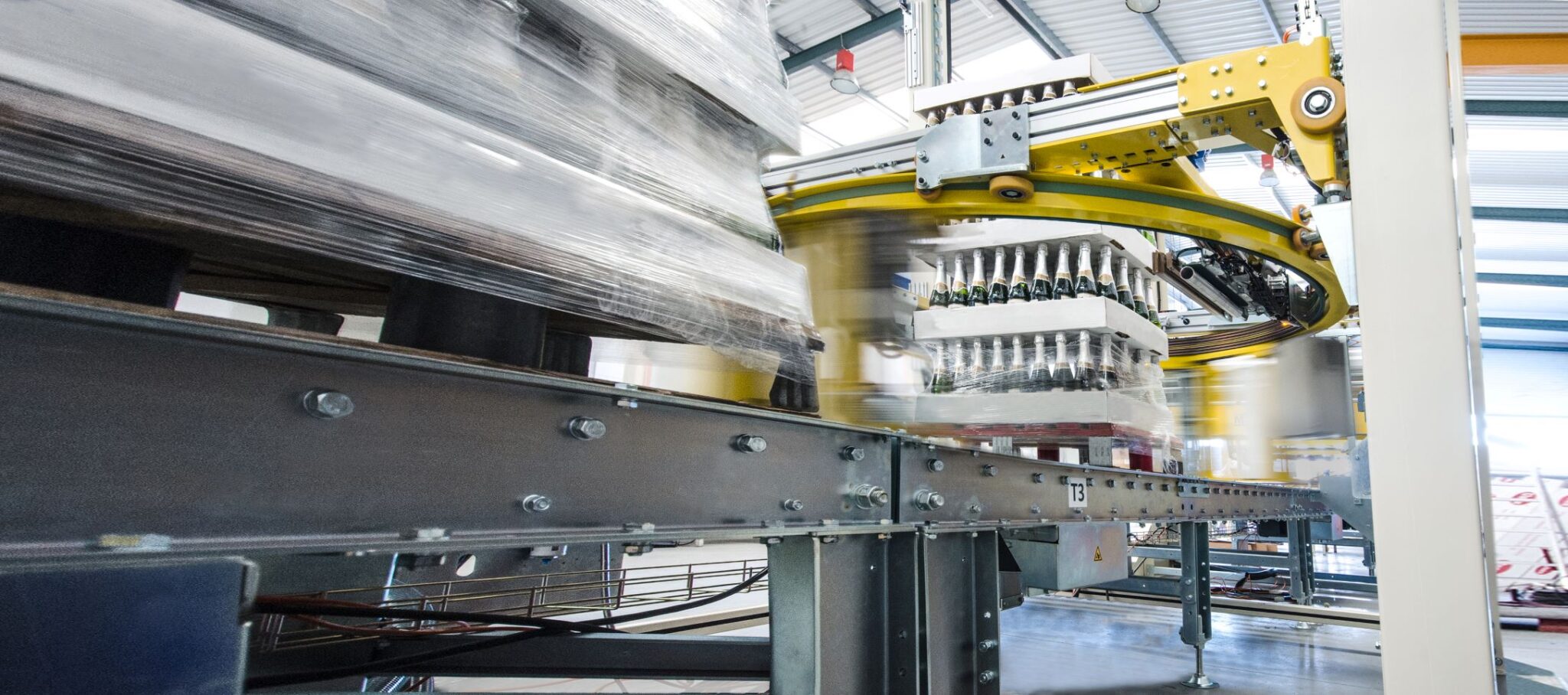
The other machine on the Mosca display stand is also designed to secure pallets. The Saturn S6 stretch wrapper from the Mosca Movitec brand wraps up to 120 pallets per hour with fully adjustable speed and tension controls. During the wrapping process, the products remain static while a film reel circles horizontally around the pallet. Stretch wrapping is ideal for securing filled beverage cans or breakable bottles.

The main focus is on protecting the products against external influences and simplifying manageability at the point of sale. Thanks to the elasticity of the wrapping material – with up to 300% film pre-stretching – and the optional top sheet dispenser, the load remains stable during transport and cardboard bottle carriers are protected from moisture or dust. Supermarket staff can strip off the film layer by layer and ergonomically remove pallets from the stack.

The Saturn S6 ring wrapper can easily label the palletised goods by applying a band/strip on the film with no trace of adhesive residue. An efficient cutting and welding system seals the film across the entire surface and eliminates film tails at the end of the wrapping cycle.


Garbe develops logistics centre near Jena

Garbe Industrial Real Estate GmbH is continuing its expansion course. In Bollberg near Jena (Thuringia, DE), the Hamburg-based real estate developer will build a logistics centre with a total area of 35,500 sq m on a 65,000 sq m site. Construction is scheduled to start in December 2022, with an investment of around €48m.

The property is located in the industrial park of Bollberg, a district of Stadtroda (Saale-Holzland district) in Thuringia. “A location for a logistics centre could hardly be better,” emphasises Adrian Zellner, Member of the Executive Board at Garbe Industrial Real Estate. The Hermsdorfer Kreuz interchange, which connects the A4 Bad Hersfeld−Dresden motorway with the A9 Berlin−Munich, is seven kilometres away. Both motorways are among the most important north-south and west-east axes in Germany. The A4 runs virtually within sight of the business park. The Stadtroda junction is easily reached after a one kilometre ride without having to pass through the town.

Proximity to Jena also played a role in the property purchase: “The city has made a name for itself as a high-tech location. Both international corporations and small and medium-sized companies are represented in Jena,” says Zellner. “Demand for developed land is correspondingly high. That’s why we decided to develop the logistics centre with a view to the future.”

A multi-user logistics centre with a hall area of 31,500 sq m is planned. The hall will be designed so that it can be divided into units of around 10,000 sq m or more. In addition, there will be 1,400 sq m for offices and social rooms as well as 2,500 sq m of mezzanine space. The new unit will be equipped with 30 dock levellers and three ground-level gates. Parking spaces for 117 cars and four trucks will be provided outside.

Garbe Industrial Real Estate is developing the property together with Terrae Immobiliengesellschaft mbH. A major focus of the construction is the consideration of numerous sustainability standards. Benchmark is the fulfilment of the Efficiency House Class 55 standards of the Kreditanstalt für Wiederaufbau / Reconstruction Loan Corporation (Kfw). For an example, a photovoltaic system will be installed on the roof to generate renewable energy. Garbe Industrial Real Estate is aiming for the property to be certified according to the gold standard of the German Sustainable Building Council.

Talks with potential tenants are already underway. “There is a lot of interest. That’s why we expect full occupancy during the construction period,” says Zellner. The property is scheduled for completion in December 2023.


Exporters report ongoing post-Brexit challenges

Research from DHL Express following a 2021 study reveals mixed perspectives among small and medium sized British exporters for the remainder of the year, with one-third of those who export or plan to (33%) feeling the outlook for their business is more positive for 2022, with the remaining disagreeing (30%) or undecided (37%).

Reflecting on the time since the UK’s exit from the EU, businesses we surveyed report ongoing challenges and concerns since the departure, including volume of paperwork (45%) and complexity of regulations (50%). Despite the challenges, 60% of those who already export from the UK or plan to in the future agree that exporting goods outside the UK will continue to be a priority for their business in the future. This represents an increase from 51% of businesses surveyed one year ago.

More than a third (34%) of exporters or businesses planning to export state that the US is the market of most interest or likely to be most beneficial for their business if the government was to secure a new or enhanced trade deal.

The research is a follow-up to a study conducted one year ago and looks to explore the challenges facing small businesses across the UK. Nearly three-quarters of SMEs who export or plan to export in the future (72%) agree that Brexit has increased their costs of doing business, with over a third (38%) who already export or plan to, remaining concerned about a lack of awareness among consumers and customers about the additional import costs payable. Despite this, only a quarter of the SMEs surveyed (28%) have proactively alerted customers to the potential customs, VAT charges and shipping costs.

Ian Wilson, Chief Executive at DHL Express UK, said: “It’s been just over 18 months since the UK’s exit from the European Union, and this latest piece of research makes clear that businesses are still facing a number of challenges and are in need of support to help them navigate the changes.

Nonetheless, it’s encouraging that small and medium businesses are still continuing to prioritise exporting outside the UK, which shows a great deal of resilience through what has been a difficult time. As we look ahead to the rest of 2022 and the years to come, we hope to see more trade deals that smooth the path for global growth, and we’ll continue to support the small business community to help them thrive in a post-Brexit world.”

Five steps to setting up US fulfilment

Operating effective e-Commerce fulfilment across the globe has become essential for many growing brands, as consumers in various countries increasingly demand certainty and speed of delivery. This has therefore necessitated the requirement for businesses to consider opening fulfilment centres in different locations to keep pace with demand. One region that continues to be of great appeal is the US market.

However, “setting up shop” stateside is not as straightforward as one might think for British businesses. It demands a vast amount of preparation and planning behind the scenes – which can often go unnoticed and is underestimated. Emma Dempsey (pictured), CEO, James and James Fulfilment, explains more.

The US retail opportunity

Traditionally the UK and USA have strong trade ties, and the UK Government has committed to continue to deepen its trading relationships with the United States (and the European Union). It also sees the US as a ready-to-trade market, and says it will continue to promote exporters to this region, among others.

Additionally, the potential to drive retail e-Commerce revenue here is exciting. Statista forecasts that by 2025, online shopping revenue in the US will exceed $1.3tr, highlighting the potential of this market. However, despite the opportunity that the US market presents, only 27% of SMEs have selected it as a preferred market destination, according to research by Newable. British businesses need further education about this opportunity and how to capitalise on it. At its highest level, this involves appreciating that there are five key steps UK e-Commerce businesses should consider as they try to enter the US.

Step 1: Register as a foreign for-profit corporation

The first step is to register your existing business as a foreign for-profit corporation with the appropriate US governing body, which differs across states. This essentially gives organisations the licence to do business in the US. In Ohio – where we have a fulfilment centre, for example – you can do this by completing a 530A form. The form is quite straightforward to complete and requires the following typical information:

Page 1: Your existing business contact details

Page 2: A Certificate of Good Standing, which you can get from Companies House

Page 3: The details of an “agent” in Ohio – such as James and James, which can act as your fulfilment partner and centre

Page 4: A Notary Public, who should be local to you, to sign and seal a hard copy of the form.

Step 2: Register to collect and remit sales tax

Unlike in the UK, there’s no blanket Value Added Tax (VAT) in the US. Instead, different states have different rules around sales tax. Usually, organisations have to collect sales tax from consumers and pass this on (or remit it) to the state, providing your organisation has a “nexus” or permission to trade.

Importantly, within this context, there are two types of nexus to consider. The first is a ‘Sales tax nexus’, which results from having a physical presence in the state, including inventory in a fulfilment centre. The second is an ‘Economic nexus’, which results from achieving a certain amount of revenue or orders from a state. So, for example, if you hold stock in Columbus, while your biggest markets are Los Angeles and New York, you’ll collect and remit sales tax in Ohio, California and New York.

Step 3: Set up your local fulfilment centre

The next step is to set up a fulfilment centre. The USA is obviously a big place, so shipping nationwide isn’t as quick or easy as it is in the UK. Having a few US fulfilment centres can help, but it also adds complexity to inventory management. For businesses entering this market, the Midwest is a good starting location, as it enables 2-3 day shipping across North America (the bar set by Amazon Prime) from one central spot.

Managing your orders and inventory in another country, with a five- to eight-hour time difference, is a complicated and complex process at the best of times too. For this operation to run as efficiently as possible, it is best to ensure that the facility is being driven by a powerful cloud-based warehouse management system (WMS), order management system (OMS), and that the centre has been set up effectively to manage any customer product returns, a bugbear for customers these days.

Equally, you want to ensure that these various systems are tied back into your UK HQ or fulfilment centres for better data management and insights. This kind of technology enables teams to know in real-time, the status of stock levels and what goods are coming in and out. It also enables retailers to track any further details about products that can be used to inform future product purchasing decisions and marketing campaigns in that region.

Step 4: Send stock in bulk to the USA

Once your US fulfilment centre has been set up correctly, it’s time to send your stock to it in bulk. Using a freight forwarding company removes a lot of hassle here. These companies help with managing aspects of the logistics and customs processes. For example, from a logistics perspective, they organise the transportation of goods to the US, whether from existing UK stock or from a manufacturer in another country. They also help to manage customs, and act as the Customs Broker or Importer of Record (IOR); making the path easier for goods as they make their way through customs, and ensuring the correct duties are paid.

Step 5: Sell, sell, sell

While you’re likely to be making some sales to the US already, once you’re properly set up, you can really turn your marketing engine on. When doing this, it’s important to think about how to localise your e-Commerce store (website) for American customers, with prices in dollars and sizes in US or imperial measurements. Ensure you really are making the most of your local fulfilment centre, by promoting cheaper shipping, faster delivery and simpler returns to US customers.

Tune your email and social media campaigns to US culture, with its more direct approach – and target those numerous appropriate national holidays and discount days. Finally, ensure you register and protect your trademarks and intellectual property in the US, as well as at home.

Conclusion

As the UK and US economies continue to grow, e-Commerce businesses must ensure they have the right operations and support teams in place to fully take advantage of these markets. Today, a large part of getting e-Commerce right locally involves setting up your back office infrastructure and fulfilment centres correctly and effectively. Add in another market though, like the US, and this becomes far more complex. This is why it is important for British businesses to consider how best to expand their business in the US – and to work with proven fulfilment partners, that can enable them to deliver goods to customers successfully and grow their brands, allowing them to tap into the $1.3tr on offer.

Subscribe

Get notified about New Episodes of our Podcast, New Magazine Issues and stay updated with our Weekly Newsletter.