Coupa is an AI-powered spend management platform with big customer numbers – and even bigger ambitions. As the company targets Europe for further growth, Paul Hamblin meets its new international head.
The name? It started with a caffe latte – or maybe an espresso.
The story begins in 2006 at Coupa, a Palo Alto cafe where two former Oracle execs sat down to formulate a transformational software for e-procurement. Nineteen years later, the cloud-based platform they created has evolved into a spend management platform used by over 3,200 customers worldwide, including some of the largest and best-known multinationals, plus a community network of over 10 million participants. In 2023, the company was acquired by private equity software specialist Thoma Bravo for a reported $8 billion.
That’s quite a journey from a couple of coffees and croissants. And the name has stuck.
What exactly is ‘Spend management’? It can mean several things to Coupa customers both large and small, including some or all of procurement, invoicing, compliance (with contracts and regulatory matters) and payments to suppliers. Automation and optimisation of processes accompanied by analytics of cost and performance are the most obvious benefits.
The real win is that the software connects an enormous network of buyers and suppliers. As the world knows, networks mean data; and data means AI can start to work its magic.
Perfect Combination for Data
Coupa’s pitch to customers and prospects is that it combines AI with the world’s best direct and indirect total spend management platform. This enables, in the company’s own words, the ‘world’s largest supply and demand data reservoir’.
It goes without saying that the best data makes the best AI. ‘We are all smarter together,’ and ‘We make every dollar matter’ are two neat messages that Coupa deploys to drive home this advantage. Put it all together and the result is a ‘margin multiplier’.
Lots of containers.
Distribution.
logistics.
Joao Paulo da Silva, a Portuguese national now based in Madrid, was appointed in summer 2024 to lead the team’s international expansion everywhere outside the Americas. I met him at Coupa Inspire in London, the latest stop on a world tour of conferences attended by customers, partners and consultants. A veteran of SAP, major consultancies and private equity organisations, he is clear about the road ahead for Coupa.
“We have a strong agenda for growth. We are currently about $1.1 billion ARR, we plan to double in size in the next 3-4 years to $2 billion, and in 8-10 years we are targeting $10 billion ARR.”
These are undeniably bold targets. How will the company achieve them?
“Growth will come from the expansion of our business both in the Americas and internationally, and by enhancing and augmenting our portfolio. First, we will widen our geographical footprint. Southern Europe including Italy and Spain, South-East Asia and Japan are all strong growth territories for us.”
Portfolio enhancements will come as Coupa widens its overall offering to customers. “Coupa is always very strong in indirect procurement, but in some of the more complex industries, such as manufacturing, we are now increasingly able to offer more in direct procurement,” he reveals.
Another expansion area is category management support to help customers strategize more specifically category by category (examples might include IT, or transport logistics). The acquisition in May 2025 of Croatia-based Cirtuo, a proven specialist in category management software, provides evidence of this portfolio broadening.
Alongside portfolio growth, the partnership network will also increase. “We are making a big global investment in this area to make sure we have a large network of partners capable of supporting mid-market businesses that are very eager to capture and use the same solutions as the big organisations,” he explains.
Supply Chain Design Support
It brings us to the core question. What can Coupa offer that its competitors cannot?
“Today we have the largest dataset in the industry with a capability beyond what anyone else has,” he argues. “We aggregate the data from 3500 customers – from Amazon to much smaller businesses – and this provides insights to our community. We are a unique company because no other vendor has the capability to provide what we can. Yes, a rival solution might give the customer the capacity to transact, to perform a procurement task, but no other company gives the ability to operate that task in the context of such useful information and insights. Our community is very strong, our customers come together to share experiences and information in a way that few software companies can achieve.”
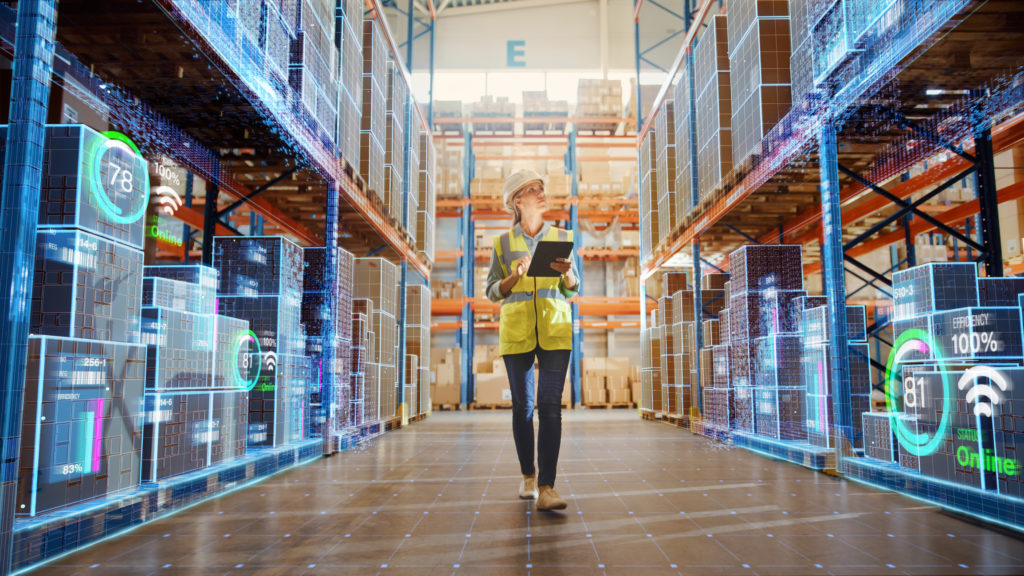
Futuristic Technology Retail Warehouse: Worker Doing Inventory Walks when Digitalization Process Analyzes Goods, Cardboard Boxes, Products with Delivery Infographics in Logistics, Distribution Center
He brings us back to that powerful ‘margin multiplier’ image. “We are the only platform that can manage the total spend of a company, from supply chain to payment, and make it transparent in one single view. That’s why we say it’s a margin multiplier, because if you multiply the small efficiencies made possible in each component of the platform, it becomes EBITDA-relevant for the company.”
He says Coupa is taking the Procure-to-Pay model a stage beyond; an updated description might be ‘Design-to-Pay’ partner. It’s a description facilitated by the company’s acquisition of established supply chain software specialist Llamasoft back in 2020, furthered by the Cirtuo addition.
“We are now helping you as the customer design your supply chain. You as the customer know your strategy and what you want to achieve with your objectives: they might be to cut costs, improve sustainability or resilience. Whatever you strategize, the important thing is that it links to the execution, the backbone of the platform where you obtain objective feedback on that strategy. Was it the right strategy? Constant feedback from the platform is crucial to your understanding. Once you are satisfied with your strategic objectives, the tool will provide three AI-based models to enable you to execute optimally on that strategy.”
AI Opportunities – Not Threats
AI is clearly a game-changer in supply chain design and execution, but do the much-discussed fears about the technology have any justification, in Mr da Silva’s view?
“The beauty of Coupa is that we have been cloud-native since the beginning and many of our solutions already incorporate AI functions. It’s something we’re very comfortable with. But look at all the innovations in history; all created more jobs than before, and I believe that is what will happen again this time.”
That’s another bold assertion. He enlarges: “This is the first time in history you have a technology that every single department in the company wants to use. Think of blockchain, say, which directly only affects certain teams. As we mature all these models and improve and develop the things that we will be able to do, workers are going to be more specialised because they will be able to process so much more information as part of their role. There will be many more insights to leverage, delivered with more precision. The AI journey is a fascinating one.”
Mr da Silva (pictured, below) advocates the view that AI and automation are about enabling people, not replacing them. He cites an example from that day’s earlier keynote at Coupa Inspire, in which a major bank explained how touchless procurement had enabled it to shift staff from cost control teams to revenue-generating functions.
“Digital also allows to react much faster,” he adds, citing another example described at Coupa Inspire. “You are alerted to a potential issue somewhere in the world straightaway. That means you can anticipate difficulties and act to mitigate them. Our client described how, very soon after an earthquake, the platform started picking up signals showing problems in supply logistics in the region, immediately generating an automated RFP to alternative suppliers so that schedules are disrupted as minimally as possible.”
The current volatility and uncertainty in world trade is a perfect example of what causes companies to enter, in the pithy phrase of Coupa CEO Leagh Turner, “a margin erosion zone”.
Joao Paulo da Silva agrees. “We are all about cost-saving, so during global slowdowns we are here to help, and in a very dynamic way. In the past, a company might take a whole month to redesign its supply chain when reacting to unexpected events; now we can do it in a few hours. The system helps customers to simulate different scenarios and thus give them greater confidence in their decision making. What do I do if the tariff landscape changes? How does it impact me? How do I redeploy logistics centres? Or production? The platform will offer options and solutions.”
A last mile conference hosted by FarEye revealed a growing appetite for AI and a waning one for carbon reduction, reports Peter MacLeod.
I had the pleasure of attending the Last Mile Leaders European Conference in Amsterdam in May, an event hosted and expertly delivered by FarEye. Bringing together retailers, carriers and tech providers from across Europe, the conference provided a clear and, at times, candid view of where the last mile is headed and how sharply the road ahead is turning.
The headline takeaway came as no surprise, namely that cost is king. But closely following behind are customer expectations and a cautious but accelerating interest in AI. Somewhat surprisingly was the finding that whereas sustainability was once front of mind, it’s now viewed as more often a bonus than a baseline. As he unveiled the “Eye on the Last Mile” report during his opening keynote, Kushal Nahata, FarEye’s CEO and Co-Founder, said the European delivery ecosystem is at a decisive inflection point.
Shifting Priorities
Nahata (pictured, below) laid out the results of FarEye’s annual report, which surveyed logistics leaders across the continent. The data reveals that 98% of logistics leaders rank cost as their number one challenge heading into 2025 and that the top three concerns – rising costs, elevated customer expectations, and the race to invest in AI-enabled solutions – are reshaping strategies and budgets alike.
Perhaps unsurprisingly, Switzerland leads in average last mile cost increases (38%), followed by France (21.5%) and the UK (17.8%). More stable cost environments such as the Netherlands and Greece offer valuable lessons in efficiency. But across the board, labour remains the primary cost driver, far outpacing technology or fuel.
Despite all the talk of innovation, many firms still rely on legacy systems and manual operations, particularly in Western Europe.
What’s clear is that cost is not just a financial concern but a strategic lens through which every delivery decision is now made. As Nahata put it: “We need to stop treating the last mile as the last thought.”
Smarter Strategies
The good news is that the industry isn’t standing still. According to the keynote, firms are turning to AI agents and advanced routing systems to claw back profitability and operational control. FarEye’s own data shows that AI-driven systems can reduce costs by up to 30% in dense urban areas, while hybrid fleet models and dynamic routing can offer savings of between 12 and 18%.
We’re also seeing a growing reliance on lockers and pickup points as businesses look to balance consumer convenience with cost-efficiency. This was also reflected in the levels of audience interaction about this topic. That said, the promise of lockers remains contingent on scale. As explored in the first of several panel sessions during the day, “Cracking the Profitability Code,” pilot programmes won’t justify infrastructure investment unless adoption accelerates quickly and broadly.
Another encouraging shift is the rise of premium delivery as a viable revenue stream. FarEye’s research shows 54% of customers are willing to pay extra for faster delivery, suggesting that not every consumer is cost averse as long as the value is clearly communicated.
Delivery Experience
The “From Checkout to Doorstep” panel showed that the delivery experience starts earlier than ever, often from the product page itself. High delivery fees remain the biggest cause of cart abandonment, and accurate ETAs, real-time pricing, and flexible slot selection have become hygiene factors rather than differentiators.
Consumer expectations are evolving rapidly. While 51% of customers still prefer standard three- to seven-day delivery, a significant 34% opt for next-day, and 8% choose same-day delivery. Out-of-home options, including lockers and parcel shops, are growing in popularity, reflecting a shift in urban consumer behaviour.
Cost is so much more of a priority in many of today’s boardrooms than carbon reduction, yet customers are becoming less forgiving of poor experiences, especially in the post-purchase phase. The roundtable on “Crafting Seamless Post-Purchase Journeys” highlighted that 65% of logistics leaders identify data gaps as a barrier to improving the post-purchase experience, with metrics like OTIF, NPS, and first-attempt delivery now mission-critical.
AI Escapes the Hype
Artificial Intelligence was perhaps the most talked-about and polarising topic of the day. From panel discussions to informal conversations, it was clear that AI is finally moving from hype to hands-on in the last mile.
The deep dive session “AI in the Last Mile: From Hype to Hands-On Impact”, hosted by me with experts from FarEye, Accenture and Microsoft, provided real-world examples of carriers using AI to automate over 70% of customer service interactions, with tools like Generative AI for comms, agentic AI for route re-planning, and digital twins for forecasting now part of serious pilot schemes.
FarEye’s study revealed that nearly half of all businesses are prioritising AI investments, and that 80% of delivery-related queries could now be handled by AI, leading to a potential 40% reduction in support costs. As one speaker put it: “AI won’t replace logistics professionals, but professionals using AI will replace those who don’t.”
Sustainability: Not Urgent
One of the more sobering findings of the day was that only 16.7% of businesses currently offer green delivery slots. That means that despite increasing consumer and regulatory pressure, a whopping 83.3% of firms still don’t offer a sustainable delivery option at checkout.
The deep-dive session on circular supply chains reminded us that sustainability needn’t be sidelined if it is integrated intelligently. Featuring examples from Philips and Danish delivery company DANX Carousel, the session highlighted how reverse logistics, repair flows, and re-use models can turn the last mile into a circular engine, rather than a linear liability.
In Western Europe, precision and sustainability are beginning to take precedence over speed, but cultural and operational differences mean Eastern Europe still favours rapid delivery over greener models.
Every Mile Is Now the Last Mile
The conference’s underlying thesis – and one of its most powerful insights – is that the last mile is no longer just the final leg of a journey, but the focal point of the entire logistics experience. From front-end checkout triggers to post-purchase sentiment, from AI-enhanced routing to circular supply loops, every part of the value chain is being pulled into the last mile orbit. And while cost pressures continue to dominate, the most forward-looking companies are leveraging this constraint as a catalyst for innovation.
Whether it’s through modular delivery networks, data-enabled decisioning, or customer-first design, I came away from this enlightening conference believing that the next era of the last mile will be defined by three key capabilities: flexibility, intelligence and integration. And thanks to platforms like FarEye’s, we not only have a clear view of what that road looks like, we also know the tools and strategies we need to deploy to successfully negotiate it.
From compliance to competitive edge, how can supply chain pressure drive decarbonisation? Jack Goodson (pictured, below), Senior Business Development Manager of Equity Energies, answers a key question.
When it comes to decarbonisation, for many in transport and logistics the convergence of regulation and customer expectations can feel like yet another operational headache, with the conversation often framed in terms of cost and complexity. But there is another way to look at it: as a catalyst for innovation and long-term competitiveness.
In today’s market, delivering at greater speed but at lower cost is no longer enough. Clients and supply chain partners increasingly expect operators to deliver cleaner too. Sustainability has shifted from being a ‘nice-to-have’ to a non-negotiable when winning and retaining contracts. That shift, driven by both regulation and the demands of downstream customers, is already reshaping the competitive landscape, and for those ready to adapt, it’s also opening the door to new opportunities.
Regulation and customer demand are aligned
The demand to reduce supply chain emissions is coming from two directions: top-down through government regulation, and bottom-up through supply chain pressure. Large UK companies are now required to disclose relevant Scope 3 emissions, the indirect emissions that occur in their value chains. That means the carbon footprint of a transport service provider is increasingly visible in the environmental performance of its customers. In addition, regulation requires suppliers on large public contracts to commit to Net Zero by 2050, while also presenting credible carbon reduction plans.
In parallel, major private sector buyers, everyone from retailers to manufacturers, are building sustainability criteria into their tenders, and in some cases deselecting suppliers who don’t align with their own Net Zero commitments.
However, rather than viewing this as a compliance burden, operators should treat these pressures as market signals. The demand for decarbonisation is real and growing, and the companies that can demonstrate credible progress will be first in line for the next wave of contracts. Indeed, as previously reported, every element of the supply and logistics chain is ultimately up for inspection.
A strategic, systems-led approach
The key is to avoid scattergun initiatives and piecemeal action. Isolated initiatives, like switching to a few electric vehicles or installing LED lighting in one estate location, can help, but to gain real traction, organisations need a systems-led approach that addresses multiple points of carbon impact and builds towards long-term targets.
That starts with understanding the baseline. Accurate data on current energy use, fuel consumption, and emissions across fleet and facilities, makes it possible to prioritise effectively. Once the baseline is set, companies can identify and act on the ‘low-hanging fruit’ first; measures that deliver quick wins from both a cost and carbon perspective. This might include reducing energy consumption across warehouses and depots, procuring better energy contracts, and switching to renewable electricity through green tariffs.
DPD made significant progress on its own Net Zero pathway through its warehouse estate, rapidly opening 16 new depots in just six months at the height of the pandemic. Working together, we future-proofed its sites for electric fleet integration, secured competitive energy contracts, and identified over £1.2 million in potential savings through energy capacity analysis. This not only enabled DPD to meet a surge in demand but also laid the groundwork for long-term carbon reduction, proving that operational growth and decarbonisation can go hand in hand.
All these efforts can further cut emissions while freeing up funds. The savings generated can then be channelled into the more capital-intensive parts of the transition, such as fleet electrification or investment in hydrogen-ready HGVs. Supplementary measures, such as advanced lubricants designed to improve EV efficiency and reduce maintenance requirements, can help maximise the return on these larger investments.
Innovation in fleet and facilities
Fleet decarbonisation remains a headline issue for the sector. While electric and hydrogen trucks are still in the early stages of adoption in the UK, targeted trials can identify where they fit best into operations; for example, shorter regional routes that can be reliably serviced by current EV ranges. Interim solutions such as biomethane or hydrotreated vegetable oil (HVO) can cut lifecycle emissions by up to 90% compared to diesel, offering a credible bridge technology while zero-emission fleets scale (source: Zemo Partnership).
At the same time, greener facilities are becoming a competitive advantage. Energy-efficient lighting, improved HVAC controls, automation, and on-site renewable generation not only reduce Scope 1 and 2 emissions but also lower operating costs. With customers increasingly looking for full supply chain visibility, being able to report improvements in facility emissions can strengthen your position in tenders.
In a market where environmental credentials are scrutinised as closely as delivery times, data is perhaps the most powerful differentiator. Tracking emissions per tonne-kilometre, fuel efficiency, and energy use, and being able to present that information clearly, allows operators to demonstrate progress, benchmark performance, and collaborate with customers on joint improvement plans.
Real-time monitoring can also identify inefficiencies, from under-utilised vehicles to energy waste in depots, enabling operators to make operational changes that deliver immediate savings. In competitive bids, the ability to provide accurate, verifiable environmental data can be the deciding factor.
Balancing cost and carbon
There’s no avoiding the fact that decarbonisation requires investment. The challenge is to integrate it into a sustainable commercial model. Grants such as the UK Plug-in Truck Grant can help offset upfront costs for zero-emission vehicles, and green finance options are expanding, offering preferential rates for low-carbon projects. In some cases, customers themselves may be willing to co-fund pilots or infrastructure if it helps them meet their own Scope 3 targets.
By sequencing investments; tackling efficiency and energy procurement first, then scaling into fleet transition, operators can spread costs over time while maintaining service competitiveness.
The direction of travel is clear: sustainability performance is becoming a prerequisite for participation in high-value supply chains. Taking action now will build a track record that not only meets regulatory requirements but also strengthens position as a preferred partner for environmentally conscious customers. Delaying progress risks being locked out of tenders, paying more for finance and insurance, and facing a steeper, more expensive transition later on.
By reframing decarbonisation as an opportunity rather than a burden, and by taking a strategic, data-driven approach, transport and logistics companies can use current market pressures as the push they need to innovate. The winners in this transition will be those who view supply chain demand for sustainability not as a box to tick, but as a catalyst for long-term resilience and competitive strength.
Peter MacLeod talks exclusively with Siemens’ supply chain guru Alexander Tschentscher about how to develop a logistics landscape with robustness at its core.
As supply chains evolve under pressure from global disruptions, regulatory complexity and technological change, Siemens is pioneering a strategic shift by transforming its culture to build not just resilience, but robustness into its supply chain operations. At the recent DELIVER Europe event in Amsterdam, Alexander Tschentscher, Vice President Supply Chain Excellence and Head of Strategy – Supply Chain & Logistics at Siemens, delivered a compelling keynote that urged logistics professionals to “think strategic.” I followed up with Alexander to explore how his team is shaping Siemens’ future-facing supply chain and how businesses across the sector, particularly those with a strong manufacturing element, can draw from their approach.
Tschentscher’s responsibility can best be described as shaping the supply chain of the future within Siemens’ Smart Infrastructure operational company. As Head of Supply Chain Excellence and Programme Lead for Supply Chain Strategy, he is both the architect and driver of strategic direction across supply chain and logistics. His background is as broad as it is deep: before stepping into his current role, he held responsibility for logistics and procurement within Siemens’ Distribution Systems unit, part of the same Smart Infrastructure business. Earlier appointments in management consulting, commodity management, project management and logistics have shaped a leadership style grounded in cultural transformation and innovation. Creating something new has been a defining theme of his professional journey.
At Siemens, he is now responsible for strategically guiding a community of 4,000 supply chain professionals who move over 400,000 tonnes annually across a network of 160 warehouses serving industries where downtime can mean blackouts… or worse.
Strategy Over Firefighting
“Most supply chain professionals are firefighters,” Tschentscher (pictured, below with Peter MacLeod) tells me over a coffee in the Sustainability Lounge at DELIVER Europe. “They’re excellent at reacting, at solving urgent problems, managing delays, tackling disruptions.”
But can organisations sustain that mode of operation for much longer in today’s geopolitical landscape? From COVID-19 and blocked canals to cyber threats and climate regulations, supply chains are no longer disrupted occasionally, but constantly. The traditional crisis-response playbook is obsolete. What Tschentscher advocates for instead is a shift in mindset: embedding strategic thinking deep into supply chain culture.
At Siemens, that shift is underpinned by a development framework rolled out across its supply chain organisation which is more than just about sending employees on a training course. It’s about recalibrating the organisational DNA. “We created a learning journey,” he explains. “We begin with self-assessment, followed by tailored learning tracks, expert deep-dives, and finally a strategy boot camp that instils a clear understanding of vision, mission, and operational alignment.” The result is that every professional in the chain is empowered to think ahead, not just act fast.
From Resilience to Robustness
The dominant language in supply chain management has shifted toward resilience, a topic that is brought up in almost every conversation I have with a supply chain expert. But Tschentscher challenges this, arguing that resilience, though necessary, is reactive by nature. He offers a more aspirational goal: robustness.
“Resilience is surviving the storm,” he says. “Robustness is building the structure so the storm doesn’t destroy you in the first place.”
This distinction is personal. Alexander, a cancer survivor, likens resilience to enduring chemotherapy: high cost, high sacrifice. Robustness, in contrast, is about preventing recurrence: designing systems that avoid the crisis altogether. Translated into supply chain terms, it means not just preparing for the next disruption, but developing systems that can absorb and adapt without burning out its people. “We put people under pressure. First it’s urgent, then very urgent, then extremely urgent. Eventually, the pressure becomes unsustainable,” he warns.
Four Forces Shaping the Future
At the heart of Siemens’ strategy are four macro-level forces that are redefining supply chains across industries:
Artificial Intelligence (AI): No longer a distant concept, AI is already being applied to processes from forecasting and scheduling to supplier negotiation. But Tschentscher cautions that AI is not a magic wand. “Too often we see AI being used to cover poor data quality or patch up weak processes,” he says. “The real value comes when AI is intentionally embedded into specific value chain elements with clear roles for both humans and machines.”
Regulation and Administration: The shift from globalisation to regionalisation has created an era of regulatory complexity. Tschentscher notes that tariffs, for example, are fundamentally reshaping supply chain operations. Companies such as Siemens have had to rethink their global sourcing strategy, pivoting towards localisation in response to political and regulatory demands.
Workforce Evolution: Generations X, Y and Z bring new expectations such as flexibility, purpose, and digital fluency. But they’re also hesitant to enter the traditionally high-pressure world of logistics. It’s not just about offering jobs, Tschentscher believes, but redefining what supply chain careers look like and empowering people to work strategically and with purpose.
Cascading Sustainability: While ESG was once a top-down initiative, it’s now non-negotiable, often tied to compliance and investment criteria. Sustainability has become more than a mission, it’s a regulatory threshold. Siemens is integrating sustainability directly into its logistics processes, from circularity planning to emissions-reduction in transport and warehousing.
Industrial Supply Chain Under Pressure
Whereas much of the DELIVER Europe event focused on consumer and retail logistics, Siemens’ industrial supply chain brings unique challenges. Its Smart Infrastructure division serves critical industries – power grids, building automation, and energy systems – with typically low- and medium-voltage products. They are typically long-lifecycle and high-stakes products such as switches and control panels for hospitals, factories and nuclear facilities.
This means Siemens can’t just pivot to new suppliers or platforms at will. “We operate in what I call a world of certification,” Tschentscher explains. “If a part is unavailable, we can’t just source another from Temu or Amazon! These components protect systems and lives. We need absolute certainty in quality and compliance.”
This constraint adds complexity, but also highlights the importance of long-term supplier partnerships, supply chain visibility, and robust risk management. AI cannot simply be plugged in. With the experience of Marks & Spencer front-of-mind at the time of the interview, Tschentscher tells me that Siemens uses a dedicated internal layer for generative AI to ensure cybersecurity and compliance, particularly sensitive in industrial applications. “We are careful, yes, but we’re not passive,” he stresses. “We are applying AI, but in a secure way.”
Enablement Culture
For Tschentscher, technology alone is not enough. “We can give people a Formula One car but we don’t always ask whether they have a driving licence,” he quips. Culture, in his view, is the differentiator between implementation and transformation.
This is where Siemens’ investment in education through its “Logiversity” learning tracks and widespread university partnerships pays off. Siemens trains for strategy and decision-making. For the supply chain professionals in this global powerhouse business, it’s not just about knowing the tools, it’s about knowing when and why to use them.
Cultural enablement also means acknowledging human limitations. When Tschentscher travelled to China, for instance, his team encountered regulatory blocks on Western digital tools – such as ChatGPT and Gamma – they’d relied on to deliver work efficiently. “That became a demotivation issue,” he notes. “Performance suffers when your digital toolbox disappears.” Preparing employees for adaptive thinking, not just operational execution, is therefore critical.
A Complex Future
So what does the future look like? For Siemens and for many others in the sector, it’s likely to be a hybrid of human intuition and machine intelligence, enabled by strategic clarity and cultural resilience. “For me, the main topic is to think about your supply chain, the elements you have, and which part of this do you want to integrate the AI long-term,” Tschentscher says. “And if you communicate it openly, I think this is exactly what the workforce must do.”
For other businesses with logistics functions at their heart, the message is clear: don’t wait for the next disruption to redesign your supply chain. Start now. Think strategically. Build a culture where strategic thinking is not the preserve of the boardroom, but a daily habit at every level of the organisation. Because, as Tschentscher puts it: “If you don’t have a strategy, you’ll become part of someone else’s.”
A new report on robotics and innovation shows that the UK has slipped from 2nd to 5th place in the Global Innovation Index. Britain now has just 112 industrial robots per 10,000 workers which is barely half the EU average and ranks only 24th in the global Robotics Density Index, setting the UK behind.
For a country seeking to boost productivity and global competitiveness, this is a wake-up call. Other governments have successfully closed similar innovation gaps by combining targeted SME funding with investment in digital and technical skills, accelerating automation adoption while creating new opportunities for workers.
Denis Niezgoda (pictured, below), Chief Commercial Officer, International at Locus Robotics told us what he thinks this report means for the UK’s industrial competitiveness:
“Until earlier this year, the UK had no national robotics strategy, which puts the country behind global peers like Germany, the USA, Japan and South Korea. Those countries have paired clear digital transformation roadmaps with SME funding, worker training, and tax incentives, and the results speak for themselves – faster automation adoption and higher productivity.
“SMEs are the backbone of the UK economy, yet between 20,000 and 27,000 SMEs still operate with virtually zero automation in their manufacturing environments. That should be a wake-up call.
“The challenge isn’t only financial; it’s cultural. Many SMEs lack exposure to the breadth of automation possibilities and the change management support needed to embrace them. Historically, automation meant huge upfront capital investment that only larger firms could justify. But with Robotics-as-a-Service models pioneered by companies like Locus Robotics, the barrier to entry is lower than ever. Businesses can treat automation like a mobile phone contract, scaling it up or down as their needs change, without being locked into rigid systems.
If the UK is serious about boosting productivity, it needs a dual approach: targeted government support for SMEs, and a strong focus on training and digital skills so employees can confidently work alongside robotics. That’s how the UK can make automation a driver of growth and put the UK industry back on the front foot globally.”
Second opinion
Adrian Negoita (pictured below, right), CTO, Dexory, also commented on the report:
“Robots won’t save UK manufacturing, people will. The Make UK report proves a harsh reality – as global competitors push ahead with automation and AI, Britain is falling behind. Not because we lack the technology but because we don’t have the skills base nor enough people who know how to use AI. It’s a critical gap.
“We need a national skills blitz. We must flood the pipeline with robotics-savvy engineers, retrain workforces to work alongside AI and ensure SMEs get practical support to adopt new technologies. That means school-to-work bootcamps, advanced manufacturing apprenticeships and making AI and automation a core part of the curriculum. Without this, our global standing will keep sliding. With it, we power a high-skill, future-proof manufacturing sector, and put the UK back on top.”
When an employee at Columbia Records saw the potential offered by mailroom automation, a true success story was born. Fifty years on, OPEX Corporation has bold new ambitions for Europe.
You give your age away if you remember the days of excitedly sending off coins in envelopes to buy items that would arrive at your front door not less than a month later. Those were the days of mailrooms with multiple staff, individually processing and ‘fulfilling’ – as we have nowadays been trained to call it – each customer order.
In that context, imagine how busy the 1970s mailroom at Columbia Records in Indiana must have been. When employee Al Stevens was tasked with finding ways to automate the manual mail processing system as a way of speeding up operations, he discovered an innovative New Jersey-based company called OPEX, which was pioneering equipment to open mail automatically and feed it via conveyor belt to seated workers.
Early Adopter to Owner
A visionary early adopter of the technology, Al Stevens eventually became sales manager at OPEX. Fast forward a few years and he and his wife took a leap of faith on buying the company outright when the opportunity arose.
The rest is history. This year the company celebrates its 50th anniversary, remaining a family-owned and run enterprise and still manufacturing its own equipment within the United States.
With some important additions: OPEX Corporation is now a great deal more than a specialist in document and mail automation, having grown over the last 15 years into a major international provider of warehouse automation systems.
Further growth in the UK and Europe is now a key objective for OPEX Corporation, having appointed Manchester-based Mike Morgan as Business Development Manager EMEA in September last year to cover a broad territory including the UK, Western Europe, the Nordics and Middle East. A Mechanical Engineering graduate with a hinterland in logistics to bring to the table, Mike is excited about the road ahead.
“I like to say OPEX is the biggest brand you’ve never heard of,” he enthuses. The numbers back up his assertion about the company’s reach. It boasts over 1600 employees, and counts more than half of the Fortune 100 companies among its customers, with 345 issued patents to endorse its credentials as a bonafide innovator.
Need-for-speed synergies between document mail automation and warehouse operational needs made the development of technology in the latter a logical move for OPEX, he says.
Speed, Versatility and Flexibility
“All of our technology ultimately derives from the document mail sortation side, and that’s where our understanding of speed comes from,” he explains. “If you look at the throughputs we have achieved for mail opening, the capability numbers are almost scarily high, and that ethos has carried over into our warehouse technology. The original innovations have been adapted to be able to move parcels and bigger items, for ecommerce and similar scenarios. Speed is rooted in the technology.”
A strong example of OPEX postroom automation capability is provided by the Mail Matrix, which can sort a wide variety of envelopes intermixed as well as small parcels to over a thousand sort destinations. There is no need to presort by size, thickness, or any other criteria; items may be dropped on the feed conveyor or via the automated feeder. Highly efficient iBOTs – intelligent wireless robots – facilitate fast and efficient mail sorting, recharging as they go. Each acts independently of the others to ensure the system remains up even if one of the iBOTs needs to be removed for repair.
It is this flexibility and versatility which informs the warehouse automation portfolio, targeting the key areas of storage, retrieval, sorting and fulfilment and with products to optimise operations in all areas.
This year, Mike Morgan is particularly excited by the potential of Sure Sort with Xtract, which builds on the sortation capability of the company’s popular (over 1400 installed worldwide) Sure Sort and Sure Sort X products to compile a package enabling the sorting, retrieval and removal of completed orders.
OPEX Xtract is an optional feature for Sure Sort X that automates the order takeaway process. The Xtract iBOTs retrieve totes of up to 30lb (13.6kg) containing sorted orders before dispensing them into the proper container, including shipping boxes, for downstream processing.
“We’re very excited about this for two reasons,” he explains. “First, no technology out there can do what it can do, so we are the first to market with this kind of technology. We can sort, retrieve and pack orders automatically, taking out multiple steps and operations from the traditional process. Second, it can also be tacked onto any existing system. So if, for instance, you already have a goods to person system, or you deploy manual picking, or you don’t have the space capability or you simply aren’t ready, for whatever reason, to make the investment, Sure Shot with Xtract is a great option for you. In terms of versatility and bang for your buck, this piece of tech is very, very exciting.”
A further differential highlighted by Mike Morgan is that the company is vertically integrated within the US. “All of our manufacturing and shipping is done in-house, from ordering parts to installing on-site with our own OPEX truck,” he says. As part of the international expansion initiative, he does not rule out exploration of a similar supply base within Europe, perhaps allied to working with selected partners in certain territories to help grow the footprint.
His objectives are clear enough. “To have a site in every territory or to get a foothold within a territory. Existing deployment within a territory matters to new customers, it gives them that element of comfort, the confidence that we’re here to stay. We understand that – after all, they are making a massive investment in many cases.”
Values of Care and Integrity
He believes the true ‘magic sauce’ of OPEX is its integrity to its customers, suppliers and staff, which springs from the Christian values of the Stevens family.
“The values of care and integrity really do soak through,” he confirms. “It’s very refreshing to be a part of that.” How do these values manifest themselves for customers?
“In our support of sites, we give everything that we possibly can to help you as a customer be successful. Put it this way: we’d much rather over-support than under-support. We don’t walk away from projects, we’ve never end-of-lifed a machine, and if we want to stop supporting a product for whatever reason, we will be there to help guide you.”
He compares the process to buying a car, another object that you are buying to use every single day. “Yes, you can buy a very cheap car without extensive aftersales support, but it’s much more likely to be regularly out of use to you because it’s in the garage being repaired. The model with the strong aftersales backup will be a much smarter choice in the long run. With our warehouse automation technology, it’s important to remember that you only buy it once, but you are then using it every day for the purpose intended.
“Our customers’ success is our success. I say to them: ‘you’re not just buying equipment, you’re buying us.’”
When your warehouse is in China but your customers are scattered across multiple continents, the margin for operational error should be close to zero, writes Mykhailo Lymar (pictured, below), CEO of Meest China.
In our case, managing fulfillment at that scale meant building systems that could be trusted to work accurately, at speed, and without constant intervention. That’s why we decided, from day one, to create our own Warehouse Management System (WMS) rather than adapt to someone else’s template.
The challenge: managing a global operation from one location
With our fulfilment centre sitting thousands of miles from most delivery destinations, every stage of the process – from receiving goods to dispatch – had to be visible and controllable in real time. Manual tracking and off-the-shelf software worked fine in the early days, but they quickly became too small for us as the company grew.
It’s a bit like being eight years old and trying to squeeze into last season’s sneakers – you love them, you’ve had your best days riding your bike and playing football in them, but they just don’t fit anymore. You’ve simply outgrown them.
That’s why, from the very beginning, we treated our WMS not as a one-time purchase, but as something that would grow alongside our business. Back in 2015, it handled simple tracking and inventory. Fast-forward a decade, and it’s an ERP-integrated, cloud-powered platform that oversees thousands of SKUs, complex order flows, and customer touchpoints every single day. (If only sneakers could upgrade like that!:)) The difference between then and now really is like moving from a desk calculator to AI: same purpose, vastly different capabilities.
Why we built our own WMS
As our business footprint expanded – more countries, more product categories, different fulfillment models – the logistics puzzle became increasingly complex. We found that most off-the-shelf WMS options were built for a single warehouse type or a narrow set of processes.
Our operation had to handle:
• Transit-focused hubs for fast-moving goods • Long-term storage facilities for bulk orders • E-commerce fulfillment centers optimized for high-frequency, low-volume orders
Rather than bending our processes to fit a generic system, we designed a standalone, cloud-enabled WMS tailored specifically for our e-commerce core. This allowed us to integrate seamlessly with ERP systems used by our customers and partners – both in China and overseas – and to scale without being constrained by someone else’s software architecture.
Owning the development process meant we could tweak, upgrade, and stress-test the system under heavy data loads without waiting on external vendors. What about the results? Once advanced modules were in place, the operational gains were concrete:
• 9% lower labour costs through better workflow automation • 1.5× faster processing speeds after introducing Cubiscan technology for automated dimensioning • Better cost control by tracking packaging, labour, and time per order – improving both pricing accuracy and resource allocation
Beyond the numbers, the WMS gave us the agility to handle seasonal spikes without the chaos that often comes with rapid scaling.
Key takeaways
If you’re choosing or building a WMS, start with clarity about what your warehouse actually does. Is it about rapid turnover, bulk holding, or last-mile preparation? Map out your operational flow – like drafting an architectural plan – before looking at software. Identify bottlenecks, understand why they happen, and prioritize fixing the 70% of processes that carry most of your workload. Resist the urge to overbuild from the start. The most effective systems grow in layers – adding complexity only when the core processes are already running smoothly. Keep development continuous, not one-and-done, so your operations can adapt to changes in volume, market conditions, or customer expectations.
Bio of the speaker: Mykhailo Lymar has served as CEO of Meest China since its founding in 2014, leading the company’s mission to make Asian logistics as accessible and seamless as possible for businesses and individuals worldwide. Over more than 10 years at the helm, he has built and guided a diverse global team, establishing operational hubs across Europe and Asia. To truly understand the nuances of Asian logistics, Mykhailo relocated to China for five years, immersing himself in the region’s culture and business practices. With over 20 years of experience in logistics and an Executive MBA, he combines strategic vision with hands-on expertise in cross-border logistics, supply chain optimization, and market expansion.
Staffordshire-based specialist shipping company Robert Wynn and Sons Ltd. has successfully completed a rotor swap for the Paluel Nuclear Power Station transporting a rotor, and its replacement, between France and the Netherlands.
The unique heavy lift ro/ro barge Terra Marique loaded a 236-tonne rotor — carried on a 72-tonne trailer — at Fécamp for onward transport to Rotterdam. Once alongside in Rotterdam, the rotor was lifted off using a shoreside crane and transferred direct to river barge ‘Meander’ for onward delivery.
A second river barge ‘Expecto’, carrying the replacement 220-tonne rotor then arrived and was offloaded by crane onto the quay, before being lifted onto the Terra Marique, where Robert Wynns’ crew lashed and secured the cargo ahead of the return voyage to Fécamp.
The project was not without its challenges. On arrival in Fécamp with the new rotor, a temporary breakdown of the port’s swing bridge prevented the planned transit. To keep the project on schedule, the Terra Marique undertook a nighttime manoeuvre, through the Bassin de Mi-Marée with centimetres of clearance into the Bassin Freycinet.
Carrying out the precise operation in darkness introduced additional navigational and operational challenges, but the vessel and crew completed it successfully before performing the offload the following morning. Once repositioned end-on to the quay, the vessel’s hydraulic roadway and ballast system were configured for a seamless ro/ro discharge of the replacement rotor, ready for onward transport to Paluel Power Station.
Working for Ziegler Group, Robert Wynn & Sons’ engineers and crew coordinated the loading, lifting, and ro/ro elements of the project alongside partners in Rotterdam and Fécamp.
Robert Wynn & Sons General Manager, Andy Manners, commented: “This project showcased not only the versatility of the Terra Marique but the skill and adaptability of all involved. While we have loaded and discharged cargo at Fécamp on many occasions, this was the first time we have navigated the 17.5m wide entrance into Bassin Freycinet in darkness. Navigating under our own power with such tight clearances was a challenge, but one our team met head-on. Our thanks go to our client Ziegler and all our partners for their commitment in ensuring both rotors were delivered safely and on schedule.”
Every good fulfilment strategy now requires automated, right-sized packaging for every product. David Priestman attended a customer innovation day in Umbria, Italy, to see how things should be done.
“There should be no excuses in designing packaging machinery – go beyond limits,” enthused Francesco Ponti (pictured below), the exuberant CEO of CMC Packaging Automation at the company’s annual CID event in delightful Citta di Castello, near Perugia. His company are advocates of utilising fully-automated packaging technology and claim to be the number one in packaging ecommerce machine supplies globally.
CMC is a family company, having been founded by Francesco’s father Giuseppe in 1980. Like the world’s biggest online retailer (who do not need the publicity of being named here!) CMC grew from garage to global in a generation. “We’re in a very good position,” says the open and good-natured Ponti. “We learn from our customers what the market needs and try to make them happy. We are one of the best in R&D and the time-to-market of new product launches. Fit the box around the product and don’t ship air!”
No Fillings
The company has offices in the UK, Germany and Netherlands, as well as 3 further sites in Italy and facilities in the USA in Georgia, North Carolina and Ohio. The Cleveland factory makes cardboard, which helps CMC to control the price of consumable materials supplied to customers and give confidence in the total cost of ownership estimates.
The North American market is huge for CMC, accounting for 58% of revenue, thanks in no small part, I understand, to that other company that started in a garage. It has 600 employees, 600 customers and partners, over 600 patents and more than 3000 systems have been installed so far. Turnover has trebled in the last seven years to €157m. Investment from KKR has enabled this growth, facilitating a succession of new machine launches, roughly one per year.
Optimize Outbound
The newest machines in the range include ‘Genesys’ (with Combo and Compact variants) for dynamic packing of multiple items regardless of shape and size into tote boxes without pre-consolidation; ‘Cartonwrap’ (plus XL and duo versions) for ecommerce 3D packing into unique, optimised cardboard boxes without void fillers; ‘Paper-Pro’ for bagging into perfect-size paper bags; ’Nexus’ for 3PL or retail use alongside AMRs and carousel technology.
‘Box first’ or ‘box last’ is often the choice in packaging and ecommerce operations. ‘Box first’ is for on-demand packing, created for each specific order, used in conjunction with an ASRS or pick-to-light system. ‘Box last’ is a ‘zero touch’ fully-automated operation fed by conveyors from inbound. DHL Brazil’s Luiz Proenca is managing warehouse operations for customers including Adidas. Migrating from plastic to paper packaging is part of a switch to a ‘circular economy’ approach. Speaking at CID he said, “the challenge for us is in handling wide variations in ecommerce packaging sizes in the same distribution centre, combined with the need for speed and under 24-hour deliveries. Customer experience is important.”
CMC’s Paper-Pro machine has replaced twenty-four manual packing stations in his warehouse. It meets the sustainability targets due to the 100% recyclability of packaging materials. “The machine is fast, with no downtime,” Proenca says. “It’s also easy to operate with a low learning curve. ‘Plug and play’ installation enabled us to connect it to our conveyors in a compact layout. We’ve standardised our parcels, can guarantee the quality of input packaging materials, creating package consistency and reducing void space. Scope, plan, implement, maintain was our mantra.”
Buffer Your Tote
Materials handling system providers like Element Logic are integrating CMC GeneSys machines with ASRS like the AutoStore, plus adding the middleware and software. Ane Furu, VP of Product Management discussed a project for the German lab equipment firm Avantor, in which small parts are stored in the ASRS, then delivered to the pick station. Vary-Totes are used to pack items which are fed into the GeneSys by conveyor.
“It’s a pick and pack process with zero-touch,” she says. “We have halved manually packed box numbers, saving 30,000kg of carbon weight per annum.” The GeneSys is 70% faster than manual operations. “It’s not a question of whether to automate,” Furu adds, “but how. Framing the problem is often more important than solving it. Orchestration is the key.”
Leveraging right-sized packaging is the challenge and Francesco Ponti unveiled new product launches at CID. “Covid caused a boom in ecommerce automation, with big investment,” he told me. “But growth has slowed, there is less greenfield development at the moment, but more brownfield projects to automate DCs. Growth in the sector is 8%, which is still super good!
Entry-Level Solutions
“The problem with brownfield DCs is they’re normally at 80% capacity and can’t stop operations during a transition to new systems. So we adapt to find new solutions for integrators: compact, plug & play and standalone.” Ponti estimates there are 1300 new fulfilment centres built globally per year. These suit advanced packaging automation systems. There are an estimated 15000 brownfield warehouse sites. CMC estimates that 5% of them will be automated in the next 5 years.
CMC has therefore launched new short and compact machines, including the ‘CartonWrap Duo’ (43 sq.m), ‘GeneSys Compact’ (36 sq.m) and ‘GeneSys Prima’ (under 30 sq.m). These create boxes on demand based on customer data and use cardboard flaps to close the lid without a separate lid-fitting process. There is no trimming of waste cardboard needed as it is used as a filler. The flaps act like a spring to close and make the box strong to protect items.
The ‘Super Vertical’ (pictured above) drew special attention. Just 3m x 3m x 3m it is a bagging machine that uses flexible or semi-rigid, padded bags. It will be able to use rigid boxes too shortly. The bag or box size is determined by scanning the item. The machine can fill 500 bags per hour, single or multi-item, label, print and apply to the envelope. This clever product needs just one day to install, can be placed up against a wall or on a mezzanine and is ideal for 3PLs. Two manual packing stations represent the same space as one Super Vertical machine.
“Carton paper, corrugated paper, bubble or pressure-resistant paper are all cheaper than boxes,” Ponti concludes, “so envelopes are the future because couriers are overtaking postal operators and winning the postal market.” Limitless customer opportunities lay ahead.
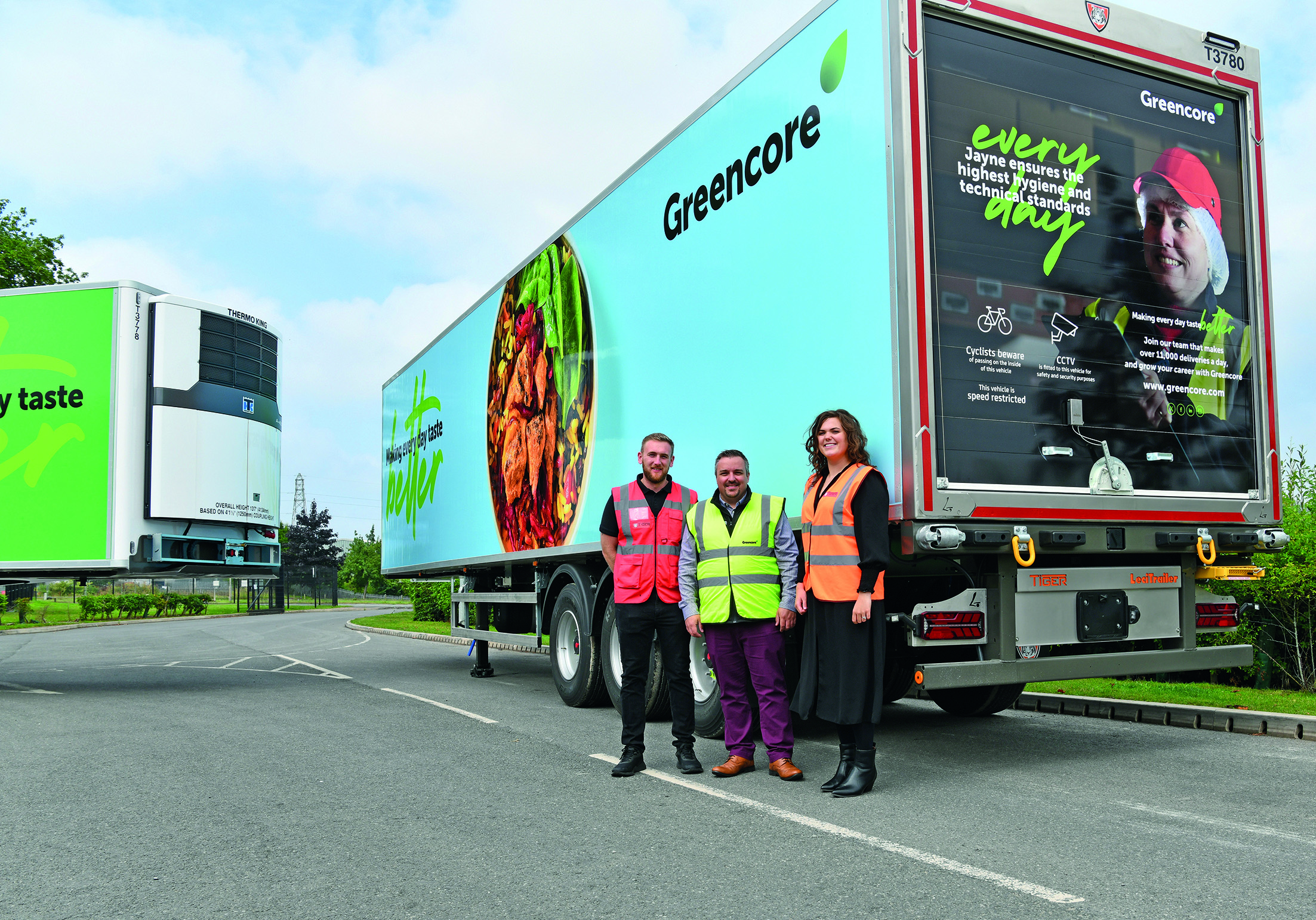
Tiger Trailers has designed, manufactured, and begun supplying forty-nine new temperature-controlled reefers for Greencore – a leading chilled, frozen, and ambient convenience food supplier to some of the most well-known retail and food service customers in the UK – split across thirty-seven single and twelve dual-temperature vehicles.
The operator has additionally welcomed to its fleet nineteen Greencore-liveried rental trailers from Tiger, comprising fifteen single and four dual-temperature variants, the latter equipped with 1.5-tonne Dhollandia tail-lifts with P-gates, 3-way ramps, and a wanderlead for easier and safer operation. Thomas Stott, Tiger’s Key Account Manager, along with Sales Manager Anna Christie, led the Greencore contract’s close customer collaboration, design and development, which included multiple visits to the two companies’ respective sites.
Adam Chittenden, Network Fleet Manager at Greencore says: “Greencore is proud to award our latest fleet contract to Tiger Trailers. After a competitive bidding process, Tiger stood out for their sharp focus on our needs and their winning mix of innovation, reliability, and sustainability. Their proven durability, low downtime, and responsive support made them the clear choice to help us boost efficiency and reduce disruptions.”
The fridges fitted to the two trailer iterations are Thermo King A400 Advancer single-temp and Thermo King A500 Advancer multi-temp units, and Greencore’s new Tiger trailers sport various eye-catching liveries. Unisto e-Guard Data units are fitted on the rear shutters, and load securing is taken care of by two rows of LoadLok tracks, combined with spring-lock poles.
With the chassis and insulated body supplied by Tiger’s partner in Spain, Lecitrailer, Greencore benefits from a KTL finish, along with comprehensive warranties, for peace of mind.
“It has been a pleasure for Anna and I to work with the Greencore team in designing their new ‘own fleet’ refrigerated trailers in different configurations”, Stott comments.
Christie added: “Our temperature-controlled range is a core, rapidly growing focus, so we’re delighted to introduce chilled Tiger products to another high-profile food service operator.” Chittenden concludes: “This partnership is a key step in future-proofing our fleet and driving greener, smarter logistics. We’re excited for what’s ahead.”
Subscribe
Get notified about New Episodes of our Podcast, New Magazine Issues and stay updated with our Weekly Newsletter.