The Beauty of a Reliable Order Picking System

With e-commerce on the rise, customers are looking for their orders to be delivered quickly, often by the next day. A reliable order picking system is therefore vital.

Online beauty products company flaconi in Germany is using Wanzl’s KT3 order picking trolleys at their 10,000 sqm warehouse in Berlin.

“We put our all into offering our customers a complete beauty experience with a high level of service quality,” says Steffen Christ, member of the flaconi management team and COO of Logistics. “In addition to our broad product portfolio, we set the highest standards with an optimal supply chain, simple order processing and fast dispatch. In our warehouse we work according to the ‘man to goods’ principle, and therefore have high demands of our order picking trolleys when it comes to day-to-day operations. That’s why we opted for Wanzl’s KT3 model.”

flaconi has a total of 100 trolleys, provided by the industry expert, in use every day for both storage and picking. The goods are stored securely on shelves that are metres high with lots of organised activity going on around – not a problem for the easily manoeuvrable trolleys from Wanzl. Two order picking trolleys need to fit next to each other in the narrow aisles when goods are being deposited or picked. In addition to high weight-bearing capacity, flexibility is also essential. Trips around the warehouse are long because the 720 brands and 45,000 products occupy a lot of space.

“A total of 150 employees work here and the trolleys are with them all the time,” Steffen Christ reports. “We’re impressed with the KT3 in use not only because of its load capacity of up to 300 kg, but mainly because it’s so manoeuvrable thanks to the additional fifth wheel and lightweight design. The separately mounted ladder also means our employees can reach the higher shelves.”

The product range stocked by flaconi in Berlin is both extensive and varied – from natural cosmetics and luxury products to the traditional Nivea cream. Tubes, glass bottles and all kinds of fragile jars find their way into the trolley’s baskets and compartments. And the trolley needs to be equipped for these various products. Its system design has allowed the KT3 to be adapted to the special wishes of the beauty pioneer. “To transport our goods efficiently, Wanzl came up with a custom configuration of the KT3 just for us. Along with the fifth wheel and ladder, all the trolleys have an additional pair of handles so they can be pushed comfortably along the aisles. We’ve also fitted the model for storing goods with a lattice back panel and four hook-in shelves, whereas we selected six hook-in shelves for the model used for picking,” Steffen Christ explains.

We first needed to work closely with flaconi in order to then develop a solution that was optimally tailored to its needs. As a holistic solutions provider, Wanzl attaches particular importance to support and providing an all-round service – a claim that the industry expert also shares with flaconi. Satisfied with the service, Steffen Christ summarises the collaboration: “It soon became clear which features we need the KT3 to have to meet our many demands. We greatly appreciate this solution-orientated way of working and the excellent communication. It made working with Wanzl a very pleasant experience.”


Digital Load Monitoring

A sensor-based on-board system aims to enable faster, efficient and safer load monitoring to meet the requirements of a new EU Directive.

Continental has developed an On Board Weighing System (OBWS) that records and displays the weight of commercial vehicles, including trailers and semitrailers. “It is quick, easy, and independent from a stationary scale – before starting a trip,” says the company.

Further functions make it possible to increase efficiency far beyond the specifications of EU Directive 2015/719, which will go into effect in May 2021. The directive requires EU Member States to measure the gross vehicle weight of commercial vehicles more frequently. In order to plan accordingly and prevent sanctions, drivers and fleet operators must already know the load condition of a vehicle before starting a trip. So far, this has been almost impossible and poses particular challenges for vehicles for which the semitrailer is usually provided by the forwarder.

Constant load overview

In order to meet the new requirements, most EU countries are looking to rely primarily on a comprehensive, stationary solution. Continental says the On Board Weighing System offers added value that goes beyond the regulatory stipulations. “Even if the load is measured by sensors in the road in the future, the integrated solution will remain interesting for forwarding agents, fleet managers and drivers,” says Marc Leinemann, a technical project manager at Continental involved in the development of the On Board Weighing System.

“Even before a truck drives off, fleet operators and drivers can check whether the weight of the vehicle is within a safe range,” he added. “Systems that determine the vehicle weight only after the start of the trip do not offer this advantage. If the weight can be determined before a trip, vehicles can be loaded more efficiently and safely as well. This reduces empty runs.” The data provided also makes preventive maintenance possible. In addition, it can serve as a basis for new business models, for example with load-dependent transport tariffs.

Sensors measure axle loads

Fleet requirements vary, as they often comprise vehicles with different suspensions. The experts at Continental have therefore developed various OBW solutions that take the respective customer requirements into consideration. Chassis with air suspension are great for constantly determining the load condition of all individual axles. Continental also offers tailor-made solutions for chassis with steel suspension.

For example, the technology company has developed a sensor for vehicles with air suspension, which uses ultrasound to measure the height and pressure of air springs in order to determine the axle’s load condition. On the same basis, a height sensor has been developed for shock absorbers for vehicles without air suspension. The suspension travel of the shock absorber provides information on the load condition of the respective axle. The strain sensor from Continental is also suitable for both steel and airsprung axles. It measures the strain of the axle body and thus enables the load to be calculated. The sum of the axle loads results in the vehicle weight including the load.

Complete system from single source

In all four cases, the data gathered is collected, forwarded and evaluated, and the results are finally displayed via the app on the driver’s smartphone or on a display in the driver’s cab. Fleet
managers can also retrieve the data and optimise the utilisation of their fleets. Continental offers all products and services as a complete system from a single source – from the air spring to the sensor through to data processing and software applications.

New Trailer Livery Partnership

Major logistics and transport suppliers, C Butt Ltd has celebrated their long-term partnership with global packaging company Sealed Air through the delivery of newly livered trailers. The six new trailers and cabs display either SEALED AIR® brand AirCap® bubble packaging, or SEALED AIR® brand Mail Lite® mailers.

Both packaging materials demonstrate a drive towards sustainable packaging materials: SEALED AIR® brand AirCap® bubble packaging contains a minimum of 50% recycled content; and new SEALED AIR® brand Mail Lite® mailers are designed for recycling with the outer kraft paper easily separated from the internal bubble. Established in 1926 in Northampton, C Butt Ltd has been a family business for generations, and a contracted distribution suppler to the Sealed Air Kettering, UK site for more than 25 years.

“C Butt Ltd is very proud to be a distribution partner with Sealed Air,” said Jonathan Butt, Joint Managing Director of C Butt Ltd. “Our companies have a true working relationship and have been able to successfully work together to ensure customers are receiving products that are meeting their efficiency, fulfilment and sustainability needs.”

“We were delighted when C Butt Ltd approached us to consider supplying the livery for their new fleet of trailers. This reflects the value of a good, long-term partnership and we are excited for people to see the new fleet on the road,” said Ash Barrs, Sealed Air Logistics Manager.

Intralogistics Provider STILL announced Reforestation Project

Hamburg-based intralogistics provider STILL has announced it supports the reforestation project PLANT-MY-TREE. This month, the first of a total of 1,000 trees were planted in the reforestation area in Hohenaspe near Itzehoe in Germany. There, on the “STILL woodland”, they will grow in peace for at least 100 years and compensate for harmful emissions.

Environmental protection is currently one of the most important issues in the logistics industry and the subject of lively discussion in the industry. The Hamburg-based STILL GmbH turns words into deeds and actively participates in the PLANT-MY-TREE project, which contributes to CO2 compensation with nationwide reforestation campaigns.

“We wanted to do our part regarding the extremely important topic of sustainability and were looking for appropriate opportunities,” reports Michael Quest, Head of the STILL Branch Hanover/Bielefeld, on how the participation in the project came about. Sven Budelmann, his Sales Manager, brought up the reforestation activities of the PLANT-MY-TREE initiative. “We were immediately inspired by this idea, and the decision to sponsor 1,000 trees quickly matured,” says Michael Quest, adding: “In my opinion, the preservation of an intact environment is the basis of the existence of all of us. Accordingly, we feel an obligation to use natural resources responsibly. This is a principle that STILL already observes when developing new products by considering their impact on the environment at an early stage”.

Spread the word

However, there is more to it: the customers of the main branch in Hanover/Bielefeld are to have a share in the environmental protection campaign. “Customers who ordered new electric forklift trucks from us and shut down their IC engine-powered forklifts in return received personalised tree certificates as a small thank-you. These certificates can be displayed prominently at their company premises and thus underline their environmentally conscious attitude and actions,” explains Sven Budelmann. The STILL Branch Manager and his Sales Manager plan to give away further tree certificates during the upcoming Christmas season to those customers who remained loyal to them in recent months during the Covid-19 crisis.

His attitude towards ecology also prevented Michael Quest from personally participating in today’s tree planting campaign in Hohenaspe. Quest: “Of course, we would all have loved to have been there and taken a look at the site where our 1,000 trees will now stand watch for at least 100 years. But for this we would have had to travel several hours to get there. This, however, is anything but ecological and contradicts our attitude towards climate protection”. For this reason, Mikinari Oki, Head of the Hamburg/Bremen Branch, and Andre Jacques, Regional Service Manager, were on site as official representatives of STILL GmbH during the tree planting campaign in Schleswig-Holstein.

STILL celebrated it’s 100th birthday this year.

Tips to Choose the right WMS

The current situation is accelerating the speed of enterprises modernization and change. The digitalization of all processes and the introduction of innovative and powerful WMS (Warehouse Management Software) is crucial. It is no longer a chimera of the future, but a specific need, leading to competitiveness, say Stamh.

But before the implementation, a company must prepare for the selection. Businesses need to understand the important features of the WMS software, select the most appropriate partner and elaborate a clear implementation plan. To implement WMS in a good, successful way, Stamh provides 4 important tips to chose the right software and implementation partner. Check them out:

Tip 1: Internal preparation for selection

One of the most important initial steps is to form a project team. To select the right WMS solution, you need to create a Cross Functional Team. It should include professionals with digital thinking from the finance, sales, production, IT and warehouse departments. A common mistake is to proceed with WMS automation of poorly organized processes. Therefore, one of the tasks of the project team is to analyse all the processes in the warehouse.

Based on this analysis, the team needs to prioritize the key functions of the software. The project team must be aware of which functionalities are mandatory, which are highly desirable and which are just ‘good to have’. Since the choice of the warehouse software is a step that directly affects the development of the business, it is advisable to make a forecast for the development of the company. What if the selected software can’t meet the future growth? Some operations require less human resources but more hardware and software solutions – automation and robotics, directly affect all other processes in the company.

And the last, but not least step is the preparation of a feasibility study. If it’s incomplete, convincing management to proceed with the project can be a failure. For this purpose, it’s crucial to make a qualitative and quantitative comparative analysis, without missing significant direct or indirect consequences. For example – what is the importance of the human element in the current pandemic situation?

Tip 2: Choose only the WMS software features that are important to your business

Once the management is convinced for the project implementation, the team must select the main WMS characteristics. First of all, WMS software needs to be accessible. Exporting data should be easy and convenient for its users. It is recommended to have a really user-friendly HMI with real time information. In addition, the program must be compatible with generally accepted standards – regulatory or related to the nature of the business.

Depending on the activity of the company, various specific functionalities of the software can be added. They can be related to the requirements for certain types of goods – for example, functionalities related to the work with excise goods, dangerous goods, serial numbers, etc. Modern WMS software must allow simultaneous pallets placement and picking. This way there will be no lifting equipment idling.

It is recommended to opt for a modular WMS solution and have the possibility for additional expansion. The time and cost can be significantly lower during implementation. This way, the software runs faster when operating with standard processes. Over time, new features can be integrated into the software. It is almost mandatory to integrate the software with other systems – ERP, CRM, TMS, BI and others. The integration possibility with automated and robotics systems, picking technologies (voice systems, RFID, pick to light, put to light, etc.) is aslo essential.

Tip 3: Don’t underestimate important aspects when choosing a partner to implement the solution

Once we have specified the software functionalities, we can proceed to the selection of a partner for the implementation. First of all, the required integrator company must have significant professional experience. Having experienced professionals in the construction and management of warehousing processes is a major advantage. Before setting up a WMS, you should asnwere questions like ‘how it should be’ and not ‘how it is now’.

It is very important whether the product has a strong market presence. Software products appear all the time, but it often happens that they also disapear. The lifespan of the product on the market is an important indicator of the level and product relevance to customer needs. The integrator shouldn’t be just a trader, but your partner. Trust between partners is a very relevant factor in every business. Therefore, in the initial conversations, try to look beyond the presentations and demonstrations. Do you feel that you are treated as a partner and not just like a good number in the annual results?

It is recommend to chose a company with real research and development team. It is important to know what investments are made in this activity to keep the software up to date. It is necessary to inform the team about additional costs for activating new functionalities in the future. Of course, special attention should be paid to the available resources for the project implementation. However, each company sets certain limits on the amount it can spend on software.

Like any product that will be used in the long run, the software needs technical support. Therefore, you should pay attention to the technical support provided by the integrator. It is necessary to ensure a minimum of debugging in the standard version. Your new partner should to be able to provide hardware solutions through reliable subcontractors.

Tip 4: Build a detailed implementation plan

The first step when developing an implementation plan is to choose the right time. It is desirable that this is a period of the year with lower business activity. You should set realistic deadlines and should outline clear tasks. Key players are selected. These are proactive people with digital thinking who will be constantly available to the integrator company and will help them.

It is a good idea to develop an employee training program from the beginning. It is not recommended to make modifications before the base model is completed. It is better to postpone the extras and concentrate on basic processes in the beginning. Of course, you should constantly monitor the implementation process.

Overhead Hands-free Barcode Reading

In logistics operations, achieving optimal productivity and efficiency are often the two main performance metrics. Increased demand has put pressure on retail and e-commerce fulfillment facilities to maintain scalable performance and throughput. One way to achieve this is through overhead hands-free barcode reading systems which offer a varitey of advantages:

– Station flexibility: Ability to handle a variety of box sizes and operator heights thanks to dynamic focus length and high resolution sensor. Ability to read a variety of code sizes and types at once
– Operator well-being: Scanning motion that allows’operators to use both hands allowing them to work switly and safely. This has proven to be ergonomically safer and reduces the risk of parcels being dropped or damaged. In addition, ‘always on” lights reduce operator fatigue.
– Clear visual indicators for read or unread codes.
– Decreased maintenance or replacement cost: no moving parts or accessories that could get damaged or lost.

Cognex fixed-mount image-based barcode readers mounted in an overhead configuration read barcodes quickly and accurately, even if they are damaged or torn, using advanced algorithms and decoding technology. Rugged solid-state construction delivers consistent results in the toughest environments. Enter for a chance to win an overhead barcode reading station, including one DataMan 374 barcode reader with mounting bracket, power supply, torch light, cables and set-up onsite.

AR Racking kits out Cold Warehouse with Storage System

AR Racking has fitted a new cold warehouse with a storage system in France for AUTTA. AUTAA corporation specialises in industrial services for lifting and transporting heavy loads, transportation of production tools, stock management and storage.

With a history that dates back to 1964, AUTAA is one of the most widely present organisations in the heavy industrial loading services and management sector in France. The company has a 5,000 m2 warehouse in Artix (Pyrénées-Atlantiques, France), where it is based. The cold storage warehouse, will help improve AUTAA’s storage asystem and performance as a goods management and logistics warehousing specialist.

“Versatility defines us as a company, so we wanted a warehouse that would allow us to offer an even more complete service. AR Racking’s systems ensure we have immediate access to goods and high-density compact storage, while the logistics capacity has been strengthened qualitatively and quantitatively”, said Hervé Dupey, Logistics Manager of the AUTAA Group.

The new warehouse has 4 areas, three of which for cold storage with a positive temperature (between 0°C and 10°C). AR Racking has installed adjustable pallet racking systems both in the dry area of zone 1 and in zone 3 designed for cold storage, resulting in 2,132 europallets (800 mm x 1200 mm) and 1,128 positions respectively. The two remaining zones, which are also cold stores, have been fitted with pallet shuttle solutions: each with a capacity for 1,736 and 1,128 industrial pallets. In total, around 6,100 new positions.

“Areas with racking for the pallet shuttle have been designed for pallets of both 800 mm and 1000 mm deep, enabling two different types of loading management”, explained Christophe Braquehais (Key Accounts Manager at AR Racking France).

Adour Manutention, strategic distributor at AR Racking, has been assigned with supplying the shuttle for its long-term rental and will be responsible for the maintenance of the shuttle services on site.

AR Racking fitted out a new warehouse in Valencia a couple of months ago for a power electronics company.


Logistics Confidence Index Falls to Lowest Level

The latest Barclays-BDO Logistics Confidence Index has fallen to its lowest ever level since the survey began in 2012 as the sector deals with the fallout from the pandemic, skills shortages and concerns over Brexit. The survey assesses the expectations of more than 100 senior decision-makers across the sector.

• Confidence index falls to lowest level since survey began in 2012 as the sector deals with the fallout from the pandemic, skills shortages and concerns over Brexit
• Some bright spots – nearly half still expect profits to increase next year and those focused on e-commerce/last mile deliveries have fared better
• Technology is being increasingly deployed to address challenges facing the sector and over two thirds are investing in sustainability
• Consolidation is on the cards with nearly 40% considering acquisitions in next 12 months

The Confidence Index has fallen from 49.7 in 2019 to 47.1 this year, continuing the downward trend seen in recent years and taking the score to its lowest level since the survey began in 2012.
This fall in confidence comes against a backdrop of unprecedented domestic and global uncertainty created by the pandemic, in addition to ongoing concerns over the UK’s future relationship with the EU and the continuing skills shortages.

The Index number, however, masks the high degree of polarisation in the views of operators, with results differing depending on the sectors they are most exposed to. A third of operators reported current business conditions as either the same or more favourable than 12 months ago, despite the economic disruption. Those focused on e-commerce and last-mile deliveries have fared relatively well, while others operating in manufacturing sectors, such as automotive, aerospace, oil and gas saw unprecedented levels of disruption.

The results are similar when asked about which industries are providing the greatest business opportunities in 2021 with more than a half of the operators surveyed (55%) saying online retail, 32% saying manufacturing and only 6% of respondents highlighting the automotive sector. This reflects how changes in consumer buying habits away from bricks and mortar stores to online purchasing and manufacturers direct selling have been exacerbated by Covid-19. To illustrate the impact of Covid-19 on the sector, the vast majority of respondents (94%) stated that they have utilised the government’s Job Retention Scheme and staff furloughs to help them through the pandemic.

In keeping with other industries such as retail and hospitality, the adoption of technology to address business challenges has rapidly accelerated this year. To help overcome talent shortages, more than two fifths (42%) of operators stated they are using technology to replace human talent. Meanwhile, many businesses are continuing to invest in sustainability with more than seven in ten (72%) putting funds into green-related projects over the next 12 months.

Looking ahead, there is cause for cautious optimism. Logistics continues to be a strong and resilient sector and remains a major contributor to the UK economy. The total combined UK revenue for the 100+ companies surveyed is £16.4bn and, even under the current highly uncertain economic conditions, nearly half (49%) of them say they still expect to see profits increase over the next 12 months. In the context of a changing market, it is perhaps no surprise that M&A is in the plans of many companies, driving many to adapt by extending existing service offerings or targeting new customer markets or industry sectors. The number of companies expecting to make acquisitions is close to the all-time high of 2017, with 38.9% of respondents saying they are likely to make an acquisition within the next 12 months.

Ian Cranidge, Head of Transport & Logistics at Barclays Corporate Banking, said: “2020 has been an unprecedented year – never has the industry faced such a plethora of multi-faceted challenges. However, longer term this is an extremely resilient sector which is ready to bounce back once the pandemic passes. Businesses are using this challenging period to build back better, by investing in technology and sustainability. The present is undoubtedly tough, but we can look to the future with optimism.”

Jason Whitworth, Partner, M&A Advisory and Logistics & Supply Chain Management at BDO LLP, said: “As we stand today, it feels like we are still in the eye of the storm in terms of uncertainty. Given this, it is no surprise confidence is low. The pandemic highlighted the vital nature of an effective supply chain, and this survey demonstrates the sector’s resilience and adaptability. Encouragingly, the responses reveal a continued appetite to invest for the future – searching out new markets and added value services, developing technology, automation and sustainability projects, and attracting, training and retaining good people.”

Abu Dhabi Ambition

Logistics Business talks to Robert Sutton of Abu Dhabi Ports, which is expanding fast and strengthening its logistics capabilities courtesy of an important acquisition.

Abu Dhabi Ports, which itself is part of ADQ, one of the largest holding companies in the Middle East, has taken another step towards establishing the Emirate as a global hub for trade and logistics with the acquisition of Micco Logistics. Micco was one of the first freight forwarders to set up in Abu Dhabi over 40 years ago and built a strong base in the Oil and Gas sector on its way to being one of the most diverse multimodal operators in the region.

Robert Sutton, Head of Abu Dhabi Ports’ Logistics Cluster, explains that the move is a natural progression for Abu Dhabi Ports. “First of all, we are more than a ports business. Abu Dhabi Ports has been enabling trade since its inception and this acquisition further strengthens its logistics capabilities. We’re enhancing the value we can add to our customers, so the acquisition is allowing us to strengthen and extend the value chain across our broad customer base. It will allow us to diversify our service portfolio.

Historically, we were focused on Oil and Gas, Polymers, and some industrial sectors. This allows us to look at our speed of diversification into retail, Pharma, healthcare and other sectors.” Where does he see that value being seen most visibly at the outset? “Micco are strong in all modes. They’re one of the major freight forwarders for import and export in the Emirates, with a very strong on-road presence of over 350 branded vehicles fitted with the latest technology. So an immediate benefit is access to a much larger captive fleet of commercial vehicles with the ability to extend freight forwarding services.”

Customer requirements are, of course, at the forefront. “The underlying requirements remain the same – customers want an all inclusive holistic service, where possible, from an integrated provider and they want it at the lowest cost or the best value available. They want to measure that against the value delivered.” Does he see those requirements changing, particularly given the global disruption we’ve experienced? “I guess the changes now are in the buying decisions, based on looking at risk management and how you mitigate risk in the supply chain. Some of the dynamics are changing in the customer’s decision criteria, with the customers now requiring very strong built-in supply chain resilience.”

It’s fair to say that at this point Abu Dhabi Ports is not an immediately familiar name to many logistics professionals based in Europe. How would we characterise the company’s ethos?

“Customer First,” he replies promptly. “We say it and we truly mean it. We spend a lot of time trying to pre-empt customer requirements and ensure that we meet them through development of
solutions.” That’s a familiar refrain, though, I point out, and ask for a specific example to illustrate his claim.

“We don’t look at a solution within four walls, we look at a customer’s entire supply chain. We will then try to identify parts of the supply chain where we believe we can create some value for
the customer. And it might be an area that’s outside our immediate influence or control. We don’t let that prevent us from having a discussion with the customer.” He provides an example from the
COVID-related push to online solutions from retailers. “The way Abu Dhabi Ports responded to that was by working with retailers to mobilise additional in-store support services. We trained those individuals, who had come from the food and beverage sector, to be familiar with piece picking in the retail environment and thus be able to match the surge in demand from the retailers when required. This allowed us to re-use and repurpose facilities within Abu Dhabi Port Logistics for the betterment of the community by being served via online retail. Speed of thought and action were
crucial.

“We started mobilising within one week of the requirement being known to us. We repurposed the Abu Dhabi Cruise Terminal and turned it into a training centre, then deploying the teams to the stores in line with their needs.” Transparency and visibility are now vital components of supply chain management. What will the acquisition of Micco add to the company’s capability?

“One of the criteria when we look at a potential business partner, acquisition or collaboration is the value it can bring. The goal of any supply chain company is to extend the visibility in the supply chain as far upstream and downstream as possible. Micco have very good underlying systems which enhance the visibility of the supply chain. We also work with external parties, such as JDA Blue Yonder to provide additional levels of visibility.”

Serious multinational logistics players these days have to think globally, and Micco can help Abu Dhabi Ports achieve that. “One of the reasons why we acquired Micco was because of their international reach. They’ve been working in the industry for over 40 years and have built up an extensive network of international partners and trade related experience with their customers. So it provides us with an opportunity to connect that ability to our ports’ capabilities.”

Does that mean Abu Dhabi Ports has ambitions as a serious global player, to be spoken of in the same breath as, to quote an obvious example, DP World? “We respect the competition, their strategies and strengths. Abu Dhabi Ports doesn’t aspire to replicate the competition, we aspire to be competitive, and to do so, we work with multiple partners. I wouldn’t say we’ve set out an aspirational goal of matching any particular logistics or supply chain company, that’s not what we’re about. We know our own direction and what our customers are looking for, and that’s our focus.”

How would he crystallise those aims?

“Our long term goal is to continue to grow, expand and make sure that we’re ahead of our requirements, through partnerships and acquisitions, and to make sure that we’re providing the type of logistics and supply chain requirements that are appropriate for the conditions.” Does that mean there are further big acquisitions to come? He is guarded. “We remain open to growth enablers,
whether that’s through partnership acquisition, mergers, or collaborations. We’re a very ambitious business, we look at the opportunities as they come, evaluate them, and move on accordingly.”

As a veteran of the global logistics industry, how does Robert Sutton view the wider sector’s future? “It’s a time of both opportunity and risk. The winners will be those who use the data and technology and are able to leverage their investments in making sure they have resilient and long-range supply chains. So that’s where the focus will be. I also think we’ll see more of a balance in the supply base – long range, near-term and maybe onshore sourcing for certain products, which historically may have been outsourced. Companies might procure from two or three suppliers, where they might once have used one premium supplier.”

Are we heading towards an end-to-end autonomous supply chain? “I see that as a far away development,” he reflects. “There’s a long distance to travel before we reach that goal. But certainly, parts of the supply chain are now fully autonomous, and there are opportunities to extend beyond. We already see it within the four walls of a warehouse on a pretty regular basis, and we see automation extending to commercial vehicles as well.”

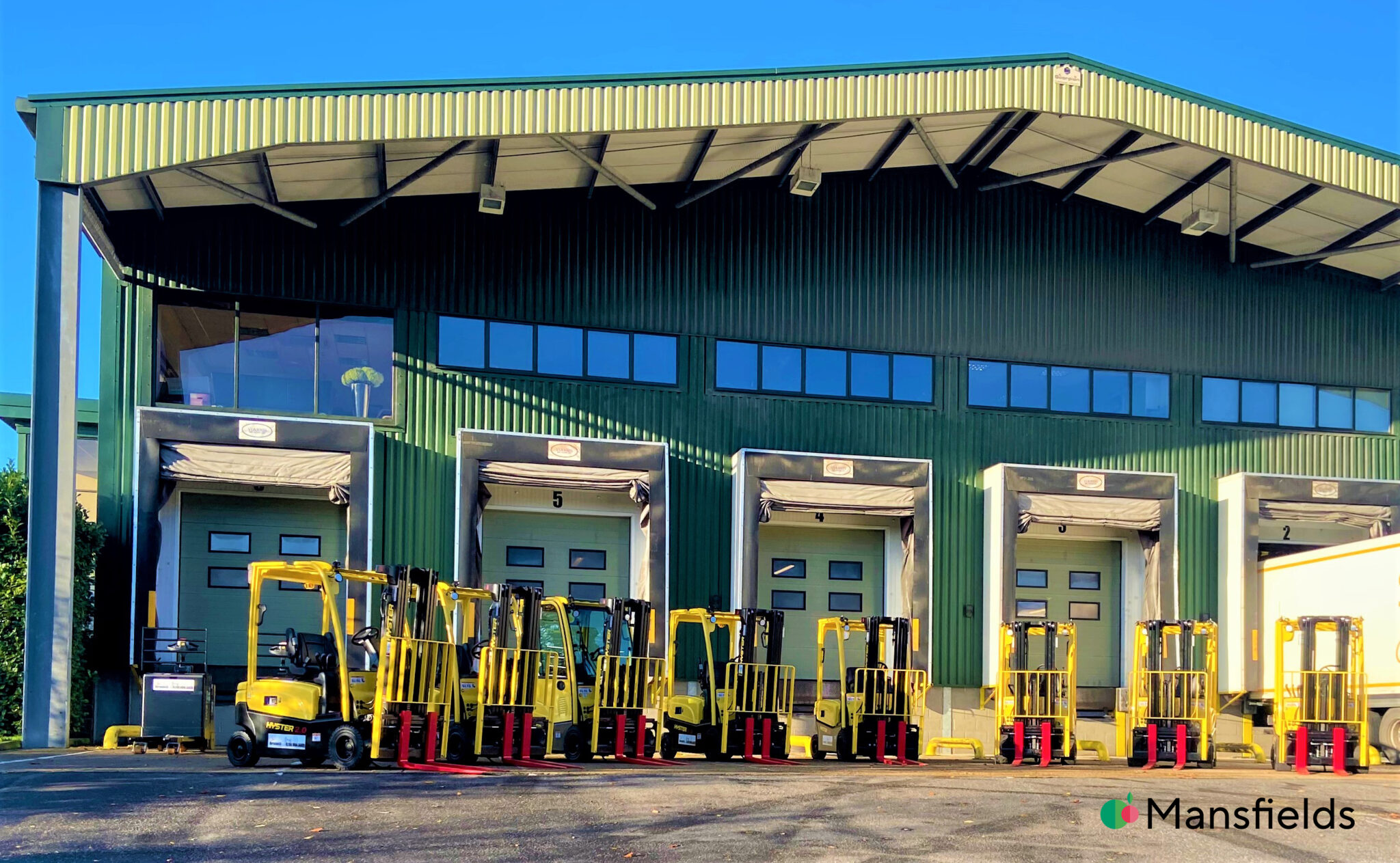
Mansfields go Green with Lithium Ion Batteries for Machine Fleet

Hiremech has completed the delivery of 15 new Hyster machines, fitted with Lithium Ion batteries, to Mansfields.

The new fleet is a mix of four wheel forklifts and platform pallet trucks, which will be used to boost productivity at Mansfields’ 20+ farms across the South East region of the UK.

Mansfields have been in the fruit business for many generations and are currently one of the largest fruit growing, storage and packing operations in the UK.

Mansfields have now completed rolling out state of the art production across all its facilities. Alongside innovating its production, the company has rolled out a carbon zero scheme and an environmental strategy to match and these new machines will help achieve greater levels of performance and efficiency. The Lithium Ion batteries mean operators can use the machines for longer, whilst also making significant energy savings and helping to reduce their environmental impact. This technology also allows for opportunity charging, which is ideal for busy shift patterns that need to keep working.

This investment in brand-new Lithium Ion equipment shows their clear commitment to sustainability and understanding of their carbon footprint responsibility.

Lee Port, Head of Operations at Mansfields, commented: “Advancements in farming technology continue apace, which is why Mansfields are constantly looking ahead to plan for future investments that will continue to keep them sustainable and ahead of the competition, and indeed continuing its legacy of innovation dating right back to its beginnings”

Paul Green, Hiremech’s Managing Director, commented “We are delighted to have completed this latest delivery of Hyster equipment to Mansfields.

“From our initial conversations, they made it clear that any new equipment would need to be energy efficient. We were quickly able to present a suitable solution of Hyster trucks fitted with Lithium Ion batteries.

“The team at Mansfields were impressed with the energy savings, performance and opportunity charging that this offered and following agreement of the deal earlier in 2020, the equipment has arrived on-time, on-site and ready to go.

“We look forward to working closely with Mansfields and supporting their equipment requirements as their business continues to grow.”

For more news on Lithium Ion batteries being used to make energy savings, sign-up to our news here

Subscribe

Get notified about New Episodes of our Podcast, New Magazine Issues and stay updated with our Weekly Newsletter.