A Global Event

This time last year we looked at the 12 months ahead in optimistic mood, visualising the further advance of digital transformation supported by sustainable solutions. The good vibes were tempered by the nervousness that, although a Brexit transition deal had been agreed, the final deal was yet to be done. Right on both counts, perhaps, but definitely not in the way we thought, writes Paul Hamblin, Editor.

Logistics has put itself front and centre in the European public imagination in 2020, driven by ecommerce adoption as perhaps the principal mass change (acceleration is a better word, maybe) of habit caused by the COVID pandemic. I think back in April we all hoped – and probably believed – that by now Europe would have navigated a path out of the crisis. Instead, we’ve become used to living our working lives through our laptop screens, seeking ever-inventive ways to maintain established business relationships as well as to harvest new ones.

Great news – Logistics Business is here to help with that. We have a brand-new global event planned for the last week in February 2021 that we are all very excited about – a fullon
logistics exhibition, with six halls, exhibitor stands, panel discussions and, above all, an outstanding networking or lead generation opportunity.

And it’s all online. No travel or hotel costs, no social distancing regulations. Put simply, it’s our way of keeping the global industry connected using the best technology we can find, as we await the return of those face-to-face contact opportunities. As Europe’s best known English-language logistics journal, we feel a duty to keep everyone talking as usefully as we possibly can, particularly at a time when Europe’s roads and borders are more restricted than we are used to.

You can choose from any of six halls to exhibit your stand: Forklift and AGV Technology, Automation Handling Systems, Packaging and Pallets, Software and Computing, Transport Services and Equipment and Warehouse Equipment. Here’s another cool bit: this isn’t a stand that you assemble and then dismantle on February 25th – you can just keep it in place for a full second run of the
show planned for September 2021. Panel discussions and seminars are set to be an important addition to the main exhibitor halls. Led by Yours Truly, industry experts and veterans will discuss a plethora of themes to inform your future decision making in compact, bitesize online formats that you’ll be able to return to at your leisure.

If you have ideas for discussions, be it digital transformation, supply chain optimisation, workforce empowerment, sustainable packaging or something else altogether, or you’d like to take part in one of the panel discussions, or indeed if you’d like to nominate a panel member for our seminars, please don’t hesitate to get in touch today via our special Logistics Business Virtual Exhibition contact sh**@***************ss.comTurn to page 6 for more details on this groundbreaking event.

Meanwhile, I hope you find plenty to inform and entertain you within the pages of our November 2020 issue. It’s packed with cutting-edge news, innovation and opinion from across the European logistics sphere.

Small Parts Picking in Pallet Racking

Edward Hutchison, Managing Director of BITO Storage Systems, explains how using pallet racking for small parts storage turns this ubiquitous storage product into a flexible order picking solution.

“While constant innovation generates a stream of new intralogistics solutions, ‘classic’ pallet racking remains the most commonly used storage system. Its relatively low investment costs and flexibility – whether through changing rack configuration, retrofitting special purpose modules or adding extra bays – have made it an indispensable framework for storage and order picking systems.

“Of course, many operations use pallet racking as the basis for straightforward storage and retrieval of full pallets, either to fulfil customer orders or as a bulk store for replenishment. But the trend toward shorter product life cycles is increasing SKU numbers. The drive to minimise stock levels for each SKU and improve picking process efficiency to speed up order fulfilment, combined with demands for Just-in-Time delivery and online retail, is generating a greater need for small parts storage.

“This is where the adaptability of pallet racking comes to the fore because small parts picking can be easily integrated within pallet racks. One option is to create small parts pick locations on the reachable ground level, with upper storage levels serving as a buffer store for replenishment. Small parts storage containers will help to store and organise small goods and C-parts – making them available for quick and easy picking. This will result in a reasonably efficient picking process but ground floor locations within a pallet rack will, of course, be limited. Solutions are therefore required to maximise the available space to create a pick face with sufficient locations for the required SKUs, and enough stock to ensure availability during picks.

“Flow shelves can be easily installed into pallet racking to increase the number of pick locations and volume of SKUs located on the ground level pick face. Goods are effortlessly accessible from the front of the racking – the rollers on the flow shelves allow bins and containers containing small items to be picked to roll smoothly to the front of the shelf – which makes picking easy. A full container of parts will roll to the operator each time the empty one at the front removed.

“Standard shelving is another option to create flexible small item pick faces within pallet racking. There are several solutions: the first incorporates static shelving at right angles to the racking, with space in between each run to facilitate picking. An alternative option is pull-out mobile shelving that maximises the available space under the racking – though movement of shelving has a negative impact on pick time. A third solution involves static shelving parallel to racking, which makes front items easy to pick. Shelving dividers can be fitted.

“Inclined supply shelving within a pallet racking bay will make items clearly visible for picking. Cardboard cartons or plastic bins can be used, though the later option enables preparation in advance at the goods-in area by filling the plastic bin with the items to be picked.

“Plastic bins and containers will keep goods protected throughout the intralogistics process and during transport to ensure products are delivered to the customer in prime condition. It is worth seeking out storage system suppliers that in addition to offering racking, shelving and flow lanes, also provide a container range comprising a variety of sizes with and a broad choice of accessories. Such a supplier will be able to design the optimum system to fit a given space, maximise the potential for small parts picking and, ultimately, improve fulfilment.”

Retailer Deploys over 100 Automated Mobile Robots

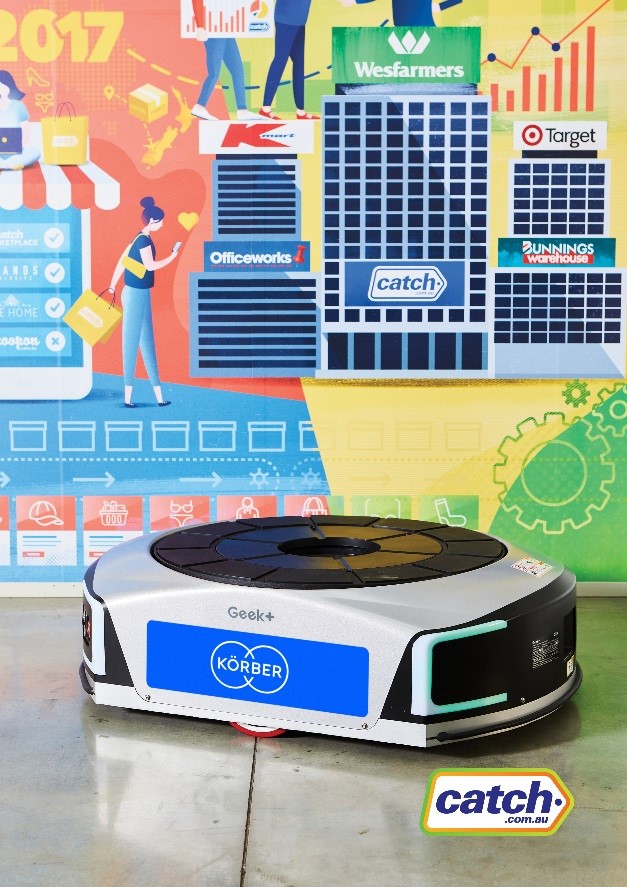
Geek+, a global AMR leader, is pleased to announce that Catch.com.au, one of Australia’s leading online retailers, will adopt more than 100 robots through its global integrating partner Körber, bringing new opportunities for the e-commerce marketplace in Australia and New Zealand.

In the past year, Catch.com.au has seen its already rapidly growing business expand with thousands of additional SKUs being added to its already extensive range of brands and products. With a rapidly growing customer base and the prevalence of COVID-19 driving more and more consumers online, the company has been looking for a solution that would allow them to flexibly scale in line with business growth and continue to increase and improve their product and service offering.

Lit Fung, VP and Managing Director of Geek+ APAC, UK and Americas, says: “We are very pleased to see our robots provide Catch.com.au with the flexibility, adaptability, and precision needed to adjust and grow in today’s volatile marketplace. We believe our global partnership with Körber will continue to generate opportunities for us to support companies worldwide with technologies that can streamline operations and promote collaborations for transforming the global supply chain.”

In November, more than 100 Geek+ AMRs will operate 3785 sqm of allocated space within Catch.com.au’s 30,000 sqm facility. By supporting them with the ability to pick an additional 2,000 orders per hour, Catch.com.au will be able to manage an additional 80,000 SKUs over and above its existing range and move one step closer to its aim of offering same-day delivery. “This investment is a significant step for Catch.com.au in its move to offer faster and more convenient fulfilment options for its increasing customer base. We are excited to see where this technology deployment takes us and to seek out further opportunities where we can utilise this kind of agile and flexible technology,” Richard Whetton, Head of Fulfilment at Catch.com.au said.

Geek+ and Körber recently announced a global strategic partnership to provide businesses with smart AMR solutions worldwide. “This partnership is an extension of the success that Körber and Geek+ have had in the Asia Pacific region and will see the innovative AMR solution reach new markets,” Nishan Wijemanne, Managing Director of Körber Supply Chain Asia Pacific and global leader for AMR Solutions at Körber said.

The integration of Geek+ robots in Catch.com.au’s DC is the second step of a successful collaboration that aims to provide businesses worldwide with technology for meeting changes in demand, quickly scale in line with business growth, and provide customers with better products and service capabilities, building resilience through flexibility.

Geek+ is a global technology company leading the intelligent logistics revolution. We apply advanced robotics and AI technologies to realize flexible, reliable, and highly efficient solutions for warehouses and supply chain management. Geek+ counts 300 global customers and has deployed more than 10,000 robots worldwide. Founded in 2015, Geek+ has over 800 employees and is headquartered in Beijing, with offices in Germany, the UK, the US, Japan, Hong Kong, and Singapore.

Support Connected Manufacturing

  • Microlise has joined manufacturers’ organisation MAKE UK, becoming a member alongside the UK’s leading manufacturers and innovators. With significant expertise in the area of connected technology and the Industrial Internet of Things (IIoT), Microlise looks forward to collaborating with and supporting members, particularly as the supply chain landscape and trading environment beyond Brexit presents a unique set of challenges that digitisation can do much to overcome.
  • Britain is one of the world’s biggest manufacturing nations, with almost 3 million people working in the sector and delivering almost half of all exports. UK manufacturers drive over 60% of all research and development, driving change and transformation. According to David Midgley, OEM & Channel Director at Microlise, the company’s early involvement has already proved to be constructive:
    “We have taken part in a number of events and webinars and can see lots of potential synergy between ourselves and other like-minded manufacturers. As a proud UK-based designer, developer and manufacturer of the hardware, firmware and applications that underpin our connected platform, and our on-highway telematics and technology solutions, we look forward to participating more widely and to sharing our thirty-plus years of global experience with other members.”
  • Charlotte Horobin, Region Director, Make UK added: “I am delighted to welcome Microlise into the largest community of UK manufacturers. Microlise is an ambitious and dynamic company that brings real technological expertise to the table. I look forward to working with them through Make UK’s portfolio of services, events and network to support their business growth and drive forward technological innovation within the sector.”
  • Nottingham based Microlise is the proud holder of two consecutive Queen’s Awards for Enterprise – International Trade in 2018 and Innovation in 2019, in recognition of the industry-leading solutions we export around the world, most notably to Tata Motors in India. The company works with a number of manufacturers, such as JCB in the off-highway space, and MAN Truck & Bus on-highway, in the UK and across the Middle East & Africa, supporting these world-leading organisations to gain insight into their own products and enhance customer experience, through our connected offering.

Agility Announces Solar Projects to Provide Clean Power

Agility, a global logistics provider, announced solar projects in Dubai and Jordan that will eventually cut the company’s carbon footprint in the region by 5%.

At Agility’s regional headquarters in Dubai, the solar photovoltaic (PV) plant involves installation of 17,500 panels at three sites with the capacity to generate nearly 8 mega-watts of power at peak. Installation will include a 5.45 MW system at two sites in the Jebel Ali Free Zone (JAFZA), and a 2.6 MW system at the Dubai Investment Park. Once complete, Agility’s solar PV system will generate enough electricity to cover 60% of the energy requirements at the sites and save an estimated 8,838 tons of CO2 each year, roughly equivalent to the emissions generated by trucking 18,000 fully-loaded containers from Dubai to Abu Dhabi.

In Jordan, the solar photovoltaic plant will encompass 1,945 panels at Agility’s warehouse in Aqaba, with a capacity of 788 kilo-watt peak. The solar plant will generate enough electricity to cover 100% of the energy requirements and save an estimated 900 tons of CO2 each year.

In both locations, the high-efficiency solar PV panels are designed to optimize energy generation in hot desert climates. The panel systems incorporate robotic cleaning and are waterproofed.

“Globally, Agility’s goal is to reduce its carbon footprint by 25% by 2050. Our investment in these solar projects is a huge step in the right direction and will cut the company’s global emissions by 3%. We are hopeful that it encourages other companies in the region to do the same. We know that greening operations is good for business and good for the planet,” says Elias Monem, CEO Middle East & Africa, Agility GIL.

The project is consistent with the goals of the UAE’s Shams Solar Policy, a local initiative for distributed solar plants in the United Arab Emirates.

In both Dubai and Jordan, Clenergize Solar Consultants was appointed as the project advisors to handle the engineering specifications, tendering, contract management, design reviews and project management.

Earlier this month Agility reported that contract Logistics was continuing to experience strong growth (12.7% net revenue growth), mainly in the MEA Region in their Q3 financial perfromance update. For more information click here

Brexit: Your Customs Guide

The Brexit clock is ticking down to zero. Is your business ready? Customs software company Descartes experts explain what you need to know and how to prepare, regardless of any UK/EU trade deal.

In theory, 2020 should have been the year of ‘Brexit Preparation’, allowing time for businesses that trade with the EU to familiarise themselves with the new customs requirements and plan accordingly. In reality, 2020 has been a year like no other, filled with mass disruption and uncertainty caused by the pandemic. To say that businesses had been distracted would be a significant understatement.

Yet, the final Brexit deadline is approaching fast, and the lack of preparedness is concerning. Andrew Tavener, Head of Marketing at Descartes, urges businesses to act now. “While the supply chain disruptions caused by COVID-19 have been devastating for many, the customs complexity post-Brexit could bring far greater disruption than we have just experienced. Action must be taken – fast,” he urges. Ready for Brexit? Independent research undertaken by Descartes clearly illustrates this point:

  • – Just 18% of UK businesses believe they are prepared for a ‘no deal’ Brexit.
    – COVID-19 has disrupted two thirds of businesses’ Brexit preparations.
    – 67% of large firms are very or extremely concerned about the impact of Brexit causing longer delays in their supply chain.
    – 40% are concerned about customs declarations impacting their business post-Brexit.

The Brexit transition period ends on December 31st. So it’s easy to see why the lack of certainty surrounding the deal/no-deal between the EU and UK is undermining business clarity. In the autumn 2020 Descartes research 52% thought a UK-EU trade deal was unlikely to be achieved in 2020, yet just 18% were prepared for a ‘no deal’ exit from the EU. The biggest concern in terms of Brexit’s impact on cross border trade is delays to the supply chain (45%). 67% of larger firms are very or extremely concerned about longer delays in their supply chain. Over two thirds (68%) of
healthcare supply chain managers are also concerned about supply chain delays. Tariff payments (40%) and customs declarations (40%) are the next highest concerns.

These illustrate how those organisations and supply chain managers that already have experience of customs declarations have far greater concern about Brexit implications compared to those that have yet to discover the complexity of customs processes. In particular, with consumer behaviour shifting significantly during the pandemic, it is this inexperience that will mean many smaller businesses that rely on ecommerce trading with the EU are likely to get caught out.

Compliance complexity

With or without a deal or no-deal Brexit arrangement, customs declarations will still be required. Even those companies that opt – and are able – to defer import customs declarations for six months, will still be required to keep detailed records of imports. Customs declarations will be mandatory, even for smaller organisations. No longer will they be able to sell goods without
paperwork or post goods abroad as if they were in the UK.

To remain compliant with regulations, companies can either complete declarations in house, or use a customs broker or freight forwarder to handle the process on their behalf. However, using an intermediary could be challenging with the anticipated increase in demand as there are not enough third-party providers to meet demand – Government figures suggest that British companies trading with Europe will have to fill in an extra 215 million customs declarations a year post Brexit.

Businesses do have the option to file directly with HMRC – but those unfamiliar with customs processes may not be confident enough to ensure that the requirements are being carried out to the letter. The complexity can be overwhelming – can they check the requirement for licences for hazardous goods? File the right documentation to ensure no delays at the border? Check the right commodity codes are used? And what about taking advantage of customs authorisations, including Inward Processing, Customs Warehousing, Transit and Customs Freight Simplified Procedures
that could simplify the paperwork requirements for importers trading heavily with the EU or moving goods through multiple territories?

Another element that businesses will have to become familiar with is security filings. While air and sea transport operators will be familiar with security filings, it has not been applicable for road transport within the EU. However, post-Brexit, security filings will be a mandatory requirement for all UK imports and exports, although UK imports will be deferred for 6 months after the Brexit deadline. Unlike customs declarations, which can be submitted when items have already arrived in the UK in a bonded warehouse, security filings are required to be submitted at least two hours before the goods are due to arrive in the UK when transported by road. And if the goods are being transported through the Channel Tunnel by Eurotunnel, a declaration must be submitted at least
one hour before check-in at Coquelles. Read the rest of the article here:

New Quarter Pallet Lifter

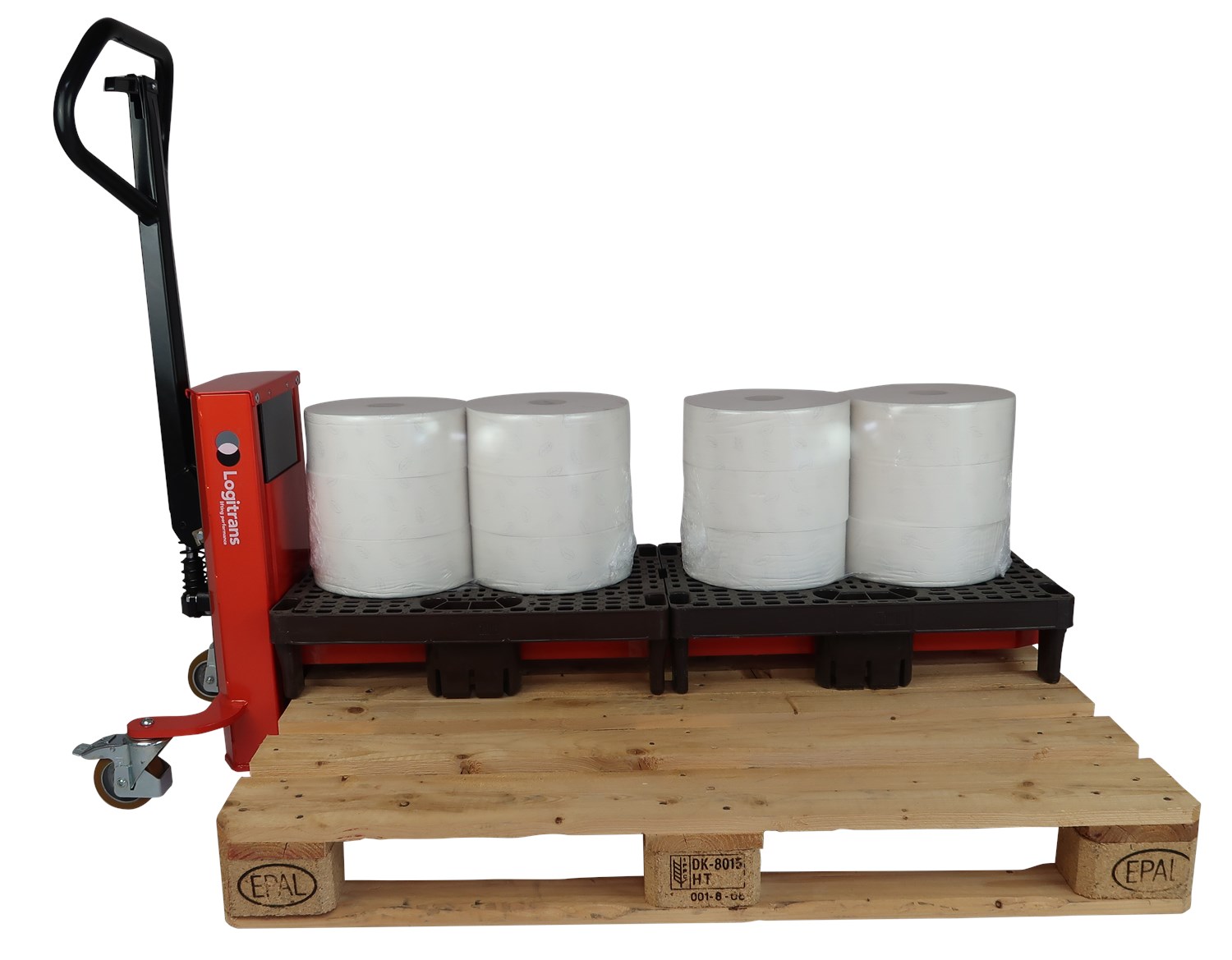
The Danish manufacturer of material handling equipment, Logitrans A/S, has released a new quarter pallet lifter (pictured above) called the DLQ200. It had a a capacity of 200 kg. Due to the one long fork, it is possible for you to handle two quarter pallets at the same time. This can increase efficiency and productivity.

Another feature is that the double quarter pallet lifter also helps the user reach the second quarter pallet at the far end of the EUR pallet. The situation where you normally need to move the EUR pallet and pick the quarter pallet from the other side. Also here, your workflow will be more efficient.

“Our new double quarter pallet lifter, DLQ200, is an indispensable and very efficient partner, when you need to lift two quarter pallets to/from an EUR pallet – and transport them to the requested locations in e.g. supermarkets, storage and packing areas, and gas stations”, says Gitte Kirkegaard, CEO at Logitrans A/S. “If you need to handle and transport one quarter pallet only, we also have solutions for this”.

DLQ200 is very manoeuvrable, and can operate everywhere, also in confined areas. The handle has ergonomically correct gripping angles, which ensures a relaxed hold. The wheels ensure a comfortable and noiseless transport – and they are gentle to the fine floor and flagstone layer in your workplace.

Vaccine Transport Protection

Temperature-controlled transport specialist Thermo King is ready to meet the challenge of storing COVID-19 vaccines, which are likely to require extreme conditions beyond anything previously needed in the industry. Paul Hamblin hears about the plans.

Pharmaceutical companies in final-stage clinical trials for COVID vaccines anticipate they will require strict temperature controls to safeguard their products – indeed, down to temperatures as low as -70 degrees Celsius. That requirement caught a lot of people in the industry off guard, says Jessica Poliner, VP Marine, Rail and Air for Thermo King, by Trane Technologies. “It’s because it’s about maintaining the temperature the vaccines need to be transported and stored at,” she explains from her office in Brussels. “It’s different than more usual vaccines, which are usually kept at 2-8 degrees Celsius. The stability profile of the potential COVID vaccines is much more uncertain, and so that certainly leaves more room for degrading, whether through human error or storage problems. It is maintaining that set point that is essential for the vaccine profile.”

Safe vaccine storage is an area that’s vital to get right, because according to the World Health Organization (WHO), nearly 20 percent of temperature sensitive health care products are damaged during transport, and 25 percent of vaccines reach their destination in a degraded state due to breaks in the cold chain.

Jessica Poliner says that she and her team have spent a lot of time talking to their customers, whether pharma companies, logistics firms, or forwarders, to look at potential solutions for something the whole world is waiting for. It is from these discussions that the temperature requirements became clear. “Everybody’s trying to put together their blueprints of what this will look like. With the Thermo King brand, we have the ability to transport, from road transportation to air cargo. What we’ve added to the mix is a storage solution as well, so that we can offer both transport and storage for vaccines at a very wide range from -70 degrees Celsius to +30 degrees Celsius.”

The requirement for ultra-low temperature isn’t new. “The neat piece with the -70 is that it’s actually a product we’ve used in the marine industry for over 20 years, originally developed to transport a premium grade sashimi tuna along some of the routes from the Mediterranean Sea to Japan and elsewhere. In the past few months we’ve worked to re-purpose that proven product into a solution for vaccine storage at that ultra low temperature of -70 degrees Celsius. So it’s really an exciting time for us to be able to tell a story about a product that we’ve sold a lot of in the past and
have a good experience with, but that’s not in essence being used for that purpose.”

Modifications to it have been relatively minor. “We make a refrigeration system and then put it into the container,” she explains. “We’re recommending a 10 or 20 foot container that has more insulation and some additional safety measures. Obviously if you are going into something at -70 degrees Celsius then safety and PPE are front of mind. But there really isn’t that much difference
to the product itself, which is partly the beauty of it.”

Of course it’s not clear when the solution will be required or in what volume, but Thermo King will be ready to support. “There’s so much uncertainty. Everybody’s been asked to scale, everybody’s been asked to move fast, and there’s still so much uncertainty with when, where and what storage temperature will be needed. Despite a few RFQs out (Request for Quotation), there are still a lot of question marks.”

So her team are having to think on their feet? “The key for us from a manufacturer standpoint is to make sure we have the product available. So, our cold storage product that goes to -70 degrees Celsius can be produced in 10 times the normal volume. That gives you a feel for how quickly we are trying to ramp up our supply.” The alternative used today for ultra-low transport is CO2 in the form of dry ice. This works well when in smaller volumes. “It requires manual intervention and control, so in essence, it’s a band-aid solution. Now volumes of vaccines to be transported and
stored are much higher, and that ‘market’ will look for solutions that are proven and safe, so this is where the Thermo King SuperFreezer makes the difference.”

SICK Extends Light Beam System Product Portfolio

Producer of sensors and sensor solutions for industrial automation applications company SICK has extended the range of its deTem 4 A/P multiple light beam system to eight metres, the longest ever available for an active/passive safety device, suitable for applications up to SIL3 / PLe.

The extra-rugged and compact SICK deTem 4 A/P safety light beam system offers wide flexibility to install safe access protection with entry/exit monitoring  in storage, material handling and logistics environments. With sender and receiver integrated into the active device, SICK deTem 4 A/P minimises wiring and helps achieve compact machine designs. With integrated muting functions there is no need for an external module and additional wiring effort.

With real-time diagnostics accessible by smartphone through Near Field Communication, and also via IO-Link, the SICK deTem 4 A/P is a smart system that enables operators to respond quickly to machine downtime. Engineers can access a range of diagnostic status and process data to manage maintenance interventions effectively.

Dr Martin Kidman, safety specialist with SICK UK explains: “The SICK deTem4 Active/Passive light beam system offers operators fingertip diagnostics to respond quickly to stoppages in common access protection applications such as warehousing, palletising or packaging machinery.  You can find out straight away what caused a lockout just by using the easy-to-use status display on your smartphone.

“The SICK deTem4 A/P offers all the functionality you would expect from a high-performance SICK safety light beam system, and more. Its slim housing and active/passive functionality lend themselves to machine layouts where space is limited. With IP65 and IP67 protection ratings, an operating temperature range of -30oC to +55oC, the deTem4 is ready for harsh industrial environments.”

Guided by the SICK Safety Assistant smartphone App, and with integral dip switches and automatic range adjustment, in-situ configuration and commissioning are quick and simple and there is no need to use a PC.

Earlier this year SICK announced it had established a new web-based platform, SICK IntegrationSpace, to be the home for its growing data-based digital software and services portfolio.

Hope for the High-Street: Over 60% of Online Shoppers will Return

There is hope for the high-street with nearly two-thirds (63%) of British shoppers will return to stores post-pandemic if they have a positive experience with a brand online, according to latest data.

Recent research conducted by YouGov on behalf of Manhattan Associates (supply chain and omnichannel commerce experts), shows that the fate of the Great British high street is not as bleak as some might have thought.

A survey of 2,000 consumers across Britain found that almost two thirds (63%) of online shoppers are either fairly or very likely to visit a physical store after having a great online experience with a brand: of the age groups surveyed, 18-24-year-olds were most likely to be influenced (80%) by positive online experiences, followed by 25-34-year-olds (65%).

This optimism from UK shoppers is positive for retailers that have endured a testing time over the last eight months. Despite many having to shut up shop and close their doors as part of the latest lockdown measures, these positive sentiments show that focusing on a positive online experience will pay dividends when restrictions are lifted, and that there is hope for the high-street when stores can reopen again.

Craig Summers, UK Managing Director, Manhattan Associates, commented: “The research is a ray of light for British retailers and shows how a great online experience can and (hopefully) will transcend into physical footfall.

While online might be the only channel available for many retailers right now, customers will be expecting the ease and seamlessness of their online journey to be mirrored when they return to stores in the New Year and retailers must be ready for that.

It’s things like having the ability to check in-store stock before visiting a shop, or the ability to deliver a variety of click-and-collect options are elements that all retailers will need to look at seriously if they are to encourage consumers to return to stores in large numbers in 2021,” added Summers.

When asked specifically about this year’s Black Friday events, the research rather unsurprisingly found that value for money (69%) and cheaper online deals (48%) were the two primary factors behind online purchasing decisions, but these were closely followed by the speed of delivery, which nearly two-fifths  (37%) deemed important.

“Speedy and reliable delivery, plus the restraints of a second nationwide lockdown will add pressure to delivery networks and supply chains over the next six weeks. However, many retailers will have learned from the initial challenges experienced during the UK’s first lockdown and should be more prepared for this crucial time of the year,” finished Summers.

All figures, unless otherwise stated, are from YouGov Plc.  Total sample size was 2,066 adults, including 560 who plan to shop online this Black Friday. Fieldwork was undertaken between 30th October -2nd November 2020.  The survey was carried out online. The figures have been weighted and are representative of all GB adults (aged 18+).

Subscribe

Get notified about New Episodes of our Podcast, New Magazine Issues and stay updated with our Weekly Newsletter.