
Wiliot launches battery-assisted version of IoT tag

Wiliot, the Internet of Things pioneer whose IoT platform is enabling trillions of everyday “things” to gain intelligence and harness the power of the cloud, has announced a milestone expansion of its product portfolio with the introduction of a Battery-Assisted IoT Pixel, developed in partnership with leading smart tag manufacturer Identiv.

The new Battery-Assisted IoT Pixel joins the company’s flagship Battery-Free IoT Pixel to address specific IoT applications that are best served by battery power.  It is a major step forward for the company as it scales its vision for a future of the IoT, where all products are connected to the internet and embedded with cloud intelligence.

This introduction marks a rapid innovation cycle for Wiliot, following the company’s March 2022 launch of its Version 2 Battery-Free IoT Pixel – a stamp-sized computer that costs pennies and powers itself by harvesting and recycling energy from radio waves.  This solution, recently recognized by the SXSW 2022 Innovation Awards, is currently being adopted by many of the world’s leading retail, food, beverage, and pharmaceutical brands.

The Wiliot Battery-Assisted IoT Pixel uses the same exceptionally-efficient chip as the Battery-Free IoT Pixel, but it augments it with a tiny printed battery. The tags are smaller than a business card and broadcast the same standard Bluetooth beacon as the company’s Battery-Free IoT Pixel.

“Wiliot was founded on the mission to transform industries by embedding everything with cloud intelligence using our IoT pixel tagging technology,” stated Roee Zeiler, Wiliot’s CFO. “We began by tackling this challenge with battery-free technology, which significantly reduced barriers to IoT adoption and will scale the IoT from billions to trillions.”

This new battery-assisted tag reduces the cost of bringing Bluetooth standards-based continuous connectivity and intelligence to things by 10X, whereas the battery-free product cuts the cost of Bluetooth standard integration by 100X.

Continued Zeiler, “We’ve always understood that certain applications are best addressed with battery-assisted technology – which is why this launch is a milestone for Wiliot, Identiv, and the industry. Now, with a portfolio that includes battery-free and battery-assisted pixels, we’re one step closer to achieving our goal of creating an Internet of Trillions of Things (IoT2).”

Unlike the battery-free version, the Battery-Assisted IoT Pixel doesn’t require bridges or any other source of radio waves to harvest energy from. All they require is a device with a Bluetooth radio to read their transmission – any phone, Bluetooth gateway, or Wi-Fi access point. As such, since any BLE reader can be configured to read a Battery-Assisted IoT Pixel, and no additional infrastructure is required, the entry price and complexity of tagging things is close to zero.

The product promises to bridge between the worlds of battery-free and battery powered tags, allowing solution providers to start using the Wiliot Cloud to deploy solutions more easily to new places that may not have been accessible before.

While Battery-Free IoT Pixels address the tracking of low-priced products – clothing, food, medicine, and more – this launch enables tracking of medium value to higher value assets such as temporary promotional signage, certain returnable transport items, IT assets, and retail assets – which benefit from the boosted connectivity yet can also better absorb the battery-assisted pixel’s higher price-point.

Compared with conventional Bluetooth tags, Wiliot’s Battery-Assisted IoT Pixel is thinner (1.3mm at its thickest), lower cost, and more physically flexible – so they can easily attach to products on a production line at speed and in volume using a label applicator. Compared with conventional Bluetooth beacons, Wiliot’s new battery-assisted beacon features extremely low power consumption that enables longer lifetime in a smaller form factor.

The first Battery-Assisted IoT Pixel will be mass-produced by leading smart tag manufacturer Identiv, which is known for focusing on more sophisticated and specialist tag designs. Limited availability of the Battery-Assisted IoT Pixels will begin next month, while larger quantities will be ready for roll-out by the end of year.

“Identiv always strives to innovate, and our contribution to this new era of Bluetooth-based IoT is an outcome of the scalable manufacturing standards, unique processes, and expertise we have mastered in the NFC and RFID ecosystem. Bluetooth is pervasive, and this new product offers the advantages of providing infrastructure-free temperature sensing, tracking, and traceability. We are proud to collaborate with Wiliot and scale solutions into many Internet of Things deployments,” said Amir Khoshniyati, VP and GM Transponders, Identiv.

The Wiliot Battery-Assisted IoT Pixel tag will be available directly from Identiv and will use the same Wiliot cloud services to manage scale, privacy and sensing, that brings intelligence to products and packaging that were previously offline.



Hyster launching new forklift at LogiMAT

Hyster will show a new A Series lift truck for the first time at LogiMAT 2022 in Stuttgart, Germany. Visitors to the show from 31 May to 2 June 2022 will get a chance to see a model that lifts 3.5 tonnes from the new line of tough, scalable, counterbalanced lift trucks at the Hyster stand.

In Hall 10 at Stand C10, experts will be on hand to discuss how Hyster can “Power YOUR Possibilities” with a range of more than 140 counterbalance lift trucks, warehouse equipment and container handlers.

On the stand, the much anticipated Hyster H3.5A will be revealed alongside the “lithium-ion ready” P3.0S Platform Pallet Truck designed for businesses cross docking, loading and unloading trailers or order picking in the warehouse. The P3.0S on show features a fixed platform with side protection for the operator, but there are options available including rear protection or a folding platform with side arms.

In addition, attendees can learn about the different power options for Hyster forklifts and warehouse equipment. For instance, Li.ON FORCE, a lithium-ion battery from Sunlight Group, has recently been added as an option for selected 24V, 48V, and 80V Hyster equipment giving customers more ways to select the best battery technology for their application. The batteries can be linked to Hyster lift trucks using the CANbus communication to optimise battery management. Real-time battery monitoring data and remote access is also available with the Sunlight Group’s GLocal telematics solution.

“We are excited to bring together some of our newest developments and diverse global industry experience at LogiMAT, showing how we support our customers’ specific needs with different solutions,” says Rainer Marian, Director Network Development at Hyster Europe.

Clever software drives AMR efficiency

In production environments, intralogistics activities performed by humans are often non-value adding according to Lean methodology. Implementing autonomous mobile robots (AMRs) to perform these warehouse transport activities is a way to reduce those costs. But to let those AMRs work as efficiently as possible, clever software is a must.

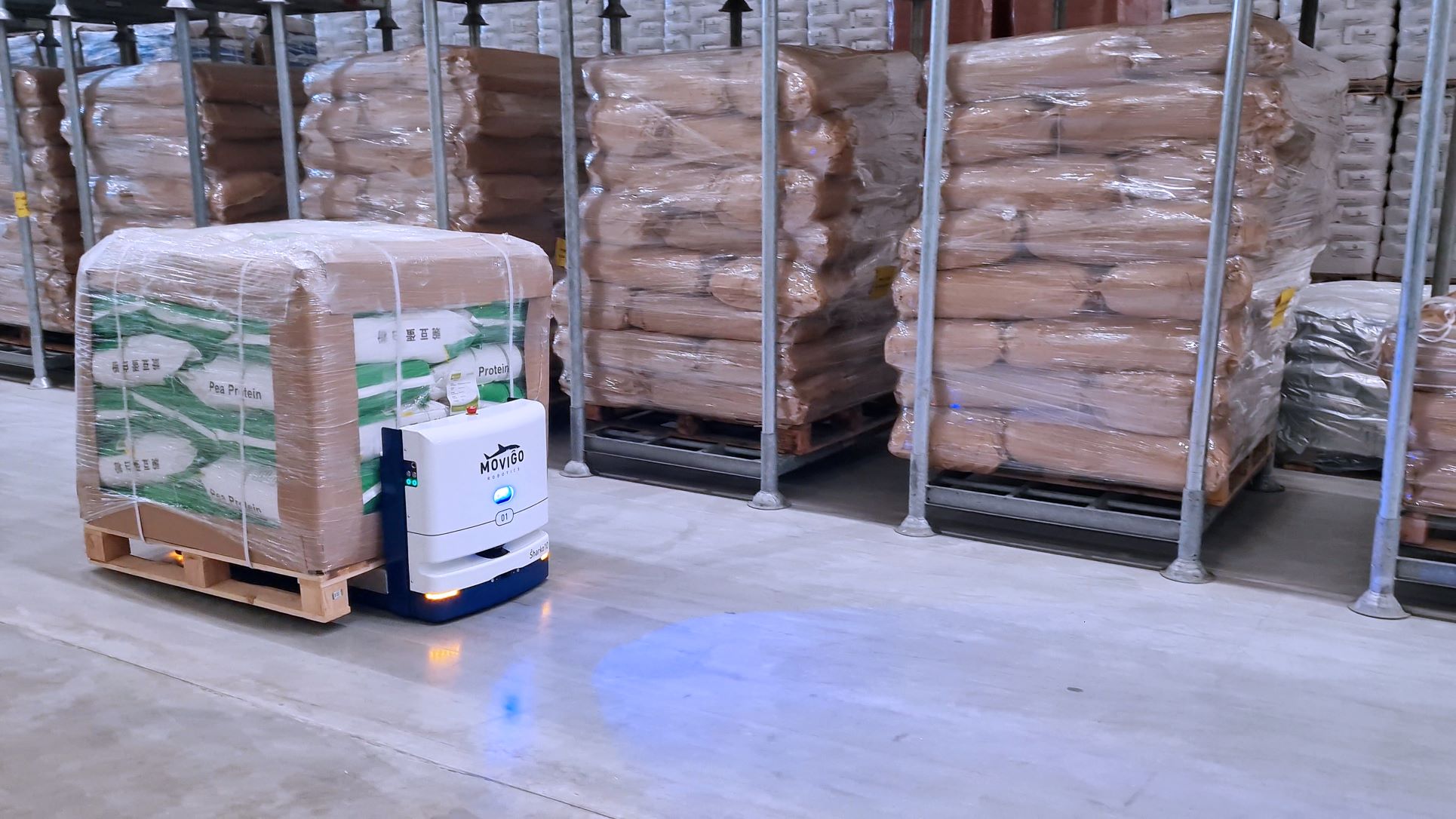
MoviĜo Robotics says it is an AMR manufacturer that constantly aims to maximise the hourly performance of its AMRs. The Dutch company constantly looks for ways to improve the efficiency of the fleet with clever innovations, and has recently launched three new ones.

The first is smart lifting technology. This enables its Ŝharko10 to adapt its lift height depending on the payload characteristics, so it always lifts the payload with the minimal amount of time needed. A normal lift has two positions: up and down. MoviĜo Robotics’ technology made the lifting height variable, so every lift movement that does not require to go to its maximum height saves time. The lift technology also adapts its riding height on the move. With the repetitive work of AMR’s, this can create several minutes of extra capacity per vehicle per hour.

One of the main areas that MoviĜo Robotics aims to improve constantly is its order management software. Paul Van der Hulst, Co-Owner & Managing Director of MoviĜo Robotics bv, says: “Our solutions focus primarily on production companies, and their processes can be very complex. This requires clever order management software to ensure all transports are done efficiently and more importantly: on time.

“Costs of a production line standstill due to lack of raw materials can be significant. We found standard order management software inadequate and not flexible enough.”

Software Director Ronald de Koning elaborates: “Our software can assign tasks based on multiple priorities, due time, time limits, time windows, actual location of the AMR compared to others, and upcoming tasks. Order lines are managed real-time. Imagine a Ŝharko driving from the warehouse to a production line to pick-up finished goods. Halfway through its mission, an order for raw materials for the same production line is created. We can interrupt the original mission and switch to the high-priority one. So, it first collects raw materials, brings it to the production line and then collects the finished goods. So, we constantly check to optimise the orders, to create optimal performance.”

But MoviĜo doesn’t only look for ways to optimise the efficiency of the vehicle, but also reduce manual input. One way to do this is through vision.

“Our camera software manages buffer locations and communicates an available location to the Ŝharko,” adds de Koning. “This enables locations to be used by AMRs and humans simultaneously without manual location management.”

But MoviĜo’s Intelligent Camera Kit can do more clever things. It detects a pallet on a certain location and automatically generates an order. Its latest update enables the system to detect if a pallet is empty and automatically generates a replenishment order.

Van der Hulst concludes: “I hate it when vehicles drive empty, because you purchase an AMR to do as much transports as possible. Even worse are Ŝharko that stand still, for example when there is no night shift. At one customer that doesn’t work at night, the Ŝharko vacuums their production facility at night. If it adds to the return on investment, we have no problem with that.”


FourKites appoints supply chain veteran to ocean role

Philippe Salles has been appointed FourKites’ Vice President of Strategic Solutions (Ocean), bringing a wealth of experience to this booming area of the company’s business.

“I’m delighted to be joining FourKites,” says Philippe, who brings experience from CMA CGM, INTTRA and maritime research and consultancy firm Drewry. “Visibility has been ocean shippers’ top priority for decades, and today’s real-time visibility platforms have completely changed the game. In addition to its market-leading machine learning-driven platform, FourKites understands that industry mindset and professionalism are as important as the technology itself. We need to provide shippers with a long-term strategic vision for their supply chain to make them resilient and collaborative.”

Philippe is an industry veteran with a detailed understanding of current supply chain issues. In his new role at FourKites, he will work closely work with FourKites shippers and carriers to support them as they execute the change management needed to improve end-to-end supply chain visibility. Moreover, he will accelerate time to value for FourKites users by removing operational pain points and maximising the effectiveness of the systems they use.

“Philippe has a rare depth of experience, especially when it comes to evolving some of the traditional areas of ocean shipping with new technology,” says Mathew Elenjickal, FourKites Founder and CEO. “His network, the trust he’s built up in the industry and his expertise in supply chain management will be invaluable to our customers as we continue to drive innovation in ocean visibility.”

Unprecedented ocean momentum

Salles’ appointment is the latest leap forward in FourKites’ momentum in supply chain visibility for seagoing container traffic. FourKites now tracks 98% of global ocean container traffic across more than 270 lanes and 120 carriers, and covers every container port in North America and all major ports in Europe.

Over the last 12 months, the company has seen:

  • 79% growth in the number of customers using supply chain visibility for international shipments, with a 23% jump in Q1 2022 alone
  • 215% growth in the volume of seagoing freight that it tracks, with a 190% increase in ocean shipments in EMEA
  • 16% growth in the number of ports tracked in EMEA, now totalling coverage of 239 ports in the region and 804 ports globally

In the last quarter, FourKites signed a number of new ocean customers, including Cardinal Health, Arizona Tile, LyondellBasell, McCain Foods, Roehm, Rove Concepts and Yamaha Motors, among many others.

LyondellBasell, to take one example, is a top-10 global chemicals producer with operations around the world. The company has been a FourKites customer since 2018, when it began tracking shipments across all modes of transport in North America. Based on its success to date with the FourKites platform, the company extended its contract with FourKites in Q1 2022 to track multimodal shipments in Europe.

“Global shippers love FourKites’ Dynamic Ocean platform because it addresses the full spectrum of shipping issues,” says Philippe. “And the company’s proprietary Dynamic ETA technology provides estimated times of arrival that are 20% to 40% more accurate than carrier-generated figures. That’s important because timing errors can add significantly to costs.”

FourKites’ Dynamic Ocean addresses the full spectrum of ocean shipping issues through advanced document management and collaboration features; state-of-the-art real-time tracking capabilities, including highly accurate predictive ETAs; and comprehensive multimodal visibility from port to door, including the yard, so shippers can identify and manage the root causes of escalating fees.

Flawless logistics at the click of a mouse

Flawless logistics. Imagine that for a moment – no kinks in the warehouse chain, no costly errors, no unhappy customers, writes Paul Hamblin, editor of Logistics Business Magazine. It’s an enticing prospect, because no logistics process is without flaws in this high-volume age, even those of the admired industry giants. So you have to sit up and take notice when a group of logistics professionals, steeped in warehouse management and IT solutions, believe they can give their clients the nirvana of flawless logistics. It’s all about intelligent video, data analytics and AI. Combine those, and you get facts – and when you have the facts, you have solutions.

Logistics technology specialist SiB Solutions, founded in Sweden in 2017, aims to provide all facts to all stakeholders, incontrovertibly, at the touch of a button. “There is no arguing with having the facts on the table,” says co-founder Staffan Persson (pictured).

In practice, the process is fast and simple. Intelligent video cameras are placed in all relevant warehouse process areas: goods receiving, goods away, picking, packing, consolidation, loading. By complementing the existing WMS, warehouse managers can, in a matter of seconds, examine time-stamped video exactly as they would use, for instance, Google, to establish what might have happened to a given order. It thus enables them to see the full facts in seconds and then make fact-based decisions.

“Let’s say a customer has said an item is broken and the evidence shows that it occurred at the packing stage,” explains Persson. “So, the video will show if it has been packed according to the right process. If yes, then something must be wrong with the packing process, because the item is broken. If the video shows the wrong process was used, the operator can be re-trained. What we are doing is ending the logistics blame game – it allows participants to look for solutions rather than to attach blame.”

Persson reckons there are three keys to this quest for flawless logistics. First, it stops errors in real time, using AI functionality to predict and improve processes for the future. The second is the provision of a time machine – a pin-sharp instant video search facility allowing past actions to be fact-checked visually. Third, and most important, is that the warehouse is thus protected from costly and time-heavy claims and counter-claims. No more blame game.

It’s an ambitious goal, but with customer numbers growing and with SiB Solutions firmly established in the Nordics, Benelux, UK, and the US and now also growing into other markets, its subscription model is finding plenty of satisfied takers.

“Despite having WMS, shelf ID, article ID, established processes, co-worker instructions, metrics, business intelligence systems – even then everyone hurts from costly, reoccuring errors,” points out Head of Sales Europe Donald Houben. “We can show them why that is happening and with our AI capability we can prevent it happening again.”

The business case is convincingly made by the cost savings, he says. “The total direct cost of one mistake in the warehouse is maybe €50,” he muses. “But the indirect cost is 10 or 20 times higher. We have a potential customer in the Netherlands; they know that each mistake costs €1,000. Those are big savings we can make for them.”

The payment model is by monthly subscription, in which everything is included – installation, support, integration, training, maintenance, upgrades.

Implementation time from initial workshop to pressing the Go button takes two to three months, and does not disrupt existing processes.

I wonder if customers might simply stop subscribing after a few months once the SiB Solutions ‘microscope’ has done its work and perfected the warehouse. Not so, says Donald Houben. “Processes change so much in warehouses, with new customers coming in, new products,” he points out. “Without intelligent video analysis, errors will always creep in.”

Subscribe

Get notified about New Episodes of our Podcast, New Magazine Issues and stay updated with our Weekly Newsletter.