
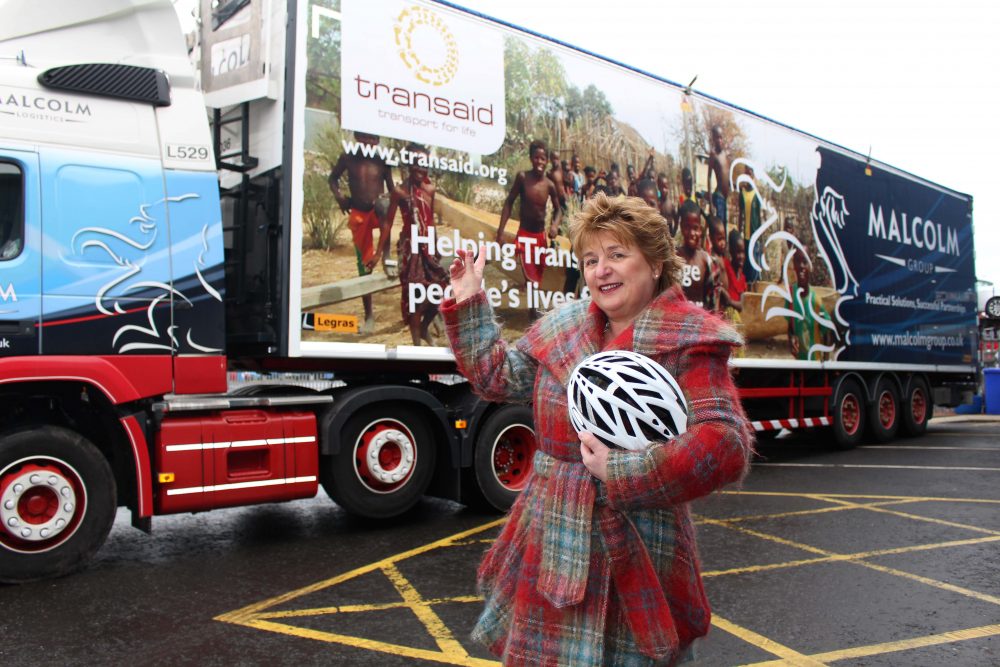
Joan Aitken appointed Chair of Transaid

Transaid has appointed former Traffic Commissioner for Scotland, Joan Aitken OBE FCILT, as Chair of its board of trustees. Joan has been a long-time supporter of the international development organisation and has taken part in two Transaid fundraising cycle challenges, visited projects in Uganda and Zambia, and been a trustee since March 2019.

She takes over from Jo Godsmark, Chief Operating Officer of BigChange, after six years as Chair and eight years on the board. During her tenure Transaid has significantly grown its programmes and fundraising income, and is currently involved in projects within nine countries across sub-Saharan Africa.

Joan was first introduced to Transaid at an industry event where Transaid was the beneficiary charity. Following conversations with the senior team, she jumped on her bike in 2017 and cycled with a team of 40 riders who collectively raised more than £200,000 during the Cycle South Africa fundraiser.

Commenting on her appointment, she says: “Transaid is the most incredible organisation and has earned a very special place in my heart. I’ve been privileged to have visited two projects in Zambia, one focused on access to healthcare and the other on road safety; plus I contributed to the driver training activities in Uganda, which cemented my understanding of Transaid’s life-saving work.

“To be appointed Chair is an honour and responsibility. I am excited by the opportunity to work even more closely with the wonderful Transaid team, which has demonstrated such incredible versatility during the challenges of the last two years.”

Jo, who will ride in Transaid’s Cycle Malawi event this October alongside Joan, says: “I’m hugely proud of what we have achieved as an organisation over the last six years, and particularly how we have increased the diversity of the board, with representation from countries where Transaid is working. When you have a team as highly regarded within the development sector as Transaid, being Chair is more of a privilege than anything else.

“This is a unique organisation and not one you can walk away from; I’m honoured to have been invited to join Transaid’s team of ambassadors and I couldn’t be handing over the reins as Chair to anyone better qualified than Joan.”

Joan is a Scottish solicitor by profession. She retired in 2019 after a varied career which ranged from local government, private practice, tribunal chairing, UK public appointments and the Senior Civil Service. In 2003 her long standing interest in the role of transport and her regulatory experience came together when she became one of the Traffic Commissioners for Great Britain as the Commissioner for Scotland. In 2019 she was awarded the OBE for services to transport in Scotland and for road safety.

She continues her involvement with transport through chairing the Glasgow City Region’s Bus Partnership Steering Group. She sits on the Scottish Board of the Royal College of Emergency Medicine and on the College’s Lay Group. Always one to volunteer, her current activities include being a simulated patient for Edinburgh’s School of Medicine, the virtuous activity of litter picking and learning to drive a canal barge.

She becomes the fourth industry figurehead to serve as Chair of Transaid. Prior to Jo, Graeme McFaull was Chair between 2010 and 2016, taking over from John Harvey CBE who had held the role since Transaid’s inception.

inVia Robotics wins innovation award

inVia Robotics – a leader in eCommerce fulfilment automation systems – has been awarded this year’s Best Practices Technology Innovation Leadership Award in the North American goods-to-person robotics market by Frost & Sullivan, a leading third-party research and consulting firm.

inVia’s true robotics-as-a-service (RaaS) model beat out category competitors as it provides retailers and 3PLs with a flexible, cost-effective solution that dramatically increases productivity in existing facilities. The RaaS system allows customers to pay for productivity of inVia robots and software versus competitors who lease or sell robots. The subscription service covers all system updates and includes 24/7 monitoring and support through inVia’s Robotics Operation Center (ROC).

A team of robotics experts is dedicated to each customer to oversee fulfilment operations and troubleshoot any problems, often fixing them before they are even visible. This model democratises automation, making it available as an operating expense to businesses of all sizes, versus traditional equipment that was capital-intensive and expensive.

“We’re honoured to receive this recognition and award for our technology that is solving the pressing issues facing warehouse employees and businesses on a daily basis,” says Lior Elazary, CEO and Co-Founder of inVia. “We recognise that eCommerce demand is continuing to rise and warehouse workers are still facing immense pressures to fulfil orders quickly. Our mission is deeply rooted in creating an environment where people can do fulfilling work and in order for us to ensure this happens, we are committed to improving the technological offerings that our customers require.”

“Frost & Sullivan applauds inVia for maximising worker productivity and providing eCommerce organisations with an attainable entry point to introduce autonomous mobile robots and the PickerWall into their businesses,” says Sankara Narayanan,  Industry Principal at Frost & Sullivan. “The company’s RaaS model, ROC, and quick deployment further enhance its customer value proposition.”

A key differentiator in receiving the award was the inVia PickerWall, as it demonstrates inVia’s unique workflow that removes interdependencies between robots and people and subsequently unleashes productivity rates, at a time when warehouse labour is hard to hire. The inVia PickerWall helps companies manage higher order volumes without having to increase labour enabling eCommerce warehouses to be 10 times more productive.

Most importantly, inVia PickerWall leverages the strengths of both people and robots. Robots work non-stop doing repetitive tasks like travelling and picking. People are allowed to do higher order tasks like sortation and work on a variety of tasks in bursts. Workers enjoy more stimulating working conditions and businesses enjoy consistently meeting service level agreements (SLAs) without dips in productivity.

inVia Picker robots were also recognised by Frost & Sullivan as solving one of the most challenging problems in the e-Commerce space; quick and easy access to a wide variety of stock keeping units (SKUs). E-Commerce warehouses are often 250,000 sq ft, comparable to three football fields – and may have 100,000 SKUs distributed across the warehouse. The robots are completely autonomous and eliminate the need for people to travel across the facility to retrieve inventory and deliver it to the packing station.

Additionally, inVia Pickers are mobile, unlike traditional shuttle systems, and can be moved to work in different zones or in other locations. This eliminates the need for reengineering facilities, allowing inVia to adapt to different environments.

The Frost & Sullivan Best Practices Awards recognise companies across the globe for demonstrating outstanding achievement and superior performance in leadership, technological innovation, customer service, and strategic product development. inVia was awarded based on its commitment to innovation, creativity, and application diversity that meet ever-evolving customer needs.


Körber and Attabotics sign strategic partnership

The international technology group Körber is entering into a strategic partnership with the Canadian robotics company Attabotics. In the future, Körber is to equip European companies with Attabotics’ 3D automated storage and retrieval technology that offers efficient order picking, including sequencing and buffering, all within the footprint of the ultra-high density storage structure. In the US and Canada, the technology has already been successfully implemented at numerous companies in the e-commerce industry.

The Körber Business Area Supply Chain Automation is not only a technological pioneer itself but is also always on the lookout for innovative partners. An innovative partner has been found with Attabotics, which was founded in 2016. Moving forward, both parties want to jointly support European e-commerce companies to overcome the challenges of order fulfilment. Körber will be a reseller, integrator, and implementation partner for the Attabotics solution in most of Europe.

The Attabotics solution is based on a vertical, very space-saving grid structure. Products are stored in square bins (571 x 571 mm inside). Robots can travel on top of the grid, underneath the grid and vertically through the down shafts to store or retrieve totes and transport them to the integrated workstations. This unique architecture increases flexibility and speed of the processes in warehouses immensely.

Customers with fulfilment operations face more and more challenges. Their business is growing rapidly, end-customer requirements are getting more and more complicated, and there is a significant shortage of labour in the market.

The Attabotics solution addresses these challenges. It offers class leading storage density, whilst still offering direct access to every product. It enables high picking speeds, has built-in sequencing and can handle short response times.

“I had this crazy idea of reconfiguring warehouse space after watching a documentary about how leaf cutter ants access their colonies vertically. A 3D system just makes sense,” says Scott Gravelle, CEO and founder of Attabotics. “We are very pleased with this partnership. Koerber’s strong expertise and presence in Europe is very complimentary to Attabotics and will offer customers a trusted partner for their operations.”

Michiel Veenman, Vice President Körber Fulfillment Solutions at the Körber Business Area Supply Chain Automation, adds: “Flexibility, responsiveness and performance are essential for today’s fulfilment operations. We believe that the Attabotics solution offers an especially strong combination of characteristics that was not yet available on the European market. With Attabotics technology, Körber can now offer our customers the next step in automation.”


BEUMER showcases new pouch technology at LogiMAT

BEUMER Group‘s BG Pouch System can meet the growing demands of e-commerce fulfilment – and the combination of retail and D2C. The operator benefits from simplified returns handling because dynamic buffering eliminates the need for re-storage and picking. The sorter increases throughput by 25% compared to conventional pocket sorters. It requires little space and is suitable for a wide range of items – from high-tech to high heels. BEUMER Group presented the BG Pouch System to the German public for the first time at the recent LogiMAT 2022 event.

This innovative system, which was developed in response to shifting market trends and customer demands, expands BEUMER Group’s offering for the warehouse and distribution industry. Making great use of available space, the BG Pouch System can be installed in unused overhead areas where single items can be buffered, sorted and sequenced to automate the order handling and returns processes, reducing floor space requirements by up to 30%. The modularity of the system means that it can easily be scaled up with minimal installation time.

The system features a capacity of 10,000 items per hour per sortation module, allowing logistics centres to flatten their handling peaks and reduce the amount of manual handling to dramatically improve overall logistics efficiency. The system has an item capacity of 7kg, making it ideally suited to handling fashion goods such as shoes and garments on hangers, as well as print and media, pharmaceutical and beauty products, and electronics.

Pouch sorting increases efficiency by reducing the number of touch points, which is particularly critical for handling returns. The BG Pouch System facilitates the e-commerce driven demand for fast cycle times. Reverse logistics efficiency can also be improved by effective handling of returns using built-in interim storage for returned products.

Different types of products, held for different clients and destined for different types of shipping, can be held in a single intelligent storage system. As the BG Pouch System is a single item handling system (one item per pouch) the warehouse management system can move the relevant item from this buffer for packing swiftly without any human touch. This means that returned goods can be sent for shipment direct from the dynamic buffer without ever being sent back to the main storage area for re-picking. For logistics operators handling a diverse array of goods, this flexibility can prove invaluable for both outbound items and returns.

The system has already seen successful use in Italy, where international fashion brand Calzedonia Group implemented BEUMER Group’s pouch technology to optimise e-commerce operations for its Tezenis brand. The company had seen a steady rise in its direct-to-consumer business, and needed to optimise its despatch operations to handle this growth while raising the level of efficiency and customer service. Following the installation, Calzedonia Group has transformed its warehouse, optimising it for omnichannel operations while continuing to achieve high efficiency in handling and fulfilment. Calzedonia Group has joined some of the world’s leading warehouse and distribution operators in embracing BEUMER Group’s solutions, along with companies including Nike, Foot Locker and ASOS.

BEUMER Group can facilitate the entire process of installing the pouch sortation solution through every stage, from the selection of the solution, through design, build, test, implementation, training, maintenance and growth. As well as operating independently with its own technology, BEUMER will also act as a full-service integrator throughout the process, working with third-party suppliers to provide a complete system.


LogiMAT 2022: “Expectations greatly exceeded”

LogiMAT 2022 has scored a big win in the post-pandemic era, re-emerging with a broad slate of exhibitors and a highly engaged visitor base. High-profile business deals and partnerships coupled with in-depth networking opportunities underscore the reputation of the International Trade Show for Intralogistics Solutions and Process Management as a leading communications hub where industry leaders come to do business.

As LogiMAT 2022 drew to a close last week in Stuttgart, it demonstrated there was stability across all leading indicators in the trade show business. The international trade show for the intralogistics industry was able to build on the success of its previous events with numbers edging back up toward pre-pandemic levels.

“A successful reboot after a nearly 40-month Covid-induced interruption,” notes Exhibition Director Michael Ruchty of EUROEXPO Messe- und Kongress-GmbH in Munich, which organises LogiMAT. “Adjusted for the pandemic-related restrictions, the results across the board show a continuation of the LogiMAT success story.”

“Smart – Sustainable – Safe” was the theme of this year’s three-day event, bringing together 1,571 registered exhibitors from 39 countries, including 393 first-time exhibitors and 74 big-name vendors from overseas – all showcasing their latest products, systems, and solutions for reliable automation and digital transformation. A wide range of new products, including some never before exhibited anywhere in the world, provided powerful inspiration for smart, forward-looking intralogistics processes. The Messe Stuttgart convention centre was once again completely booked this year, with exhibitors spread across 125,000+ square meters in all 10 exhibit halls.

After a pandemic shutdown of two-and-a-half years, 50,000 industry professionals seized the opportunity to explore and directly compare the latest technologies and their integration into intelligent, future-proof systems – live and in person. At peak times on the second day of the event, 3,000 industry professionals streamed through the turnstiles at the entrance within 10 minutes.

More than a quarter of the visitors work for large companies with 1,000 to 9,999 employees. Broken down by industry, 58.8% of visitors came from the manufacturing sector, 12.4% from wholesale, and another 4.3% from retail. Some 6.9% of visitors work in freight forwarding, with most (52.8%) holding a position of responsibility for purchasing decisions at their company. For them, LogiMAT is the primary platform for information on the latest solutions for efficient intralogistics.

Among all visitors, 55.1% came to learn about innovations and trends, while 27.7% wanted to make new business connections. There was particular interest in innovations in the product domains of material handling and warehousing technology (55.8%), industrial trucks (38.3%), and AGV/AMR technology (18.3%).

Some 36.5% of the industry professionals who came to Stuttgart also had specific investment projects in mind. The high number of sales contracts, business deals, and partnership initiatives signed at LogiMAT underscore the character of LogiMAT as a hub for information, education, and communication where people come to do business. A full 5.2% of the visiting industry professionals awarded a contract during the show, while 31.7% plan to do so immediately afterward. This naturally resonated well with exhibitors, all of whom emphasise the quality and sophistication of the contacts they made.

Some 38.5% of visitors travelled more than 300km to attend LogiMAT. The high level of interest among international industry professionals and exhibitors remained stable. Data gathered by the independent Basel-based market research institute Wissler & Partner shows that one in five event attendees came to Stuttgart from outside Germany. Of these international guests, 73.8% came from other EU countries, 7.9% from non-EU countries, and 8.3% from Asia, the Americas, and other areas overseas.

“We’re extremely pleased with the numbers for LogiMAT 2022 and how it unfolded,” concludes Ruchty. “LogiMAT 2022 continues online through the LogiMAT.digital platform. The 14 stimulating presentations from the high-quality accompanying program in the LogiMAT Arena spanning all three days will be streamed on LogiMAT.digital in the coming weeks.”

The organisers confirmed that LogiMAT 2023 will take place in Stuttgart on April 25th-27th, 2023.


INFORM optimises Toyota Logistics Services’ delivery network

INFORM, a leading provider of AI-based optimisation software that facilitates improved decision making, processes and resource management, has successfully completed an ambitious network optimisation project on behalf of Toyota Logistics Services, the finished vehicle logistics provider for Toyota North America.

TLS sought to further advance its mission of operational excellence and turned to INFORM to address today’s increased market and operational complexities including various contract conditions (i.e., carriers’ rates, capacity constraints, minimum/maximum viable volumes, etc.), while gaining the tools needed to better evaluate and manage its large volume of data and criteria.

INFORM’s network planning optimisation solution for TLS includes a user interface which eliminates the need for users to have programming skills, enabling TLS to quickly gain the solution’s benefits without a lengthy learning curve. The solution provides intelligent, strategic and holistic planning for the organisation’s entire outbound logistics network.

It enables information relating to locations, logistics services providers (e.g., freight forwarders) and partners (i.e., rail and truck carriers) to be recorded with the data entered into the solution for improved network stability and service quality. Using the INFORM network planning tool, TLS is able to benefit from optimised routes and modes of transportation determined in conjunction with transport volumes and with consideration to various restrictions and business rules.

INFORM’s optimisation solution enables numerous scenarios to be run based on various criteria. The network planning strategy process began with a baseline scenario, which evaluated TLS’ existing network and bid rates, and then created a scenario focused on pure cost optimisation and a limited set of restrictions, less weight on transit times, and no limit on potential changes. This then led to the creation of several competing business scenarios incorporating business requirements and restrictions along with information such as costs, Service Level Agreements, and other factors like emissions.

Next, various business rules were applied, including minimum/maximum volume, number of legs and distance between origin and destination, lead times, and volume of business being allocated to individual carriers. After this process of scenario building and discovery was completed, TLS could achieve the optimum decision making.

As a result of its network optimisation project and the related optimisation process, TLS has been able to derive many important benefits. It has realised a 3% cost reduction annually; an important accomplishment given that TLS has seen its costs increase annually by 2%, which computes to a 5% cost avoidance. TLS is also now able to check on the accuracy of its assumptions and compare them to the actual number of vehicles it is shipping month to month.

Overall, TLS can now interpret data and arrive at optimal decisions as to its best carrier partners based on their performance and related costs. TLS can issue RFPs that give them real world competitive bid information, since the organisation can now ask its partners to provide additional data as the INFORM network planning optimisation tool is able to handle a very high volume of data and calculations with relative ease. Even prior to the process beginning, TLS had maintained a very high quality of data which is required for the optimisation process to work.

Other key benefits derived from its network optimisation project include the ability to better address their sustainability goals. TLS recognises that rail has lower CO2 emissions than trucks and therefore it is striving to introduce more rail ramps to somewhat reduce truck miles. TLS is reviewing truck miles per unit and considering a ratio of rail to truck to determine carbon footprints, as well as factor in whether a carrier has a CO2-reduced fleet. The organisation is also able to promote greater cost competitiveness between rail and truck carriers.

Due to the success of its network optimisation project, TLS plans to run the optimisation process every five years.

Subscribe

Get notified about New Episodes of our Podcast, New Magazine Issues and stay updated with our Weekly Newsletter.