Truck Racing with Advanced Video Telematics

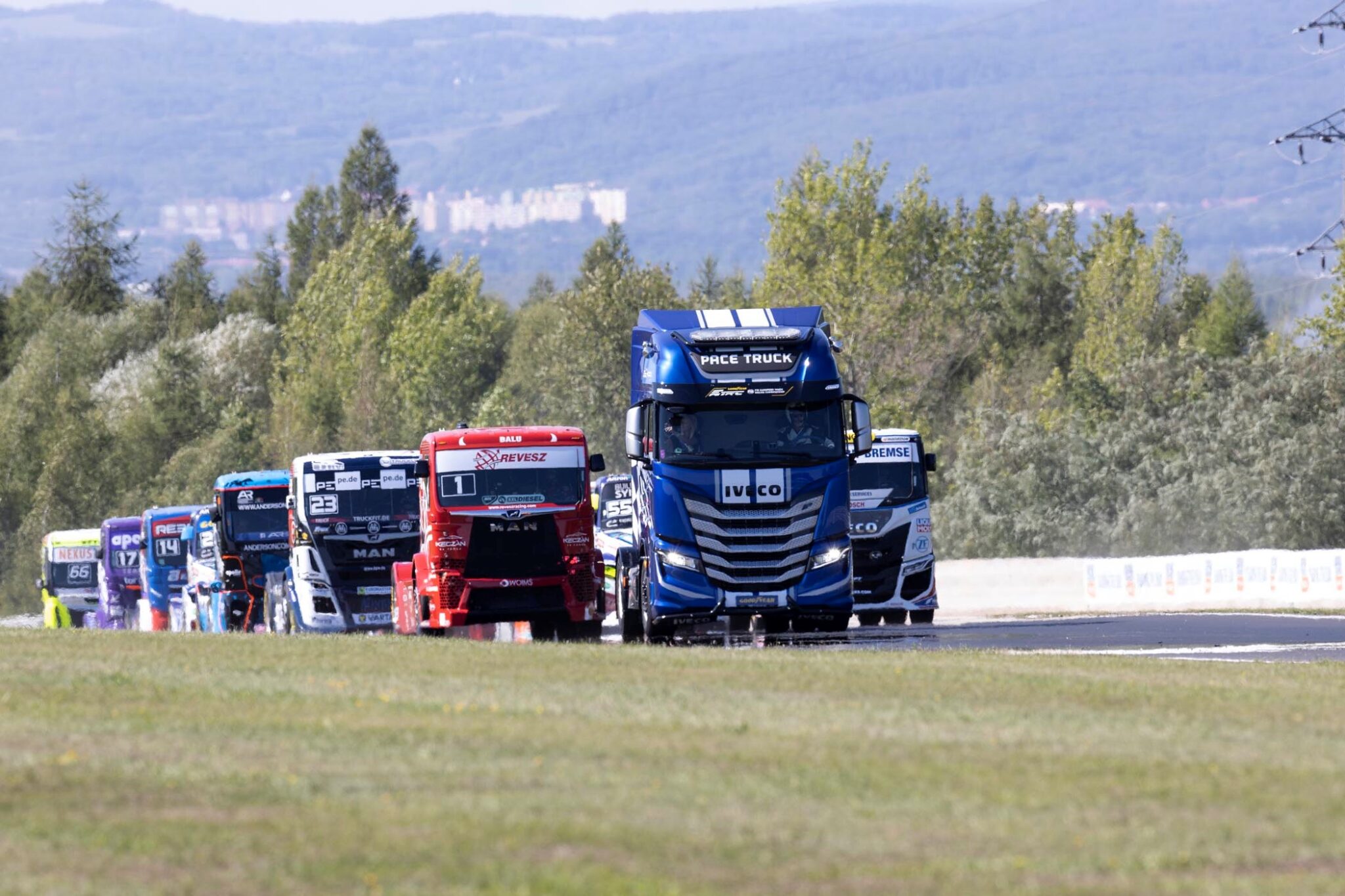
VisionTrack has become the official video telematics partner for the Goodyear FIA European Truck Racing Championship (ETRC), which begins at the Misano World Circuit track in Italy later this month. VisionTrack will provide an advanced multi-camera solution to all competing teams that will support race officials throughout the eight-date calendar as well as capture broadcast quality footage.

VisionTrack will supply a full HD mobile digital video recorder (MDVR) for each truck with forward, rear and driver facing cameras. This will provide the visibility needed to effectively manage on/off track race compliance to help maintain safety levels. Race control will also benefit from live viewing, instant playback and downloadable footage within seconds to quickly investigate driving incidents, while HD video will be available for during and post-race broadcasting and other media opportunities.

‘Welcome to VisionTrack as a new partner to the championship,” said ETRA Managing Director Georg Fuchs. “VisionTrack is a leading provider of advanced video telematics and their onboard camera solutions will support our race control to investigate incidents on track. The advanced system will also allow us to bring the excitement of truck racing and wheel-to-wheel action closer to our fans.”

Dean Leonard, Vice President of Technical Services at VisionTrack said: “We are delighted that our video telematics solution will be playing such a crucial safety role during the season, providing the footage and data needed for race activity management, and providing action-packed broadcast content. This latest agreement follows our successful and ongoing partnership with the British Truck Racing Championship over the past three years.”

VisionTrack is a leading global provider of AI video telematics and connected fleet data. The company’s advanced vehicle camera solutions are underpinned by a device-agnostic, multi-award-winning IoT platform, Autonomise.ai. The company’s unique approach is helping tackle some of the most complex challenges faced by the fleet, transport and insurance sectors, providing the operational insight, business intelligence and enriched vehicle data needed to make strategic mobility decisions.

Cost-efficient Brownfield, Retrofit Solutions

For the expansion of their existing logistics infrastructure, retailers have for a long time mainly preferred greenfield solutions over brownfield, says Witron. There is currently a trend on the market, both nationally and internationally, for brownfield solutions – i.e., the integration of new technology into existing buildings – to become increasingly attractive and a viable addition to the greenfield strategy. Specifically, this can involve both modernizations and expansions of technology and building. Consequently, it is a matter of transforming facilities that were previously used manually into automated logistics centres.

True to the credo ‘use your assets’, there are many factors that speak in favour of making existing logistics structures fit for the future within a brownfield strategy and thus saving money and time. The advantages of a brownfield strategy are versatile:

• The existing distribution centre is already at the right location
and is logistically well-integrated into the retail network in terms of stores and suppliers – with a good connection to the traffic route and rail network. The energy and communication systems are already in place and employees already come from the region – an enormous advantage in terms of retaining know-how, corporate culture, and recruiting.

• It is difficult to obtain new land for greenfield solutions
New building land is becoming scarce, as many communities are designating fewer and fewer commercial property due to their sustainability strategies. In addition, the brownfield logistics center already exists and often provides additional neighbouring expansion areas.

• New commercial real estate and new buildings are expensive
Both the acquisition of the property, its infrastructure, as well as the actual construction work cost money – currently with permanently rising costs for land, material, and craftspeople. In addition, any marketing of existing real estate is completely eliminated.

• The construction of a new building is a time factor
A brownfield solution can be utilized more quickly because it eliminates the time needed to find land, obtain permits, plan constructions, and erect the building.

• Implementing state-of-the-art technology into an existing building is
cost-efficient – whether by modernizing already existing components (racking systems, mechanics, conveyor systems, PLC + IT) or by completely integrating new innovative storage and picking solutions. The result is another positive cost and time factor.

• In terms of a holistic sustainability strategy, the reuse of existing assets is a decisive factor in avoiding land sealing or other waste of resources – economically, ecologically, and socially.

End-to-end implementation concept required

In order to evaluate whether the existing logistics facility is suitable for the future strategic approach, the first step is to obtain a thorough analysis and an end-to-end implementation concept. This includes:

• The verification of the existing building structure / building fabric
Depending on the temperature zone, e. g. floor conditions, statics, clear height, technical building equipment including air-conditioning technology, available building areas, possible expansion areas, possible building expansions, etc.

• The extent to which existing logistics technology can be modernized or is replaced, complemented by new logistics technology (e.g., OPM, AIO, ATS, GTP, shipping buffer, highly dynamic stacker cranes, and conveyor system, etc.)

• The design of material flow processes
In addition to the optimal connection of all logistics areas and temperature zones, typical building requirements are also being considered. These include, for example, good accessibility for service and maintenance teams, cleaning of the facility, fire protection, escape routes, or how the new technology can be physically implemented into the building in the best way (e.g., via the roof or by opening side walls).

• The transformation process – meaning how the commissioning processes are implemented in terms of organization, timing, and technology.

This requires an end-to-end change strategy (including installation and modernization cycles, dismantling phases, transition concepts with scenarios for temporary local relocation of existing business operations, pro-active backup scenarios, etc.). In the process, the most important question has to be clearly addressed: How will the project be implemented throughout the entire project phase – and how will the ongoing operation or delivery to stores and consumers take place at the same time. Depending on the individual case, it is possible to use different approaches to implement this in a practical way either at the site or in the logistics network.

Brownfield references worldwide

WITRON experts are very familiar with the requirement to economically map brownfield solutions with automated storage and picking technology. The company is considered one of the global market leaders in the design, implementation, maintenance, and system operation of highly dynamic distribution centres. Since the company’s foundation more than 50 years ago, 2,000+ projects have been successfully implemented – including more than 100 highly efficient logistics centres especially for food retailers throughout Europe, North America, and Australia. More than 30 percent of these are brownfield solutions.

COOP in Norway, for example, has increased the output of its dry, fresh, and frozen food areas by 30 percent during ongoing operations at its multi-temperature distribution centre in Oslo by installing eleven additional COM machines, including corresponding infrastructure such as further pallet storage aisles, tray storage aisles, stacker cranes, stretch-wrappers, de-palletizers, and conveyors, and now picks more than 625,000 cases daily.

For the Swiss food retailer MIGROS in Neuendorf, WITRON integrated a completely new logistics system into an operational distribution centre during ongoing operations and transformed it into a fully functional omni-channel distribution centre together with the existing facility. For this purpose, WITRON has installed a highly dynamic automated case and piece picking solution (OPM + AIO), and modernized, as well as optimized already existing logistics areas (receiving, shipping, e-commerce area), mechanical elements (high bay warehouse, conveyor systems), IT, and material flow processes. The system is currently designed for a daily pick performance of 472,000 cases and supplies 700 stores, as well as many thousands of home shopping customers in Switzerland from a range of more than 100,000 different items per year. The existing building in Neuendorf was complemented by a state-of-the-art, fully automated frozen food warehouse with WITRON OPM technology, which supplies 1,400 stores daily with more than 100,000 cases in a store-friendly manner. Order picking is done on both pallets and roll containers.

In addition, MIGROS replaced a completely manual convenience solution with a highly automated WITRON system (OPM, DPS, ATS) at its existing building in Suhr to stack goods onto pallets, roll containers, and into totes. This was preceded by the modernization of the dry goods logistics processes, which included the installation of a fully automated picking system with 28 COM machines on the roof of the existing distribution centre as part of the “Future COM” project. A masterpiece in terms of both technology and architecture. This site now supplies a total of 600 stores and 300 shops (kiosks, gas stations, etc.) with more than 430,000 cases daily.

The Spanish omni-channel retailer Condis in Montcada uses an existing manual high bay warehouse to supply a WITRON OPM system with goods.

French food retailers such as Diapar, E.Leclerc, and Intermarché also rely on WITRON’s brownfield experience. In North America, economic solutions were integrated end-to-end into the existing building structure for customers such as Albertsons, Kroger, and Sobeys.

Businesses Unprepared for Next Global Crisis 

New data from Board International, a leading global provider of Intelligent Planning Solutions which help organisations plan smarter, enabling actionable insights and better outcomes, reveals that despite nearly every global business executing some form of planning transformation attempt since 2020, 90% (Supply chain planning professionals: 88%) report it failing to some degree.

Good intentions aren’t enough

Three years on from Covid-19 caused widespread economic and social disruption, the new Board Planning Transformation Benchmark Survey asked 2,450 decision makers across the UK, US, Germany, France, Italy, Japan, Australia and Singapore how they are faring in light of a series of economic ‘unprecedented’ events. Just 13% (Supply chain planning professionals: 11%) said they were unaffected by events, such as Covid-19, the war in Ukraine and the cost-of-living crisis.

As a result, 85% (Supply chain planning professionals: 89%) of businesses say planning is now taken more seriously across their organisation; 76% (Supply chain planning professionals: 82%) have seen budgets for planning transformation and planning teams increase; and 94% (Supply chain planning professionals: 95%) are being asked for a more strategic approach to planning by their boards and / or investors.

The report highlights that 90% (Supply chain planning professionals: 88%) of transformations failed for one reason or another. A lack of technical capability within the organisation is cited as the top cause of failed transformations by over a quarter (Global: 26%; Supply chain planning professionals: 29%) of decision makers. Lack of investment in skills (Global: 23%; Supply chain planning professionals: 25%) and scarcity of team resources (Global: 22%; Supply chain planning professionals: 21%) came in close second and third places.

Antiquated practises

In addition to skills gaps, the data reveals wide usage of inefficient planning practices are preventing progress. When asked what tools they use to plan, nearly all (Global: 98%; Supply chain planning professionals: 98%) of the decision makers responded that they do some of their planning on spreadsheets like Excel – a tool built in 1985. And planners are taking on average 27 hours (Supply chain planning professionals: 27 hours) a week to model different scenarios for their business.

The need for a new approach is made clear when asked how ready decision makers feel to navigate the next ‘globally significant’ event on the horizon. When asked if they felt ready to cope with continued supply chain disruption (Global: 29%; Supply chain planning professionals: 26%), rising interest rates (Global: 22%; Supply chain planning professionals: 20%), another pandemic (Global: 32%; Supply chain planning professionals: 32%), or a recession (Global: 34%; Supply chain planning professionals: 35%), around a said they were not.

Marco Limena, Board CEO said: “With all the uncertainty that we see in the world, business leaders need to recognize a new reality: the era of continuous disruption is here. Those seven words are meant as a wake-up call for organizations to continuously adapt and find new capabilities and efficiencies to deal with today’s challenging environment. Continuous planning is an imperative, and the good news is that companies that advance their digital capabilities can steer their business at the speed of change and gain a competitive edge.”

About the survey:
2,450 decision-makers across the UK, US, Germany, France, Italy, Japan, Australia and Singapore in the financial, supply chain, or retail and merchandise planning functions in businesses with 500+ employees were surveyed online between the 26th of January and the 2nd of February 2023.  Of these 849 are supply chain planning professionals. The findings for this subset are noted in brackets.

Add-On AI Solutions and Intermodal TOS

INFORM, a leading provider of intelligent AI and optimization software solutions, will showcase its proven optimization add-on solutions for maritime and intermodal terminal operators at the upcoming TOC Europe conference in Rotterdam, the Netherlands. In addition to its add-on optimization modules, at booth number G90, INFORM will also showcase its Intermodal Terminal Operating System (TOS) solution.

By visiting INFORM’s booth at TOC Europe 2023, terminal operators can discover how advanced optimization modules can help them improve their operational efficiency, optimize their resource utilization, and increase overall productivity. On display will be a series of artificial intelligence (AI) and operations research (OR) based optimization modules that empower terminal operations. Having been exhibiting at the show for nearly a decade, INFORM is a regular contributor through its presence on the tradeshow floor as well as typically delivering and moderating conference sessions on the TECH TOC stage. This year, it will take place from June 13-15, 2023 at the Rotterdam Ahoy Convention Centre in Rotterdam, the Netherlands.

Alex Van Winckel Director Strategic Relations and Sales at INFORM’s Terminal & Distribution Centre Logistics Division commented, “We are thrilled to be presenting our Intermodal TOS solution at TOC Europe. Our solution has been developed with optimization built into its core and with the specific needs of European terminal operators in mind. We believe it can make a significant impact on their operations and look forward to showcasing our system and discussing how it can help driving the industry forward.”

In addition, six proven modules for maritime and intermodal terminals with will be presented: They include INFORM’s Crane Optimizer (CO), Yard Optimizer (YO), Vehicle Optimizer (VO), Train Load Optimizer (TLO), Rail Scheduler (RS), and Machine Learning (ML) modules. As add-on solutions to the existing IT and software infrastructure (including a terminal’s TOS), these modules add an intelligence layer behind the existing operational layer to support and/or automate decision-making within a terminal.

“We believe that TOC Europe will be a great event for experts from the whole industry to learn about the latest trends and technologies,” added Dr. Eva Savelsberg (pictured), Senior Vice President at INFORM’s Terminal & Distribution Center Logistics Division. “We look forward to meeting with our customers and partners at the conference, and of course to build new relationships as well.” INFORM is a market leader in AI and optimization software to facilitate improved decision making. Based in Aachen, Germany, the company has been in the optimization business for 50 years and serves a wide span of logistics industries including ports, maritime, and intermodal terminals with both add-on optimization modules as well as TOS solutions.

New Electric Combilift Forklift

As leading forklift manufacturer Combilift continues to celebrate its 25th anniversary, it has launched the second of five new products planned for this year. The Combi-CB70E was unveiled in mid-May at Ligna, the international timber and woodworking show in Hannover.

This is a further addition to Combilift’s ever growing range of electric models which offer powerful performance, extensive battery life and unrivalled ergonomics. The Combi-CB70E, in the vibrant Combi-green livery first seen on the recently launched Combi-CUBE product, boasts the distinction of being the shortest 7t capacity counterbalance truck on the market whilst also benefitting from multidirectional ability, enabling the versatile space saving handling of both long and bulky loads.

Design features incorporated into the high-capacity Combi-CB70E include large super-elastic tyres and compact wheelbase. With a 7,000kg/15,500lb lift capacity, this model benefits from an impressively small footprint as well as exceptional manouevrability meaning that it can easily move bulky loads around in confined spaces.

Occupational health and safety requirements mean that the welfare of the workforce has become ever more important over the years. Drivers of industrial vehicles, who are often required to spend extensive periods in their work stations, quite rightly expect the highest levels of comfort and safety. Combilift’s designers have therefore gone to great lengths to ensure that the latest generation of models are kitted out with top quality components that ensure sophisticated ergonomics for a stress-free in-cab environment. Features in the spacious cab include generous glazing for excellent all-round visibility, the tilting steering column, hydraulic steering and the Grammer MSG65 seat.

What sets the Combi-CB70E apart from other forklifts is its gas strut suspension cab, which uses components such as those found in large scale industrial machinery with cab suspension. Combined with the super-elastic tyres this guarantees the smoothest of rides over uneven or less than perfect ground conditions.

Combilift’s newly developed Auto Swivel Seat was also premiered at the show. This optional feature automatically engages and swivels the seat and armrest 15° to the right or left to accord with the direction of travel selected by the operator – reducing driver strain, particularly when travelling in reverse. (Patent Pending Application No. 2305983.5)

The truck also features Combilift’s internationally patented and Red Dot awarded independent electric traction which provides all front and rear drive wheels with 100% traction control. This negates the need for differential lock on slippery surfaces and significantly reduces long load momentum twisting when travelling sideways. Each electric drive incorporates parking and regenerative dynamic braking for power efficiency. Roll-out access for major electrical components also simplifies maintenance tasks.

This mix of next-gen performance, extensive battery life and exceptional ergonomics combined with all the advantages of the Combi-CB range, makes this the most powerful compact electric multidirectional forklift to date.

Combilift CEO and Co-Founder Martin McVicar said: “The increased capacities that we are offering in our electric range will answer the demand for ever more powerful products which at the same time help companies to achieve their aims for more sustainable operations. We are confident that the Combi-CB70E will be a popular addition to our portfolio for diverse industry applications.”

Mitsubishi Electric Invests in OTTO Motors

Mitsubishi Electric Corporation, a global leader in factory automation solutions, has announced a strategic investment in Clearpath Robotics, the parent company of autonomous mobile robot supplier, OTTO Motors.

With more than 4 million hours of production experience, OTTO Motors’ pioneering autonomous mobile robot (AMR) technology and award-winning software are used by Fortune 500 companies to deliver productivity and safety in material handling operations. The investment expands the strategic relationship between OTTO Motors and Mitsubishi Electric, and strengthens the two companies’ commercial collaboration.

Mitsubishi Electric Invests

“Industrial automation is continuing to transform businesses around the world. As a globally-trusted leader with a strong mission to invest in continuous technological innovation and ceaseless creativity, Mitsubishi Electric has been an important partner for OTTO Motors. We are proud to have their continued support and share a vision to accelerate industrial automation globally. We look forward to pursuing the tremendous opportunity ahead,” said OTTO Motors’ CEO & Co-Founder, Matt Rendall.

“The relationship between Mitsubishi Electric and OTTO Motors is built upon years of respect and trust. OTTO Motors is well positioned to become a leader in industrial autonomy. We see a bright future ahead for OTTO Motors and are honored to support their continued success,” said Mitsubishi Electric’s Chief Strategy Officer, Satoshi Takeda.

cargo-partner Sold to Nippon Express Group

As cargo-partner is celebrating its 40th anniversary, company owner and founder Stefan Krauter has decided to sell the Austrian global logistics firm to Japanese stock-listed Nippon Express Holdings, the parent company of Nippon Express, APC, Franco Vago and others. Having started operations in 1983 with only five employees at Vienna Airport and having developed the company almost completely organically to now 4000 employees in 40 countries around the globe, Krauter had already passed on the baton to his management and now has also passed over ownership to his ‘ideal successor’, NX.

After exceeding the billion euro mark in global turnover for the first time in 2020, cargo-partner’s turnover increased by 72%, reaching over 1.8 billion euro in 2021, and further increased to 2.06 billion euro in 2022.

“Leadership by agile founders bears some considerable advantages, but from a certain stage on, highly professional and long-term stable ownership is the bigger asset. It is the founders’ challenge and responsibility to decide about both management and ownership succession at the right time. Not too early to be able to build a stable internal management succession but, for sure, also not too late,” Krauter says. “That is why, together with the Corporate Executive Board, we started evaluating different options for the future of cargo-partner.”

Stefan Krauter continues to explain: “It would also have been a good option for the management and employees to continue going completely alone, but since the ideal new strategic owner was found in NX Group, we were ultimately convinced that this was the right way to go forward. Following the integration policy we have seen from NX Group so far, cargo-partner will remain cargo-partner in regard to both organization and branding – and it will become the strongest cargo-partner ever!”

The deal was signed on May 12, 2023 and will come into effect subject to the usual regulatory (anti-trust and FDI) approvals in an estimated four to seven months along with the subsequent closing.
“Both organizations will benefit from considerable synergies in global office coverage, an expanded service portfolio, strengthened regional, product and IT know-how, increased scale and others. NX Group will benefit from our strong and extensive network in Central and Eastern Europe that complements NX’s existing network in an ideal way, and cargo-partner will jump several leagues in the Intra-Asian and Trans-Pacific trade lanes,” Stefan Krauter states. He adds: “cargo-partner will also continue to work with its current global agents’ network, strive to expand this section of its business and support it in future with its upgraded platform which is presently under development.”

“I will personally continue to support the transition in my new role on the Corporate Supervisory Board and in my advisory function to the Corporate Executive Board. I will be focusing on smart partial integration with the new owners as well as on other matters regarding strategy, M&A and ESG. What an interesting and rewarding challenge at the end of my career!” Krauter says. The sellers have been advised by J.P. Morgan (financial), ValueAdd (financial), BCG (commercial), Schönherr (legal), and Deloitte (accounting and tax) on the transaction.

Nippon Express is a provider of logistics services. It is based in Tokyo and has a strong global network that spans over 40 countries, with company direct operations in 33 nations, such as Austria. The company offers air freight, marine transportation, heavy haulage, warehousing and distribution processing, logistics design, information technology services, chartered truck services and moving services.

AR Racking Equips Lekkerland’s new DCs

Lekkerland, an on-the-go consumption specialist with has around 51,300 points of sale throughout Germany, employing 3,140 people, has new DCs. The company is part of the REWE Group, one of the leaders in the retail and tourism sector in Germany and Europe. In 2021, the REWE Group recorded a total turnover of approximately 75.3 billion euros. Founded in 1927, the REWE Group is present in 21 European countries with more than 384,000 employees.

Lekkerland is in the process of reorganising its logistics in Germany between now and 2030 to adapt it to the present and future opportunities and threats of on-the-go consumption. In this context, the storage solutions specialist AR Racking provided its support in the opening of two new warehouses in Germany.

Lekkerland is dedicated to the distribution of food products and other items to petrol stations, kiosk, retailers, quick service restaurants and similar businesses. The two new warehouses in Kerpen and Wedemark will help to optimally serve the needs of customers in the long-term, for example, meeting the growing demand for fresh items such as wraps and salads.

The storage systems designed (adjustable pallet racking) manufactured and installed by AR Racking mean that the Wedemark warehouse will have a capacity of 30,954 pallet positions, while the Kerpen warehouse has 26,505 positions. In the latter case, seismic zone 3 criteria were also adopted. This is racking designed for euro pallets of up to 1,000 kg, that allow the storage of refrigerated and non-refrigerated products, among others. “We considered their specific needs for the project”, explained Roland Fischer, Key Account Manager at AR Racking Germany, and added that, “the AR Germany team met all the requirements in due time and to Lekkerland’s satisfaction”.

Lekkerland’s new DCs

Some areas were fitted with frames with three uprights, which are equipped with ascending roller beds for order preparation. The industrial racking installed by AR Racking is 10 metres high in various layouts and with up to 6 levels. The aisles between the racking are 3.5 metres wide.

According to Robert Kosmol, Corporate Real Estate Development Manager at Lekkerland, “the objective was to invest in very versatile and adaptable infrastructure that would help optimise the space without losing flexibility to increase our stock and improve inventory control in the picking area. The quality of the racking, the comprehensive project management and the continuous communication with AR Racking gave us added value in the installation of these two new warehouses.”

AR Racking is part of the Arania Group, an industrial group of companies with extensive experience and scope, and with a multi-sectoral activity based on the transformation of steel that dates back more than 80 years. AR Racking provides the market with a wide range of solutions with high certified quality standards and a comprehensive project management service. AR Racking’s industrial storage systems stand out for their innovation, reliability and optimum efficiency.

Kaup Expands its e-op Range

The leading independent manufacturer of forklift truck attachments, KAUP GmbH & Co adds to its electrically operated material handling solutions, as part of its e-op (Electrically Operated) line.

Following the launch of the world’s first electric fork positioner, in Stuttgart, over half a decade ago, KAUP has continued to develop and expand its electric range. The latest editions to enter its range of forklift truck attachments is the all-electric double pallet handler, rotator, and side-shift.

With an industry focus on electric forklift trucks, providing not only environmental benefits, but also lower total cost of ownership and extended truck life, the next logical step is to add an electric attachment. Not only will an electric attachment prolong your electric trucks battery life, but the most obvious benefit lies in the fact that the e-op series does not require any hydraulics, or oil, eliminating the risk of hydraulic leaks.

Another benefit of the electric range is the ‘drive systems’ energy efficiency. All KAUP electric attachments require only a fraction of the energy needed compared to its hydraulic counterparts, even though they are manufactured from the same basic components from the modular system.

The precise positioning of the e-op attachments allows for accuracy when positioning loads, whether this be via the autonomous control of the attachment, or the control of the industrial truck. The attachments also incorporate numerous safety features, such as ‘redundant function monitoring’ and ‘emergency stop switch’, ensuring safe operation at all times.

Mike Barton, Managing Director of B&B Attachments; the official UK and Ireland distributor for KAUP products comments, “Electric attachments together with electric forklifts are becoming the preferred choice at many job sites. The cutting-edge technology of the KAUP e-op range offers businesses tremendous cost savings, efficiency, safety, reliability, and sustainability.” The KAUP e-op range is available through-out the UK and Ireland via B&B Attachments.

Embracing Automation to Facilitate Near-sourcing

Automotive Original Equipment Manufacturers (OEMs) have led the world in creating incredibly efficient, optimised, Just-in-Time (JiT) supply chains. However, the responsibility falls on their Tier 1 suppliers to ensure products arrive on time, in the right order, in perfect condition, and in accordance with each customer’s personal specification. With the rise of near sourcing in response to inconsistent Far East supply, pressure on suppliers is set to intensify. OEMs are likely to expect smaller, incremental deliveries that further enhance efficiency, making it imperative to automate loading and unloading processes. Wouter Satijn (pictured), Sales Director, Joloda Hydraroll, explains.

Reducing risk

Global car production volumes are forecast to grow by 5.3% in 2023, with Western Europe leading the charge after three years below 10 million units. However, while supply chain pressures are easing, many OEMs still face significant delays in sourcing key components, especially semiconductors, from the Far East. The resultant uncertainty is additional pressure on the tightly integrated supply chain.

After years spent building hugely complex and extended global supply chains, a serious change is afoot. Businesses recognise the challenges associated with single sourcing, especially to far-off locations with long lead times. The value of near sourcing is gaining ground fast, providing resilience and contingency while reducing risk. For Tier 1 suppliers under incredibly tight and punitive contracts with automotive OEMs, pressure to change is coming from all sides. Not only must companies explore local providers to safeguard their own supply chains, but they must also conform to the new supply chain designs created by OEMs.

Supply chain redesign

Suppliers have fine-tuned production processes to ensure products arrive at the OEM on time and 100% quality controlled. The problems arise when the goods are loaded from the supplier’s warehouse and unloaded at the OEM. Unloading and loading processes are still predominantly manual at many facilities. Companies rely on labour and forklift trucks, winches and ropes to move heavy and potentially dangerous items from the truck to the shop floor. The problem is that this process is both time-consuming – potentially jeopardising delivery schedules – and high risk. From colour-specific bodywork to custom-designed entertainment systems, product damage leads to production delays that can cost £10,000s to the OEM. This results in conflict between the companies as blame is apportioned and potentially significant fines applied to the supplier.

The shift towards near sourcing will exacerbate these issues. Supply chain redesign will lead OEMs towards smaller, incremental deliveries, creating more risk and pressure for suppliers. It is now vital to move away from manual processes and embrace faster, more efficient, safe and controlled unloading and loading.

Improving control

Automated loading radically reduces the risk associated with product damage, eradicating reliance on forklifts and avoiding human error. Plus, automated loading systems are significantly faster and more efficient: manual processes that currently take more than half an hour can be achieved in two or three minutes. With the certainty that drivers will not be left waiting for hours outside the facility, suppliers can also reduce the contingency required in their delivery schedules.

Better control, certainty, and a reduced risk of product damage during the loading and unloading of trucks will enable OEMs and suppliers to confidently embark upon a new supply chain model. They can embrace the value of near sourcing and incremental delivery, improving agility in an uncertain marketplace.

Subscribe

Get notified about New Episodes of our Podcast, New Magazine Issues and stay updated with our Weekly Newsletter.