Connecting Data to Maximise Value

Supply chain visibility is the nirvana for most supply chain and logistics managers. It is well recognised that having real-time insights into the supply chain leads to a wealth of benefits – from improved performance, reduced costs and greater customer satisfaction. 

That said, the path to supply chain visibility is filled with questions – from how to achieve it; what tools are required; to – most significantly – what insight is the business looking for; what data do you need and have available; and how to connect disconnected data sources and convert those into automatic action.

Elmer Spruijt, VP Transport Management EMEA, Descartes outlines some of the key considerations to maximising value from supply chain visibility.

The Importance of Supply Chain Visibility

There are a number of reasons why real-time visibility has increased in importance in the last 10-20 years. One reason is the ability to react better and faster to uncertainty in the supply chain. Another is being able to set and meet customers’ delivery expectations more accurately. Yet another is the need to do something with the increasing amount of data being collected as a consequence of digitalisation.

However, despite the increased interest and investment in supply chain visibility, success remains limited. According to annual research from Supply Chain Insights, instigated in 2015, there has been no improvement in the gap between how much companies value visibility and their actual achievement of it. One of the reasons is that data collection remains fragmented and carriers’ ability to combine and convert data into actionable insights also remains limited.

Strength in Data

As a shipper or forwarder, a business will want to be able to automatically combine data from across the supply chain and several applications. Logically, this will need to involve data from software tools such as the transport management system (TMS) and customs software for providing insights into events at item and line-level, as well as data derived from sensors (e.g. from containers).

Successfully combining this data is a challenge. It is not always clear which applications and standards are needed, while the actual physical data exchange is also complex, considering the following:

  • Is a standard really a standard or is it just an interpretation of a standard? Did a carrier develop a variant of a standard because it was easier, and then want to add more data to it?
  • Is there already a standard EDI or API link between the different systems in the supply chain, between the carrier’s and shipper’s software? Does this still need to be developed and if so how long will it take?
  • Is an existing link still usable when one of the supply chain applications is updated?
  • Do the supply chain partners use the same definitions? Are you talking about the same assets or content?
  • What does a container ETA mean? Do you mean the time when the boat arrives? There’s a chance that a forwarder will interpret the container ETA as when the container is off the boat and released by customs. The actual pick-up time depends on the definition.
  • How do you make sure you can use data to influence the way a forwarder works?

A Single Platform

The power of data is enormous, but at the same time this calls for systems (e.g. a TMS) that can combine these data points in one logical place or system – including data from different modes and a clear picture of customs issues.

This will enable a business to use this data to optimise its supply chain and keep stakeholders informed, but also to measure the performance of logistics partners in detail and hold them to account.

Visibility depends on flexible data exchange, where the systems used can also handle the different standards, as outlined above. Setting up the necessary application landscape and carrier network is not always easy, though a modern TMS provider will have the functionality and a vast logistics network for collecting all the relevant real-time data and for enabling communication (bookings, invoices, etc.) between shippers and their forwarders/carriers automatically via EDI/API.

Controlling the Supply Chain

Companies that can combine and process real-time data can then also analyse it and take steps to fine-tune operations in the supply chain. However, this real-time data is only valuable if it is meaningful, reliable and of use to the various stakeholders in the supply chain and forms part of an automated communication flow between suppliers, carriers and customers.

The most important data should be made visible through a centralised control dashboard; one of the ways to create value from aggregating data. A control dashboard makes it significantly easier for planners to see what is and isn’t going well in the supply chain and accordingly put their energy and knowledge into fixing what could and should work better.

Single Version of the Truth

Once a business understands what is going on in the supply chain, that information can be shared with partners, giving a better idea of each other’s strengths and weaknesses.

Ultimately, sharing data and insights from analytics provides the opportunity to work with shippers, forwarders and logistics service providers to make your supply chain different from those of your competitors. A business is more likely to succeed if it uses a single version of the truth, in the form of a central TMS that organises data and communication automatically – enabling the continuous rectifying of imperfections and creating value throughout every step of the supply chain for yourself, partners and customers.

Read Similar

Vans in Growing Importance to UK economy, Says FTA

Warehouse Management with DexoryView

Dexory, a data intelligence company, today announced it has deployed DexoryView, its cutting-edge AI and robotics solution, at the state-of-the-art warehouse facility of FLX Logistics, part of the Freshlinc Group, in Peterborough, United Kingdom. By using robotics and digital twin technologies, FLX Logistics, specialists in ambient logistics management, will be able to drive efficiencies and confirms the company’s commitment to innovation and operational excellence.

“At FLX Logistics, we are always looking for ways to enhance efficiency and accuracy across our operations,” says Sam Goodger, General Manager for FLX Logistics site at Peterborough. “Using DexoryView from the outset at our new facility provides us with unparalleled real-time data on stock accuracy that empowers our team to drive the business forward.”

In a recent successful implementation, at FLX Logistics’ brand new facility, spanning an impressive 140,000 square feet and housing products ranging from diverse food products, raw materials and finished goods, Dexory unveiled its DexoryView solution, featuring state-of-the-art autonomous mobile robotics (AMRs) and a seamlessly integrated digital twin. FLX Logistics was able to generate data from the outset to ensure it has stock accuracy from the opening of the new warehouse. This combined with having access to real-time data of the warehouse on an ongoing basis, allows the business to elevate the efficiency of its warehouse operations to an unprecedented level.

“We are thrilled to be working with FLX Logistics in revolutionising their warehouse operations,” says Oana Jinga, Chief Commercial and Product Officer & Co-Founder at Dexory. “Having implemented DexoryView from the outset shows that FLX Logistics is a forward thinking business and sees the benefit in utilising real-time data and insights to better drive efficiency across its operations. We have already seen the company use the data to effectively manage and transform its day-to-day operations thanks to the insights they are able to glean from DexoryView.”

Dexory captures real-time insights into warehouse operations using fully autonomous robots and Artificial Intelligence. Using autonomous technology to unlock data and drive insights through all levels of business operations, helping companies boost their performance and unlock their full potential. Instant access to real-time data helps optimise the present, de-risk the future and discover the intractable in each location and at every stage of the product journey through the warehouse and onto dispatch.

Founded in 2015, by three founders, Andrei, Oana and Adrian, and is based in the UK. The founders are school friends from Romania, who moved to the UK a decade ago with experience accumulated across engineering and tech roles at Formula 1, Google, and IBM. Combining commercial nous with deep technical expertise, the three founders are now working together to help transform warehouse management practices worldwide.

read more

Maersk Expands DexoryView Partnership


Easier to do Materials Handling Projects

Repeat custom now accounts for almost two-thirds of the Beumer Group’s business. That’s why the motto of the company’s appearance at LogiMAT was ‘Easy to do business with’. David Priestman reports.

BEUMER Group is a large organisation operating on a global scale, with locations in more than 50 countries, but is determined to avoid organisational complexities and local variations in quality and service. The goal is to always offer the best possible service or product, and the motto of being ‘easy to do business with’ encompasses everything from allocating customers a consistent point of contact from project start to completion to providing data insights via its Customer Diagnostic Centre that enable customers to make better operational and investment decisions.

Brian Hansen (pictured below), Systems and Proposals Director, says: “We talk openly to customers and potential customers and we want to be approachable. Choices are more complicated now. We prefer to discuss products and solutions later down the line after talking through their challenges and requirements.” The company says it recognises the challenges and uncertainties that customers and partners face and does what it can to mitigate them, for example by simplifying the organisational structure and communications. This includes encouraging customers to call the mobile phones of their Beumer contact, at any time.

“If a customer wants to increase optimisation in the warehouse the system will run for 15 or 20 years,” adds Hansen, “so they need to live with it. Brand loyalty and repeat business are fostered by providing the best customer experience and trust, not at the lowest cost.” According to Beumer, it is often the small details that make the biggest difference. For example, one international CEP customer recently benefited from the fact that Beumer does not use internally generated codes on their technical drawings: they are labelled clearly and descriptively to avoid any confusion.
“As a designer, I look at sustainability,” Hansen tells me. “Long term projects that last and work are an inherent good.” Is this ease of doing business good for retaining customers are obtaining new ones? “It’s hard to tell customers to switch materials handling supplier, but we believe in the invite, to give it a try. We don’t know everything but we can find the next steps with customers.”

Dark warehouses?

Despite its global presence, Beumer is still a family-owned business. From the outset, customers are assigned a consistent point of contact so they develop a personal relationship with someone who has the relevant experience and understanding of their business and challenges. This same contact is present during system installation for total continuity.

Brian Hansen

The ’customer first’ philosophy is also evident in the way Beumer conducts itself on site. The way its materials handling systems are packaged and delivered is organised meticulously to minimise the time spent on unpacking and assembly. In addition, all waste is removed from site for recycling or disposal once the installation is completed. The company also prides itself on never letting a customer down: they do not leave the site until the job is finished.

Gregor Baumeister is the Director of Warehousing and Distribution. He says that as AI and robotics advance we are moving towards full automation in the DC. “Market uncertainty and the restriction on brownfield developments means customers must use and maximise the existing space. Unused headroom requires 3D handling systems. We’re not talking about making people redundant,” he asserts, “we’re mitigating risks for customers as they cannot find staff due to demographic ageing.” Goods to person is key in new systems, along with pouch sorting and robotic picking. “Retail verses ecommerce picking in a DC are vastly different quantities,” he points out. “Technology can therefore provide certainty in throughput, for example with a 2 step batch pick-up.”

Diagnostics and maintenance

Providing customers with certainty extends into maintenance and obsolescence management. Beumer offers a minimum of 15 years parts support, simplifying maintenance and giving customers confidence that their material handling system will perform reliably with minimal downtime over its lifetime. Indeed, such is the quality of some automated solutions that they are still maintaining and updating systems that are more than 25 years old.

Christian Buhrmann oversees the company’s customer diagnostic centre, which currently has 60 staff. ‘Improve, Prevent, Ensure’ is his motto in this venture. “We collect so much data,” Buhrmann acknowledges, “we must use it to empower customers. We’re system agnostic.” ‘Improve’ is about taking advantage of data analytics, enabling customers to gain efficiency. ‘Prevent’ is using diagnostic models and cyber security. “We do our utmost to stop problems and breakdowns,” Buhrmann states. ‘Ensure’? “When something goes wrong we utilise our best-in-class hotline to get operations running again. You can get straight through to a systems specialist, not a customer call centre,” he emphasises. That sounds easy.

Home Delivery Specialist Creates Dedicated Contact Centre


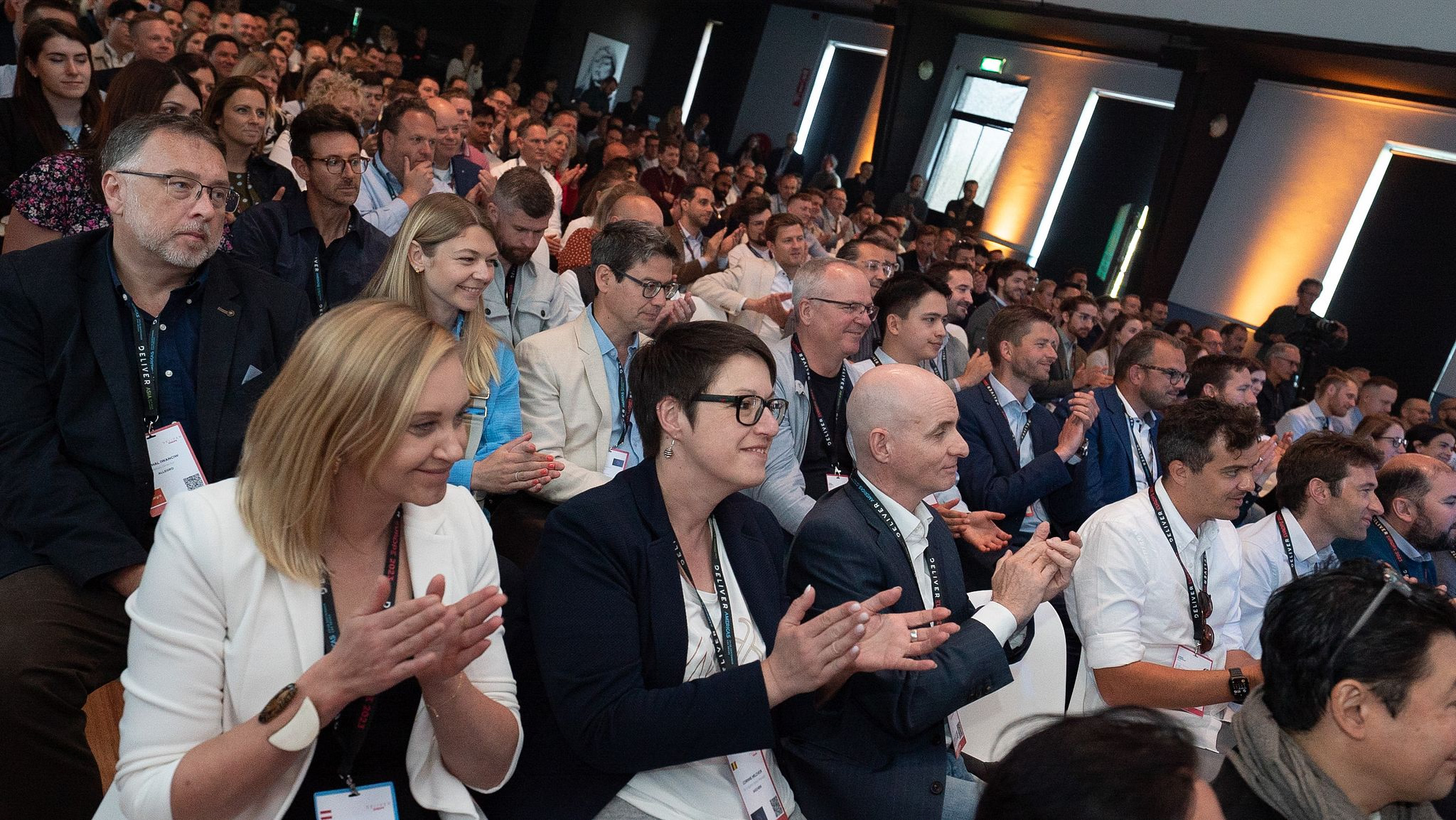
Deliver Europe Event Format is a Win-win

The iconic TAETS venue in north Amsterdam will host the 9th edition of DELIVER Europe, the 4th at this site. The event has become well-established, with an American version launched last October in Las Vegas and an Asian event coming to Singapore next March.

Stephane Tomczak, Founder and CEO, told Logistics Business that this year the regular themes of ecommerce, retail and last mile will be extended to encompass visibility, sustainability and cost-effectiveness. “Shippers and retailers are looking for solutions and tools to assist with stock management, meet inflationary challenges and enable savings to be passed to consumers,” he says.

This year there will be 1500 delegates, including many new faces, brands and speakers. “We start with a blank page each year,” Tomczak explains, “and have an amazing programme of insightful sessions. Speaker slots are in high demand and not just given to our customers.” Highlights include keynotes on circularity, customer-centricity and on-demand delivery. Speakers are drawn from blue-chip companies like Tesco, Lego, Ricoh, Maersk and Decathlon.

Unique Format

Exhibitors and sponsors buy a set amount of pre-arranged meetings with delegate buyers, ranging from 20 to 200, which determines the cost, which includes a stand/booth. “1-on-1 meetings, that’s what they’re buying,” says Tomczak. “It differs from traditional expo settings in that our delegates meet strict criteria and agree to having 6 meetings over the 2 days, in addition to attending the conference.” In return the delegates get free accommodation, transfers and catering. It’s a win-win.

Deliver Europe
Deliver Europe

Why attend

With around 70% of exhibitors returning from last year, plus new ones like Ocado Intelligent Automation, the focus has been on refreshing the audience whilst maintaining its quality. The organizers target the whole of Europe in attracting delegates and so have a large pool of decision-makers to work with.

“We’re still onboarding and almost at full capacity,” says Tomczak. “It’s the best use of your time. In 2 days, under 1 roof, you can meet meaningful vendor exhibitors, hear announcements, learn from content provide by your peers which is heavy on best practice. There are hundreds of business leaders, you can expand your network and it’s always super-useful.”

DELIVER is eco-conceived, with carbon emission offsetting of the delegates’ travel, making it perhaps the only carbon-neutral show in the logistics sector. Profits are invested in green funds and tech. To learn more about Deliver Europe or to register, click here

read more

Logistics network conference sees record attendance


ASRS to OSRS Automation

Ocado are a familiar name in grocery ecommerce in the UK, but now aim to challenge major warehouse systems integrators internationally. CEO Mark Richardson spoke to David Priestman.

Ten communications per second between a warehouse robot and its operating software is impressive. Not only does that prevent collisions between the picking bots, it means that ‘appointments’ for each robot can be made for a specific tenth of a second. The routing software, ‘Dash’, communicates with every robot ten times per second in scheduled time slots. This is no ordinary automation system. Such expertise has been honed by 20 years’ operating Ocado’s 50,000 grocery line SKU storage and retrieval system in Britain.

“It’s a leading-edge ASRS, high-dense cube that can be scaled up as large as is necessary. The robots are designed to lift up to 35kg. Each storage bin can contain just over 30kg of product,” Richardson explains. Brands with complex, high-throughput operations in healthcare, retail apparel/footwear, consumer packaged goods, plus their third-party logistics operators can now access this automated fulfillment technology from Ocado Intelligent Automation (OIA). “It’s a global offer, pretty broad applications, especially in pharma,” Richardson adds.

OIA, a division of Ocado Group, formerly part-owned by the John Lewis Partnership, debuted its Ocado Storage and Retrieval System (OSRS) for the first time in North America at Manifest in February. OSRS simplifies and streamlines complex challenges facing modern supply chains using software, hardware, and processes proven in the demanding grocery industry.

“A non-grocery cube, on average, is not as big but it can be even larger, if required, for example in a general merchandise warehouse,” Richardson reveals. “We’re going for the larger systems. Non-grocery presents a breadth, rather than a throughput challenge. As the technology matures we can automate anything.” Food-retail demands fast, continuous picking, but non-food may have more and slower-moving items.

“We’re using our technology to create new products at our R&D centre in Welwyn Garden City,” Richardson says. Mention of the town of my birth and childhood, in Hertfordshire, peaks my interest further. “Automation tends to deliver better results, it’s more deterministic and very reliable. We can load our bins without humans. Inbound goods are delivered to the decant stations by pallet truck, for now,” he adds. “OSRS can buffer the outcome of the pick. Completed picks can be stored back in the grid for despatch later, therefore decoupling the processes of picking and dispatch. Prior to despatch, robots retrieve all the orders for a delivery route and bring them out of the grid. This allows the finished pick to live in the grid.”

OIA also incorporates technologies brought into the group with the acquisition of 6 River Systems and Kindred AI. These bring depth and flexibility to OIA’s products, offering a range of solutions. ‘Chuck’ is a robot order picker that does not necessitate a major investment. Kindred’s powered robot is deployed as a picking arm on top of the OSRS grid. It can be tele-operated remotely, so no engineer is required on site and Ocado Group has more than 1000 maintenance and support personnel around the world plus a 2500 strong development team in eight countries.

I asked Richardson the million-dollar question. How does OSRS compare with AutoStore, the Norwegian-invented system that has become the go-to for ASRS in the DC, sold by many system integrators? “We’re the most dense system, saving footprint,” he claims, “and OSRS is faster – more products can get through it. OSRS can be built taller than an AutoStore so can achieve a greater density in a given floor space. Because OSRS robots occupy just a single grid space, they create less congestion, so for busy grids total system throughput is higher. This all reflects our background in grocery, where volumes are typically very high compared to other industries.” The gauntlet has been laid down. What of further acquisitions? “We’re not specifically looking for new technology right now,” says Richardson, “but absolutely will do so in the future.”

read more

Ocado Claims Breakthrough Advances in Robotic Arm Capability


Sending Freight Together

Many hands make light work, and the saying holds true for big logistics contracts. David Priestman met with a digital freight forwarder making this happen across Europe.

David Nothacker is CEO and co-founder of Sennder, a Germany-headquartered company of 1000 employees and 11 European offices. The company’s forte is as a full truckload (FTL) third party logistics (3PL) broker for European road freight contracts. It acquired Uber’s European Freight Business in September 2020 in an all-stock transaction, with Uber acquiring a minority stake in Sennder as part of the deal. The acquisition began a strategic collaboration between the two companies to provide shippers with market-leading levels of service, efficiency and advances technologies across the USA, Canada and Europe.

“We handle the contracts and take the risk,” Nothacker informs me. “Clients come to us, we guarantee the price and break the transport work down from say a €200m agreement, like with have with the Italian Post, into small components with managed rates that many hauliers and transporters can operate between them.” By leveraging proprietary technology, Sennder is building an ecosystem.

Digital Freight Platform

“Uber Freight and Sennder are partners and mutual advisors, Nothacker explains. “We are continuously exploring opportunities for collaboration and synergies, particularly now that Uber Freight offers 4PL services in the European market that can be executed via our platform. We operate in different segments of the European market (4PL vs. 3PL), and on this basis we are able to advance our joint mission to fast forward road logistics.”

Sennder provides the compliance, delivery schedules and more on its digital freight exchange platform. This can either be for contract shipping or spot rates for ad-hoc, chartered transportation. The pitch is for companies needing to send freight to not have to choose between the dependability of an asset-based carrier (a traditional 3PL) or the agility of a digital TMS. Shippers access the connected carrier network enabling continental-wide shipping and forwarding to be divided-up by multiple local carriers.

Sennder has a large group of them on board, with 40,000 trucks connected to the platform transporting 50,000 loads a month. “While we are always open to new partners to increase our network density, our business focus is also on driving technology adoption with existing partners to maximize the benefits of our platform for carriers and shippers alike,” Nothacker states.

David Nothacker, sennder CEO

Similar networks have been put together in the palletised freight market, of course, and for less than truck loads. But Sennder claim originality in FTL and to be Europe’s largest digital freight forwarder. Scania invested in the company in 2017 and this has developed into the Swedish truck manufacturer being one of the largest shareholders as well as a strategic partner. “The transport industry is facing a revolutionary transformation through digitalization. With the knowledge and network of Scania, we will be able to accelerate our growth journey, with the ambition to offer the most customer focused and efficient service in the sector,” Nothacker tells me.

Investment in EVs

Scania is the electric vehicle (EV) partner for Sennder, with a joint-venture called JUNA. JUNA aims to advance large-scale e-truck adoption in Europe and to drive the transition towards a sustainable logistics industry, in line with the goals of the European Union’s ‘Green Deal’ to achieve climate neutrality by 2050. JUNA enables access to e-trucks, which are 2 to 3 times more expensive than diesel vehicles, and guarantees transport volumes by granting preferential access to spot and contract loads on Sennder’s digital platform. In doing so, JUNA reduces the risks of EV adoption for carriers, in particular the financial risks associated with high upfront costs and the uncertainty of the residual value.

70% of European hauliers have less than 10 trucks, but EVs are relatively expensive. “How do we persuade them to switch from diesel to electric?” asks Nothacker. His answer is via a pay-per-use model, per kilometre. “Truck owners don’t have to finance buying a lorry/truck. Our rate includes maintenance and insurance, though the EVs cannot be shared. If you don’t drive, you don’t pay.” Carriers benefit from driver apps, fleet management software, and individual reports and automated notifications, as well as from a higher utilization of their fleet, reducing costs and harmful emissions.

“With our shippers’ increasingly ambitious targets to reduce their Scope 3 emissions, we are seeing a constant increase in demand from our customers for green transportation,” Nothacker says. “In 2023, demand for green transports via our platform increased six-fold. This enables us to guarantee the use of EVs to both small and large fleet operators in our network. If set-up properly they’re no more expensive than diesel in terms of TCO, and they’re beneficial,” Nothacker continues.

“We get large EV contracts with the end-user shipper and sub-divide them among small haulage carriers – economies of scale.” Sennder compete, therefore, with 3PLs for contract volumes of at least €1 million Euro per annum. “The FTL business is slightly different, we work with larger shippers,” he concludes.

read more

sennder and Everoad Merge in Bid to Build Europe’s Largest Digital Road Freight Platform


Temperature-Controlled Trailer Unit Reduces Fuel Consumption

The Vector® HE 17 temperature-controlled trailer unit is now available, adding to Carrier Transicold’s Vector High Efficiency (HE) range. Offering complete versatility for all trailer applications, this new unit offers refrigeration capacity output at above 16 kW, as well as a significant reduction in fuel consumption and noise levels. Carrier Transicold is part of Carrier Global Corporation (NYSE: CARR), global leader in intelligent climate and energy solutions.

By integrating advanced inverter technology with the proven all-electric E-Drive architecture, the Vector HE 17 sets a new benchmark for Total Cost of Ownership (TCO) and performance in its category. It delivers superior cooling capacity, reduces fuel consumption by up to 30%, and lowers noise emissions by 6dB, for a sound perception decreased by more than 50% compared to the Vector 1550.

“The Vector HE 17 positions itself as a versatile solution, the ideal fit for long-haul transportation and urban deliveries, providing our customers access to a more efficient and sustainable trailer solution,” said Victor Calvo, Vice President & General Manager, International Truck & Trailer, Carrier Transicold.

The system incorporates Carrier Transicold‘s E-Drive technology, a key technology of the company and constantly improved since 1999, which has revolutionised the semi-trailer segment by removing the need for the mechanical transmissions found in belt-driven refrigeration systems and converting engine power into electricity to drive the unit.

The Vector HE 17 also builds upon the proven strengths of the Vector HE 19 unit: a hermetically sealed compressor and an economiser, increasing the machine’s efficiency. This system offers greater efficiency, reduces the risk of refrigerant leaks, and significantly lowers fuel consumption, thanks to the inverter technology, which constantly adapts the compressor speed to meet the cooling demand.

In addition, the unit is equipped with a telematics box ensuring its compatibility with Carrier Transicold’s Lynx Fleet digital platform, which combines refrigeration equipment data with machine learning. It helps customers to make faster, data-driven decisions and helps improve the effectiveness, efficiency and sustainability of their supply chains.

The launch of Vector HE 17 is another milestone for Carrier Transicold as it contributes to Carrier’s Environmental, Social & Governance (ESG) goal of helping customers avoid more than one gigaton of GHG emissions by 2030.

First Autonomous Electric Refrigeration System


Logistics trio acquire Freight Software Business

Following a lengthy due diligence process, the Cardinal Partnership, Davies Turner and Woodland Group have created a holdings company and purchased UK-based freight software company Forward Computers Ltd from the Freight Software Group.

The joint venture is called Forward Computers Alliance Limited and is the vehicle through which the three leading independent freight forwarding and supply chain management companies now jointly own Forward Computers Limited, which trades as Forward Solutions.

Both the Cardinal Partnership and Woodland Group are long-standing clients of Forward Computers, and have been investing and building their own digital logistics software in-house for many years. Davies Turner has been assessing the freight software company’s products as part of an exercise aimed at enhancing its existing freight management systems that have been developed in-house to date.

Freight Software Group acquired Forward Computers Ltd in 2019, with its products rebranded to trade under the Forward Solutions name in 2021, and will continue to own BoxTop Technologies.

Speaking about the reason for the sale, Christopher Hewlett CEO of Freight Software Group (pictured above) said:

“I was excited when two existing clients and a potential client made it clear that they were keen to combine forces to invest in the business, and utilise their huge practical experience in the operation of freight forwarding and supply chain management services to influence the design of next-generation systems. The development will likely result in an increase in the number of staff employed by Forward Computers, which will remain headquartered in Nottingham, whilst having no negative impact on the existing IT structures of the three joint venture partners.”

Speaking on behalf of the new owner, Brian Hay (pictured left), CEO of the Cardinal Partnership said: “We welcome this opportunity to acquire one of the UK’s foremost suppliers of software to the freight transport sector. With hundreds of years’ collective experience in providing multimodal solutions across air, sea, road, and rail freight, the three partners understand how the industry is evolving, and how freight management software needs to evolve alongside to offer a range of processes and systems that deliver success.

“As co-owners, we look forward to supporting Forward Computers in further developing its range of software solutions that help its clients adapt to an ever-changing landscape. Those clients, many of which have business relations with the joint venture’s three owners already, can rest assured that Forward Computers trading under the Forward Solutions brand, will continue to be run as a completely independent business, with client confidentiality assured.”

Read Similar

Food supplier modernises DC operations


Calling ‘order’ on Inbound Goods

Supermarkets face a pressing need to automate their DCs. But first, they must put their inbound processes in good order. Dan Migliozzi, Sales & Marketing Director, at independent systems integrator, Invar Group, gets to the root of the problem.

With floor areas measured in hectares, carrying tens of thousands of SKUs to supply the daily needs of 67 million people, the distribution centres of our major food retailers are surely the textbook case for extensive and profitable automation.

Dependence on manual operations is looking increasingly unsustainable. Post Covid mitigation measures have introduced inefficiencies, recruitment is tough as the gap between the wage rates the food chain can afford and the salaries available elsewhere is growing, in contrast to the levels of skill, capability and commitment offered by those who are prepared to work for the money. Meanwhile, margins are shrinking in a highly competitive market faced with the ‘cost of living crisis’.

And yet in 90% of grocery DCs across Britain and Ireland, manual operations are still all-pervasive, and where the supermarkets have invested in automation the benefits and the returns on investment are often underwhelming. What is going wrong?

Feeding the beast

It’s not the technology. From the simplest conveyors to robotic arms and Autonomous Mobile Robots (AMRs), automation continues to become smarter, faster, more capable, more flexible, even more energy-efficient. The problem lies not with the appetites of the automation, but in how we feed the robotic beast.

Because, in a strange way, the robots are only ‘human’. Like us, they work most consistently and efficiently when presented with standard, predictable, ordered tasks. When the job is random or chaotic, even the latest advances in sensors, vision systems, artificial intelligence struggle – indeed, often human workers are better at creating order from chaos. Which is why even in relatively highly automated facilities there are many workers purely engaged in sorting goods so that they feed the right piece of automation in the right order at the right time.

This in turn arises because of the haphazard way in which incoming goods are received from suppliers. Too often there is no standardisation or uniformity in the way goods are received, even from one supplier let alone across the supply base.

Arriving in a mix of roll cages, totes, pallets, boxes, bags, goods destined for quite different routes through the DC are often mixed promiscuously. ‘Zero day’ goods, or consignments that should be cross-docked for immediate onward shipment, are in the same cage as goods that will be held for days; robust and heavy cartons of dry goods alongside (or on top of) the perishable or the delicate. There is little consistency in how labels and bar codes are presented. Even the distinction between ambient, chilled and frozen may be only loosely observed and within those categories, while surely no supplier would put cooked meats adjacent to raw chicken, lesser sins are regularly committed.

Need for SKU-specific protocols

In short, there are no SKU-specific protocols – rules that mandate the supplier that ‘this is how this SKU should be delivered, in these temperature conditions, and in this form of pack. These are items it can legitimately be co-shipped with; putting it in with those items is a no-no’. And so on.

Creating and enforcing such protocols across tens of thousands of SKUs is a major, we would say strategic, task, but it has to be done if automation is to yield its much-needed benefits.

Across the range of SKUs questions need to be asked. What am I receiving? When is it arriving? When does it need to go out again? Where will it be stored (if at all), in what conditions and for how long? Which are the items I want to see arrive together – based not just on the nature of the goods but on what is going to happen to them on their journey through the warehouse, which effectively is asking what elements of automation are going to touch these items?

Driving collaboration

This can’t be done in isolation. The supplier, after all, isn’t presenting a chaotic mix of items just to be awkward – they will have their own constraints, for example on batch sizes and times, or on their own storage capacities. So, this needs to be a joint venture – which in some cases will be the job of a 3PL or 4PL – working with suppliers almost in the role of consultants, to understand supplier challenges and making sure the supplier understands the challenges in the DC, so that goods can consistently be delivered in a way that can feed the automation with minimal intervention.

Naturally this requires top class, intelligent WMS/WCS not just for operations within the warehouse or DC, but to interact with outbound transport logic. There is a lot of data-driven software involved, but the benefits will be significant.

If the product is sorted logically before it hits the automation, the system works faster, more consistently, with smoother flows, better use of storage and so on. Further investment, in say scanners and vision systems, or AI applications, then becomes justified because the payback is visible and predictable. At the moment ‘the product is sorted logically’, more or less, by scarce and expensive manual labour – how much better it would be if it was already in order when it leaves the supplier.

read more

Tesco Picks Transporeon To Manage Inbound Logistics Flows


Logistics Sector Calls for Action on new EU Import Declarations

Global and European trade associations representing commercial transport have issued an urgent alert to all businesses involved in the movement of goods into or via the EU, Norway, Switzerland or Northern Ireland, by sea, road or rail. The new Import Control System (ICS2) will start to be introduced from June this year.

The World Shipping Council, the International Federation of Freight Forwarders, the Global Shippers Forum, the European Community Association of Ship Brokers and Agents, the European Community Shipowners’ Associations, the European Associations for Forwarding, Transport, Logistics and Customs Services, the European Shippers Council and the International Road Transport Union have together stressed the importance of the new controls and their impact on the movement of goods into or via the European Customs Territory by sea, road and rail.

Awareness of the implementation of the new requirements is key, says the group, as is understanding how ICS2 will affect various entities in the supply chain at different times and in distinct ways.

ICS2 is an enhanced safety and security regime introduced jointly by customs authorities in the EU that requires specific details of imported goods to be provided before loading or before arrival at the EU border.

The requirements were introduced for air cargo in 2023 and will be extended to sea transport from June 2024 and for imports arriving by road or rail in 2025. The extensive new data requirements include six-digit HS codes for each item in a consignment, an “acceptable description” and detailed buyer and seller information.

The trade bodies, each representing different parties in the supply chain, have urged businesses involved in moving goods into the EU to begin their preparations for the extension of ICS2 now and to seek further information on how they will be affected. The European Commission’s website is the best place to start.

Failure to comply with ICS2 requirements will result in delays and disruptions to imports into the EU, and, potentially, in accordance with Member State practice, fines and penalties for persons liable for submitting the safety and security data to ICS2.

Cooperative efforts between the different parties involved in such shipments is crucial to keep goods moving, as symbolised by the joint call to action by the eight trade bodies.

read more

Changes in Transportation of Goods to EU


Subscribe

Get notified about New Episodes of our Podcast, New Magazine Issues and stay updated with our Weekly Newsletter.