Supply Chain Predictions: Evolution of Commerce

As another year draws to the end, it seems that change is happening faster than ever: technological advance continues to race forward, global dynamics are shifting on a near daily basis, and consumer expectations are evolving faster than at any time in retail history, writes Martin Lockwood, Senior Director of Manhattan Associates.

If there’s one prediction that comes true every year, it’s this: what worked last year won’t cut it in the next edition. And, while predictions are notoriously difficult to make with any certainty, our 2026 forecasts aren’t just guesses, they’re born of powerful, data-driven insights, professional experiences gained over decades and what we’ve seen (and heard) from customers over the last twelve months.

Every new year offers the chance to shape the future, not just watch as a bystander as it happens. At Manhattan, our mission has never been simpler: cut through the noise, focus on what truly matters to our customers, and make sure we’re not just keeping up with change, we’re leading it.

Below is a selection of predictions for 2026 from our team of experts from around the globe. From the ongoing creep of AI into all areas of business, the evolution of commerce as we know it, and what trends like ‘hyper-personalisation’ mean for already stressed (B2B and B2C) supply chains, hopefully, these insights will provide food for thought and provoke some interesting conversations in the New Year!

2026 Predictions

  • While 2026 will see AI tools deployed more extensively to reduce the cost of labour-intensive tasks and accelerate project deployments significantly, these tools will also evolve to offer incident management capabilities, leading to machine-driven self-healing and ultimately, more resilient supply chains.
  • Professional services organisations will accelerate the adoption of AI-driven automation to streamline delivery, enabling faster onboarding, smarter resource allocation, and support models that improve operational delivery. As clients demand more transparency and value, Professional services teams will shift toward outcome-based engagements, leveraging real-time data and collaborative platforms to co-create solutions and demonstrate measurable impact.
  • While we can expect to see more organisations leveraging new AI capabilities next year, the growth will be a slow climb as supposed to the frenetic pace of the last 24 months. 2026 will be the year organizations quickly realise that they need data cleanup and digital modernisation if they want to leverage new AI capabilities effectively, and deliver the speed, accuracy and true value, everyone is looking for.
  • In the B2B space, intelligent decision making at the moment of the truth, (i.e. the moment that customer wants to place the order), is becoming more and more the norm as organisations look to maximise customer service and profitable operations. Intelligent sourcing, order allocation versus supply, and continuous re-allocation will be a recurring theme, putting ERPs in the spotlight when it comes to meeting customer expectations in 2026.
  • The consumer is now ubiquitous: they want to transact anywhere, have orders fulfilled however they chose and return items how and when they like. As a result, supply chain will have no choice but to commit in real-time to consumer orders, regardless of what channel the order comes from. Expect an acceleration of unified commerce uptake as retailers battle with the increasing demands of hyper-personalisation.
  • By the end of 2026, legacy registers will be replaced by mobile-first POS platforms that function as omnichannel hubs rather than transaction terminals. These platforms will connect to real-time inventory and fulfilment engines, giving associates dynamic options like ship-from-store, pick-up-later, or same-day delivery at the point of decision. They will (crucially) also deliver context-rich associate experiences including customer history, loyalty status, recent browsing and open carts, so staff can serve customers faster, with more accuracy and a greater degree of personalisation.
  • Retailers such as Walmart have already announced huge investments in conversational commerce and we can expect it to fundamentally change how we shop online, moving from traditional search to AI interaction shopping.
  • Social commerce will continue to accelerate at a rate of knots. Tik Tok Shop has just had a record year with 6,000 live shopping sessions being held every day on the platform, on average. M&S in the UK is one of the latest retailers to jump into this new sales channel so expect many more to follow suit in 2026.

Supply Chain Professional Club

With supply chains facing some of the most volatile conditions in recent years, a new UK Supply Chain Professional (SCP) Club was officially launched at an event at Hampton Manor last week. The club aims to bring together supply chain professionals from across industries to share expertise, collaborate on common challenges, and drive innovation at a time when global networks are under unprecedented strain.

The SCP Club will serve as a space for honest conversation, peer learning, and collective problem-solving, delivering tangible value in the form of great venues, food and experiences.

“Our vision is simple,” said Jenny Lowrie, Director, UK SCP Club. “There is a massive knowledge gap and pressing need for a forum which unites supply chain professionals in spaces where we can learn from one another, share experiences, and build meaningful, long-lasting connections.

“Supply chains are cool. They’re complex, impactful, and at the centre of how the world works. If my four-year-old doesn’t get a Barbie Dreamhouse this Christmas, it’s either because a supply chain has failed, or my own S&OP process at home has! These systems shape every part of our lives. And by bringing our community together, we can debate, challenge, and grow in a way that moves both our industry and our own professional development forward.”

The UK SCP Club’s launch comes at a critical moment as supply chains grapple with more complexity than ever according to Dave Food, Lecturer and Industry Strategist at the University of Warwick. “When professionals share knowledge openly, whether it’s around planning, forecasting, resilience, technology or talent, we build stronger networks and smarter responses. The SCP club will play a vital role in helping supply chain leaders to stay ahead of the challenges inherent in tomorrow’s supply chains.”

Jan Kraaijeveld, Slimstock’s Strategic S&OP Expert echoed this sentiment: “Too often, businesses tackle supply chain challenges in isolation when the real breakthroughs happen through collaboration. The SCP Club is a place where expertise can be exchanged freely, whether you’re building an S&OP process from scratch or refining mature operations.”

Launched at the first event of its kind, the club brings together a diverse audience, from organisations actively implementing new processes, to partners and consultants specialising in change management and operational transformation. Focused on practical insights, real case studies, and collaborative problem-solving, it aims for members to leave each session having gained knowledge, built relationships and fuelled progression.

Paralympian and World Champion Coxwain Erin Kennedy shared a powerful message in her keynote, reinforcing the importance of leadership, culture and teamwork which underpin the principles of the UK SCP Club: “Even in the toughest conditions, people can achieve amazing things when they support each other. Community is often the difference between struggling and succeeding.”

“As it evolves, the SCP Club will be shaped by the people it is designed to help through ideas, and what’s most important to our community, and we can’t wait to announce details of the next one.” Lowrie concludes.

IKEA Strengthens AI-Driven Home Delivery Capabilities

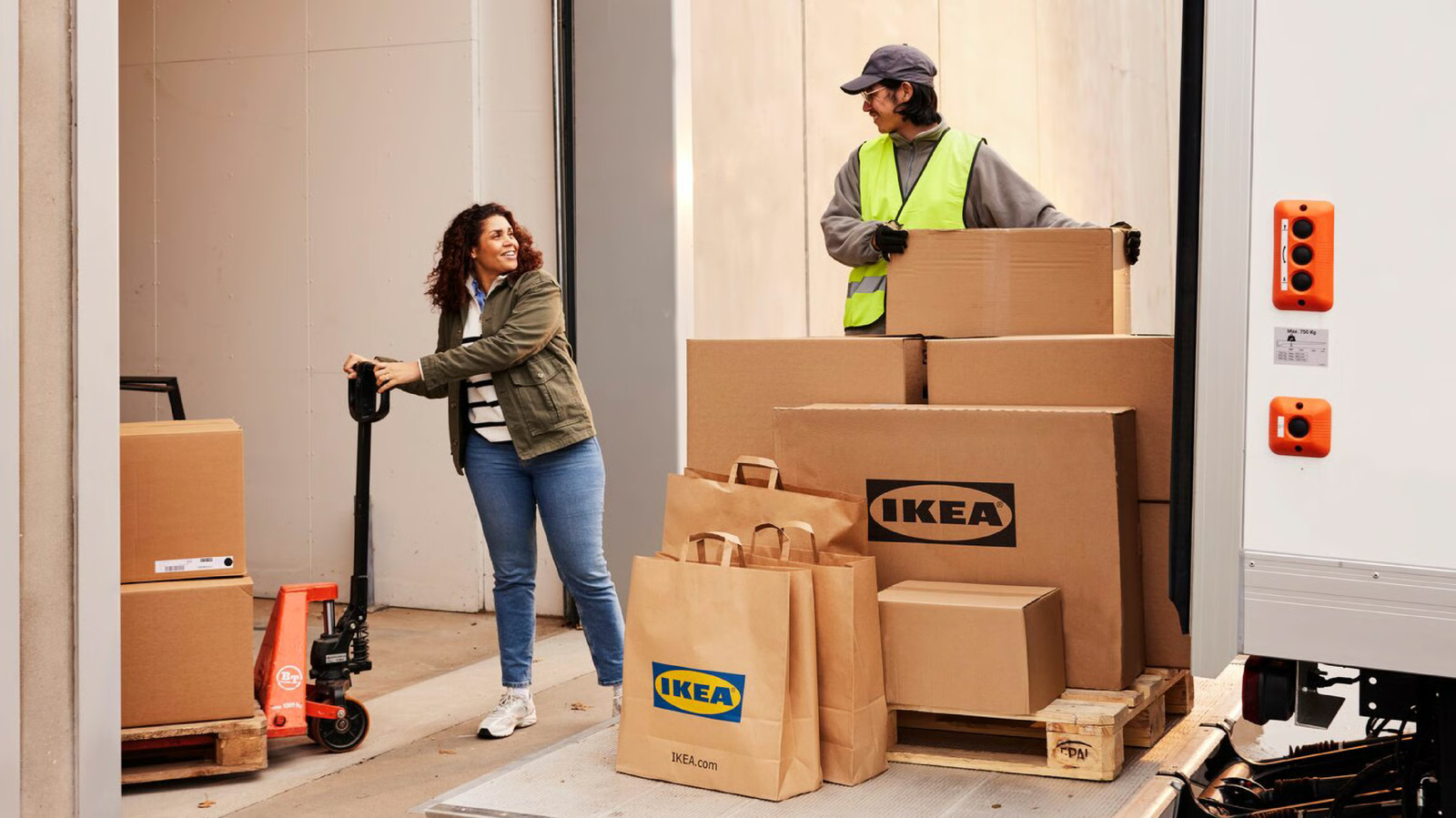
In a strategic push to elevate its home delivery capabilities, Ingka Group – the largest IKEA retailer globally has acquired Locus, a U.S.-based logistics software company powered by artificial intelligence. The move signals IKEA’s intent to bring critical logistics technology in-house to better manage and optimise last-mile delivery operations, a key differentiator in today’s competitive retail environment.

Taking Control of Delivery Logistics

Traditionally reliant on third-party providers for delivery execution, IKEA’s acquisition of Locus marks a shift toward tighter control of its logistics stack. Locus offers an advanced AI-driven logistics management platform that includes real-time tracking, dynamic route optimisation, intelligent vehicle and resource utilisation, and capacity planning tools. By integrating these capabilities, Ingka Group aims to streamline the entire home delivery process – from order allocation to doorstep fulfilment – boosting both efficiency and customer satisfaction.

Tolga Öncü, Head of IKEA Retail at Ingka Group, underscores the strategic importance of the acquisition:

This acquisition aligns perfectly with our commitment to improving the customer journey at every touchpoint… allowing us to deliver with greater speed and flexibility to the many.

Strategic Timing Amid Online Growth

The acquisition comes at a pivotal time for IKEA’s e-commerce business, with online sales now representing a significant portion of total retail revenue – a clear indicator of shifting consumer behaviour toward digital channels. Bringing Locus’s technology onboard helps IKEA manage this accelerated demand while enhancing fulfilment agility.

Locus Remains Independent

Despite becoming part of Ingka Group’s technology portfolio, Locus will continue to operate as an independent entity, retaining its existing brand and leadership while serving customers beyond IKEA. This approach is designed to sustain innovation and allow Locus to grow its product and engineering teams to support broader enterprise logistics needs.

Global and Local Impact

The acquisition also carries regional significance. Integrating Locus’s AI capabilities aligns with IKEA’s broader “One IKEA” supply chain strategy, aiming to reduce operational complexity and prepare for surging home delivery volumes. This is expected to support not only faster delivery but also more affordable and sustainable service options.

What This Means for Logistics

For logistics and supply chain professionals, IKEA’s move reflects a growing trend: retailers investing in proprietary technology to gain competitive advantage in delivery and fulfilment. As consumers increasingly prioritise visibility, speed, and reliability, owning the underlying logistics technology – particularly AI-driven optimisation platforms – can deliver measurable operational and financial benefits.

By embedding Locus’s capabilities deeper into its logistics framework, IKEA is positioning itself to handle evolving fulfilment challenges and set new benchmarks for home delivery performance across global markets.

Under the Skin of a New Conveyor

From the outside, everything is in a consistent style: uniform design, elegant, streamlined, fascinatingly smooth and closed. Whether straight conveyor lines, curves, diverters or transfers, roller conveyors or belt conveyors, horizontal or upward or downward transport, everything looks from outside the same, like a single, unified whole. The frame construction, aesthetics, and height are identical. Everything is closed without any visible holes or screws, nothing sticks out. This makes a convincing impression in a large logistics centre.


A good design sells easier


All in all, Avancon has been granted 12 patents for its systems and for various individual elements, as well as additional design protection for the external design in most industrialized countries. Avancon calls it ZPC for short, which stands for ‘Zone Powered Concept’. In general, it always works with zero pressure wherever it is necessary to accumulate.

Deeper inside

Where are the drives, the control boxes, and the cables and cable ducts? How can all this work without anything being visible from the outside? Yes, that is precisely the special, patented concept from Avancon.
Everything is housed hidden in the frame profile.

The absolute highlight: apart from the motor mounting, there are no screws in the entire frame-profile system. All elements are snapped into the patented preformed ribs of the aluminum profiles. Assembly is therefore simple and quick. The same applies to any maintenance and replacement of an element.

In addition, communication with almost any higher-level IT infrastructure and bus systems is easy via a gateway. The DC power supply and data transmission are ensured by a concealed ‘3-in-1’ power supply unit. What are the benefits of all this? Customers can save costs, especially on the construction site, as all elements such as the motor, light barrier, cables, control system, etc. can already be mounted in the frame at the factory, where labour costs are lower than on the construction site.

However, the biggest savings come from the fact that no cables need to be laid on the construction site, meaning that cable ducts are no longer necessary. And because all control boxes with pre-programmed firmware, BLDC motors, the entire drive system, and cables are already available inside for each conveyor zone, you save on programming costs and the central control cabinet. All this easily saves 30% of the total investment.

N.B. Avancon delivers products only via conveyor manufacturers and integrators.

Subscribe

Get notified about New Episodes of our Podcast, New Magazine Issues and stay updated with our Weekly Newsletter.