
Jungheinrich Accelerates Electric Future

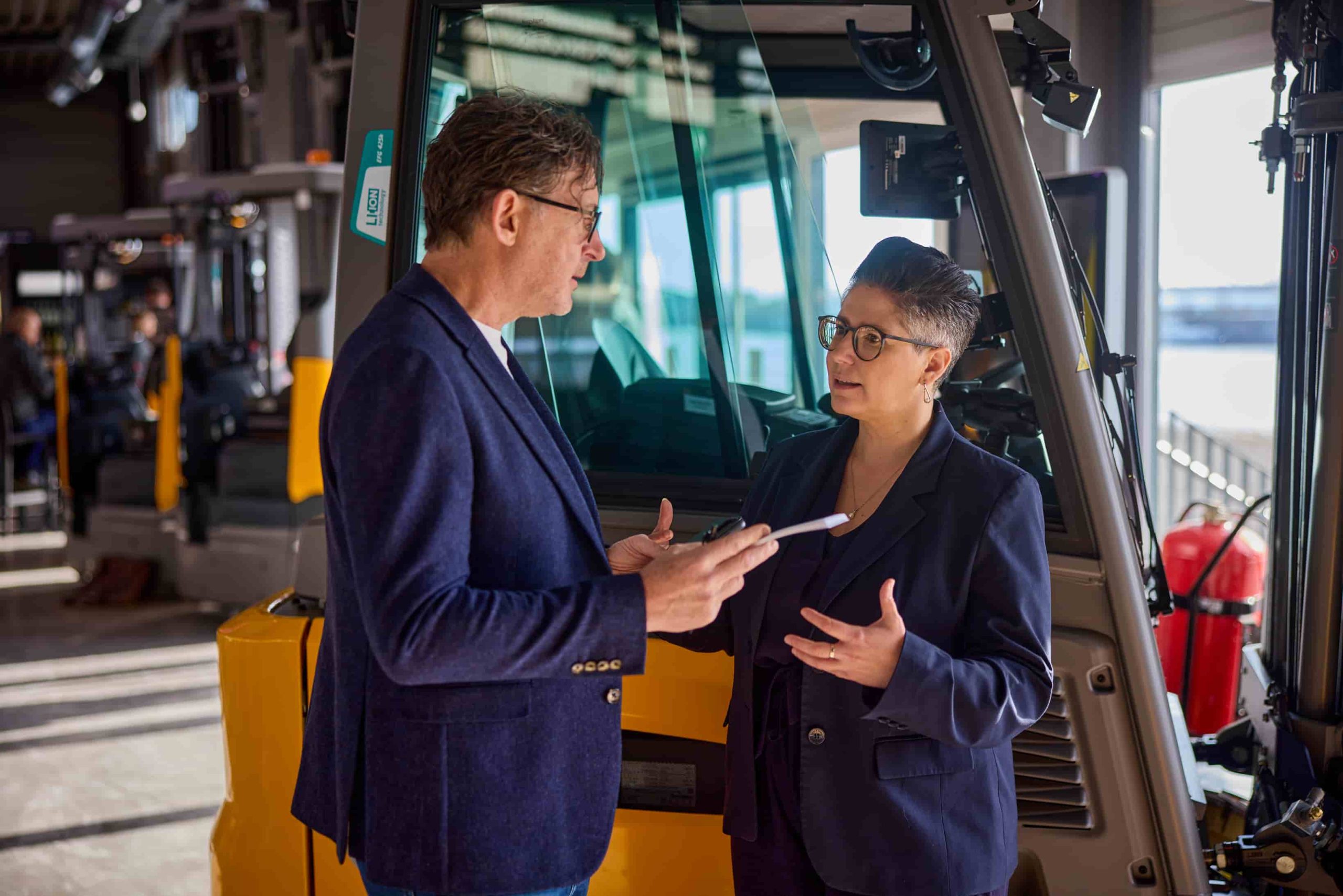
Editor Peter MacLeod attended Jungheinrich’s launch event in Hamburg last week to witness not just five new electric forklift truck developments, but to hear of a clear articulation in the company’s long-term portfolio strategy, which spans from simpler entry-level products to high-voltage heavy-duty alternatives in areas traditionally dominated by ICE trucks.

At one end sits the newly introduced purple-coloured ‘AntOn by Jungheinrich’ brand, designed to address a segment Jungheinrich had not previously targeted with its traditional yellow trucks.

“Typically, these are small to mid-sized customers,” explained Nadine Despineux (pictured with Peter, above), Member of the Board of Management at Jungheinrich, speaking exclusively to Logistics Business at the event. “They buy two, three, four, five units. They don’t have 24/7 high-performance applications. It’s important for them to have a truck available when they need it, but they don’t use it all the time.”

AntOn’s trucks are manufactured in China by electric specialists EP Equipment. Unlike Jungheinrich’s highly configurable core range, AntOn trucks are standardised and built to stock, making them well suited to distribution partners and e-commerce channels. “When you need consultancy and tailored configuration, you typically go through direct sales,” Despineux said. “Jungheinrich is predominantly direct. AntOn is predominantly partner and distribution business.”

Quality control, she stressed, remains non-negotiable. An OEM centre in Shanghai oversees supplier management and compliance, while vehicles are tested again in Germany. “Trust is super relevant. Safety is super relevant,” she said. “If customers cannot build on that trust, there is no reason they would ever move from AntOn to a yellow truck.”

That yellow portfolio is now undergoing one of its most comprehensive electric renewals in years. The redesigned 1i pallet and double-deck truck series focuses on compactness, lithium-ion scalability and integrated safety features, with vehicle fronts shortened by up to 152 mm for improved manoeuvrability in tight warehouse environments.

In the 48-volt counterbalance segment up to 2.0 tonnes, the fully redesigned EFG 2/2i and 3/3i models deliver up to 15% improved space efficiency through reduced turning radii and compact design, alongside enhanced ergonomics and AI-supported assistance systems.

For heavier applications, the new EFG 5 series provides up to 15% higher handling performance via a two-motor drive system and SRM+ lift motor, positioning it as a fully electric alternative to diesel trucks in the 4.0–5.0 tonne class.

High-bay productivity is addressed with the ET

V 4i reach truck, offering what Jungheinrich describes as market-leading lifting and lowering speeds and fully integrated lithium-ion technology to minimise downtime in multi-shift operations.

Looking further ahead, the dramatic (and currently unpainted) new FalcOn prototype showcases high-voltage architecture in a 5-tonne counterbalance truck capable of ultra-fast DC charging up to 150kW, underlining Jungheinrich’s ambition to electrify even the most demanding heavy-duty segments. This truck has been introduced to offer the performance of a diesel equivalent, but with a much cleaner environmental profile.

Despineux positioned the combined portfolio as a strategic continuum rather than separate product silos. Customers today, she noted, sit at different stages of operational maturity. “They are on this tipping point: when does it make sense to invest into automation? What is the right solution? They are searching for partners who can help them on that journey.”

That journey increasingly includes rental and refurbishment models designed to enhance flexibility and reduce carbon impact. “Many customers prefer OPEX over CAPEX,” she said. “Optimising a complete fleet is a huge leverage.” Refurbishment and reintroduction into the market “closes the cycle of sustainability”.
From entry-level purple to high-voltage yellow, Jungheinrich’s message is clear: whatever stage customers are at, be it manual, mid-tech or fully automated, the company intends to offer a solution.

Despineux concluded,

As a company, if you have the opportunity to say yes, there is a solution that is powerful. Having somebody you can trust is super relevant

Structural Differences Shape Logistics Capacity

The road transport markets in Europe and the United States have shown clearly divergent developments since 2024. And while both regions experienced similar capacity movements in 2022, they have taken distinctly different courses in recent years. Christian Dolderer, Lead Research Analyst at Transporeon, a Trimble Company, analyses the market and explains the reasons behind these trends looking ahead to 2026.

The capacity index, based on transactional data, reflects overall market sentiment regarding available road freight capacity. Comparing developments across both regions provides deeper insight into the underlying dynamics of supply and demand.

In 2022, both Europe and the US experienced expected capacity constraints, followed by a rebound a few months later. However, the US market experienced this cycle approximately four months earlier than Europe. In 2023, available capacity in both regions reached its highest level in years, after which the markets began to diverge in the first quarter of 2024.

In the US, available capacity remained high through the fourth quarter of 2025, creating a favourable market environment for shippers and brokers. In contrast, capacity in Europe steadily declined, a trend that, after a brief stabilisation in 2025, has continued into 2026.

According to Dolderer, this development can largely be explained by differences in market response on the supply side:

European carriers reacted relatively quickly to declining margins and sharply rising operational costs by reducing their fleets. The increasing number of bankruptcies in the sector accelerated this process. Combined with declining transport demand in 2024 and the first half of 2025, this explains the continued capacity contraction in Europe. As a result, the market climate for shippers and brokers is significantly less favourable than in the US.

In the US, a recent decline in capacity has also become visible. In addition to increased transport demand, Dolderer points to external factors: “Severe weather conditions have had temporary impacts, but we also see clear signals on the supply side. New heavy truck registrations fell sharply in 2025, making it clear that the decline is continuing. Reduced investment in fleet expansion and modernisation could indicate a structural shift toward consolidation after years of overcapacity.”

Despite the recent decline, trucking capacity in the US remains historically abundant. Dolderer therefore, describes the trend as more of a psychological correction than a fundamental shift: “After years in which demand exceeded supply, markets react strongly to signs of tightness, even when actual capacity remains relatively high.”

Over the coming weeks, Dolderer expects a slight easing of capacity in both regions due to seasonal factors. However, he anticipates different dynamics for 2026: “In the US, capacity is expected to decline further. This development is driven less by demand growth and more by carriers’ reactions and bankruptcies. In Europe on the other hand, I expect that a recovery in transport demand will put further pressure on capacity.”

Agentic AI for Warehouse Processes

There is a new term in the AI lexicon. Paul Hamblin asked Manhattan Associates’ Raphaël Hervé to explain Agentic AI and its potential to transform warehouse process execution.

Artificial Intelligence, Machine Learning, Generative AI – the buzz phrases keep coming. “That’s the world of today, concepts are developed so quickly,” smiles Hervé (pictured, below), Senior Director, Technical and Support Services at supply chain technology leaders Manhattan Associates.

The latest term is Agentic AI. Let’s get straight to the point – what is it?

“If we look at AI in its original definition, for several decades it was about the ability to understand complex algorithms,” he begins. “We then developed IT systems able to make predictions on a very high number of data sets and then even improve those data sets, which we can call ‘Machine Learning’. Then two years ago, Chat GPT arrived along with the phrase ‘Generative AI’, which I would describe as the capacity to make sense of content – whether text, music, sounds, or pictures – and also create this type of content. When you can make sense of language you can begin to ‘push’ these systems to execute tasks for you.

AI Agents take this a stage further. They are geared towards actually achieving a specific goal, rather than simply making a response.

Autonomous capability

A key breakthrough is autonomy, he says.

“Operationally, AI Agents are empowered to make decisions and act on those decisions. They also have the ability to interface with the user in normal language. Agents take the instructions in natural language and show the decisions made and steps taken in natural language. Remember, it has an ultimate goal and is able to derive the steps it should follow to reach that goal autonomously.”

As a layman, like many others I’m as nervous of AI’s much-feared potential for chaos as I’m dazzled by its transformationally positive capabilities. Does the autonomy of Agentic AI not make it more likely that repetitive mistakes might become wired into the system?

“Good question, but just like every system it needs to be tuned and optimised,” says Raphaël Hervé. “Let me turn it around. When a complex IT system NOT based on generative AI, or not trained to operate autonomously, makes an error, it is actually very hard to understand why. Because you have to debug, analyse, go into source code. With an agent, you just need to tell it, ‘I think that’s wrong. Why did you say that?’ And the agent will say, ‘I did this for this reason’ and it is therefore far easier to derive the source of the anomaly. Agentic AI is a lot more dynamic in terms of fine tuning than was possible in the past. And unlike your dog or your child it will not resist your instructions,” he adds.

The clarity of AI Agents in explaining what steps they take and why they are taking them is reassuring. “They are very efficient in making adjustments, should you need to,” he promises.

There are several logistics contexts in the Manhattan Associates portfolio of solutions.

An examples is Labor Agent, which is not actually a fully 100% autonomous agent that reaches a goal on its own. Think of it more as an assistant to manage your labour efficiency.

“But it can autonomously sift data, analyse, and procure advice on your labour optimisation,” Raphaël explains. “A typical use case might be a warehouse manager asking Labor Agent if that day’s packing deadlines are likely to be met in terms of human resource. If Labor Agent replies that the team is likely to be late because three people are lacking, it can explore the opportunity to take capacity from elsewhere, for instance from Picking. That team might be able to supply up to five people, so Labor Agent might perhaps select the top three resources with highest ratings and performance on packing. It can then message all parties and reassign via text. The agent is working autonomously and speaking to the user in natural, normal language.”

Time-saving benefits

The question all warehouse managers – and finance leaders – will want answered is, how will we see the benefits manifested in day-to-day use?

One precious win is time, invaluable in any warehouse context.

The example we just gave is perhaps a 30-second conversation via text, which would have been 15-20 minutes in the past. If packing is late because it lacks three people, it is a complex calculation without the assistance of Labor Agent. You’re looking at process, schedules, performance of packers. There can be big variables, which you then need to compare with what you’re expecting to achieve. The agent can do this for you in seconds.

Manhattan’s transportation portfolio offers AI Agents with similar benefits.

“Our Freight Invoice Agent is capable of picking up any form of document – PDF, email, spreadsheet – used as carrier invoice materials, and will automatically reconcile actuals with the expected cost of that shipment. This is a role traditionally carried out by manual resources, who spend time receiving documents, comparing screens, shipping costs, taxes, driver hours, and it’s a process that can eat up 15 minutes per invoice. We have built an agent that will automatically ingest anything that comes up, recognise the shipment, align it with expectations, and explain any anomalies. What used to take multiple people hours a day is managed in a few moments.”

Manhattan formally released AI Agents in January of this year, and are marketing the technology to all customer segments, large and small. It even includes Agent Foundry, a developer workspace for customers to build their own agents to their own specifics, either from templates or from scratch.

Raphaël Hervé is brimming with confidence about the prospects.

We believe Agenti AI is very powerful in terms of productivity gains for our customers. It will drastically improve human-machine interactions, and it will make access to data and functions faster and easier. Customers will enjoy acceleration in project implementation, because integration, mapping, and development are all so much faster.

Subscribe

Get notified about New Episodes of our Podcast, New Magazine Issues and stay updated with our Weekly Newsletter.