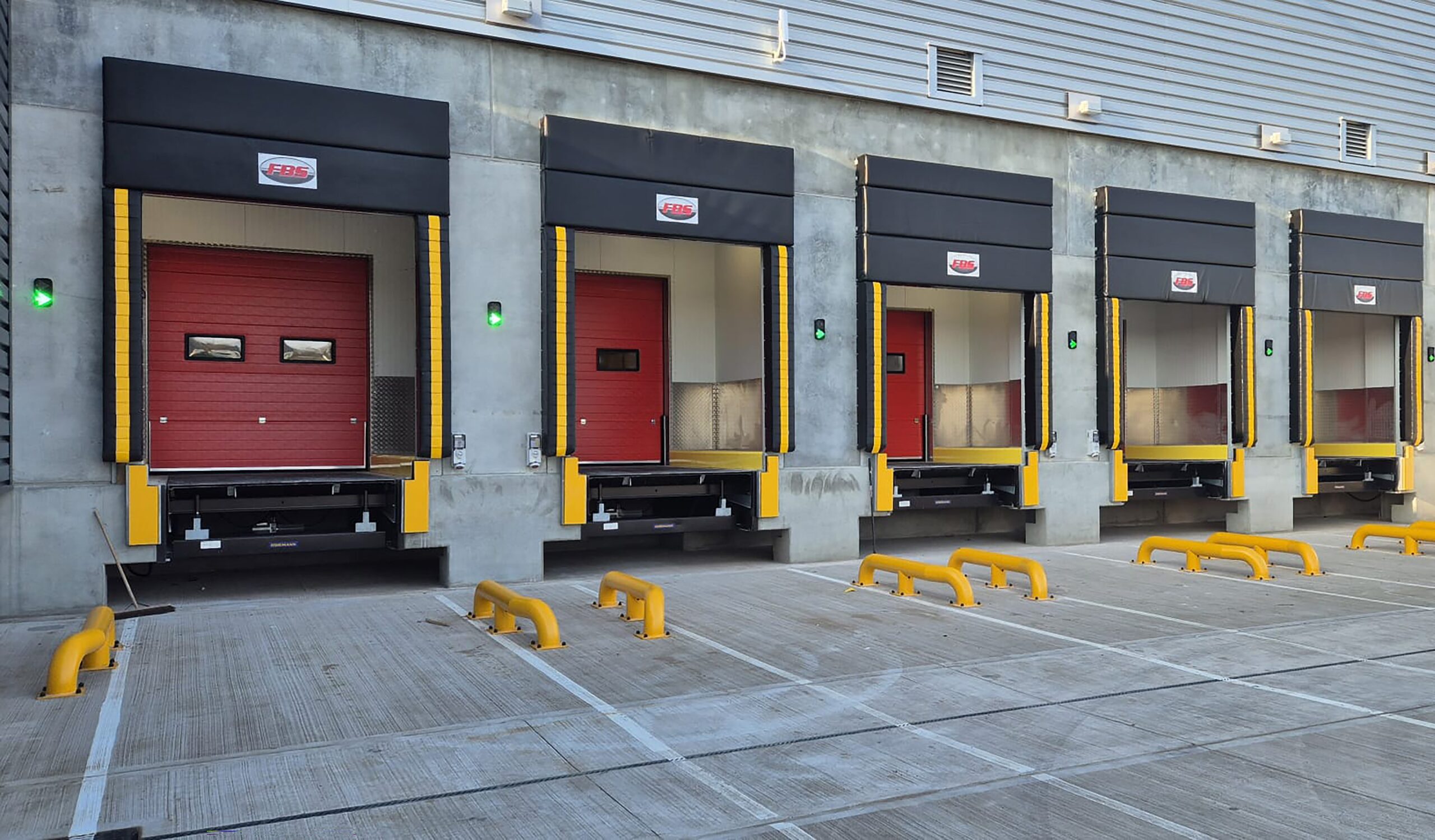
FBS Hörmann UK has successfully completed the installation of loading bays, level access doors, and temperature-controlled door systems at Bidfood’s new distribution centre in Worcester, reinforcing a long-standing partnership between the two businesses. A trusted supplier across Bidfood’s nationwide estate for many years, FBS Hörmann was appointed to deliver a fully integrated solution designed to meet the operational demands of the high-performance facility.
The Worcester project comprised nine complete loading bays, each equipped with Hörmann HTL2 dock levellers and SPU67 fully automated industrial sectional doors and bespoke dock pads and bumpers. The dock pads and bumpers were designed and manufactured in-house by FBS Hörmann specifically to accommodate the varied vehicle types within the Bidfood fleet, ensuring safe, efficient and consistent dock operations while minimising the risk of vehicle and building damage. In addition, a Hörmann SPU67 sectional door was installed to serve a dedicated level access bay, providing greater flexibility for loading and unloading operations.
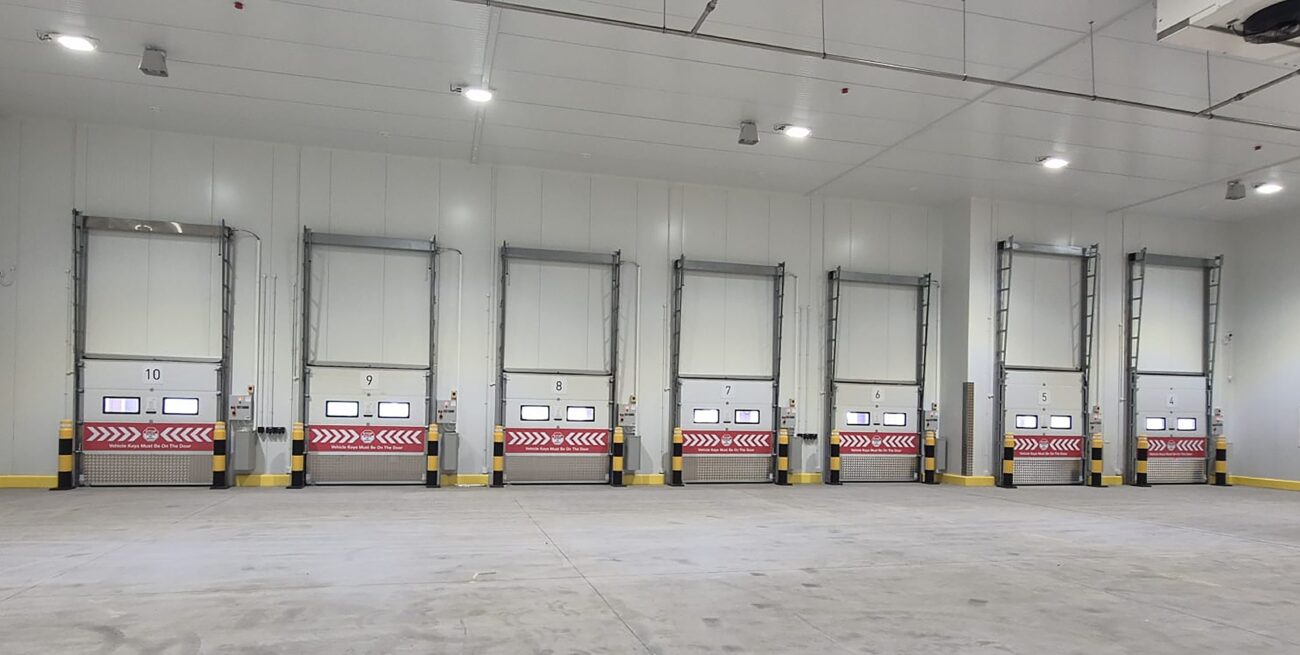
Internally, FBS Hörmann supplied and installed two Mavicold freezer doors and six Mavipass chiller doors to support temperature-controlled operations within the facility. The high-speed, isothermal Mavicold and Mavipass chiller doors are specifically designed for cold environments, using rapid stacking technology to reduce heat transfer and maintain cold chain integrity. Their robust, frost-resistant construction, combined with a range of safety and control options, ensures reliable, energy-efficient performance in demanding settings.
Well known within the industry, Maviflex joined the Hörmann Group in 2019. Since then, it has continued to expand its comprehensive portfolio of flexible high-speed doors for internal and external applications, engineered to provide rapid automated operation and advanced integrated safety features.
John Aitken, Managing Director of FBS Hörmann, commented:
“Our relationship with Bidfood has been built over many years on trust, performance and a shared commitment to operational excellence. We understand the specific demands of foodservice distribution, particularly within temperature-controlled environments, and the Worcester project demonstrates the value of close collaboration and a fully integrated approach.
The completion of this installation marks a significant milestone with now more than 100 Maviflex high-speed doors having been installed across the Bidfood estate. Many have completed over a million operating cycles, and they have proven to be a true workhorse in challenging environments, consistently delivering reliability alongside low maintenance and repair costs.”
With the installation now complete, FBS Hörmann will continue to support the Worcester depot through its comprehensive aftersales and maintenance services. Backed by an extensive stock holding, the company is well positioned to provide rapid access to replacement parts and fast-turnaround repairs, ensuring minimal downtime and continued operational efficiency.
DELIVER Europe, an invitation-only event for retail and supply chain leaders, has unveiled its full 2026 conference agenda, as its matchmaking platform officially goes live. This milestone marks the next phase in the countdown to the event, giving confirmed and prospective attendees early access to both the high level content programme and the opportunity to secure curated 1-2-1 meetings ahead of 3+4 June at Taets Event Park, Amsterdam.
The agenda features senior decision makers from some of the world’s most influential retail brands, including Amazon, ASOS, eBay, John Lewis and Nike, alongside leading voices from across logistics, supply chain and technology. Key speakers include Neha Singh, VP Global Supply Planning Transformation at Diageo, Erin Augustine, VP Global Sustainability at Oatly, Dane Percy, VP of Research and Development Petcare, Mars and Kirsty Keoghan, General Manager Fashion & Luxury EU at eBay, bringing retailer led insight to the forefront of the programme.
You can register to attend with this Logistics Business offer here. Our Editor, Peter MacLeod, will be attending again.
They are joined by a strong line-up of innovative solution providers and industry experts, reflecting the breadth and depth of the DELIVER network. Together, they will address the most pressing challenges and opportunities shaping the future of retail, supply chain and logistics, from artificial intelligence and sustainability to digital transformation and next-generation fulfilment.
Stéphane Tomczak, Founder and Chairman of DELIVER Europe, commented:
DELIVER Europe exists to connect the industry’s most influential decision-makers in a highly focused and efficient way. Our curated 1-2-1 meetings are at the heart of this experience — enabling meaningful, pre-qualified connections that drive real commercial outcomes. Combined with a world-class conference programme, this is where partnerships are built and business gets done.
With matchmaking now live, attendees can begin building their personalised meeting schedules, selecting the partners most relevant to their business needs. This curated, pre-arranged 1-2-1 format remains DELIVER’s core differentiator — ensuring every interaction is targeted, valuable and commercially focused.
Taking place in an exclusive, fully hosted environment, DELIVER Europe will bring together over 1,000 senior-level retail and supply chain decision makers, including C- and Director-level leaders, alongside more than 140 innovative suppliers. Attendance is strictly limited to ensure quality connections, high-level networking and a premium experience for all participants.
As anticipation builds, further speaker announcements and session highlights will be revealed in the lead up to the event. DELIVER has a global portfolio of events, including Europe (Amsterdam), America (Las Vegas), the Middle East (Dubai) and Asia (Singapore).
For more information on attending, exhibiting, or sponsoring, please click here
Are you prepared to take your logistics operations to the next level? In our latest episode, Jamie Spencer from Ocado shares insights into the future of fulfillment. Discover how to bring flexible, scalable automation that meets the ever-changing demands of the market.
In this episode, we explore how use of AI and Autonomous Mobile Robots (AMRs) is transforming logistics and aiding Flexible Fulfilment. Jamie discusses the importance of flexibility and scalability in fulfillment technology, highlighting how these innovations allow businesses to adapt quickly to market changes and consumer needs. Learn about the strategic use of data-driven insights to optimize operations and prevent costly overinvestments.
Why You Should Listen:
Enhance Efficiency: Explore how Ocado leverages AI and AMRs to create a responsive and efficient logistics ecosystem.
Smart Investments: Learn how to avoid costly overinvestments by adopting adaptable, data-driven solutions.
Success Stories: Be inspired by real-world examples of retailers who have transformed their operations with Ocado’s innovative technology.
This episode is essential for logistics professionals and retailers looking to stay competitive in a fast-evolving industry. Gain valuable insights that will help you future-proof your operations and exceed customer expectations.
Listen now to transform your fulfillment strategy and lead the way in logistics innovation!
From 5 October 2026, Spain will require a digital Documento de Control Administrativo (DCA) for commercial road freight transport. What was meant to have an effect for domestic transports and cabotage control only, will, in practice, also be relevant to much of the transit traffic passing through the country. Companies should take action now.
The Documento de Control Administrativo (DCA) is an administrative control instrument under Spanish transport law that, until now, was mandatory to be used paper form. However, a change in the law will make the digital version mandatory from October 2026. It is neither a ‘Spanish eCMR’ nor a consignment note in the contractual sense. It regulates neither liability nor the condition of the goods, but serves as an official control document. Nor should it be confused with the upcoming European eFTI regulation, which aims at structured data exchange between businesses and authorities. From October 2026, a paper copy of the DCA will no longer suffice.
“The DCA is not about a new digital data world, but about the digital replication of a paper-based process”, explains Dr. David Saive, Legal Product Owner at the Open Logistics Foundation. “Anyone who cannot provide the document digitally immediately will face an operational problem in future”.
Access on demand: QR code or reference number
A deciding factor is how the DCA is made available during an inspection. The Spanish approach is ‘view-by-request’: no structured interfaces with the authorities, but rather a document-based approach where an unstructured document must be provided on request. There are two ways to do this. In the first, a numerical reference is issued during the inspection, and the company makes a PDF version of the document available via the authorities’ portal. In the second method, the company registers a central server path in advance, and the driver then presents a QR code that leads directly to it. The key point is that access to the document must work immediately during an inspection, whether via a smartphone, a driver’s tablet, or a back office.
Covering the DCA with the eCMR
As the DCA is largely similar with the CMR consignment note in terms of content, a correctly implemented eCMR can functionally replace the DCA, provided that the requirements of the Resolución of 22 May 2023 – the Spanish implementing regulation for the digital DCA – are met.
The technical requirements depend on the method chosen. The following applies to both methods: the document must be in PDF/A format and accessible online. Those using the QR code method require not only the QR code on the document but also a domain registered in advance with the authorities. In addition, there are mandatory fields that many eCMR data models do not yet cover: registration numbers of the tractor unit and trailer, as well as any special transport permits where applicable.
Anyone who incorporates these requirements into the data model can use the eCMR functionally as a DCA, thereby avoiding parallel systems. “Digitalisation is not about recreating paper documents on a screen. It is about designing systems that replace multiple paper-based processes with one shared digital infrastructure.”, says Dr Saive. Building a separate system for every mandatory document does not solve a problem; it simply creates the next one. In the long term, this becomes expensive, error-prone and difficult to scale. Therefore, the changes in Spain should not be a reason to develop country-specific silo solutions, but rather to set up the eCMR so that national requirements can be seamlessly integrated. As a neutral and open source solution, the OLF-eCMR is designed precisely for this purpose.
Prepare now for what matters during inspections
For many foreign companies, the real hurdle lies not in creating the digital DCA but in accessing the Spanish platform. Foreign documentation is not always sufficient. The recommendation is therefore clear: check now whether your own processes cover the inspection requirement. Where is the document? Who can provide it immediately in an emergency? How can the driver quickly gain the right access? And who will handle the formalities with the Spanish authorities? In the end, only one thing matters: the carrier must be able to produce the necessary documentation during an inspection.
Interoperability paves the way for DCA and eFTI
Some view the Spanish DCA as a precursor to the upcoming eFTI regulation. However, the two requirements differ fundamentally. eFTI aims to facilitate structured data exchange between businesses and public authorities, whereas the DCA remains a document-based proof of inspection. For businesses, both systems may become relevant in parallel. This is precisely why it is worth choosing not the quickest solution, but the most adaptable one. Open source approaches such as the Open Logistics Foundation’s eCMR are designed for this purpose: open, interoperable, and extensible, so that every new regulatory requirement does not necessitate a new system.
Subscribe
Get notified about New Episodes of our Podcast, New Magazine Issues and stay updated with our Weekly Newsletter.
Add Logistics Business MediaGet faster access to news, podcasts, magazines and your saved content.