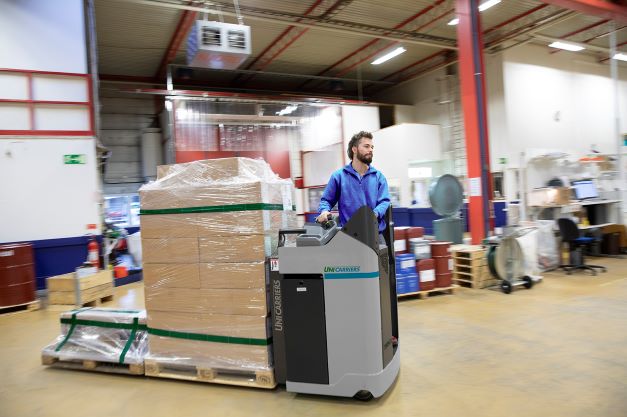
UniCarriers introduces next-generation low lifter

UniCarriers has launched a new generation of the ALR stand-in low lifter, now offering enhanced features in line with the highest standards of technology, quality and ergonomics.  Available in 2 and 3-tonne capacities, UniCarriers says the ALR is ideally suited to heavy-duty operations such as internal transportation and cross docking applications.

The compact ALR stand-in low lifter is specifically designed for use in confined warehouse spaces and allows for agile movement in areas where other pallet trucks may not fit. The operator is contained safely inside the compartment, helping to minimise risk of injury when working up and down narrow aisles near racking and pallets.

For flexibility, the ALR has a newly redesigned steering wheel that can be fully adjusted in both height and angle depending on the operator’s driving direction, and new ergonomic controls enable smooth, intuitive handling with less strain. While driving, the operator can maintain a comfortable position thanks to the optical presence control, which is an alternative to a pedal as it allows the operator to lift their foot without it causing the truck to brake.

The operator compartment has a low step for easy entry, and a dampened floor minimises vibrations to reduce fatigue – helping operators to stay alert and productive through long shifts. The advanced multi-functional display is easy to read and shows a variety of information, including driver settings, battery status and hour meter.

UniCarriers says it understands that every business and every application is different, which is why it works closely with customers to provide tailored products.  The ALR low lifter offers a range of optional features to allow customers to create a product package adapted to their needs. For example, customers can choose to add an overhead guard combined with a panoramic roof, or 360° steering for improved manoeuvrability.

If a task requires the truck to move with forks trailing, the Ergo Forks Trailing Control will allow the operator to face ahead whilst maintaining a completely unobstructed view.

Time is of the essence during fast-paced picking operations. The ALR has a powerful AC motor for high speeds, quicker accelerations and greater efficiency on jobs.  When it comes to motive power, multi-shift applications may benefit from a high-performance Li-ion battery option which offers fast opportunity charging.  But to ensure high availability at all times, UniCarriers believes it is essential that customers receive quality full-maintenance site support. The modular ALR is built using UniCarriers’ shared components concept, which enables its engineers to provide exceptional first-time-fix rates for maximum uptime.


EFFIMAT brings SINA to LogiMAT 2022

EFFIMAT is bringing its SINA automated solution to life once again together with its German partner Ecosphere Intralogistics at LogiMAT 2022 in Stuttgart.

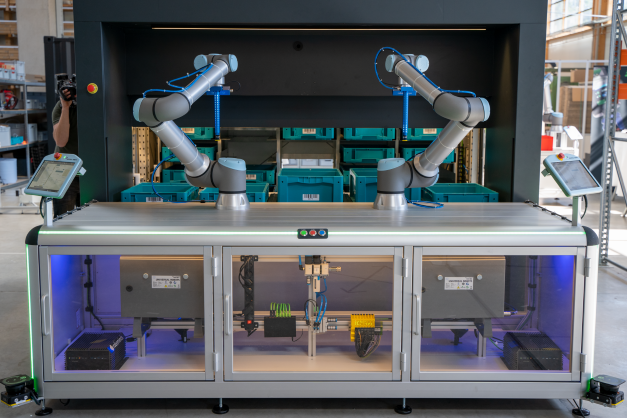
SINA – Smart kitting solution for Intralogstics Automation – a solution that automates the intralogistics and material handling processes, in for example production, from inbound to delivered kitted items directly at the production line.

The solution can also be applied to 3PL and e-commerce businesses by automating the order handling process. This makes companies able to operate flexibly 24/7 at a low picking cost.

SINA has its origin in EFFIMAT Automated which work with the thought of connecting various robotics solution, matching the customer’s needs. SINA became the result of eight partners coming together with some of the absolute best solutions within each of their product range and of course the knowledge of integration.

SINA is built around the EffiMat, which is a tote-based solution for storage and handling of items. The patented technology within the EffiMat ensures fast picking and the design allows picking processes to be more dynamic and efficient as five totes are presented in every picking cycle. This technology and design make EffiMat the optimal goods-to-robot solution.

Optimal components

To automate the picking and kitting process the most essential components was added. In the front the UR10e collaborative robot is placed to secure efficient picking. With its payload of 12.5kg and large reach of up to 1,300mm and high level of flexibility the UR10e is perfect for the SINA setup.

Attached to UR10e is the Piab MX suction cup. This suction cup is a real all-rounder and is ideal for holding all products, regardless of what material the product is made of or what surface and finish is has. To ensure picking accuracy the AI-based robobrain.vision from robominds has been added.

For safe transport of the kitted items to production line, the AMR MiR250 is used together with the TR125 top module from ROEQ. The top module can recognize and precisely control the loading station via its WLAN-independent optical measuring system.

To make the SINA solution safe, the sBOT nanoScan3 from SICK is mounted on the solution to ensure that the speed of the solution reduces the closer an employee comes to the solution and stops entirely if the employee comes too close.

The intelligence behind SINA

Every solution like this needs a software to connect all the pieces. EFFIMAT Connected was developed for this exact purpose. With a simple interface the software connects all components to the EffiMat, making it a complete and efficient solution.

If needed EFFIMAT connected can be integrated with the customers ERP system, which enables seamless kitting and order handling.

Ecosphere Intralogistics has been the integration partner on the SINA project. It has been taking care of everything from plugging in the components to testing and optimising the entire SINA Solution. Ecosphere Intralogistics will be the EFFIMAT partner in Germany, who will take care of sales of SINA in the German region.

At LogiMAT 2022 in Stuttgart, the eight partners are once again coming together and EFFIMAT will together with Ecosphere Intralogistics be showcasing SINA. You will find SINA in hall 5 at booth F60 where it will showcase how kitting can be handled. Further EFFIMAT and Ecosphere Intralogistics is bringing something new – an updated, even better SINA.


Human-centric design integral to logistics buildings

To mark the publishing of JLL’s report, ‘Logistics buildings of tomorrow: Labour challenges highlight the importance of human-centric design’, Lisa Graham (pictured), Head of EMEA Industrial & Logistics Research & Strategy, JLL, looks at the need to transform warehouse and distribution centres to attract and retain workers amid a labour shortage crisis.

Labour shortages are a growing challenge faced by businesses globally. This is particularly concerning for occupiers of logistics facilities, especially with heightened competition and growing online demand for goods. It is therefore vital that businesses consider how to stand out amongst competitors to attract and retain skilled employees whilst there is a dwindling labour supply.

JLL’s report, ‘Logistics buildings of tomorrow: Labour challenges highlight the importance of human-centric design’, delves into these challenges and pushes the envelope on warehouse and distribution human-centric design.

The research shines a light on the issues with existing logistics buildings, and the simple design considerations that can transform the wellness of workers and bolster the success of business drastically, therefore attracting the desired skilled labour force

The Problem

In the fallout of the Covid-induced lockdowns of 2020, labour shortages continue to be a primary concern and challenge for businesses across industries, who have been left struggling to find skilled labour to employ. As economic activity recovers and demand for goods surges, these shortages are causing bottlenecks across the supply chain. After contracting by 6% in 2020, the EU economy rebounded last year by 5.2% with the latest forecasts from the Oxford Economics showing continued strong growth of 3.8% in 2022.

With intensified competition for workers over the past two years and the take-up of warehouse space across Europe reaching record highs, demand is pushing greater requirements for labour. While the European logistics market revealed strong levels of demand before the pandemic, in 2020 the take-up for floorspace jumped to 16% and the strong dynamic has been confirmed in 2021, in reaching a new record (34 million sq. m., +35% YoY). The scarcity of labour is one of the most challenging issues facing companies and a key factor influencing a company’s choice of warehouse location,

Large e-fulfilment centres, which operate 24 hours a day, are a significant contributor to the strain on worker levels. Labour intensive due to the speed and intensity of operations and range of tasks that need to be performed,  e-fulfilment centres put a strain on already shrinking labour pools, exacerbated further by an accelerated shift to online shopping during the pandemic.

Post-pandemic, accounting for a higher share of total retail sales, e-commerce is expected to continue to grow and expand to a greater number of product sectors. Therefore, it is vital that e-fulfilment centres transform to attract and retain workers to efficiently meet this growing demand.

The importance of worker engagement in human-centric design

Logistics buildings that support worker wellbeing, whilst also being operationally efficient and environmentally sustainable, are more likely to help companies build and retain their workforces. Integrating wellness features and nurturing employee welfare is crucial if businesses want to stand out in an increasingly competitive market.

In recent years, the term ‘human-centric’ design has gained traction across the property industry, as awareness of worker wellbeing has increased. The term refers to buildings that put people at the centre of the design process. Typically, human-centric design has been more widely adopted in the office sector than within logistics, but now leading develops are now also starting to promote the concept.

To foster this culture of wellness, logistics buildings should incorporate natural lighting, improved air ventilation, and ‘soft’ features which help to increase worker productivity. Soft features like green plants, thermal comfort, sound, the use of materials to brighten interior spaces, more break areas both inside and outside the facility, and accessible design can all contribute to a more enjoyable working environment.

Beyond helping companies provide a wellness environment for their workers in a competitive labour market, human-centric design also provides evidence to developers, corporate occupies and investors that social and environmental considerations are a core priority for the business.

The road ahead

Going forward; occupiers, developers, and investors will need to take advice from experts on the design considerations and locations of logistics buildings to facilitate an understanding of human-centric design.

Through the promotion of worker wellbeing, human-centric buildings have great appeal to both workers and investors alike.

CLICK HERE to read the full report.

GS Yuasa provides schools with outdoor wear

Pupils up and down the country were treated to a new set of outdoor clothing thanks to GS Yuasa and The Waterproof and Wellies Project after the leading battery manufacturer became an official donator to the newly founded campaign.

Set up by Gina Bradbury Fox and launched by TV presenter Gemma Hunt from CBeebies in March 2021, The Waterproof and Wellies project is part of The Outdoor Guide Foundation. It aims to raise £5m to provide ten sets of high-quality outdoors kit, consisting of a waterproof jacket, trousers and welly boots to every state primary school across the country over the next six years.

The idea behind the thoughtful initiative is to see children from all backgrounds getting outside and enjoying the natural wonders that are around them and enabling them to learn about and enjoy the outdoors.

The donation from GS Yuasa covered four schools across England. These included Harlow Green School in Gateshead, Wilburton Primary School in Cambridgeshire, St. Denys Infant School in Leicestershire, and Headfield Junior School in West Yorkshire.

Jon Pritchard, General Sales and Marketing Manager – Auto, MC and Ind Comp Division at GS Yuasa Battery Sales UK Ltd, said: “We’re delighted to offer our support to The Waterproofs and Wellies campaign. This fantastic initiative absolutely coincides with our values as a business and we are pleased that our support is helping to get children outside and develop their knowledge of the natural world around them.”

Gina Bradbury Fox, Managing Director of The Outdoor Guide Foundation added: “We can’t thank GS Yuasa enough for their generous contribution towards the project. Lack of access to weatherproof clothing is a real barrier for children engaging in outdoor learning. These kits allow children to jump in puddles, roll around in the mud and kick through leaves without messing up their school uniform.

“Having the support of a global business such as GS Yuasa means so much to us. They are a company willing to go the extra mile and help give back to the community. Without companies like them we wouldn’t be able to do what we do, so their incredible generosity is greatly appreciated.”

GS Yuasa is a leading battery manufacturer for vehicle and industrial batteries.


Fast modular flow sorting system from FATH

FATH Components has announced the arrival of its Flowsort automated diverting units, said to herald a new era of affordable, flexible sorting in conveying, handling and logistics

As the intralogistics industry continues to expand at pace, one of the challenges faced by conveyor line designers and systems integrators – never mind the customers themselves – is where to pitch a plant design or upgrade in terms of its capacity. Overly ambitious predictions can cost lots of money with valuable equipment purchased, installed and maintained whether it is used or not and overly cautious planning can strangle a rapidly growing business at a critically early point in its growth. With the arrival of its new Flowsort products, FATH states that it can help customers solve the dilemma by offering a new solution which is affordable, simple to install and set up, and can grow easily as a business expands.

Flowsort is a modular sorting and diverting product that has been designed from the outset to provide users in the intralogistics business with that most elusive combination of advantages – the benefits of speed, low investment cost, low running costs and scaleability.

“Some think of Flowsort as a ‘Pay as you go’ solution for users who need to invest in greater throughput only when the demand actually increases,” says FATH UK Managing Director David Hayes. “Flowsort helps obviate the need to second guess growth rates by allowing users to purchase and install additional conveying and diverting capacity only when they actually need it. And when they do, Flowsort installation is swift and straightforward.”

The company, based in Aldershot, UK reckons that for every mammoth intralogisitics centre in the UK there are many smaller, more localised or specialised sorting centres that are much more difficult to design processing and handling systems for. It is these users that FATH says it is targeting with Flowsort because put simply, it allows an intralogistics business to start sensibly and grow smoothly with an affordable, flexible solution that is fully modular and is also – critically – a simple ‘Plug and play’ system too.

Unlike many alternative solutions, Flowsort is an open platform in terms of both software and hardware integration: it means that Flowsort modules can be seamlessly incorporated into a wide range of belt or roller conveying systems. They can be added swiftly and effortlessly says FATH, thanks to the simplicity and range of units offered. Further, the fact that Flowsort can be retrofitted and introduced into existing lines at almost any point (and without interrupting productivity) is cited as another key advantage.

Designed and manufactured in Holland, Flowsort modules can be combined in a variety of ways to offer gentle package diverting in conveyor systems with widths between 400mm and 1050mm. FATH states that the footprint of the Flowsort modules is minimal, so users benefit from higher performance conveying and sorting without taking up significant floorspace. Further, because the Flowsort units run on 24V, energy efficiency is also high, helping users be more productive whilst using less power.

Three types of standard Flowsort diverting units are offered, Single Line Diverters (SLD), Double Line Diverters (DLD) and ZigZag Diverters (ZZ). Because the units are modular, users can expand throughput capacity quickly, easily and cost efficiently by simply adding extra modules as demand increases. The Flowsort rollers can rotate through 180° in just 0.3/sec, allowing a completely customisable outfeed direction. FATH claims a sorting rate of up to 6,000 PPH for the units, which can safely handle boxes, packages or envelopes of between 50g and 35kg.

DB Schenker opens sustainable terminal in Finland

DB Schenker has opened a new, highly sustainable cargo terminal in Finland for the Tampere region. With this terminal, which is located in nearby Lempäälä, DB Schenker is significantly expanding its green distribution services in Finland. Five fully electric trucks will soon begin operating in Lempäälä and serve Tampere’s city centre. Except in winter, the energy needed to recharge the vehicles in the fleet will be provided by the company’s own solar power plant.

“The new Tampere terminal underscores our leadership role in making logistics more and more environmentally friendly,” says Cyrille Bonjean, Head of Land Transportation for DB Schenker Region Europe. “The fact that we actually produce our own solar energy for the fleet in Lempäälä makes our case even more compelling.”

The solar power plant at the terminal has a surface area of 1,750 sq m, a rated output of 250kWp, and an estimated annual yield of 200MWh. The terminal building will also use geothermal energy and other sustainable solutions such as green asphalt, LED lighting, and airtight loading docks. In addition, DB Schenker has become a climate partner of the Tampere region for the establishment of a carbon-neutral Tampere.

“Pirkanmaa is the second largest region in Finland and home to one out of every ten Finns,” says Petteri Nurmi, CEO of Schenker Oy. “With this larger terminal, the regional capital Tampere will now play an increasingly important role in DB Schenker’s network, as we will be able to grow with our customers and offer more versatile logistics solutions. Pirkanmaa has long been a strong region for us in terms of warehousing, and we are now exploring a hub-type operating model for domestic and European transport at the terminal in Lempäälä.”

The terminal will combine operations from Tampere and Hämeenlinna. It has a total area of nearly 18,000 sq m, with 12,000 sq m of heated space and 3,900 sq m of unheated loading space in an outdoor hall. The new facility employs approximately 340 people, including those who work for the carriers.


Faster fashion fulfilment

Challenged by poor labour availability, how will fashion fulfilment cope with a return of footfall to the UK high street and growing omni-channel sales? Darcy de Thierry, Managing Director of Ferag UK, believes advanced pouch sorter technology holds the answer.

Successful fashion retailing is all about maximising margin, growing sales volume and getting faster throughput. But for the last two years, omni-channel businesses have, by necessity, had to rely on their ecommerce channels for survival. The strain on fulfilment centres has been enormous, particularly as ‘single’ and ‘few’ item picking and packing operations are traditionally highly labour intensive activities – and labour has become a scarce and costly resource, leading to concerns over performance during critical peak periods.

Now that consumers are returning to the high street, how can businesses re-balance their fulfilment operations to cope with growth and higher throughput across all channels, and at the same time contain costs to maximise margins?

In addition to the challenges of finding labour, the National Living Wage is set to rise from £8.91 to £9.50 per hour in April 2022, coinciding with a hike in National Insurance of 1.25p in the pound for both employers and employees.

With operational costs rising and fewer people available to carry out manual picking operations, many retail fashion businesses are turning to the use of automation to boost the productivity of their labour force. Automation applied to the right processes can free up people for tasks that require human ingenuity, judgement and manual dexterity – tasks such as packing and inspecting returns.

Advanced technology

An innovative technology helping to transform operational performance in the fulfilment centre, freeing-up human resources for value-adding activities, is the pouch sorter. Overhead pouch sortation systems offer a flexible and highly scalable, conveying, sorting and dynamic buffering solution appropriate for both fulfilling ecommerce orders and assembling store friendly sequenced replenishment. One pouch system is capable of sorting and processing many thousands of orders an hour, with each pouch able to carry both hanging garments and flat items, such as shoes and flat pack goods, enabling fast order fulfilment from a single pool of inventory.

Creating a single pool of inventory from which store replenishment and ecommerce orders are served offers significant financial and operational benefits. Efficiencies in accessing available stock, greater flexibility in allocating stock to maximise sales and faster processing times for preparing orders, are just some of the key advantages.

In particular, pouch technology lends itself to ecommerce operations, allowing for greater wave picking efficiency, with late order cut-offs of around 10pm for a promise of delivery to the customer first-thing the next day. The speed and reliability of Skyfall, Ferag’s ultra-fast automated pouch sorter solution, enables the retailer to gain greater operational efficiencies by accumulating orders in advance of a final pick-wave at 10pm. With processing speeds of up to 25,000 units per hour orders can be picked, sorted, packed and dispatched within the shortest time window, giving fashion brands the keen competitive edge of a late cut-off with an early next day delivery.

For consumers fast, reliable fulfilment and delivery is often a decisive factor when purchasing a fashion item and a positive experience is likely to result in repeat sales and recommendations on social media. However, a late delivery of a party dress has the potential to cause great distress and may lead to negative reviews, with the loss of future sales, so a reliable fulfilment process is essential. Of course, pick accuracy is important too, as a mispicked item is likely to be disappointing for the customer, as well as costly to the business. However, automation enables exceptionally high pick accuracy.

Store friendly sequencing

As stated earlier, the same high-speed Skyfall pouch sorter system used for fulfilling ecommerce orders can also be deployed to create store friendly sequenced consignments for high-street shops – pulling from the same, pooled inventory. The benefit of sequencing product for a particular store’s layout is that the shop assistant assigned to replenishing shelves and rails is able to perform the task quickly and efficiently, freeing them to spend more time with customers – potentially, to secure more sales.

An obvious advantage of a high-speed pouch solution, such as Ferag’s Skyfall, is that it uses available overhead space – the third dimension of the building – keeping floor areas free for pedestrians and other processes. What’s more, pouch systems are a highly cost-effective alternative to other forms of goods-to-person automation, like multi-shuttle and mini-load solutions, that can cost up to 30% more. Then there is the core benefit that the Skyfall overhead pouch system undertakes high-speed sorting, conveying and buffering processes too, which with Ferag’s modular conveyor technology allows for tremendous flexibility and scalability. And as the pouch has the ability to carry flat items, such as shoes, and flat pack goods along with hanging items, there is no need to have a separate cross-belt sorter for flat items, with all the issues associated with bringing flat and hanging items together.

Leaders in fashion

A number of leading fashion brands are taking advantage of pouch sorter technology to increase capacity and boost performance of their fulfilment operations. Ferag has recently installed a flexible high-speed Skyfall system at a new distribution centre for children’s fashion company, Mayoral Group, in Malaga, Spain. The extensive overhead pouch solution is one of the largest to date, with a mix of hanging pouches and garment hangers totalling more than 58,000 Skyfall hangers, and a throughput of up to 12,000 units per hour. The system features fully automatic unloading of pouches, including flat goods.

Ferag has developed an advanced automated induction process where pouches automatically open at an induction station, the operator scans a product, passes it down a chute and it drops into the awaiting pouch. The process is fast and efficient.

Similarly, Ferag has also introduced auto-unloading technology with three levels of performance depending upon product characteristics and gentle handling requirements. Contingent on the items, between 1500 and 2200 orders per hour can be automatically unloaded from pouches at packing stations. Driving performance, the rate at which orders are presented at the packing station can determine the pace of packing.

Interestingly, when comparing traditional goods-to-person operations, where you may have six to twelve open orders at the packing station, with a pouch system there can be a hundred or more open orders, simply by keeping them in a dynamic buffer near to the packing station. Items can quickly be called from the buffer as required, providing greater flexibility and speed.

Faster returns

When it comes to the fast processing of returns, overhead dynamic buffers can offer a cutting-edge solution to removing the time, cost and effort of placing returned items back into stock. Manually sorting and placing items back into stock is a very time consuming and costly process, but now it can be avoided. For high-demand fashion products, keeping returned items in a buffer close to the packing area enables a quick and efficient re-despatch of the item. In fact, some retailers anticipate and predict levels of returns, allowing them to re-sell items even before they are returned to the warehouse. Such techniques help boost sales and increase margins.

Of course, reliability is absolutely critical for any automated system. Failure to perform at peak or during critical promotional periods can result in unfulfilled SLAs and dissatisfied customers, which in turn may damage both sales and, importantly, brand. Businesses looking to invest in overhead pouch sortation systems should look very carefully at the quality of the engineering, materials and components used. Only ultra-low friction components should be considered and plastic chains should be avoided. Good design and sound engineering bring long-lasting rewards.

Ferag’s Swiss-engineered pouch sorter technology was originally developed for some of the most testing of handling applications, the international print industry, where super-fast overhead conveyors are required to offer ultra-reliable performance on daily newspaper production runs in the millions. The same materials, technology and design expertise has been successfully applied by Ferag within the intralogistics sector, bringing reliable, high-performance conveying at speeds of up to 25,000 units per hour to fashion businesses the world over.

 

GKN chooses AR Racking for Spanish plant

GKN Ayra Servicio, a subsidiary of the global leader in propulsion systems GKN Automotive, has chosen the storage systems specialist AR Racking as the industrial racking supplier for the warehouse at its plant in Carcastillo (Navarre, Spain).

With its headquarters in Birmingham (England), the multinational GKN has made a strategic investment in its factory in Navarre to become a leading plant in spare parts for automotive transmission systems in Europe, and to triple its sales in the short term. GKN therefore turned to AR Racking to install industrial racking to achieve a logistics operation that would maximise warehouse efficiency.

AR Racking has installed a combination of several storage systems adapted to the different volumes and rotation of products that GKN works with at the Carcastillo plant.

The pallet load will be stored on very narrow aisle (VNA) racking, with a storage capacity of up to 5,696 pallets. This system is an adaptation of the adjustable pallet racking system, but compacted by the narrowing of the work aisles, which creates a high-density storage system that helps to increase the warehouse capacity but without expanding the space.

For the manual storage of GKN’s smaller spare parts and for their handling using picking solutions, AR Racking has installed 2164.5 linear metres of longspan shelving. It is very versatile racking that adapts to all types of unit loads and that facilitates access to products stored directly and immediately. In addition, for long and higher volume loads, AR Racking has implemented a solution with cantilever racking that covers a total of 166.5 linear metres. It is a system that offers excellent goods handling mobility.

AR Racking has also installed a mezzanine floor on two levels for a light shelving warehouse. The mezzanine floor covers a total of 1,809 sq m and is a storage solution that helps increase useful area at height.

“AR Racking’s storage systems meet the strictest European quality standards. What’s more, equipping the warehouse just as we had planned proved to be an agile and smooth process,” stated Pablo Hernando, GKN Project Manager.

Xabier Rica, AR Racking Sales Representative and project manager, added: “We are convinced that GKN will be able to achieve greater competitiveness with the industrial racking installed and therefore improve its logistics operations.”

CLICK HERE to watch the video


Active Ants to open UK fulfilment centre

Active Ants, a subsidiary of the bpost group, will open its fifth fulfilment centre in September 2022. The newest facility is located in Northampton, England and is owned by M&G Real Estate, the property investment arm of M&G plc.

After operating two successful sites in the Netherlands, Active Ants has expanded into Belgium and Germany in recent years. “Active Ants wants to be the best fulfilment company in Europe”, says Co-founder and Managing Partner Jeroen Dekker. “We are delighted that our arrival in the UK will further increase our presence in Europe and we believe we are moving into one of the most exciting online markets.

“With our strong focus on innovation and automation, we offer tailor-made business-to-consumer (B2C) logistics for (SME) web shops. We are convinced that this will create superior value for our customers.”

Founded in 2010 with the idea of making e-fulfilment more accurate and efficient through innovation, automation and working with robots, Active Ants has since grown into one of the larger players in the Netherlands with over 250 customers and more than five million orders per year.

Northampton is situated in the heart of England. The Brackmills Industrial Estate is the centre of e-commerce logistics in the United Kingdom. Dekker comments: “This combination makes it the perfect location for our e-fulfilment activities. We will be close to our customers and have good connections with last-mile distributors.

“In our search for the right location and the right building, it was important for us to find a building that fulfilled our mission and values. The ‘outstanding’ BREEAM certification of the Brackmills Estate means that the building performs at the highest environmental level, which fits perfectly with our sustainable – and highly automated – way of working. Active Ants is committed to sustainable relationships with all its stakeholders: customers, employees and the community.”

Michael Wood, Portfolio Director at M&G Real Estate, comments: “With this scheme, M&G is delivering on its commitment to providing high quality, ESG-led schemes which meet the exacting requirements of modern occupiers, and we are delighted to be welcoming an innovative international operator with this significant pre-let.”

“Storage, order picking, packaging and sorting are also fully automated in this brand new fulfilment centre,” says Dekker. “For order picking, employees work efficiently together with robots. The receipt of goods and the return flow remain manual processes. This mechanisation ensures efficiency, high quality and a pleasant working environment for our employees. The set-up is unique in the world.”

Warehouse with AutoStore

The basis of this warehouse is the Autostore, a unique system where goods are stored very compactly in bins. On top of the AutoStore is a framework of rails, on which robots ride. By means of intelligent software, a robot knows exactly which bin to take to the employees at the picking stations. Autonomous Mobile Robots (AMRs) bring empty boxes to the employee who fills them with goods delivered by the storage robots.

The innovative AutoStore solution takes up six times less space than in a traditional warehouse. This goods-to-man system has a very low footprint. The system stores up to six times more stock per square metre, and the robots reuse their own energy, so electrical consumption is minimal.

The carrier robots drive to various packing machines which select the ideal size boxes and close them to size – weighing them and providing a shipping label, so that no padding material is needed. As a result, Active Ants transports on average 40% less air to the customer. This also allows it to transport more packages in a truck and reduce its CO2 emissions even further.

Once filled, closed and printed, the carrier robots pick up the parcels and sort them out to their respective carriers.

Also in Northampton, Active Ants‘ specially developed box-closing machines with built-in printer will be used. Dekker says: ”This allows every customer to get their own custom-printed box. Through this unique functionality, we enable large, but now also smaller webshops, to offer customised packaging. Keeping pre-printed boxes in stock is no longer necessary. This saves our customers costs and also reduces their footprint.”


Logistics company commits to Hams Hall

Prologis, one of the UK’s leading developers of logistics property, has agreed a 10-year lease for a new 131,780 sq ft unit, currently under construction at Prologis Park Hams Hall. Birmingham-based logistics and distribution company LTS Global Solutions will be moving into DC3, which is due for completion in the summer, as part of its ambitious expansion plans.

LTS Global Solutions, advised by Gerald Eve, provides a comprehensive range of services within logistics, transport and shipping worldwide. It is partnered with some of the world’s major shipping line and airlines to facilitate the provision of bespoke supply chain solutions which include storage, Just In Time delivery and international freight forwarding.

Like all new Prologis UK buildings, DC3 at Prologis Park Hams Hall will meet the highest standards of sustainability and is planned to meet net zero carbon emissions in construction. Additionally, the building will aim to be BREEAM ‘Excellent’ as well as achieving an EPC A rating.

Located only 10 miles from Birmingham City Centre and 1 mile from Junction 9 of the M42, Prologis Park Hams Hall is already home to Jaguar Land Rover’s Battery Assembly Centre and is often described as one of the leading manufacturing and logistics locations in the UK. The wider Hams Hall park also features an on-site rail freight terminal and is home to global brands such as BMW, Sainsburys and DHL.

Tom Price, capital deployment and leasing director at Prologis UK, commented: “Welcoming LTS Global Solutions as one of our newest customers is testament to the growing demand for prime logistics real estate space right now – and the business will certainly be in good company at Prologis Park Hams Hall.

“Dave and his team have growth in their sights and we’re extremely proud that we’ve been able to provide a high quality facility in a prime location that will allow the business’ expansion plans to come to life.”

Dave Hands, managing director at LTS Global Solutions, adds: “Moving into the new unit at Hams Hall signifies an exciting time for us. It’s been a pleasure working with the Prologis team and we can’t wait to move in and push on with our plans to expand our operations further.”

John Sambrooks, Partner for Gerald Eve, said: “The successful lease of Ham Hall illustrates the continued demand for well-located, high-spec industrial facilities. Its strategic location, combined with LTS Global Solutions’ track record of industrial supply chain solutions, makes this an attractive dynamic for the company’s significant expansion plans. We’re delighted to have secured the premises for LTS, and look forward to seeing the company grow over the coming years.”


Subscribe

Get notified about New Episodes of our Podcast, New Magazine Issues and stay updated with our Weekly Newsletter.