Space and Speed at Scale

Ecommerce in Europe is expected to be worth €717 billion at the end of 2020. Distribution warehouses and fulfilment centres need to be ready, says an emerging player in the space, writes Paul Hamblin.

In the race for bigger market share, e-commerce companies are opening more locations across Europe. At the same time, offline businesses are increasing their online presence. It follows that the fulfilment centres of today need to get ready to meet increasing demand, not only from online and offline shops but also from the person at the end of the line, the e-commerce consumer.

According to Hristo Urumov, owner of Sofia-based storage technology and material handling specialist STAMH, this is going to be tricky for some DCs unless their managers make changes,
because many are going to receive more orders per day than they can physically fulfil. “Already, a typical online customer is likely to fill their check-out cart with more than one item per online order and it’s a fair bet that they will expect their new purchases to arrive within two days, at most, of making that order,” he points out. “And guess what – they don’t care where the fulfilment centre is located.”

It’s not just the number of online shops that is growing either. The total of items in each product line to be stored and distributed is on the rise, too. Warehouses need to accommodate a growing list of inventory, in some cases without switching location. Businesses know all too well that customer satisfaction is essential to success in the online space, which means a well functioning fulfilment and logistics centre is a vital piece of the jigsaw. Limited picking, sorting and logistics capacity can prevent business expansion because fulfilment centres simply can’t meet the demand.
E-commerce businesses need to act in order to get ready for the upcoming growth.

“There are two ways to grow – to expand the range of products offered or to enter new markets,” says Hristo Urumov. “It’s better to do both.” To solve the puzzle, growing e-commerce business can opt for 3PL or scalable automation solutions to stay in control, he says.

“Outsourcing the problem means losing control over the quality of the fulfilment process,” he argues. “If you use a 3PL, it actually means handing over the satisfaction and retention of your hard-won customers. The ability to affect and control your service to your customers is outsourced to a new partner and you are relying completely on that partner.” STAMH’s owner predicted several years ago that the next step in warehouse development would lie in the refinement of picking automation as a way to meet growing demand and to boost a DC’s capacity to prepare new orders.

He recognises that full automation can be an expensive solution. “In this context, scalable automated modules may be the answer to the growing demand,” he points out. “The engineering solutions of modern warehouses offer space optimisation and picking automation at a speed step by step and hand in hand with the growth of your business.”

STAMH’s engineering team already knows that the modularity of these solutions offer businesses the possibility to make scalable investments, according their optimisation needs. “A lot of companies are opting for partial automaton. They proceed to a full solution only when they actually see the results,” he says. Successful automated e-commerce solutions need to offer space
optimisation, productivity and 100 % picking accuracy, he argues. “They are here to stay and can offer e-commerce business the possibility to break though the wall of growing demand.”
Mates in Mind Support Employee Mental Health

Palletways, an Imperial Group company and one of Europe’s largest and fastest-growing express palletised freight networks, has partnered with Mates in Mind, a UK charity that helps organisations improve their workforces’ mental health.

Mates in Mind was established in 2017 to address mental ill health in the construction sector and more recently, has partnered with an increasing number of logistic and transport companies. They specialise in providing training and support for staff and employers to raise awareness, improve understanding and address the stigma that surrounds mental health.

Over the next month, Mates in Mind will run nationally accredited Mental Health First Aid training with participants from all Palletways’ sites across the UK. The two organisations have also carried out an all-staff mental health survey and are in the process of implementing a three-year wellbeing strategy to improve Palletways’ mental health provision and better support all employees.

Rob Gittins, Palletways’ UK managing director, said: “This year has been incredibly challenging for everyone, and we recognise the impact it has had on our employees’. The mental health and wellbeing of our employees is of paramount importance and that is why we are committed to investing in our staff. Our new partnership with Mates in Mind is an important step in providing extra support and training to our employees. We want to create a cultural shift where mental health is viewed on a par with physical health in our business.”

Martin Lockham, growth development manager at Mates in Mind, added, “We are delighted to welcome Palletways as a supporter of our charity at Mates in Mind. Three in five employees experience mental health issues because of work and this needs to change. As we all navigate the pandemic and the changes it has brought, and continues to bring to our lives, it has never been more important to raise awareness, improve understanding of and support our workforces by develop a culture of openness on this subject. By working with us to develop their own mental health programme, Palletways has shown the kind of progressive leadership that acknowledges that employee mental wellbeing should be at the forefront of organisational health and the future of the wider transport and logistics sector.”

Brexit Supply Chain Management

A provider of bespoke business services has announced the launch of a Brexit support package that will assist the management of supply chains and support companies whose staff travel to work across the EU.

Jigsaw Business Group – headquartered in the North East of England – has already in its 25 years of business carved a reputation for providing bespoke business services and transforming supply chains for global brands across Rail, Automotive, Renewables and many other STEM manufacturing Industries.

The business – over the last nine months – has applied these skills to develop a Brexit roadmap that will support manufacturing and operational locations across the EU with both supply chain management and, particularly, the movement of staff and recruitment.

This includes:
• A confirmed pool of in country EU contract staff across all 27 member countries
• An established pool of UK staff who have Frontier Worker status
• A country by country EU requirements matrix that identifies what is needed by citizens of UK Businesses to work in the EU
• Patented secure monitoring technology that allows clients to remotely see and verify, in real time, what is happening in supply chains, enabling fact driven discussion and action planning to transform the way companies collaborate and manage their supply chains.

Speaking about the company’s preparedness for Brexit, Executive Chairman of Jigsaw Business Group, Dean Stennett said: “Brexit in whatever form, will place additional administrative burdens on any UK business importing or exporting product and where staff need to work across the EU.

“Combine this with the recent impact of Covid-19, and we have witnessed a fragility to the modern supply chain like never before seen. Manufacturing businesses are now looking to design smarter, stronger and more diverse supply chains where a balance of near shoring, lower cost manufacturing, and digitization are seen as being key to building more robust supply chains and ensuring a lasting recovery. With more than 25 years’ experience supporting the management of client supply chains across the EU and Asia, Jigsaw Business Group can offer the same support to those companies now affected by the Brexit transition. We have spent more than nine months at Jigsaw Business Group preparing for all options when it comes to the end of the Brexit transition and, be it a Hard or Soft Brexit, we are making sure we can support our clients and other businesses through this transition,” added Stennett.

And, the company’s planning and innovation doesn’t stop there. The company’s recent launch of its unique patented technology – Jigsawsafe® – has seen Jigsaw Business Group take the market by storm with the first product of its type designed to support teams to collaborate remotely, gather and store data and safely enabling teams across various global locations to be onsite from their desk.

“As part of our nine-month Brexit planning we were already well underway with the development of Jigsawsafe® as part of our efforts to drive down costs, reduce response times, increase staff safety, limit carbon emissions and eliminate supply chain fragility for our clients,” Stennett continued. “Recent world events have accelerated the development of and demand for Jigsawsafe® as companies across the globe look to transform their supply chain strategies and keep their workers safe.”

Jigsaw Business Group is a leading provider of business services, delivering supply chain management, business improvement, recruitment and training and development services. The company specialises in working with clients in a range of sectors from rail, automotive and energy through to aerospace, manufacturing, engineering and retail. The business works in full accordance with all industry best practice standards including being certified to ISO9001:2015 across all its service areas.

New Electric Piggyback Truck Launched

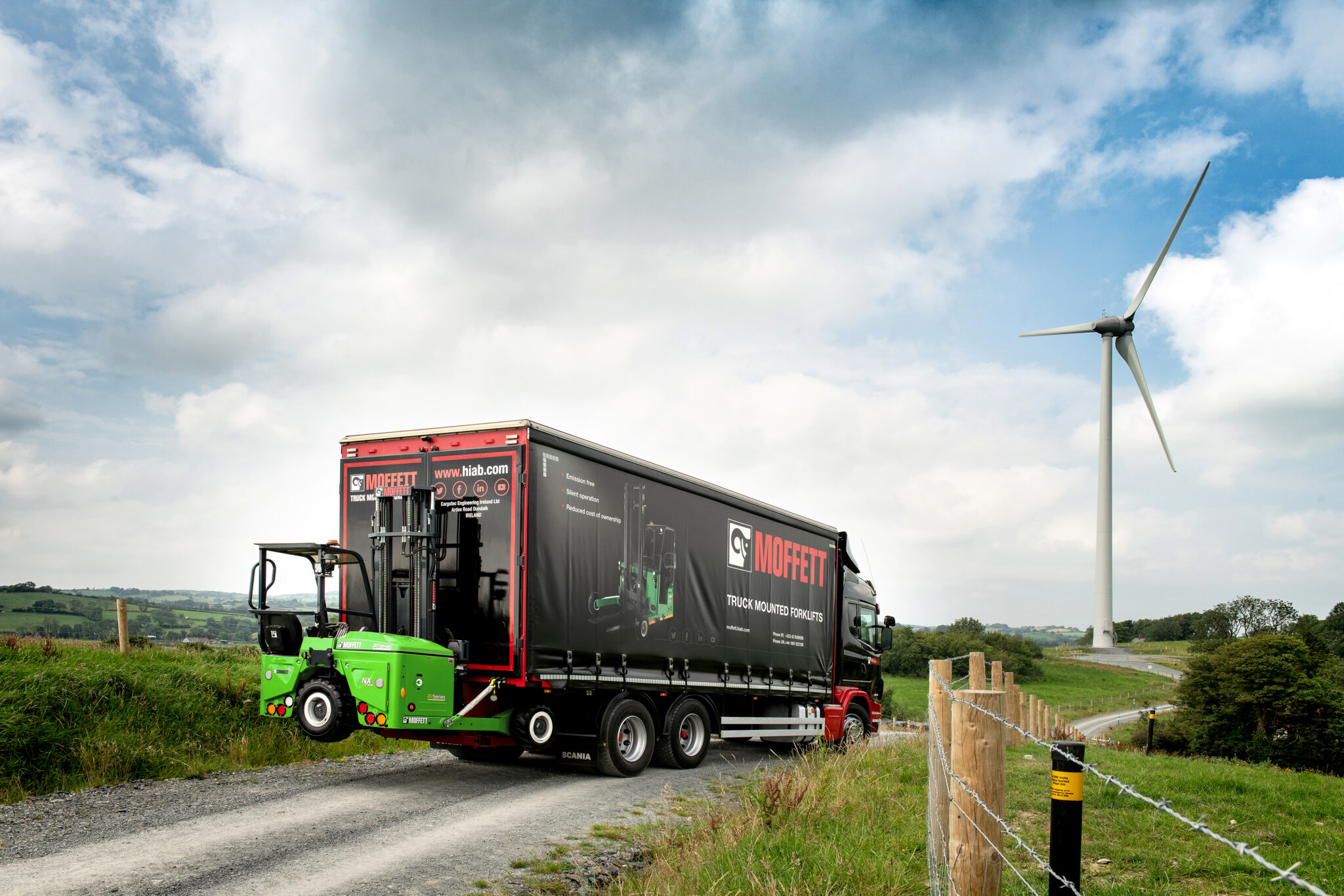
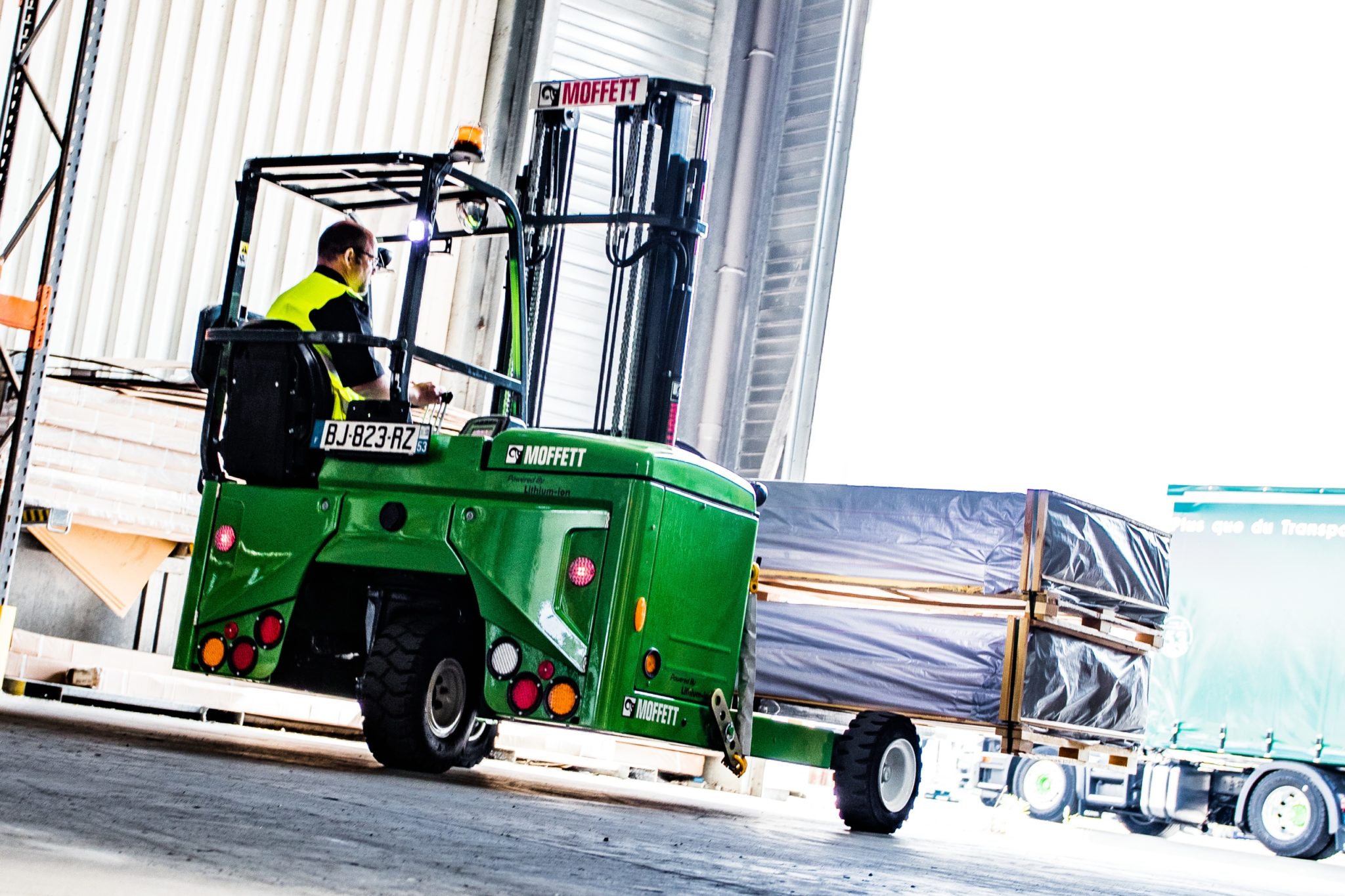
Hiab, part of Cargotec, launches the MOFFETT E4 NX, its next generation eSeries of electric forklifts and the world’s first all electric 3-wheel drive truck mounted forklift. Inside the chassis of a MOFFETT M4, Hiab has constructed a zero-emission truck mounted forklift powered by lithium ion batteries with new controllers and the new HMI (Human Machine Interface) that displays battery capacity, machine performance and service information. The MOFFETT can be charged from a regular household socket or a 30 amp socket for faster charging, as well as from the truck in between deliveries.

The new MOFFETT eSeries, currently available in four E4 NX models with more being added, is not only beneficial to the environment as it has zero emissions, it is also much more comfortable and safer for the operator as it is virtually silent and has less vibrations than a diesel powered truck. The low noise means it can be operated without earplugs allowing the driver to both see and hear danger. It can also be operated at night-time and deliver the cargo inside warehouses.

The total cost of ownership is lower than the equivalent diesel model as it can be electrically charged and has reduced service costs. It is engineered with fewer moving parts, which reduces service time and spare parts costs.

“The MOFFETT eSeries is the natural choice for customers who need to enter low emissions zones, work at night or meet sustainability targets. However, as it’s cheaper to run, safer and more comfortable, we think it will prove popular with customers in a wide range of industries. We are certain that drivers will appreciate working in an exhaust free environment and being able to hear what is happening around them,” says Jann Hansen, Director, Sales & Product Business Management, Truck Mounted Forklift, Hiab.

The MOFFETT eSeries have in-built connectivity so that owners can access Hiab’s HiConnect™. HiConnect monitors over 100 machine parameters. Some are displayed on the HMI while the full range of data are available from the HiConnect web portal. Parameters range from battery capacity to delivery route and time, driver safety and service notifications.

Rethinking ASRS and Robots

Rethinking automated storage and retrieval systems is the challenge that Rob Sullivan, President and CEO of AutoGuide, has laid down for the industry. David Priestman joined him online to
learn more.

AutoGuide Mobile Robots designs, develops and manufactures high-payload industrial autonomous mobile robots (AMRs) for assembly, warehousing and distribution operations. The company has a mobile robot R&D centre located in Chelmsford, Massachusetts, and a manufacturing facility in Georgetown, Kentucky and was acquired by Teradyne last November. European
production is coming shortly.

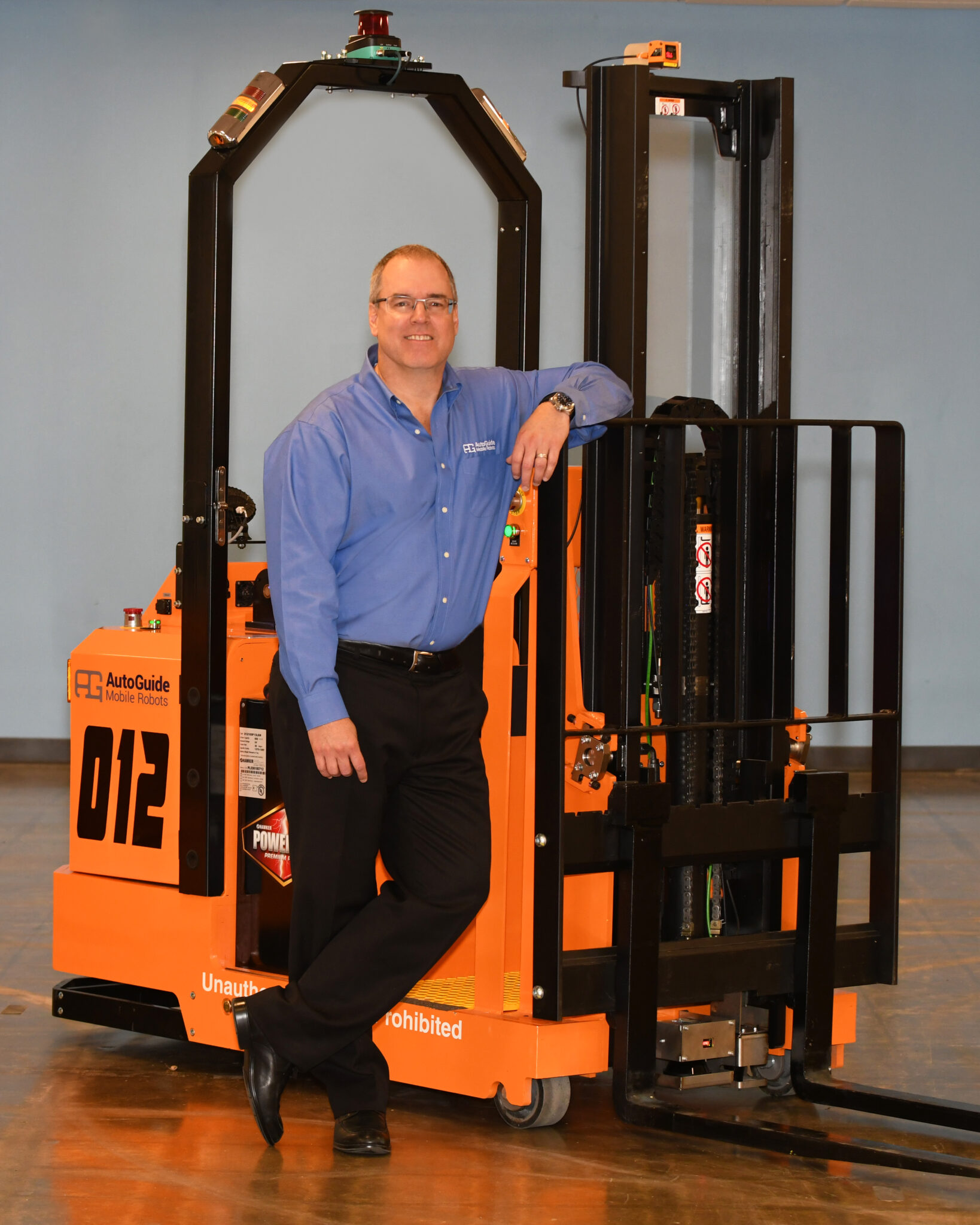
Covid is driving ecommerce and next day delivery, leading to increased expectations. AutoGuide has launched what it claims is the first fully autonomous mobile robot designed to automate racking and picking operations at high bay warehouses, competing with traditional stacker cranes in pallet storage aisles. The new ‘MAX-N High Bay’ is an autonomous counterbalanced forklift that can travel up to 4 mph and lift 1000kg payloads up to 11m high.

The MAX-N High Bay works seamlessly with existing warehouse infrastructure so there’s no need to invest in new racking systems or pallets, and installation can be complete in weeks. Like all AutoGuide AMRs, the MAX-N High Bay exceeds safety standards and travels along a network of approved, predictable paths to decrease workplace risk for employees in shared workspaces. Using ‘SurePath Enterprise’ software, it receives data from existing order management and warehouse management systems and can be quickly deployed to complete a wide array of high bay operations. SurePath Enterprise defines the most efficient route for each job.

Rob Sullivan points out that traditional high bay operations can be complex and potentially dangerous. “Autonomous solutions increase efficiencies and keep both employees and products safe, providing an excellent return on investment in high-bay environments. Labour costs are more than half of distribution centre budgets. Adding space is difficult.”

The MAX-N High Bay is part of AutoGuide’s patent-pending modular AMR system designed to maximize fleet flexibility and uptime. The Max-N High Bay is one of multiple high-payload adapters designed to fit the MAX-N Base AMR. With a change of adapters, the base AMR is converted from a high-bay forklift to a pallet stacker or tow tractor. In addition, AutoGuide claims to be the only manufacturer that engineers and builds AMRs from the ground up to be fully autonomous, high performance material transport robots. The majority of robotic solutions are retrofitted manual vehicles, built from parts supplied by various vendors.

With inventory management software, the MAX-N High Bay becomes part of the new AutoGuide Mobile ASRS. The inventory management software connects with facility WMS and inventory
management applications to keep track of facility inventory, manage finished goods or WIP inventories; speed reconciliation; and provide daily cycle counting digitally.

“As part of the new AutoGuide Mobile ASRS, our autonomous MAX-N High Bay can safely and efficiently transport materials from the receiving dock directly to the storage racks without the need for conveyor systems or other inflexible material handling infrastructure,” Sullivan says. “When connected to detailed, facility-wide inventory awareness, the MAX-N High Bay can get material exactly where it belongs. It’s time for ASRS to be untethered, autonomous and accessible for all warehouse facilities. With our Mobile ASRS, what used to be automated and heavy is now
autonomous and light. Mobile ASRS can be rolled out in a matter of weeks and bring autonomous efficiency to smaller footprints across the facility floor.”

Large, high-revenue facilities that move thousands of pallets a day have increasingly installed ASRS solutions with proprietary racks, custom pallets and massive cranes. Smaller facilities that move less inventory recognize the efficiencies offered by ASRS but have been unable to justify the high-cost and time-consuming deployment. Customers can start flexibly with just 5% automation
with mobile ASRS, combined with existing racking and work up from there. AutoGuide AMRs bring facility-wide freedom to automation strategies, so facility managers do not have to restrict
storage and retrieval operations to specific, crane-only zones.

“Human error in inventory management is both common and costly and automating manual vehicles is suboptimal,” Sullivan concluded. “Mobile ASRS is best-in-class. Digital inventory
control helps eliminate storage and retrieval errors.” Read the whole article here.

New Packaging Process that is over 99% Plastic-Free

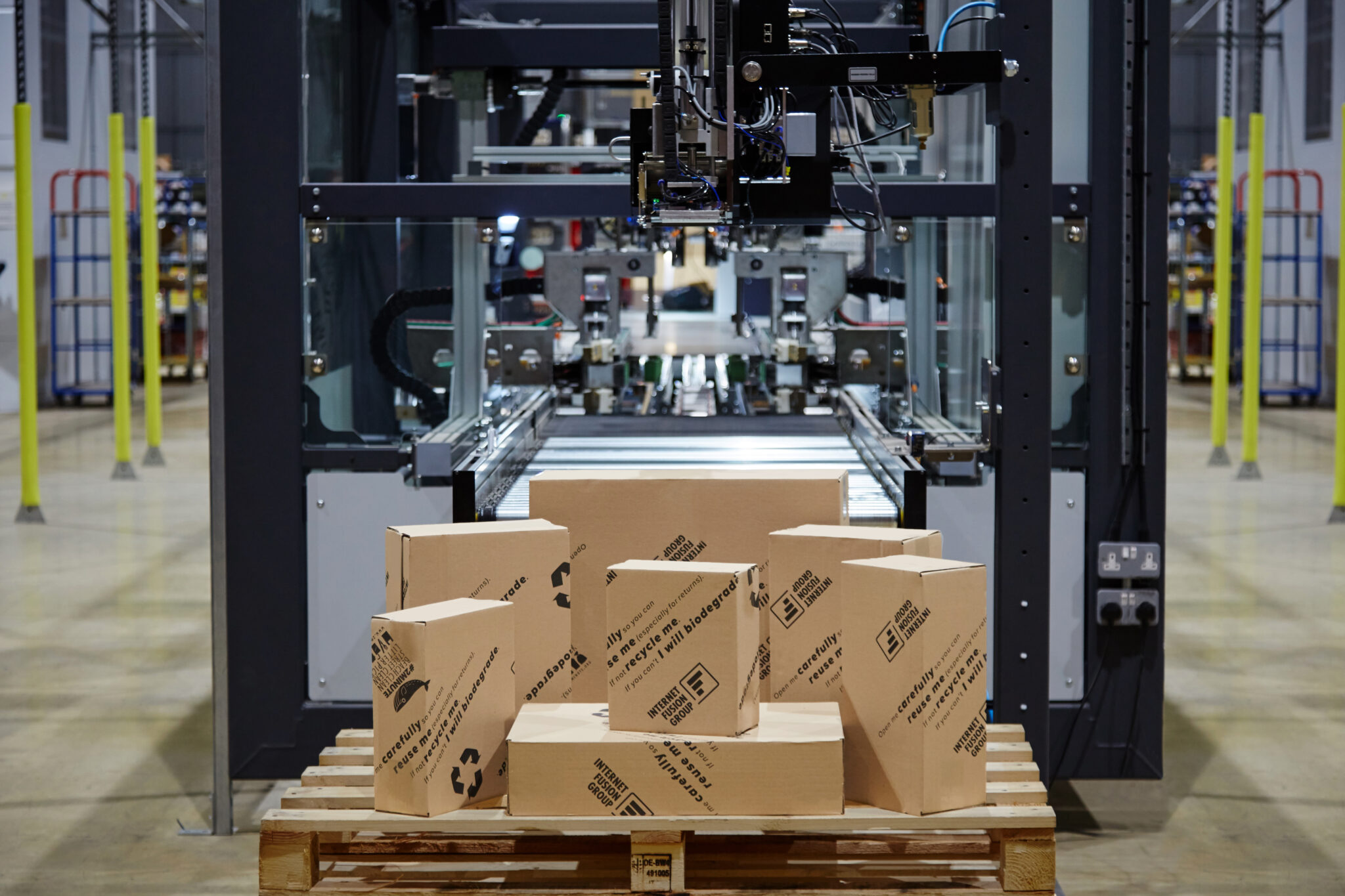
E-commerce retailer Internet Fusion Group has created a sustainable packaging process that is over 99% plastic-free. Investments in two Quadient CVP-500 automated packaging machines and switching to Corrugated Fanfold material from Ribble Packaging, have aided with their pursuit of an environmentally sustainable right size packaging process.

To highlight the full extent of their achievements, Internet Fusion have released a report investigating the environmental effects of paper-based packaging versus plastic packaging products. The report explores the full manufacturing process of both paper and plastic packaging, through to the recyclability and long-term environmental effects once a package has reached its destination. Head of Sustainability at Internet Fusion, Adam Hall said; “Our customers are tired of plastic pollution, and we are tired of the justifications being put forward for continued plastic production in the middle of a marine plastic crisis. When you dig a little deeper these arguments simply don’t stack up, so we felt it was time to share the decision-making process that has led us to our packaging being over 99% plastic-free. Our customers choose us because of our environmental efforts and in turn, we choose Ribble for the same reasons – it’s partnerships such as these that can shift a whole industry towards a more sustainable future.”

Right Size packaging specialists Ribble Packaging supply Internet Fusion with over 75% of their packaging material in the form of Corrugated Fanfold board, a versatile fully recycled and recyclable cardboard product that feeds many of the leading automated packaging systems in the UK.

Stephen Rector, Managing Director of Ribble Packaging, commented on Internet Fusion’s success: “It is fantastic to see that Ribble products are helping our customers in creating more environmentally sustainable packaging processes. We also see the need to improve our in-house operations to make them more sustainable.”

Earlier this year, Ribble embarked on a project to make their operations carbon neutral. Stephen added; “We understand the need to focus on the effects our manufacturing process has on the environment, this has led to us embarking on a carbon-neutral project that will see us embrace new sustainable technologies and practices. Our products allow customers to create a more sustainable packaging process, but we can enhance these benefits by offering a carbon-neutral manufacturing process as well.”

Are your pallets “Brexit Ready?”

 When the United Kingdom leaves the European Union on 1 January 2021, import and export companies fear that trade to the former member of the EU and back may no longer function smoothly. The reason that they are citing for this, is a lack of IPPC-compliant wooden packaging and pallets, which from 1 January 2021 must be treated according to ISPM 15 for transport to and from the United Kingdom.

The ISPM 15 standard has been compulsory for the international movement of goods outside of the EU since 2002 to protect native woodlands from pests. For goods transport inside the EU, the treatment is not obligatory. For import to a third country, compliance with the standard is rigorously checked upon arrival and if a load carrier has not been treated the whole cargo will be refused entry. From 1 January 2021 the United Kingdom will be considered to be a third country and for goods transport, wooden pallets at all borders to and in the United Kingdom will be checked for compliance with the ISPM 15 standard.

The ISPM 15 standard requires the treatment of solid wood with an approved measure. This is achieved on all EPAL pallets by heat treatment (HT) in a drying chamber. This is recognisable through the branding of the central block with the IPPC marking and the licensee’s IPPC permit number as well as the abbreviation, HT. These markings may only be used by operations which are registered with the responsible phytosanitary authorities.

EPAL wooden pallets are treated in accordance with the ISPM 15 standard making them suitable for the unrestricted movement of goods outside the EU.

According to the company’s technical regulations, it has been compulsory for all EPAL pallets to be treated in accordance with ISPM 15 during production since 2010. For repairs, EPAL requires that its licensees use new wood and furthermore obliges repair operations to observe the national ISPM 15 regulations.

For more news about the logistics industry and the impact Brexit will have, sign up for our magazine and newsletters here.


BEUMER Group wins Chairman’s Manufacturing Performance Award 2020

With its AFR Systems (Alternative Fuels and Raw Materials) business unit, BEUMER Group supports cement producers in feeding calciners and main burners with alternative fuels and raw materials. The system provider develops complete solutions for efficient handling of different materials. The Portland Cement Association (PCA) has now named BEUMER Group as a winner of the renowned Chairman’s Manufacturing Performance Award 2020.

 The production of cement has always been one of the most energy-intensive operations. In order to avoid expensive primary fuels such as carbon, gas and oil, and to produce cement in a more economic and sustainable way, many factories have relied on alternative fuels for the incineration process in the calciner for several years. These include waste tyres, rubber chips, plastic or other oleaginous mineral materials as well as processed industry/household waste. With its AFR Systems business unit, BEUMER Group supports cement manufacturers with extensive know-how and customised systems. With this capability, it is able to supply and install the whole chain from acceptance and unloading of the delivery vehicle up to the storing, conveying and feeding process of the solid alternative fuels for the specific user. The customer receives everything from one source, thus having a unique contact. The system provider has now been honoured for this with the Chairman’s Manufacturing Performance Award 2020, presented by the Portland Cement Association (PCA), a leading organisation in the cement industry. “I am very honoured to receive this recognition on behalf of BEUMER Group,” said Brian Giese, BEUMER Corporation Director of Business Development, Conveying & Loading. “It demonstrates our commitment to support cement manufacturers in their efforts to make production greener and more sustainable.”


Founded in 1916, the PCA is the premier policy, research, education, and market intelligence organization serving America’s cement manufacturers. The award recognises achievements in three areas, the development of innovative products, unique processes, and best-in class-practices, and was presented to three companies this year.

Multi-million-pound Battery Partnership brings Greener Outlook

Hyperdrive Innovation, the UK’s leading designer and manufacturer of lithium-ion battery technology, today announces a new multi-million-pound 4-year supply agreement with Moffett, part of Hiab and world leading forklift truck manufacturer, to supply state-of-the-art battery packs for zero-emission machinery.

The supply agreement, worth more than £500,000 in the first year alone, will initially see hundreds of high-performance battery packs deployed in Moffett’s fully electric truck-mounted forklifts. The partnership will instil clean, electric technology into the operational heart of hundreds of organisations worldwide, including well-known British brands Pets at Home and Topps Tiles.

Orders for the world’s first fully electric Lithium-ion powered truck-mounted forklift – the Moffett E-Series – have grown significantly since its release in 2013. With the support of Hyperdrive, Moffett aims to meet this increasing demand by growing its fully electric fleet six-fold by 2030 to around 30% of all vehicles produced.

Jann Hansen, Sales Director Moffett said: “Customer demand for cleaner, quieter and more sustainable equipment is growing like never before. Our partnership with Hyperdrive allows us to cater to this demand, without compromising the world-beating performance and trusted reliability expected from all our equipment. Going electric offers countless operational advantages for our customers and we’re excited to be leading the industry in this space.”

The near silent drivetrains of Moffett’s electric forklifts allow operations to continue out of traditional working hours and enables night-time deliveries for Moffett’s customers – a significant advantage to operational efficiency. The lack of exhaust pollution also means that the same machinery can be used for both outdoor and indoor applications. This means drivers can unload and load delivery trucks and stock warehouses without switching between electric and diesel vehicles – ideal for warehousing and distribution settings.

There are also significant fuel and maintenance savings associated with Moffett’s fully electric forklifts, with total ownership costs for Moffett’s E-series approximately 20% lower than diesel equivalents. Diesel powered forklift trucks typically produce more than 18 tonnes of carbon emissions per 1,500 hours of operation. Moffett estimates that its fully electric forklifts can achieve a carbon emission reduction of 75%, providing a significant boost to companies’ green credentials. Steve Travis, Transport Manager at Pets at Home said: “Fully electric forklifts give us the potential to significantly improve our operating costs, while at the same time minimizing the environmental impact to neighbours of our stores.”

Hyperdrive’s modular battery packs were chosen due to their top of the range energy density and modularity, allowing flexibility and straightforward application in a number of different machines. This opens up the possibility of deploying fully electric equipment across a variety of different settings, including warehousing, distribution and logistics, materials handling, and construction.

The news comes just weeks after a European-wide report – which included views from experts from Wilmott Dixson, Innovate UK, Colas Group, and NCC – forecast rapid growth in demand for cleaner and quieter electrified equipment over the next decade to meet emission targets and ‘build back better’ following the COVID-19 pandemic. The construction industry is responsible for 40% of European carbon emissions, making it an urgent priority for decarbonisation to meet net zero targets.

Stephen Irish, Commercial Director of Hyperdrive Innovation said: “Electrification will be central to the decarbonisation of heavy industry and it’s no surprise that demand for cleaner electrified equipment is booming. Our partnerships with forward thinking companies such as Moffett will help meet the massively growing demand for electrified solutions and support the delivery of a more sustainable future.”

Wholesaler Doubles Output with Robotic Logistics

The leading wholesaler in the Swiss organic market, Bio Partner, has doubled its output following the implementation of innovative robotic logistics from Swisslog at its facility in Aargau, Switzerland.

Bio Partner supplies business customers in the organic specialist trade as well as the rest of the retail and food industry from its location in Seon. As a result of the merger with Somona GmbH, the warehouse reached its performance and capacity limits, and the wholesaler turned to a local partner with a global footprint to deliver an automated storage system.

The 12,200m2 warehouse handles 10,000+ products, a process now optimized thanks to the high-performance AutoStore storage solution, delivered by global warehouse automation specialist, Swisslog, a member of the KUKA group.

“Companies with large warehouses have to constantly work on increasing efficiency and our robot systems work flawlessly around the clock,” says Swisslog CEO, Dr. Christian Baur. The aim of this new system from Swisslog is to automate the storage and picking of the dry assortment and to compress it in terms of volume.

Consistently high performance

The new AutoStore system at Bio Partner has 44 robots with the ability to handle 25,000 containers and at least 6,000 products completely autonomously. “The high-tech robots create a volume of 900 containers per hour and, depending on the development, this system can still be expanded considerably,” says CEO, Dr. Baur.
The orders are automatically transmitted to the AutoStore system and processed in accordance with parallel processes, which is a huge advantage in large warehouses. This means that higher volumes can be made available in a shorter time. Picking errors cost time and money, and robots don’t make mistakes since the hardware and software work together perfectly. Bio Partner relies on the modular warehouse management software SynQ from Swisslog to orchestrate the warehouse and picking processes based on data-based insights.

“Our company relies on long-term, sustainable partnerships. With Swisslog, we found a strong local partner and the system installation was quick and easy,” commented Lukas Mettler, head of warehouse logistics at Bio Partner.

As a leading global integrator with over 200 realized projects, this is just one example of many projects which showcase the wide implementation spectrum of AutoStore empowered by Swisslog.

Subscribe

Get notified about New Episodes of our Podcast, New Magazine Issues and stay updated with our Weekly Newsletter.