24/7 Endurance Doors

A Bavarian body component manufacturer has installed doors which close at 1.8m per second, every 30 seconds, 24 hours a day, 7 days a week.

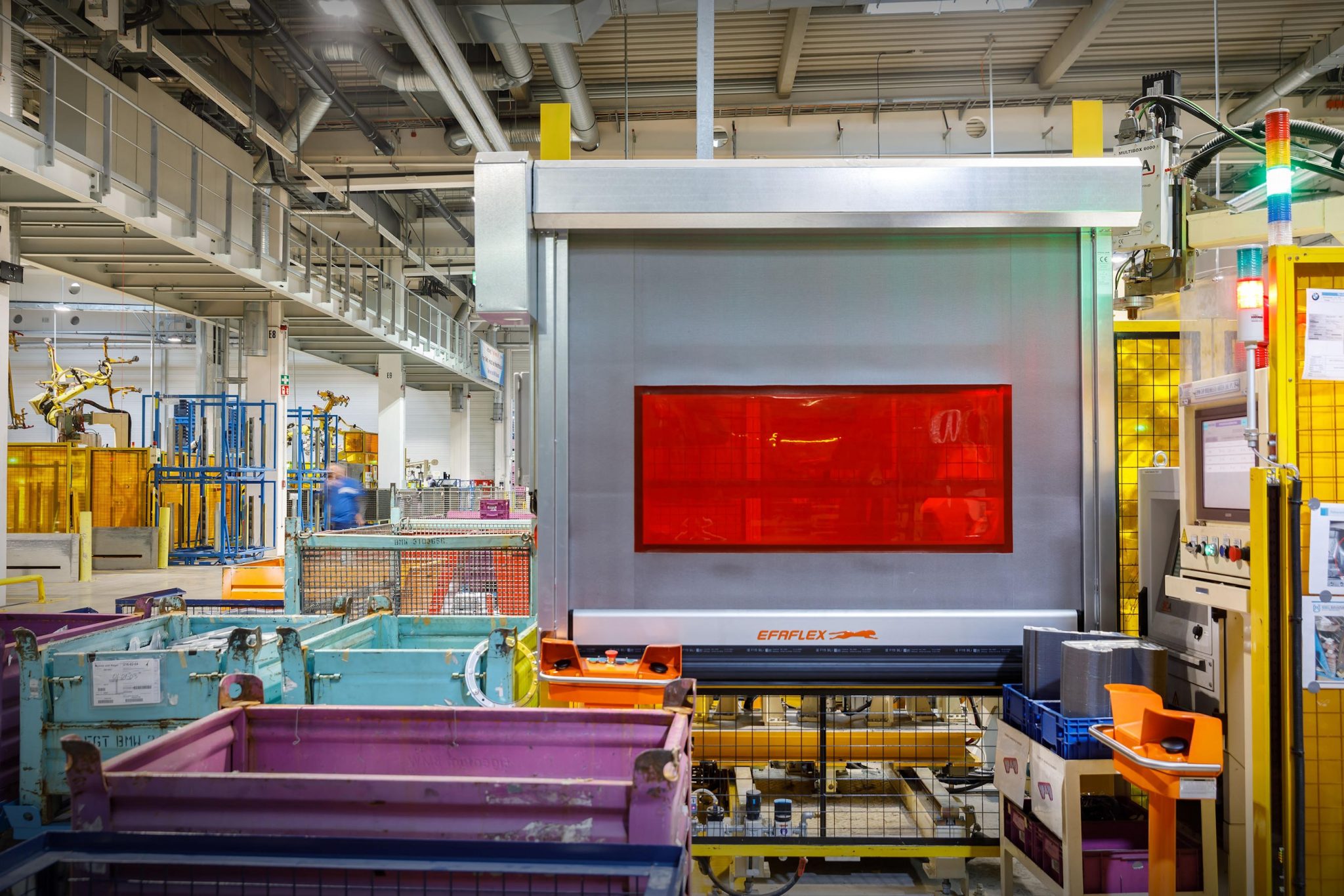
The EFA-SRT® MS machine protection doors from Efaflex open and close at a speed of up to 1.8 metres per second every 30 seconds, 24 hours a day, seven days a week at the new WMU
Bavaria GmbH plant in the town of Niederaichbach, Bavaria, to be fully reorganised under robotic lines by 2022.

Efaflex, the world market leader in the field of industrial high-speed doors, has developed door systems that are not only equipped with all conceivable safety features but can also be used as
EC type-examined safety components as per Machinery Directive 2006 / 42 / EC. Automotive component specialist WMU Bavaria benefited from this development when setting up the new plant. With 18 doors having successfully passed their two-month continuous load test, WMU Bavaria ordered 22 more machine protection doors. A total of 40 door systems have now been in operation to protect employees since the beginning of April. Many of the EFA-SRT® MS are equipped with a flame-retardant door hanging and an optional UV protection window for special application in front of the welding cabins.

Due to their space-saving, self-contained design, the machine protection doors from Efaflex can be adapted perfectly to the required protective devices. They stand out due to their extraordinary resilience and stability. The standard EFA-SRT® MS door leaf is fully transparent and equipped with warning strips as standard. Coloured, highly tear-resistant and transversely stable curtains are also available without any problems. All curtain versions are free from substances that interfere with the lacquering process.

The interplay between a high performance frequency inverter controller and a functionally adapted drive makes the high cycle rate of up to seven cycles per minute possible in production processes. Because of the lack of a weight counter-balance mechanism, the side frames are very slim; thus, the maintenance work and spare parts required are reduced significantly. The doors are designed for 250,000 load cycles per year.

A transparent cover provides a clear view of the integrated safety end-limit switch of cat. 4 / Pl »e« according to DIN EN ISO 13849-1. Thanks to optional floor supports, the safety devices can be installed as a stand-alone system. Uneven ground is compensated by levelling screws. Like almost all products from the world market leader, these door systems can also be perfectly integrated into fully automated processes and highly intelligent systems, which does, however, also require great flexibility on the part of the manufacturer for assembly: the machine protection doors were installed between Friday evening and Sunday, i.e. outside production times, to ensure that production could run smoothly during the week.

Efaflex designs, manufactures, installs and services high-speed doors for industrial and commercial applications. Founded in 1974, the company supplies to clients including food processing, manufacturing, clean room, cold store and the chemical, pharmaceutical sectors. As the only manufacturer of high-speed industrial doors, Efaflex has been entered into the world market leader index and is one of the 461 top companies in Germany, Austria and Switzerland. The privately-owned company has more than 1,200 employees worldwide.

Software to Support Distribution of Covid Vaccines

Huge logistical efforts are needed to for the distribution Covid vaccines worldwide. The vaccine doses have to be kept constantly refrigerated, which makes the challenges even greater. At Frankfurt Airport (FRA), Fraport has increased the number of its cold storage dollies for transporting temperature-sensitive pharmaceutical cargo. The software of the refrigeration control system has also been improved.

INFORM GmbH, a leading global provider of intelligent optimization solutions for airlines, airports and ground handlers, supports the security of the cold chains of these thermal transports. The fleet of now 20 thermo vehicles has a computerized control of the refrigeration. Special dialogs have now been built into the existing software, through which the driver can recognize the temperatures to be maintained, check them, and electronically document exact compliance. The solution thus makes an important contribution to the unbroken cold chain. “The upcoming distribution of vaccines will be a mammoth task that will tie up our capacities for many months,” says Stefan Reiss, Senior Operation Manager, Fraport. “The safety and reliability of the transport is our top priority. So, it’s only natural that we improve our existing systems once again.”

The modification of the existing cargo transport system was specifically commissioned with the safety of the upcoming vaccine transports in mind and was implemented on short notice. “The INFORM and Fraport teams worked together in a very coordinated manner,” Reiss said. “The fast and flexible approach allowed us to go live within a few days. Our partner, INFORM, responded quickly here and supported the specification process with their expertise.” The software changes now make it possible to document quality assurance even better. In addition, the system generates the aspects of preparation for other thermal units, such as heating up or cooling down the units in time, so that then they already have the required temperatures during transport.

The new dollies are called “Cool Box”. They enable temperature-sensitive products to be transported with pinpoint accuracy within a range of minus 20 to plus 30 degrees Celsius. Each transporter consists of two cabins that can be efficiently accessed from both sides. Each cabin is also equipped with an individual controllable cooling system. Even with the engine off and an outside temperature of 30 degrees Celsius, one cabin maintains the desired temperature for more than 60 minutes. The transporters continuously transmit up-to-date information on the load via an electronic temperature monitoring and tracking system.

Transport Operator Adopts new ‘Co-Driver’

Ambroise Bouvier Transports, based in St Pierre des Landes, is taking full advantage of the new version of the Co-Driver application. A long-time user of AddSecure’s fleet management solutions since 2014, Ambroise Bouvier now benefits from the the updated Co-Driver application, deployed since March 2020.

A multi-activity company with five agencies specializing in full-load transport, pallet collection and distribution, cold transport, transport management, and logistics, Ambroise Bouvier has 420 vehicles connected via the Co-Driver application. The migration from the old AddSecure solution to Co-Driver has enabled the company to upgrade and benefit from new technical and operational functionalities.

“Via a more reliable and high-performance on-board device, Co-Driver offers better truck positioning accuracy, which enables more efficient driver guidance, as well as better network coverage with fewer ” blank zones ” and more reliable real-time data feedback,” says Yves Le Bourdoulous, the Information Systems Manager at Ambroise Bouvier Transports. “The system is operating successfully and has received strong support from our teams and drivers. Co-Driver provides vehicle tracking with timeline analysis of a journey, driver name and driving times. The dispatcher keeps track of all the resources on the same tool. This makes it possible to generate very good scores for the connected trucks.”

Benefits from the new Co-Driver version:

Drivers now use the Co-Driver application on smartphones. They have easy access to their personal data (driving and rest times), messages from the dispatcher, and their eco-driving score. The eco-driving index, set up with the AddSecure team, is based on the analysis of indicators (overspeed, idling, harsh braking, rollout and coasting). Co-Driver also provides information on empty kilometers and CO2 emissions. The human resources department retrieves on D+1 the legal files of the vehicles and drivers in order to establish salaries and calculate fees. Previously, the time limit for collecting the legal files was 7 days.

With Co-Driver, fleet managers and the workshop service can control the connectivity of the onboard computers, and get the mileage performed. This data simplifies the follow-up of maintenance to prevent breakdowns, and ensures good connectivity is maintained.

“Thanks to the fleet’s connectivity and geo-location, Co-Driver offers a real-time vision of the available resources and makes it possible to adapt and harmonize the workflows. The application’s interface has been improved to offer better performance and integrates new functionalities. The AddSecure solution is particularly simple and fast to deploy with an average installation time of 30 to 45 minutes per vehicle, depending on the brand. We also benefit from AddSecure’s excellent assistance and the daily support of the project manager,” continues Yves Le Bourdoulous.

In the near future, Ambroise Bouvier Transports will deploy the advanced fees calculation and salary administration functionalities. And an interface with their TMS software is going to be implemented to send mission data and roadmaps directly to the drivers’ smartphone application.

New European Office for Mobile Robots Supplier

AutoGuide Mobile Robots, a leading manufacturer of high-payload autonomous mobile robot (AMR) systems, today announced the opening of a new European office. The office in Munich supports sales, service and support, as well as deployment and training, throughout greater Europe. Local staff will work closely with its European system integrators to meet increasing demand for AutoGuide’s innovative autonomous mobile robots.

“With strong demand for our high-payload AMRs across the region, we felt expanding our European operation would deliver the highest level of support for our distributors and customers,” said Jan Nicolay, director for European Operations, AutoGuide. “Munich’s highly talented and efficient workforce, business-friendly climate and central location made it the ideal choice.”

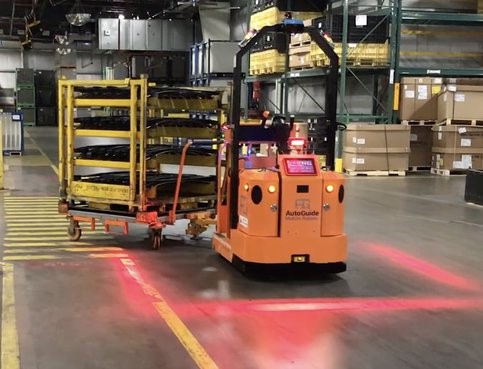
AutoGuide’s patent-pending modular AMR system begins with a MAX-N Base AMR, which is guided by the company’s SurePath fleet control software, designed to maximize fleet flexibility and uptime. With a change of high-payload adapters, the base robot can easily be converted from a pallet stacker to a tugger or high bay forklift—and back again. Earlier this year, AutoGuide’s MAX-N Pallet Stacker and MAX-N Tugger received CE mark approval, indicating that the systems meet the European Union’s directives and standards for health, safety and environmental protection.

“The CE mark indicates our AMRs have met the strictest levels of safety and compliance required by the European Union,” Nicolay said. “Facility operators can easily deploy our AMRs to autonomously manage their dirty, dull and dangerous material handling jobs, freeing up workers to focus on higher-value tasks.”

Increase Output with Automated Labelling

Save up to 5 minutes per label print job: Automate labelling to remove intermediate exports or data retyping from your production process.

Are you retyping label data or using intermediate data exports? Increase production output by improving label data quality while printing labels at greater speed on fixed or flexible locations with automated label printing directly from your ERP.

  • Increase label data quality: avoid cos
  • tly labelling errors by using data directly from a single source of authority, which can be a simple spreadsheet, a complete ERP-system, or anything in between
  • Increase labelling speed: remove the need to retype data and save up to 5 minutes per label printjob
  • Great printing flexibility: print on a wide range of professional label printers on fixed locations or anywhere with wifi-acces

Checkout our infographic and find out how you can implement automated labelling >>

 BRADY UK


UK Port of Tyne Increases Container Handling Ahead of Brexit

In the final days of the transition period before Brexit and after 10 months of challenging supply chain conditions due to Coronavirus, The Port of Tyne in the UK has a clear message to shipping providers, cargo owners and freight forwarders.

“We’re fully open, there’s no congestion, goods are moving freely in and out of the port and we are doing everything we can to help ports in the south east of the UK. Port of Tyne has extra capacity to further increase our cargo handling volumes and we’re here to keep Britain moving,” says Richard Newton, Commercial Director for Logistics at Port of Tyne.

The Port of Tyne is one of the UK’s leading deep-sea ports, takes almost 90% of the world’s largest ships and has been working tirelessly to support container movements and minimise the current delays faced by end users in the region. Due to increased volumes of goods arriving for the Christmas festive period and the legacy supply chain impact of Covid-19, in recent weeks the Port of Tyne has seen a significant increase in vessel calls and associated container volumes.

To alleviate the supply chain disruption seen at ports elsewhere in the UK, the Port of Tyne has been supporting shipping lines and feeder operators by allocating additional berths to assist in the evacuation of empty containers to a variety of north European ports for European consumption. This ensures containers are used for loaded export shipments and reduces the number of empty containers shipped back to Asia.

Richard Newton adds: “We are here to help everyone in the supply chain including shipping lines, freight forwarders, end users and hauliers, and we want to demonstrate that there has never been a better time to re-configure supply chains and shipping routes into the UK. We’ll handle your containers so that the environmental, cost and efficiency benefits from shipping goods closer to the point of consumption are realised.”


Everything. Except Emissions

A new electric truck in the 3.5 to 5-tonne sector promises efficient results both indoors and outdoors. Paul Hamblin hears about it.

“A bit of colour in your workplace routine, which can sometimes be autumnal grey,” said Gerald Strugg, STILL GmbH Product Manager, E-trucks. Via a slick online press conference, he was referring to the latest model of the STILL RX 60 electric forklift, an eye-catching all-rounder which offers what has been a tricky deliverable in the electric space, a truck marketed to be effective
both indoors and outdoors. “It offers everything except exhaust gases,” he quipped.

The 3.5 to 5-tonne model aims to build on the RX 60 series’ achievements in agility, manoeuvrability and high driving comfort. The compact 80 Volt electric forklift truck offers, says the company, outstanding handling performance and high availability. STILL says it is opening up a new perspective for even more companies when it comes to designing their truck fleet, whether in terms of performance, cost, environmental compatibility or efficiency of use.

This year is a special one for the Hamburg-based company founded in 1920 by Hans Still and it is making much of the switch to electric power. Using resources optimally and efficiently is inherent to its DNA. Ever since the company was founded 100 years ago everything has revolved around the innovative combination of electrical energy and mobility – as well as a pioneering spirit and
passion for progress with a clear eye for current market requirements. In the post-war period it was the lack of fuel combined with the growing mobility of the economy that brought great success – first in 1946 with the electric cart EK 2000 and only a few years later with the first STILL electric forklift, the EGS 1000. Numerous successful forklift truck series later, it is still the clear focus on customer and industry needs that is at the centre of this latest product development: powerful performance and ergonomics combined with high energy efficiency and the possibility of implementing zero emissions in internal logistics. It’s a logic that makes the power pack the very heart of the RX 60-35/50.

Power for any application

Seven different vehicle variants are available to customers with a load centre of 500 mm as standard, or 600 mm upon request. A high-performance variant is available in all weight classes,
which excels in demanding application profiles with even more handling capacity, more power and acceleration. CSO/Member Management Board at STILL GmbH, Thomas A Fischer told
me that the truck will be marketed to multiple sectors. “We have a wide range – automotive, chemical, beverage, retail, indeed anywhere with a need to lift heavy loads.”

Crucially, both lead acid batteries and lithium-ion technology are available, and STILL says it has firm evidence of their effectiveness. As early as 2019, an independent test certified that the
smaller version of the new series, the RX 60-25 (carrying 2.5 tonnes), ranked among the best in direct electric forklift truck competition, offering handling performance and gradeability on a par
with a comparable diesel forklift truck. STILL engineers have now transferred this successful drive concept to the 5-tonne model. This is made possible by two powerful encapsulated three-phase
drive motors with active cooling in the front axle. In the high performance version, the two 11 kW motors provide even more power. They increase the drive motor output by 46 percent compared to the predecessor. As both motors are driven even at full steering angle, the truck is particularly manoeuvrable. Demand-driven active cooling ensures high thermal stability even at maximum handling performance. Robust and maintenance-free fans cool the encapsulated components of the power electronics as well as the lift and drive motors via temperature control, all without filters.

Thanks to its low consumption and a battery capacity of 930 Ah (59.5 kWh), or up to 118.4 kWh in the Li-Ion version of the RX 60-50, STILL says the power pack can easily cope with two shifts
in a row without interim charging. To change the battery, the now proven lateral battery door opens up new perspectives – quite literally. The 4 mm thick steel door of the RX 60-35/50 can now also be easily opened 180 degrees to the rear, and the battery can be changed by just one person using an electric pallet truck, saving space, time, energy and resources. Optionally, an integrated built-in charger provides even more flexibility for quick and easy interim charging during work.

It’s important to offer choice to customers, says Thomas Fischer. “We have a good portfolio and we offer both lead-acid and lithium options. We see a clear customer trend towards li-ion, though,” he points out. He predicts that market-share of electric trucks will be “over 50% in 5-10 years”. Does he see a similar success curve for hydrogen-based fuel cell technology? “Fuel cell is not as economic, and particularly so if it is not subsidised. There are some big political discussions needed, as it could be impossible to develop more fully without Brussels subsidies,” he says.

Speed and ergonomics

Speed and stamina are also features. The RX 60 can hit a nippy 20 km/h, while time is saved (and safety preserved) with the quick start mode and an automatic spring-loaded parking brake if the driver steps out of the cab. Meanwhile, the intuitive on-board computer enables clear and convenient overview of all relevant performance functions and truck information. STILL designers have recognised the role of both ergonomics and enjoyment in maintaining employee engagement. The RX 60 stands out with its low front body and easy-access placement of controls and displays. The mast profiles designed for optimum visibility create an extra large field of vision around transported goods and past the mast.

The driver’s cab not only has 16 mm more headroom than its predecessor, its footwell is also particularly spacious. For a fatigue-free leg position for the driver, it is about one hand’s width wider than the predecessor and also offers sufficient freedom of movement for feet up to huge shoe sizes. For greater safety and comfort when getting on and off the vehicle, the enlarged step has an additional nonslip edge. The ergonomically shaped battery cover also provides comfort: even with the seat adjusted to the maximum rearward position, the calves do not touch it. The pedal position alleviates strain on the legs and allows an unimpeded movement between the accelerator and brake pedals.

On the wider business front, Chairman of Management Board, Henry Puhl suggests that the company has coped well with the unexpected rigours of 2020. “We created a safe working environment, we’ve stayed fully functional and we’re working with customers to feel secure in what we do.” Indeed, he strikes a note of optimism, which is a rare commodity in Europe as the much-feared second wave of the pandemic unfolds. “I want to spark some confidence,” he suggests. “We know a lot more about COVID now, we a know a lot more about how to handle it and we feel
connected to our customers – all of us have to work together to get through it.”

He admits to a double-digit percentage drop in orders caused by COVID, but counters that STILL will reap the benefits sown by the pandemic’s ‘winners’ within its customer sectors – led by intralogistics, driven by fast-growing ecommerce transactions. STILL’s message is that choosing the right forklift is nowadays about much more than brand and tonnage. Internal logistics systems matter, and the right energy choice plays a vital role. This can vary depending on the application profile and individual perspective – e.g. total operating costs, sustainability, digitalisation or service.

Partnership Drives Growth and Success

Paul Roehricht, UK strategic account manager for Brandsafe, considers the critical role aftersales care and partnership plays in delivering the highest standards of safety and protection in the warehouse and logistics environment.

It should really go without saying that taking care of your customers once you have provided and installed products is best practice and the number one priority for any supplier. But too often in the scramble to deliver and look for new customers, it can be to easy to fail to follow through or appreciate that active aftercare can be beneficial for business. Indeed, aftersales care and support reflects a genuine insight into customer needs as well as an opportunity for a supplier to secure additional business in future: it’s been estimated that margins generated by post-sales activities can be several times higher than those of initial product sales.

Good customer service does not stop once a purchase has been made, installed and your team has left the building. It’s only right that customers investing significant sums in safety and impact protection systems – indeed, any products – deserve the highest quality service, fast and effective resolution of problems or queries, as well as a touch of added value.

Understanding demand and managing the supply chain efficiently to secure product stock levels, supported by the deployment to customer sites of skilled, well resourced service teams, who understand the nuances and critical issues on the ground when it comes to onsite installation of systems and products, are key ingredients in a recipe for getting things right first time, every time. For example, if you cannot supply customers with the right part or product when they need it, and then install properly, they will go elsewhere.

Positive experience

Customers will be far more satisfied if they see your demonstrable focus on service and aftercare support, too. They’re more likely to purchase from you in the future if they have a positive experience of your company and project management capabilities – they may even recommend the brand to other potential customers as a result. For most companies, better service and aftersales support boosts revenue, delivers greater profitability and inevitably creates a powerful competitive advantage for the brand. Simply put, it’s good business.

Undoubtedly, the current pandemic is re-shaping the way many organisations conduct business. And this can be reflected in the role partnership plays in areas such as project management – and how sector suppliers such as Brandsafe go the extra mile.

Suppliers and customers who adopt a partnership approach can see rewards and reap significant benefits; particularly in the warehouse and logistics industry, which has been prone to accusations of unwillingness to share best practice and engage collaboratively on safety matters to drive wholesale improvements for the benefit of all sector operators.

Supply chain collaboration has a lot to offer. Relying on your supply partner to effectively project manage critical installations, for example, can reduce costs while improving quality and service levels. As we see online sales surge as a result of the pandemic seemingly without end, many retailers and distributors are peddling fast to re-organise and invest to either upgrade or redevelop existing warehouse infrastructures, or build new multi-complexes and international distribution hubs to accommodate strategic growth and expansion.

Operators may be rightly concerned about investing at a time when managing the bottom line is crucial but, with so much current change in consumer behaviour and purchasing decisions, there is no time for businesses to rest on their laurels.

Indeed, online sales in 2020 are expected to grow 19% year-on-year, up from pre-pandemic estimates of 11%, rising from a total of £66bn in 2019 to almost £80bn this year. Some forecasters suggest UK e-commerce will grow in value by as much as £5.3bn by the end of the year. Supermarket supply chains are also seeing big surges in demand, placing additional pressure on their distribution and supply chain infrastructure.

Partnership delivers

Skilled labour, which should be utilised effectively, is a resource in short supply, whose use must be effectively deployed. Many businesses in the warehouse and logistics sector might not be able attract or retain all the skills they require to support their capital investment and redevelopment plans, or may need these skills on a more flexible basis. Working in partnership with your supplier, who will have the requisite experience and expertise in place and available for use, will add even more supply chain value and allow people to benefit from skilled resources.

Innovative approaches can be shared throughout our sector, opening up advantages and delivering benefits for all. Partnership can make things a lot easier, quicker and cheaper, helping to support your health and safety commitments as you move into new geographical areas, expand operations or enter markets to access new customers and opportunities.

It will unquestionably facilitate new dynamics in the supplier/customer relationship, paving the way to mutually beneficial commercial and operational advantages. So in a sector that constantly evolves to meet the ebb and flow of changing consumer tastes and faces challenges around keeping people safe and secure while maximising productivity, surely there’s no better time to explore partnership with your suppliers and the role it plays in delivering the highest standards of protection?

Game on for Bulgarian e-commerce

With lockdowns around the world this year, many have relied on e-commerce as a way to shop, and even with many physical stores now allowed to re-open, consumer behaviour continues to change at unprecedented speed.

A leading e-commerce business in Bulgaria, ozone.bg, cited a 55% increase in online orders a few weeks into March compared with pre-lockdown sales. Other events, such as Black Friday and seasonal peaks has led the company to modernise its distribution centre near Sofia.

With a wide product range within the gaming industry, Ozone.bg needed a partner who could deliver an order picking solution that could collect multiple products in different areas or floors. Engineering company, STAMH was selected.

STAMH’s engineering and software teams re-organise the centre to allow areas and systems for the storage of palletised goods, space for small goods storage and a sorting area for orders. In addition, the team built packing areas.

STAMH also build an automated and mechanized storage system that would work on 3 different levels. In order to do this STAMH built a gravity roller conveyor to connect the second and third storage levels as well as the packing and sorting areas on the ground level (pictured above).

Once, the pre-assembled order or package is packed and ready for shipment, it’s placed along a motorized roller conveyor. This conveyor line drives the package to the area, where it’s automatically sorted and leaded to the area of each courier company. Each package can be placed anywhere along the conveyor line for boxes and trays.

The distribution centre now has a barcode scanning system to allow for faster order processing and sortation.

Nadezhda Blagoeva, Technical Director in STAMH says, “The conveyor system connects different areas and speeds up all processes in the logistics base. In a very intuitive way, conveyor lines organize orders preparation processes.

“Warehouse operators no longer have to carry heavy trays and packages across long distances. They are organized in different areas and manual work is significantly reduced. Now, thousands of new orders are prepared much faster and in a more efficient way”.

Based in Sofia, STAMH built a new mobile racking system earlier this year for ice cream business, CERMAT. For more information on this project  click here.

Red Sea Gateway Terminal Wins Sustainability Award

Red Sea Gateway Terminal (RSGT), has been named winner of the 2020 Sustainability Award at the 17th Annual Seatrade Maritime Awards, Middle East, Indian Subcontinent & Africa, hosted virtually from Dubai. RSGT was selected in recognition of “the exceptional initiative that supports sustainable maritime commerce” by the judging panel of independent industry experts.

“We are very proud to have been selected by our peers for this award,” stated RSGT CEO Jens Floe, who added, “we remain dedicated to pursuing environmentally sustainable operations at Saudi ‘Arabia’s largest container terminal, through our CSR program, constant investment in new, low emission and efficient equipment, procedures, and the extensive training of our personnel”.

RSGT is currently commissioning two new latest-generation electric-powered STS cranes and 10 new technologically advanced hybrid-Rubber-Tyred Gantry cranes (RTGs) delivered in November, into the i’ ‘facility’s container handling operations. The use of electric cranes eliminates emissions of CO2 and other greenhouse gases resulting from diesel-powered cranes; the hybrid-RTGs switch from diesel to battery power depending upon usage needs, also reducing diesel-related emissions, while improving fuel efficiency. RSGT has also established artificial reefs just outside the port area in support of biodiversity and marine life.

Over the 30-year term of the concession agreement signed last year with the Saudi Ports Authority (Mawani), RSGT will be investing USD 1.7 billion in new terminal infrastructure and equipment to improve operational efficiencies and reduce greenhouse gases and other emissions, as the terminal expands annual container throughput capacity to 8.8 million TEU. RSGT incorporates programs and training in support of sustainable terminal and port operations, and environmentally-conscious conservation planning, reflecting a core philosophy of the ‘company’s business model.
“Our commitment to sustainability and protection of the environment and natural resources of the Red Sea Region is shared by all of our staff, and is a guiding principal in our daily operations, as well as our long-term strategic planning”, noted Mr. Floe.

Subscribe

Get notified about New Episodes of our Podcast, New Magazine Issues and stay updated with our Weekly Newsletter.