Manhattan Associates again named leader in Gartner report

Manhattan Associates Inc. has been named a Leader for the third consecutive year in Gartner Inc.’s Magic Quadrant for Transportation Management Systems.

Changing consumer delivery expectations, reductions in store sizes and locations and the desire to maintain business continuity have created a growing need for transparent and unified transportation solutions. Manhattan’s broad, deep and powerful TMS combined with its nimble integration and implementation services position it as a leader in this rapidly evolving industry.

“It is an honour to once again be recognised by Gartner Research as a Leader in transportation management solutions,” said Gregg Lanyard, director of Product Management for Manhattan Associates. “Manhattan TMS is designed to manage every transportation function, across any mode or size of network. Its state-of-the-art modelling and optimisation tools can increase profitability, lower a company’s carbon footprint and help users predict and adapt to future change.”

Manhattan’s TMS received one of the top three highest scores for Level 4 Complexity and Level 5 Complexity Use Cases in the Gartner Critical Capabilities report that accompanies the Magic Quadrant. Manhattan was also praised by its customers on the Gartner Peer Insights website. When compared to the other TMS Leaders, Manhattan’s solution was the most highly recommended by customers and rated highest for Integration & Deployment and Service & Support.

Manhattan’s transportation and logistics management solutions leverage advanced intelligence to solve the most difficult transportation problems. The software allows shippers and carriers to be more flexible and responsive to price and service pressures to harmonise inbound and outbound logistics management and carrier management.

K Group on the road with fully electric chilled deliveries

Thermo King, a leader in transport temperature control solutions, has worked with K Group to test successfully the electric E-200 refrigeration unit paired with the electric-powered MAN eTGE van in its food delivery operations in Finland.

K Group is the third-biggest retail operator in Northern Europe, with over 1500 grocery stores in Finland under the Kesko Food brands: K-food, K-Citymarket, K-Supermarket and K-Market.

K Group has been piloting the use of fully electric trucks and vans as part of its efforts to reduce emissions and achieve carbon neutrality by 2025. For its last-mile grocery delivery operations, it chose the new electric-powered MAN eTGE and equipped it with the E-200 multi-temperature refrigeration unit from Thermo King.

“In an urban environment, the zero-emissions and quiet operations offered by electrified transport deliveries are particularly looked forward to by the residents,” said Eneko Fernandez, product leader at Thermo King. “We are proud of working closely with retailers as the K Group and helping them make sustainable all-day and nighttime deliveries a reality. Electric-powered delivery vans like MAN eTGE, coupled with the E-200 confidently meet current and future sustainability targets throughout the cold chain and allow customers to operate in areas with the lowest Urban Access Requirements (UVARs).”

“We have a long history with Thermo King units and we could always count on close support and cooperation from their dealer, VTA Tekniikka,” said Vesa Ylikotila, fleet manager at Kesko Logistics. “With this project, we wanted to test the electric MAN eTGE in daily operations and gain real-life user feedback from these trials. We chose Thermo King’s E-200 unit to refrigerate the van as we were looking for a quiet, sustainable delivery solution – fully powered by electricity. Months of operation proved we made the right choice.”

The E-200 units, being inverter driven, unlike typical direct drive solutions designed for diesel combustion engines, deliver constant capacity and can seamlessly work with electric-powered vehicles like the MAN eTGE. The units feature patented power management that contributes to lower energy consumption, increased vehicle autonomy and higher efficiency and reliability.

“When preparing the test van for the K Group we were looking at various options, but Thermo King and VTA Tekniikka were the only ones that could offer the most complete solution,” said Timo Puustinen, product manager at MAN Finland. “The Thermo King E-200 unit can work without separate battery packs, which lowers the costs and increases overall usability. It allows K Group to benefit from maximum load capacity of the vehicle. During the tests, the range of the vehicle remained in line with our requirements and proved that the eTGE and E-200 are a very good combination.”


Samskip drives forward with commitment to sustainable marine biofuels

Global multimodal logistics company Samskip has increased its commitment to greener shipping through a new formal agreement with sustainable cargo initiative GoodShipping to run part of its fleet on marine biofuels and significantly reduce carbon footprint.

The initial usage of biofuels will enable a CO2-reduction of up to 45%, with plans to scale up to a CO2-reduction of up to 80% for any given voyage later in 2021. This initiative underlines the company’s longstanding dedication to take a leading role in reducing CO2 emission within the sea freight industry.

The Samskip Endeavour, an 800TEU capacity containership which normally runs on traditional fuels, had the honour to kick-off the partnership by using sustainable biofuels in its recent sailings. By bunkering sustainable biofuels, Samskip enables cargo owners to reduce their ocean carbon footprint significantly in their supply chains.

Two years ago, it was also the Samskip Endeavour that was the first ever vessel to be biofuel-bunkered through the GoodShipping initiative, demonstrating the viability of biofuels as a marine alternative to fossil fuels. Made from sustainable waste streams, the fossil-free bio-residual fuel equivalent product has proved to be a successful substitute for conventional marine fuels as part of the vessel’s operations between the Netherlands and Ireland.

Under the renewed agreement, also in partnership with GoodShipping, biofuels supplier GoodFuels is supporting Samskip’s plan to rapidly extend the use of biofuels on more of its vessels this year. GoodFuels’ second-generation sustainable biofuels consist of certified feedstock, labelled as waste or residue. There are no land-use issues, no competition with food production or deforestation during the production process.

“Sustainability runs through Samskip as a core value from every perspective. Therefore, we take great pride in and welcome the collaboration with GoodShipping to strengthen our deep partnership, becoming one of their fulfilment and innovation partners,” says Ásbjörn Gíslason, CCO and Deputy CEO at Samskip.

“We always aim to build a better future and to leave a positive footprint on our planet. By playing a forward-thinking and pioneering role in the energy transition, our customers can now benefit from a simple and easy means of decarbonising their cargo streams. We get to pioneer advanced marine biofuels, and the environment benefits from an immediate carbon reduction.”

“This announcement marks yet another important milestone in our journey beyond the fossil default,” says Katarin van Orshaegen, Commercial Lead at GoodShipping. “Reducing fuel emissions and consumption is a vital next step for the maritime transport industry, so we are extremely pleased to have found a stable fulfilment outlet for our sustainable cargo streams with Samskip, deepening a long-term partnership that is helping to change the way our market thinks about future fuels.”

New partnership yields cloud-based print innovation

Perceptor PTXL is the first innovation to emerge from a new partnership between thermal print specialists, TSC Printronix Auto ID, and complex optical inspection solutions expert, InterVision Global.

The joint cooperation sees TSC Printronix Auto ID‘s world-renowned barcode verifier, the ODV-2D, and its T8000 printer combined with an unparalleled centralised, cloud-based inspection system. The end-to-end solution, Perceptor PTXL, enables companies to monitor, verify and control their print process across multiple networked printing systems, irrespective of where in the world the devices are located.

“We are delighted InterVision Global has leveraged our unparalleled ODV-2D and T8000 printer technology with a cloud-based system to enable unlimited printers around the world to be connected and managed by one central server,” says Neil Baker, Sales Manager UK, Ireland, BeNeLux and South Africa, at TSC Auto ID Technology EMEA GmbH.

Perceptor PTXL is expected to prove most beneficial to global brands in highly regulated sectors such as automotive, healthcare, life sciences, medical device, pharmaceutical, and food and beverage, where printed barcodes and human readable text must meet minimum quality requirements. Incorrectly printed barcodes, label content or duplicate serial numbers can prove costly in chargebacks for non-conformities and rework, as well as rejected deliveries.

“This integrated solution makes global control of printing processes possible, ensuring labels meet ISO barcode print quality and data content compliance. Perceptor PTXL inspects and verifies every label in real-time. It ensures codes are formatted correctly, or if label sizes are correct or barcode heights are wrong. Every defective label is overstruck and destroyed with no need for manual intervention,” says Mark Worlidge, Managing Director at InterVision Global.

Perceptor PTXL controls the print process so unauthorised labels cannot be printed. Once an authenticated user is logged in and the system is running, labels can be printed and barcodes verified by the T8000/ODV-2D. Once they’ve passed verification, labels are inspected for OCR on human readable text, for blemishes and that data content and patterns match.

All this is done in real-time with each failure being overstruck. All data is recorded to the customer’s own Azure Hosted Tenancy which is held and replicated in the cloud ensuring full traceability and an audit trail. Batch information and accumulated serial numbers are all held centrally ensuring that no two systems can duplicate label printing.


Strapping machine secures single and double pallets economically


With two-in-one functionality for pallet strapping, Mosca introduces the flexible, high-performance KZV-321 strapping machine. It easily adapts to a variety of product shapes and is ideal for logistics and transport of goods.

“The KZV-321 is the latest addition to our portfolio. It is an extremely adaptable high-performance strapping machine designed to secure goods for transport on pallets. This model makes it possible to strap single and double pallets at different heights with just one machine. Until now, this operation required two different machines,” explains Mosca CEO, Timo Mosca.

To combine the two applications, the KZV-321 is equipped with an open strap frame and six movable strap lances at three different heights. The machine automatically detects the height of a product as it enters the machine. The strap lances then close the frame at the appropriate height and the KVZ-321 securely straps the package.

Timo Mosca: “This new machine variant helps us support our customers by making their processes more efficient and reliable.”

The KZV-321 straps up to 130 single pallets or 65 double pallets per hour. The machine can be optionally equipped with an integrated turntable that enables it to efficiently secure two pallets for transport. The KZV-321 first straps each pallet separately to create a stable bundle.

A machine operator or automatic pallet doubler then stacks the two pallets on top of each other. This stack is fed into the KZV-321 again and, if necessary, realigned on the turntable. Finally, the machine’s strap lances pass through the planks in the base of the upper and lower pallets. This second strapping creates a stable bond between the stacked pallets.

“By strapping the double pallet through the pallet bases, the KZV-321 introduces a completely new process to the market that automatically and efficiently creates a stable unit,” explains Christian Zwieb, Sales Manager at Mosca Engineering. The straps are threaded through the planks in the pallet base and therefore do not touch the products. This allows maximum strap tension without damaging the product.

“The strapping simply attaches the top and bottom pallets and does not need to be placed around the entire stack. This ensures maximum stability, saves consumables, lowers costs and helps protect the environment,” adds Christian Zwieb.The two-stage securing process also makes it easier to split double pallets again without affecting the bond between pallet and product. The straps are removed quickly and easily without leaving any residue.

To ensure optimum machine availability and energy efficiency, the KZV-321 is equipped with the Mosca SoniXs ultrasonic sealing unit that has been tried and tested in high-performance machine operations. This unit does not require warm-up and efficiently seals strap ends with minimal wear.

To simplify maintenance and service, the two sealing units are located on the side of the machine and close to the floor. The KZV-321 is more compact and lower than previous KZV versions. “This machine requires less space, is easily accessible for operators and easy to maintain,” says Christian Zwieb.

The modular design of the KZV-321 also allows users to choose individual strap spacings. The standard is currently 480 millimetres. “Depending on the type and composition of the product to be strapped, we can adjust the strap spacing to customer specifications,” explains Christian Zwieb. The machine ensures safe transport of goods across all industries including intralogistics: for example, products packed in plastic containers or cartons, barrels or bags and stacked on pallets. This makes the KZV-321 a good choice for manufacturers from a wide range of industries, including food, chemicals, construction or agricultural products.

“No matter what type of packaging is used for goods stacked on pallets, the KZV-321 can be adapted to a wide range of dimensions and formats to optimally secure products for road, sea or air transport,” concludes Timo Mosca.

Inform integrates middleware into Syncrotess

Inform has successfully integrated Linker, a proven middleware, into ITS Synrotess Rail Scheduler, an add-on solution to optimise train unloading and loading processes.

As a result, all container terminals using a standard Navis N4 Terminal Operating System (TOS) can now introduce Inform’s Syncrotess Rail Scheduler quickly using this proven middleware for faster deployment and return on investment (ROI).

Inform is a market leader in add-on AI and optimisation software to facilitate improved decision making. Based in Aachen, Germany, with a regional office in Atlanta, United States, the company has been in the optimisation business for over 50 years and serves a wide span of logistics industries including ports, maritime, and intermodal terminals.

“We are excited to have successfully launched integrated version of Linker at GCT Deltaport. With a proven middleware between Syncrotess and the Navis N4 TOS means that other terminals wanting to benefit from the advanced add-on optimisation that Inform offers for rail operations can do so more quickly and cost effectively,” commented Dr. Eva Savelsberg, Senior Vice President, Logistics Division of Inform.

The Syncrotess Rail Scheduler optimises train loading and unloading processes between yard blocks and rail tracks and back again. The optimiser accomplishes this in real-time by adjusting to crane schedules and crane positions, aiming to reduce the cranes’ travel distances and simultaneously increase container handling efficiency.

The solution supports double-cycling whenever possible to create positive handover and equipment transfer flows. In terminals with multiple rail cranes, the Rail Scheduler considers the full picture (i.e., all handling equipment) when assigning work and dynamically splits the cranes to avoid handling delays. Workloads are adjusted automatically for planned maintenance, breaks, and unforeseen workflow disruptions.

Dr. Rafael Velasquez, Senior Consultant and Project Manager for North American optimisation projects at Inform commented: “The Linker has been successfully integrated into Inform’s Syncrotess solution and enhanced with additional logging and monitoring services to bring it up to Inform’s high standard for software development and has successfully gone live in our North American installations.”

Yale launches new platform pallet truck

Yale’s new MPX Series platform pallet trucks offer impressive ergonomics designed around the needs of the operator.

The MP20-30X trucks are ideal for medium- to high-intensity applications and can manoeuvre comfortably even in the tightest of working environments. A range of innovative options enables the MPX Series trucks to be tailored to the specific nuances of an operation.

When it comes to maintaining high levels of productivity, comfortable employees can make all the difference to a company’s operation. The machine should be able to work in perfect harmony with its operator, requiring minimal effort to execute the task at hand. The new MPX Series platform pallet trucks from Yale Europe Materials Handling embodies this philosophy, offering impressive ergonomics and exceptional manoeuvrability.

“The Yale MP20-30X platform pallet trucks have been designed around the needs of the operator during horizontal transportation of loads,” explained Gianbattista Scaramuzza, Senior Product Strategy Manager, Warehouse Products at Yale. “Even in the most congested of spaces, these new low lift trucks can work effortlessly. For businesses looking to reduce operator fatigue and increase productivity, the MPX Series trucks are the perfect addition to a fleet.”

Ideal for medium- to high-intensity operations, the MP20-30X can be used in the loading and unloading of trailers, working around the dockside, order picking and cross docking.
The MPX Series tiller head has an ergonomically shaped handle, fitted with an integral hand guard, and will automatically return to the vertical position when released by the operator. The large butterfly control buttons are engineered to support natural thumb movement, with all dash panel components within easy reach.

Rather than forcing the operators to adapt to the same driving style, the MPX Series trucks feature driver mode selection to suit different operators’ skills.

MPX Series trucks are available in three configurations. For operations managers who would prefer the versatility of switching between ride-on and pedestrian mode, the MPX Series is available with a foldable platform and side arms for support. There are also two fixed platform options: one with permanent rear protection for the operator, and one with permanent side protection.

To meet the needs of specific applications, a foot sensor can be installed on trucks with permanent side protection, which will only allow the truck to be driven with an operator on-board.
“The operator platform on the new Yale MP20-30X Series trucks is designed to support a number of comfortable driving positions, while the rubber floor mat delivers extra grip while in transit,” explained Gianbattista.

The MPX Series trucks have a number of new features that allow operators to move loads smoothly and efficiently. The new, robust design of the foldable side arms provide stability and security when the truck is in motion, while also reducing maintenance costs and improving productivity.

As well as its ability to work in tight spaces, the MPX Series trucks can transfer loads across extended distances and offer a wide capacity range of 2 to 3 tonnes. The new fork design is available in a range of lengths, with customers also able to choose from two fork heights to suit their specific needs. The extended forks option allows the MP20-30X to transport up to two pallets or three Europallets crosswise per journey.

Operation managers can choose the power solution that best fits their needs with lead acid and lithium-ion batteries offered for the MP20-30X trucks. Its durable design combined with a low energy consumption helps keep ongoing running costs under control.

The MPX Series can be tailored to applications with a range of additional options. A smart lift option can elevate loads and begin transporting pallets before its load arms are at full lift, eliminating the need for the operator to continually hold down the button.

A height adjustable tiller is suitable for a wide range of operations. Simply by adjusting the position of the tiller, operators can adapt the truck into a driving position that they find comfortable.

For low-light environments, a working light package on the Yale MPX Series illuminates the load area. A cold store solution enables the MPX Series trucks to cope with temperatures as low as -30°C without any effect on its performance.

“We’re really proud to unveil our new MPX Series trucks. Yale has worked hard to identify features in which we can offer comfort and ease to the operator to help them be as productive as possible during a shift in a busy environment. We believe the MP20-30X accomplishes this and would be an asset to any warehouse operation,” concluded Gianbattista.

Geodis makes Americas appointment

Geodis has promoted Anthony Jordan to the role of Executive Vice President (EVP) and Chief Operating Officer (COO) of the Americas region.

An industry veteran with more than 35 years of experience, Jordan is appointed EVP and COO after serving most recently as Senior Vice President and Head of Market Line Operations for Geodis in Americas. Jordan has dedicated the past 15 years of his career at Geodis in various senior-level positions.

“Throughout Anthony’s 15-year tenure at Geodis, he has proven himself as a true logistics professional who has played an instrumental role in supporting our company’s growth,” said Mike Honious, Geodis in Americas President & CEO. “Since his start at Geodis, Anthony has been an integral team member responsible for cultivating impactful customer relationships, and his experience and vision will be critical to the continued success of the company as we move into the future.”

Jordan began his career at Geodis in 2005 as the Director of Customer Care where he led critical initiatives such as its customer satisfaction survey, net promoter score and quarterly business reviews across key accounts. In 2010, he was promoted to Vice President of Account Management. Among his many accomplishments, he was responsible for implementing its Customer Relationship Management Program to maintain and enhance its client service capabilities.

In 2013, Jordan was promoted to Senior Vice President of Contract Logistics Operations where he oversaw the design and implementation of customized logistics solutions from production and warehousing to distribution to the final customer. Prior to his promotion as EVP and COO, Jordan served as Senior Vice President and Head of Market Line Operations where he developed and executed strategies to optimize key accounts utilising multiple Geodis sites across its vast network.

In his new role, Jordan will be responsible for developing the strategic vision and providing operational leadership across Geodis in Americas. Leveraging his expertise, Jordan will continue developing strategies to further grow the company’s high level of customer service.

Prior to joining Geodis, Jordan spent 18 years in similar industry positions at FedEx Supply Chain. He earned his Bachelor of Science degree from the University of Memphis in Tennessee.

Smurfit Kappa invests further €35m in Germany

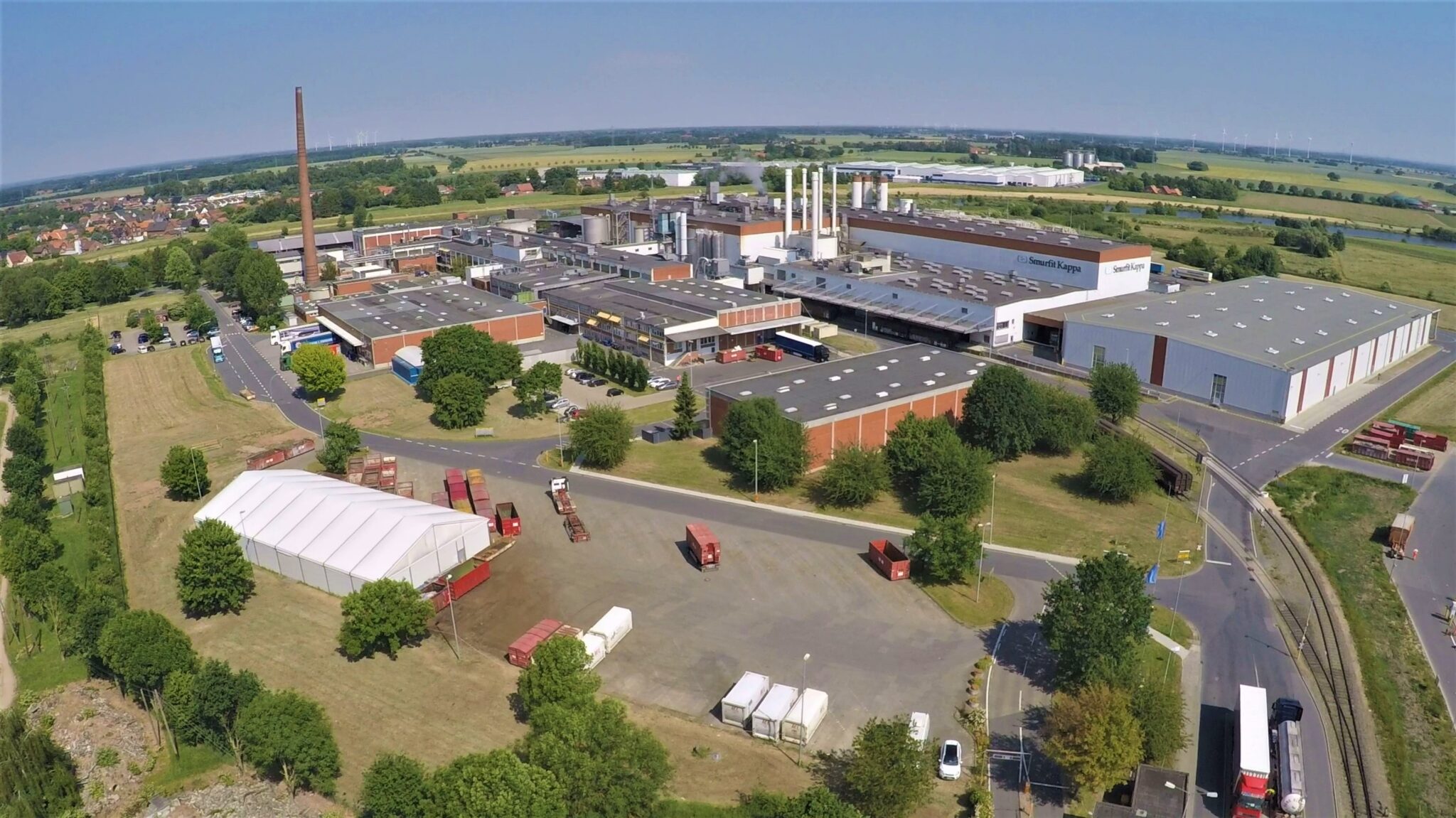
Smurfit Kappa has announced a significant investment in its Hoya paper mill and board manufacturing plant in northwest Germany. It is the latest phase of an investment programme, which commenced in 2011, and this last phase will see production output increase by 70 kt to 450 kt per annum.

The investment will replace the complete press section of the PM2 paper machine with new state-of-the-art technology, increasing the overall efficiency of the manufacturing process. The PM2 is a 7.5m-wide paper machine, producing both testliner and fluting packaging paper. Production speed will increase to 1250 m/min and upon completion, this world-class machine will further strengthen the industrial efficiency of Smurfit Kappa Group’s containerboard system. It is expected to be operational from the first quarter of 2023.

Saverio Mayer, CEO, Smurfit Kappa Europe said: “This investment will be the final and significant phase of a programme of sustained investment at our Hoya Mill which commenced over a decade ago. Today’s announcement underlines Smurfit Kappa’s continued commitment to developments in leading edge technology and our operations in Germany.”

The investment means that CO2 emissions will be reduced by 5,500t per annum.

Also commenting on the investment, Andreas Noss, Managing Director of the Smurfit Kappa Hoya Mill, said: “This investment will make the PM2 a state-of-the-art light weight paper machine that enables us to meet the changing needs of our customers. It will increase production speed and produce light weight paper in the most efficient and sustainable way possible.”

The Hoya site in Germany has been in operation for over 50 years and is a major regional employer, with over 300 people working at the facility.


One-millionth Linde truck rolls out of Aschaffenburg

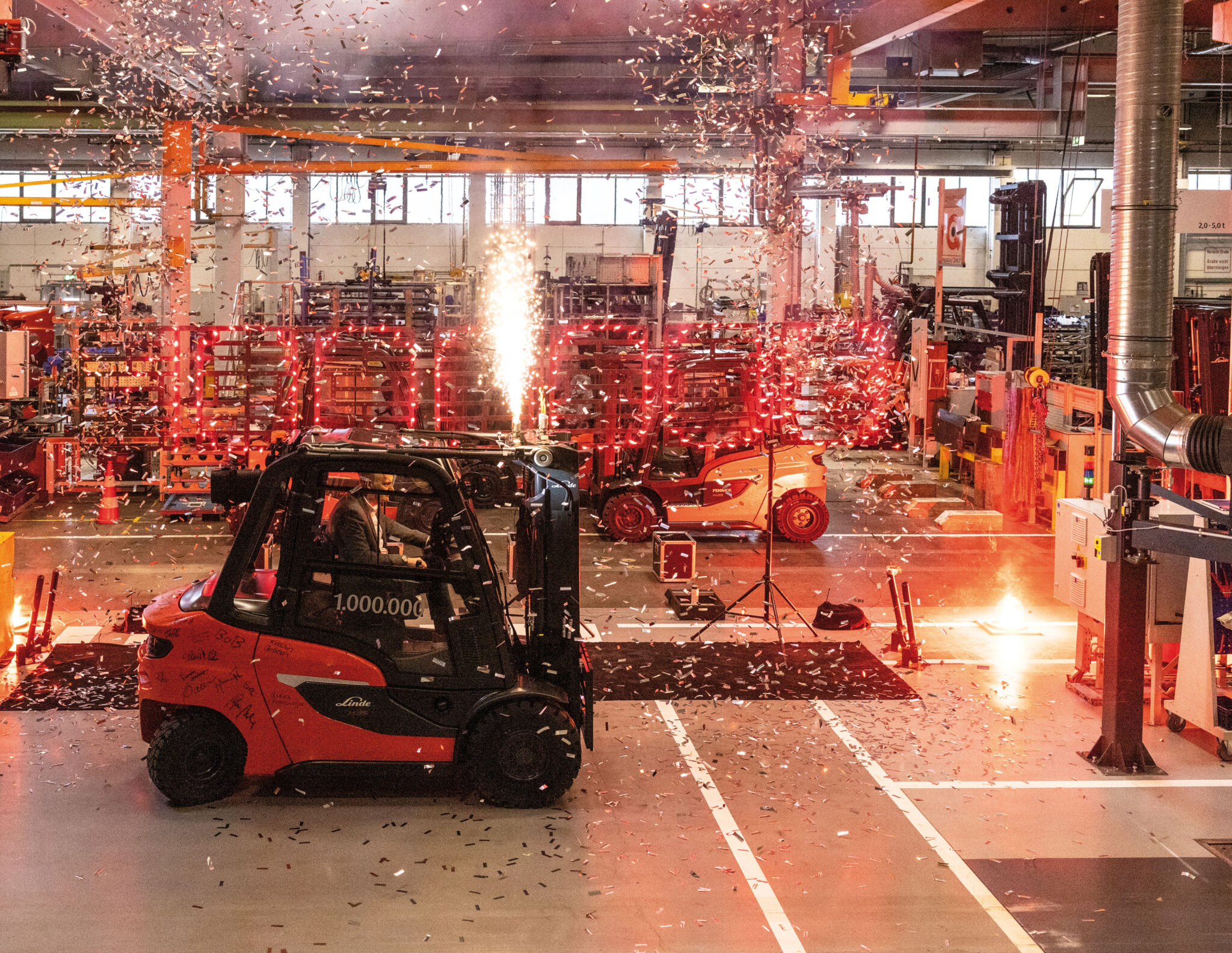
Linde Material Handling has been manufacturing counterbalance trucks at its Aschaffenburg, Germany production site since back in 1959. In March 2021, the one-millionth vehicle rolled off the assembly line and has since been ceremoniously handed over to customer company Colorobbia España S.A., one of the largest facilities in the world for the production of frits, pigments and other products for the ceramics and glass industry.

Even though big celebrations had to be cancelled due to the pandemic, it was a real goosebump moment when the one-millionth counterbalance truck came off the production line at the Aschaffenburg plant in mid-March. Captured on video for everyone to see, the completion of the milestone vehicle was celebrated with a minute-long indoor fireworks display of red Bengal lights, sparklers, smoke and lots of glitter raining down around the figure “1,000,000”.

The next day, the latest-generation Linde diesel forklift truck with a load capacity of 3.5t set off on the journey to its future workplace at Colorobbia España S.A. on the east coast of Spain, with the signatures of all assembly employees written on the back of it. There, it will reinforce a fleet of 60 vehicles.

“We have been relying on Linde brand forklifts for 24 years now and particularly appreciate the trucks’ user-friendliness and safety,” says Gonzalo Trilles de Castro, Managing Director of Colorobbia España S.A. Equally important to him, he says, is a reliable partnership with a company that shares his own philosophy on sustainability, innovation and technology.

“All of this is a guarantee of long-term success, which we share with our customers as a competitive advantage.” The truck’s arrival at the Spanish customer company, which is celebrating its centenary this year, was duly recognised with a specially decorated cake which features sparklers too.

The one-millionth counterbalance truck from Linde Material Handling’s Aschaffenburg headquarters represents the latest highlight in its corporate success story, which now spans more than 60 years. With the “Hubtrac”, Linde’s first forklift truck, the intralogistics specialist offered an industry-defining, technological alternative to the commercial vehicles that had up to then been difficult to operate, usually having a jerky clutch and gear shift.

Thanks to the innovative hydrostatic drive, which allowed a double-pedal control to be fitted, this forerunner was ideally suited for retrieving and storing goods or loading and unloading trucks: no shifting was required when frequently driving back and forth, allowing both feet to be able to rest in a relaxed position on the respective pedal.

Even back then, this resulted in higher efficiency in goods handling and has remained the hallmark of all of Linde’s counterbalance trucks to this day – regardless of whether they are powered by internal combustion engines or electric motors.

Today, Linde Material Handling is once again setting technological standards and making its industrial trucks fit for the future: by means of a wide variety of energy types, intelligent assistance systems and networking as standard.

“Our goal is to enable customer companies to make their material flow processes as efficient and safe as possible, so that they will become even more successful in their core business,” says Stefan Prokosch, Senior Vice President Brand Management at Linde Material Handling. “With products that convince our customers, we already have our sights firmly set on the next milestone in our company’s history – the launch of Linde’s new electric forklift generation in June of this year.”

Subscribe

Get notified about New Episodes of our Podcast, New Magazine Issues and stay updated with our Weekly Newsletter.