eTrailers a “game changer” for decarbonising long hauls

DB Schenker has signed a cooperation agreement with Trailer Dynamics and the Krone Commercial Vehicle Group on the use of eTrailers in European land transport.

“This agreement marks a further step in the electrification of land transport,” says Cyrille Bonjean Executive Vice President Land Transport for DB Schenker in Europe. “It is essential for us to look for new sustainable solutions that can be integrated into our daily business. With the eTrailer from Trailer Dynamics, we have obtained another promising model for the future.”

Wolfgang Janda, Executive Vice President, Head of Network & Linehaul Management, DB Schenker, adds: “The use of eTrailers enables early entry into the phased transition to a completely CO2-free fleet. In our view, electric trailers do not represent a transitional technology but will instead be a firm component of our commercial vehicle fleet over the long term. This marks yet another step in our efforts to reduce our environmental footprint and become net-zero by 2040.”

Michael Nimtsch, Managing Director at Trailer Dynamics, says: “The vision of Trailer Dynamics is to use eTrailers to make an important contribution to the decarbonisation of the economy and sustainable and environmentally friendly logistics for long-haul trucks. With our cooperation partner DB Schenker, we are taking the next important step toward transforming this vision into reality.”

“Electrification, digitalisation, automation, and decarbonisation are the strategic goals that Krone will achieve with its innovative products – and especially the eTrailer,” adds Dr. Stefan Binnewies, CEO of Krone Holding. “We are therefore very pleased that we not only share these goals with our long-standing customer DB Schenker; we are also jointly making them a reality with this eTrailer project.”

The use of eTrailers makes trucks more sustainable and lowers their CO2 emissions.

The electrified trailers of Trailer Dynamics have an electric drive train that makes it possible to support the drive of the tractor unit. A specially developed component uses a patented sensor system to determine the driving dynamics of the tractor-trailer combination and then readjusts the eTrailer so that the eTrailer supports the tractor unit. The tractor unit cannot be overridden at any time, however. The electric drive train also allows energy to be recovered during braking.

The eTrailer’s drive control system operates independently, so no interface with the tractor is necessary. In addition, the trailers can be combined and used with tractor units from all manufacturers. The eTrailers support diesel, gas, electric, and hydrogen-powered tractors.

The trailers can be equipped with 300kWh, 450kWh, or 600kWh batteries as required. This can extend the range of electric tractors by up to 500km, depending on the use case, and also significantly reduce the fuel consumption of conventional diesel tractors. CO2 emissions can thus be reduced by 20%-40%.

The logistics provider will successively roll out these 2,000 eTrailers across its European network starting in 2024.

Returns are a fact of retail

Retailers need to maintain efficient returns systems in their warehouses to retain customers, maximise margins and remain competitive, says Edward Hutchison, UK Managing Director of BITO Storage Systems.

Returning goods has become as an established part of shopping as buying them, since being accelerated during the era of growth in online shopping, where goods are purchased without being tried. The free returns promise carried over to all retail channels, including the high street, and has created a situation in this ultra competitive sector where the unconditional invitation of free return of goods has become enshrined. Returns being limited only to occasions when a retailer failed to match customer expectation has become a distant memory.

This has led to an evolution in shopping habits where consumers, taking free returns for granted, purchase multiple sizes or varieties in the knowledge that they can be returned at no cost. This practice is felt acutely in fashion retail, where shoppers are now accustomed to buying clothing and shoes in a variety of sizes in the knowledge that they will send back any unwanted items.

This can be clearly seen in the returns of online purchases by category in the UK in 2022, as shown by Statista Global Consumer Survey published in May of this year. It asked: ‘Which of these kinds of articles have you sent back after an online order in the past 12 months? Clothing topped the list of items people shop for by far, with almost a third of purchases returned (32%). Shoes come next (15%). All other categories follow some way behind, being evenly distributed between 3% and 8% – though 51% said they didn’t send anything back.

However, there is of course a cost to processing a return and this is leading some retailers to question the economics of free returns and to consider invoking a charge for customers. Such thoughts may not go down well with consumers, some 89% of who identify ease of returns as their top priority when purchasing online, according to data from delivery experience platform Sorted. Research from market researcher Appinio found that 71% of UK consumers would avoid shopping online if they were required to pay to return the items. It will be interesting to see what happens. But irrespective of whether a charge is imposed or not, returns still need to be processed with maximum efficiency.

Indeed, dealing with a return correctly does provide the retailer with an opportunity for positive customer sentiment, potentially increasing customer loyalty and to gain customer advocacy. Having a low-cost, simple yet effective and above all efficient returns processing pathway, will allow returned goods to be placed back on sale as quickly as possible.

The logistics sector has developed solutions to help returned goods to be processed as quickly as possible to gain the maximum value through reintroducing the goods back into stock. For many retailers now, returns are a large and important element of their inventory.

This makes the selection of the appropriate shelving system, container transport, picking methods, as well as the complete internal warehouse processes, a vital factor for an efficient returns system.

BITO provides many products and solutions that contribute to this aim. For example, pallet racking can be configured with a single pallet bay level and shelving above to provide locations for unpalletised ‘returned to stock’ items.

When using BITO’s galvanised shelving for returned items, dividers can be placed on a shelf to help organise stock simply. They can be easily moved to change the size of compartments and can clearly identify new products, for example, at a glance or separate product lines or returns.

To speed the movement of returned goods back to stock, a driverless container transporter, such as the LEO Locative from BITO, makes a smart addition to a warehouses. It helps to reduce travel times for returns as well as other tasks.

Proactive action to reduce returns can be instigated by retailers handling large numbers of items. Deploying order picking systems with minimal error rates will reduce picking errors in e-commerce. This will not only result in higher customer service levels, but will also help to eliminate incorrect orders in fulfilment as a cause of returns.

A sophisticated and highly efficient returns processing system is critical to success in many sectors and can be decisive for a business’ profitability. BITO distribution systems massively optimise order and returns logistics, improving online retailers’ competitiveness. They meet the e-commerce sector’s current demands for flexibility, speed and maximum accuracy. As a result, logistics specialists can optimise goods flow and organise returns logistics so that returned products promptly show back up in the system.

CILT releases driver shortage report

In 2015, The Chartered Institute of Logistics and Transport (CILT) carried out an opinion survey looking at the driver shortage crisis. Seven years later, after numerous member requests, it sought to review this matter again by launching a new survey.

The purpose of the survey was to gauge the opinions of industry members about the current driver shortage in both the movement of passengers and the movement of goods, through the CILT(UK) benchmarking clubs LogMark and BusMark.

The aim of this report is to establish a series of recommendations to fleet operators, industry and government, by examining the data and comparing it to the last report from 2015.

Goods movement

The lack of lorry drivers has been a problem for many years with younger generations avoiding the occupation due to the industry image and a lack of careers guidance, towards the transport sector, from schools.

73% said that the industry image was something that both the government and the industry should focus on as a top priority. In addition, 64% of those moving goods are currently experiencing issues with driver shortage, with the average age of drivers now over 50 years of age.

As a result the logistics industry is having a hard time finding new drivers.

The report highlights that there has been an increase in shortage within every part of the UK. Areas including the North East, Yorkshire & Humber, East of England and Scotland have, in some cases, more than doubled since 2015.

HGV work can be difficult. The job can include long/unsociable hours (this is has the biggest increase as an issue within this year’s report), with mental health challenges coming from isolation and loneliness.

It is also well documented that roadside facilities and depots can be extremely poor, with 45% saying that this is a big issue.

In addition, there is also the pressure of the job with drivers having a lot of responsibility to pass health checks, CPCs (which need to be retained) and licences. From a young person’s point of view, a role in retail or an office environment may be more appealing. This has also reflected in the retention of drivers, with the highest staff turnover in goods movement being 25%.

Mark Bentley, Senior Lecturer in Supply Chain Management at Anglia Ruskin University, says: “There is also an undercurrent of dissatisfaction of drivers in how they are treated (i.e. spoken to and interacted with) by Traffic Office staff. There are instances of where agency drivers, in particular, avoid working for some companies where they are not treated with respect in their interaction with Traffic Office operations. Training of Transport Office staff and demanding a more customer approach for driver interactions is something that needs to be considered.”

A further concern is that 64% of goods movers have been unable to cover driving work in the past year.

With the ever-increasing demand of next-day and even same-day deliveries, this will undoubtedly raise the cost of delivery services even further.

While many agree that the work life balance is a key issue, others have stated that there are challenges with age restrictions and because of this it is a secondary career choice.

92% of participants stated that the government are not doing anywhere near enough to deal with the driver shortage issue. 51% said that there should be more opportunity for engagement with government bodies, 67% said that there should be improved funding and 73% said that the government should be looking at improving the image of the industry. Equally, 73% also said that the industry itself should work on improving the image. Perhaps this should be done in a collaborative way.

71% of participants believe that the industry should improve its terms and conditions.

Regarding this, Bentley said: “Terms and conditions are noted in the report as continuing to be an issue. In employment terms these are referred to as ‘hygiene factors’ and are imperative to recruiting and retaining employees. There are still a number of employers who are not seriously engaged with such issues. I appreciate it is extremely tough economically in running road haulage operations, but there can be no compromise in not paying a good rate of pay and providing good terms and conditions.”

The ongoing issue, and the potential for negative business impact, remains of great concern to those moving goods. In question 16 we can see that there has been minimal change with most saying that their concern was on a level of 7-8 out of 10. However, those who are very worried have increased by 50%.

Final thoughts

The CILT’s interpretation of the survey results is as follows:

From the report, we can see that the situation is certainly not improving, so what can be done? During our report review meeting, a number of ideas were suggested with many agreeing that the industry image needs to change. The industry needs to look at this internally by working with schools/colleges to promote the industry. Many participants get involved with careers fairs and hold open days.

Industry supporters, like CILT(UK), could do more by offering more careers advice within schools and colleges, promoting the benefits of the industry and facilitating working groups with government, academia and industry leaders.

Another option is to work closer with MoD and their leavers. The survey results show that only 39% of participants do this and the MoD staff are trained to a high level in many areas.

Organisations, such as the British Forces Resettlement Services (BFRS) and Veterans into Logistics, offer direct links to ex-forces staff and companies should consider engaging with them to promote roles that may be available.

Bentley said: “These solutions are within the current remit of operators themselves. Funding, as an example, is already available through subsidies for apprenticeships (95% for non-levy organisations) along with Bootcamp funding from the government.”

We see staff engagement, advertising and top of the list, pay, as the most popular methods of seeking and retaining drivers. Appointment of European drivers has reduced greatly since Brexit and presents a compelling case to seek special exemptions across the transport sector, especially as the number of unemployed people per vacancy has fallen to a record low of 0.9, so more positions available within UK PLC than there are available people.

Competition for recruits with other industries is fierce, and some operators are showing greater flexibility in assessing applicants’ driver licence points on a case-by-case basis.

Across BusMark and LogMark, over 60% are not actively seeking to engage MOD service leavers. Is this, in part, because operators don’t know how to engage with the military, or organisations that seek to find leavers employment post-service? We also find that just 30.5% of Passenger respondents are currently recruiting trainee drivers, compared to 46.5% of Freight participants.

The report finds that the main reasons for Passenger and Freight driver shortages, Brexit aside, are unsociable hours, poor industry image, long hours, sub-standard facilities and poor wages. If these factors, as well as the ‘other’ responses, show the reality of professional driving, does this explain why the shortage may be a generation issue, who require a different work/life balance than in days gone by? If it’s even just their perception of a professional driving career, then many potential recruits are not giving the industry a second thought as it stands.

Up from 2015’s 89%, today 92% of respondents believe that Government isn’t doing enough to help. Whilst the Government-backed Generation Logistics initiative seeks to promote careers in the Logistics sector, but bearing in mind the Bus & Coach driver plight, we are keen to see a similar initiative for Passenger Transport careers launched as soon as possible.

Members believe the best way to attract drivers is to improve industry image and, improve driver terms & conditions, particularly when compared to entering other occupations, such as Retail, where entrants do not undertake medicals and eye-sight tests.

Perceptions have to change, and professional driving should be seen as an aspirational, highly-responsible career of choice.

When we look at the final question on scale of worry, the only surprise here is that the most common level of 7-8 remains similar to 2015, rather than being at 9-10. The industry should be worried but not to despair, believing that a Busmark/Logmark working group should use this data to plan our future efforts, which we can all get behind, champion and engage with The Institute’s policy groups (Bus & Coach / Freight & Logistics), the General Public and Government.

In conclusion, this issue isn’t going to disappear anytime soon, but neither is the CILT, which would love to hear your feedback and further suggestions for improving this ongoing issue.

 

Technology specialist scoops award

A specialist logistics technology firm is celebrating after picking up an award at the prestigious UK Business Tech Awards 2022. The annual UK Business Tech Awards are designed to recognise the UK’s finest tech businesses and reward the innovative and exceptional applications of technology to transform and grow businesses.

Wise provides over 250 UK last-mile delivery firms with innovative software to help them save time, stress and money when engaging a self-employed workforce. The tech company, based in Solihull, were awarded Tech Company of The Year (small) at the glamorous London event.

Sifting through hundreds of entries, the judging panel noted that Wise had ‘demonstrated innovative thought in solving an important issue’ within the logistics industry, whilst also receiving ‘excellent funding results, clearly giving confidence in the company’s long-term future’.

Dan Richards, Chief Commercial Officer at Wise, said: “We were absolutely thrilled to be a winner at this year’s UK Business Tech Awards, especially considering the incredible businesses we were competing alongside.

“As a business, we’ve been on an incredible journey over the last few years, bringing together some of the UK’s best technology talent under one roof in Solihull. Being recognised with this prestigious award is a great testament to the technology we have created over the past couple of years and the real impact this is having on self-employment within the logistics and last-mile delivery industry.”


Future-proofing can minimalise strike effects

A strike at Liverpool, one of the UK’s largest container ports, has entered its second day leading to predictions of severe disruptions to the supply chain. Mark Hughes, Regional Vice President UK and Ireland at ERP company Epicor, says the strike may affect businesses both now and for the foreseeable future.

“Over the past two and a half years, supply chain resilience has been put to the test and in some cases, at breaking point.​ The strike action at Liverpool Port, one of the UK’s largest container ports, is another illustration of how complex national and international supply chains can be impacted by one weak link.

“Getting insight into the future supply chain and developing lines of communication with partners are the most critical things to focus on in terms of what impacted firms can do while the strike is in progress, particularly as companies prepare for the busy season ahead. If companies have accurate information on the movement of goods, what products are arriving and when, including expected delays because of the strike, they can help manage their stock levels and customer expectations more successfully.

“We’ve seen businesses adopt a pragmatic approach to acquiring goods and they want to maintain a strong partner network, and clear communication is essential. Even though the anticipated delivery date for all, or a portion of their order may now vary, businesses still want to be informed in advance of what can be delivered and when. Due to the sheer volume of data involved, this approach requires a combination of automation and sophisticated supply chain planning systems.

“Beyond the continued strikes in Liverpool this month and the recent crisis at Felixstowe, businesses can consider futureproofing in this area.

“Stress testing – the process of understanding the performance and current resiliency of supply chains and identifying any weak links – is crucial. By simulating specific scenarios, organisations can understand the potential risks they may face and any threats to their operations. Dual sourcing – i.e., using two suppliers for a given product, material, or service – can also be an important supply chain risk management strategy to lessen the risk of blockage in the production or movement of goods and services and will provide business stability when a crisis occurs. It can also help a business grow by keeping up with customer demand. As a result, it increases the supply chain’s adaptability and resilience which will help protect against future threats.

“Every step in the supply chain has the potential to be a weak link, especially in the post-Brexit era where there are ongoing challenges between borders. Businesses can meet end-to-end expectations by moving to less complex supply chains and purchasing more goods that are made in Britain.”

Glenn Koepke, Vice President Network Collaboration at FourKites, adds: “Shippers and BCO’s have been expecting the continuation of strikes at the UK ports of Liverpool and Felixstowe and many have built up inventory by importing product while ports were operational as well as shifting capacity to road freight from mainland Europe into the UK.

We anticipate Liverpool not having a major impact on the UK economy but as peak season arises, shifting volumes to operational ports will put a strain on ports and ultimately affect shippers that are waiting last minute for freight.”


Haulage team overcomes bridge challenge

A team from Collett & Sons has successfully delivered an 80-tonne transformer from Lancashire to the Harting Rig Wind Farm substation in Scotland. Appointed by Fracht UK, Collett was tasked with providing a transport solution to deliver the heavy cargo the 230 miles from Goole to South Lanarkshire. But what would normally have been a relatively straightforward journey for the experts from Collett was complicated just three miles shy of the wind farm site in the shape of Glassford Bridge.

Identified in the planning process, weight restrictions were in place on the structure, resulting in limitations to the vehicles and cargoes crossing the bridge. The loaded trailer and truck combination would have exceeded the structure’s maximum permitted weights, therefore a new approach would be required.

Alongside the weight limitations, Collett was also required to observe a maximum speed of 10mph and ensure that no other traffic or pedestrians would be present on the bridge during the transport operation. In addition, all vehicles must follow a three-metre strip of the bridge, with a series of cat’s eye markers in place to ensure each vehicle maintained a set alignment throughout.

With all this identified, Collett executed innovative transport arrangements to overcome these obstacles.  Arriving at Glassford Bridge, the process began by uncoupling the loaded trailer from the 8×4 MAN TGX tractor unit. Once disconnected, two 40m wire cables were attached, connecting the trailer and primary ballast truck.  A secondary 8×4 ballast unit was then connected at the rear of the trailer, again using 40m wire cables.

The extended combination was then ready to go.  Having implemented Temporary Traffic Restriction Orders, the lights on the bridge were turned to red and the team from Collett was able to proceed. With all other traffic restricted, the secondary ballast tractor reversed and the primary drove forward. This tensioned the cable, removing any slack, then both vehicles began the slow drive forward.

Controlling the cable tensioning throughout, the primary tractor unit cleared the structure, followed by the trailer, transformer and Steersman in tow. With the ability to control the trailer’s steering and braking, Collett’s Steersman ensured that the trailer and cargo remained within the necessary alignment whilst traversing the structure.

Once clear of the bridge, and with the trailer brake applied, the secondary ballast unit took up the cable stack and crossed Glassford Bridge to complete the operation.

With the wire cables removed and the primary tractor unit re-coupled, the 80-tonne transformer completed the remaining three miles of the journey to Harting Rig Wind Farm. On arrival, the cargo was met by Collett’s Heavy Lift Team for jacking and  skidding to its final position.#


DP World invests €80m in HSE innovations

DP World has reduced the risk of injury by 40% across its European portfolio by investing €80m in key safety practices and equipment upgrades, as well as improving reliability using the latest digital software.

The global end-to-end logistics and smart trade enabler has always put employee safety at the centre of its daily operations and has a strong record on safety in Europe, but DP World believes it has made huge progress in safety and accident prevention in the last 12 months due to significant investments in smart solutions.

Combined with innovation and employee experience, DP World’s redefined HSE practices are resulting in a marked improvement in safety, which in turn enhances productivity trade movement across the continent.

Enoma Woghiren, Regional Head of HSSE for DP World Europe, said: “With 20 terminals in 12 countries across the breadth of Europe, and 8,000 staff to care for, we have been guided by our first ever Environmental, Social and Governance (ESG) Risk annual report, a North Star for our efforts to become a beneficial and safe logistics operator. Our activities across the continent are creating a safety benchmark for us as an organisation and our industry peers in Europe and beyond.”

Facilities in terminals in, Belgium, the Netherlands, and Turkey are prime examples of the innovative DP World approach to reducing safety risk.

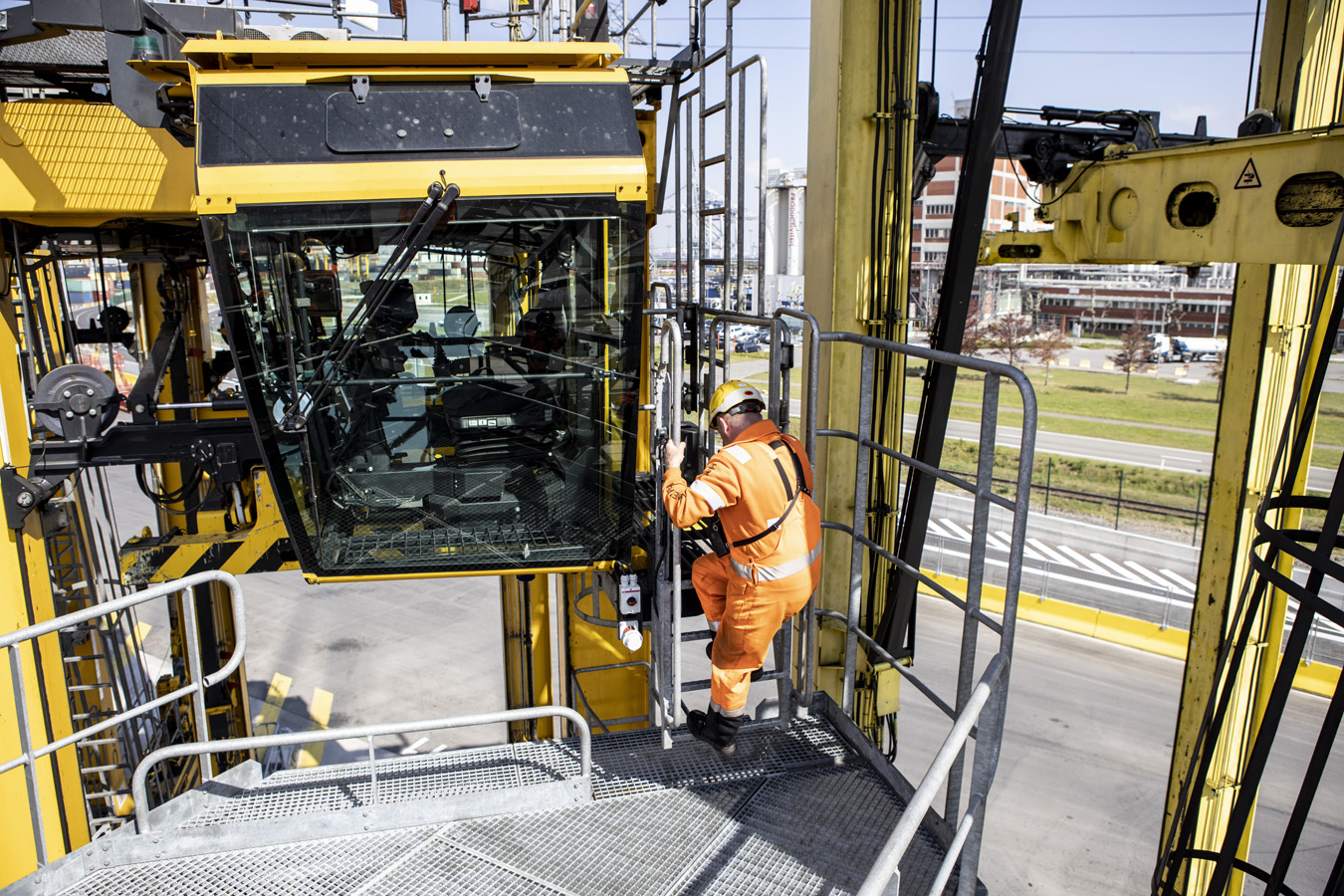
In Belgium, DP World Antwerp has built a world-first straddle carrier platform and refuelling station. The €2m, 150m-high structure was opened in September 2021, allowing drivers to get on and off their tall vehicles safely, while also creating a shielded safe zone for fuelling, cleaning and inflating tyres.

The platform allows drivers to enter the straddle carriers at cab level, thereby removing the risk of them climbing the ladder into the cab. The tyre inflation station protects staff from the risk of injury from parts being pushed out due to air pressure and improves productivity by inflating tyres in just two minutes rather than 15.

The investment in the platform is part of DP World Antwerp’s wider €200m investment to increase capacity and productivity using an approach that will redefine sustainability at the terminal by continually enhancing safety features and reducing its carbon emissions.

Another such feature which has recently been launched is its Route 1700 mobile app, which protects truck drivers from harm by giving them the option to complete their pre-shift administrative processes before entering the port vicinity where there are lots of moving vehicles.

Elsewhere in the region, DP World Yarimca, Turkey, is finding innovative ways to make safety smarter. This terminal has recently adopted Digital Surveyor, which allows customers and employees to view the work being done on vessels remotely, thereby reducing the number of people on-site and reducing the risk of accidents.

The cutting-edge analysis software can inspect and assess safety levels and risk in marine vessels and their cargo. This process is normally carried out by an individual and can take 78-hours a month per vessel. For a small-scale port, this process is repeated 10,360 times for an average of 1,480 containers every month – which equates to significantly reduced capacity and revenue.

DP World Yarimca’s new technology is reclaiming all this lost time, while also identifying and reducing potential risks and their related costs. That means safer employees and customers, reduced ongoing costs and increased capacity.

In the Netherlands, Rotterdam World Gateway has invested in more sustainable electric vehicles and has identified the potential risk of an increase in battery fires, which can happen as batteries age or are damaged in any way. To prevent this, the team have built an on-site battery pool, where they can sink at-risk batteries in water until they can be repaired or sustainably disposed of.

Celebrating the region’s safety accomplishments, Woghiren concluded: “At DP World we want to change what’s possible. We are committed to introducing the latest technology to enhance our proposition and our operations across the globe, but this is not just enhancing our customer experience and enabling growth – it is also allowing us to reduce the carbon emissions generated by our terminals and making them safer places to work and visit.

“This focus on innovation has allowed us to make huge strides in terms of improving the overall safety at our terminals and we will continue to enhance the safety features as we grow and evolve to meet the future needs of our customers and employees.”


Packfleet steers away from gig economy

All-electric delivery company Packfleet says it is revolutionising seasonal driver standards this Christmas by offering sector-topping benefits during the notoriously busy period.

At a time that is plagued with horror stories from drivers working for well-known courier companies, Packfleet is paying all its drivers above the London living wage, and provides private healthcare and pensions.

Workers will receive free lunch and snacks when they’re on the road, and £30 a month to spend at some of the 130+ merchants who ship with Packfleet – including meal kit service Dishpatch, and online cheesemonger Cheesegeek.

Packfleet will more than double its workforce during the seasonal spike, with a variety of part-time and full-time roles available. The business will be offering drivers permanent contracts once the Christmas period has finished, to help expand their operation across the country.

At a time where many cash-strapped Londoners are looking to supplement incomes, Packfleet’s seasonal staff are both paid 30% better than industry average and are set to be the best treated in Britain. Drivers from the likes of Yodel, DPD and Evri have already jumped ship, citing the better workplace culture as the main draw.

Packfleet says it isn’t just leading the way with driver standards, it says it is also protecting the planet. Its entire fleet is electric and charged by renewable energy, and it plants a tree for every parcel shipped.

Tristan Thomas, CEO and co-founder of Packfleet, says “We believe that every driver should be treated fairly all year round. You see office staff up and down the country receive all sorts of benefits during the festive season, so why shouldn’t it be the same for drivers?

“The logistics sector is rife with horror stories – especially during such a notoriously busy period – and we’re changing that. We don’t overwhelm our drivers with parcels, and our tech puts them on the quickest route possible, meaning they don’t have to speed around London to hit delivery targets.

“We’re bringing driver employment standards in line with the rest of the working world. The stories we hear from drivers at the major courier services are, quite frankly, unacceptable. It’s disgraceful that these have become the industry standard.”

Ayath Ullah, a delivery driver for Packfleet, says: “At Packfleet, we deliver on time, but I’m encouraged to speak with customers, and never feel overwhelmed with unrealistic delivery expectations. In my previous courier job, I constantly felt under pressure to deliver parcels quickly at all costs – but I’ve never felt that way at Packfleet.

“I’ve been here for over a year now, and my experience with them has been 10x better than at any other company. I love it here, and don’t understand why more businesses aren’t treating their drivers this well.”

Applications for the seasonal roles are open now, and prospective drivers can apply by following THIS LINK.

Cargo First strengthens Bournemouth Airport operations

Cargo First, Bournemouth Airport’s dedicated cargo handling service, has strengthened its fast-track ‘One Team’ operation by bringing its on-site customs bonded warehouse facilities fully in-house. The move further streamlines Cargo First’s ground handling operation which is geared to providing a faster alternative to the congested London airport system for freight customers.

It comes as global e-commerce demand continues to grow. IATA (International Air Transport Association) suggested in a recent industry briefing that global e-commerce parcel volumes could double to 260 billion by 2025, with 80% of sales estimated to be cross-border.

And FedEx Express recently published research saying e-commerce would continue to take a growing proportion of total consumer spend. But the number one customer complaint (53%) is that deliveries take too long, with an expectation of receiving goods within three days to one week of ordering.

Bob Matharoo, Head of Cargo Development at Cargo First, said: “We’re fine tuning our system to make the cargo ownership chain as short and responsive as it can be, with no third parties. Our focus is speed to market and being a cost-effective alternative to the hub airports.

“E-commerce continues to grow, and with it customer expectations around speed of delivery. Capacity at the big London hub airports is severely constrained but we’re not. We think that’s a real opportunity for Bournemouth Airport and Cargo First, especially bearing in mind our location just 90 minutes from the capital.”

Cargo First was initially working jointly with a global logistics partner to handle customs processing through the bonded facilities on the airport site. It now has full control over the whole cargo process, from offloading aircraft through to processing, onward loading and delivery.

The company spent 18 months benchmarking freight deliveries via Bournemouth to London warehouses and found it could halve the time of delivery to the same end destinations compared with using a London hub airport.

Cargo First and Bournemouth Airport are part of the UK’s privately-owned Regional and City Airports (RCA) group, which also owns Coventry Airport, Exeter Airport and Norwich Airport. RCA also operates the XLR Executive Jet Centre FBO facilities at Birmingham, Bournemouth, Exeter and Liverpool airports.


Revealed: the worst industries for cyber security risk

New research carried out by cyber crime expert FoxTech has revealed that the five UK industries with the weakest cyber security – and therefore most at risk of a cyber security breach – are mechanical and industrial engineering (with a CyberRisk score of 59.1), environmental services (57.8), furniture manufacturing and installation (56.8), logistics and supply chain (56.5), and construction (56.2).

The research is based on analysis of 9,500 companies in the UK, and used a CyberRisk score, a diagnostic tool which calculates risk using publicly available information and an analysis of a wide range of cyber security indicators. Companies with scores of 25 or less are considered to be at a low risk of attack, while scores of over 50 demonstrate a high risk. FoxTech’s report found that other industries with scores over 50 included higher education (56.0), accounting (55.2) and hospitals and healthcare (53.4). Scores higher than 75 indicate an extreme risk of attack.

Anthony Green, CTO and cyber crime expert at FoxTech, explains more: “We audited thousands of UK companies across a wide range of sectors and found that while industries such as financial services, aviation and government administration had a lower risk of falling victim to a cyber crime, many other industries were not doing enough to protect their systems from attack.

“It is encouraging that no sector averaged at an extreme risk of attack, with a score more than 75. This is reflective of many businesses’ increased investment in cyber security in the past year. However, a score of over 50 still demonstrates a high vulnerability to cyber crime, so it is concerning that many of the UK’s key industries fell into this bracket.”

What common security issues did FoxTech’s report identify? Green explains: “It’s not that organisations don’t care about having good cyber security, but that they are unaware that their IT infrastructure contains weaknesses that make them a potential easy target for hackers.

“Companies often don’t realise that their anti-virus or endpoint protection software is incorrectly configured, or simply not robust enough to stave off an attack. Another common misconception is the belief that you are safe from attack if you use cloud-based services, rather than an internal server. This is not the case – in fact, 46.3% of the companies we surveyed were using a public cloud provider, but many were still at a high risk of attack.

“Inadvertently leaving assets exposed to the internet is another big issue. Some businesses we surveyed had databases visible to the internet, and over 40 companies had a camera accessible from the internet!

“Sometimes, an organisation can be exposed by something as simple as poorly managed user accounts or using out-of-date software and obsolete or end-of-life technology – as was the case with 4.7% of businesses we surveyed. Email filtering is also a vital aspect of any good cyber security strategy. Only 55.4% of companies we surveyed has email filtering in place, and just 13.7% had DMARC correctly configured to prevent email spoofing attacks.”

Green highlights that hacking is a gradual process, and not something that happens overnight. On average, hackers will spend 207 days between breaching a company’s IT security and exploiting it.

“The fact that hackers are going undetected for so long shows that businesses usually have plenty of time to detect intruders and prevent a cyber attack from occurring – if they know where to look.”

The answer? Green says: “The best thing to do for any company is to arrange a cybersecurity audit of their IT systems, processes and procedures. This won’t necessarily be through their IT provider, but via an independent cyber security company that is set up to focus fully on cyber security and can protect businesses and their customers on a much higher level. A good audit will involve vulnerability scanning – also known as ethical hacking, where a cyber security expert tries to enter your system, just as a malicious hacker would, but with the intention of helping you find and fix your security weaknesses before they are exploited by a cyber criminal.

Companies interested in finding out their own CyberRisk score to get an immediate indicator of how high or low their security risk is are invited to order this for free from FoxTech.


Subscribe

Get notified about New Episodes of our Podcast, New Magazine Issues and stay updated with our Weekly Newsletter.